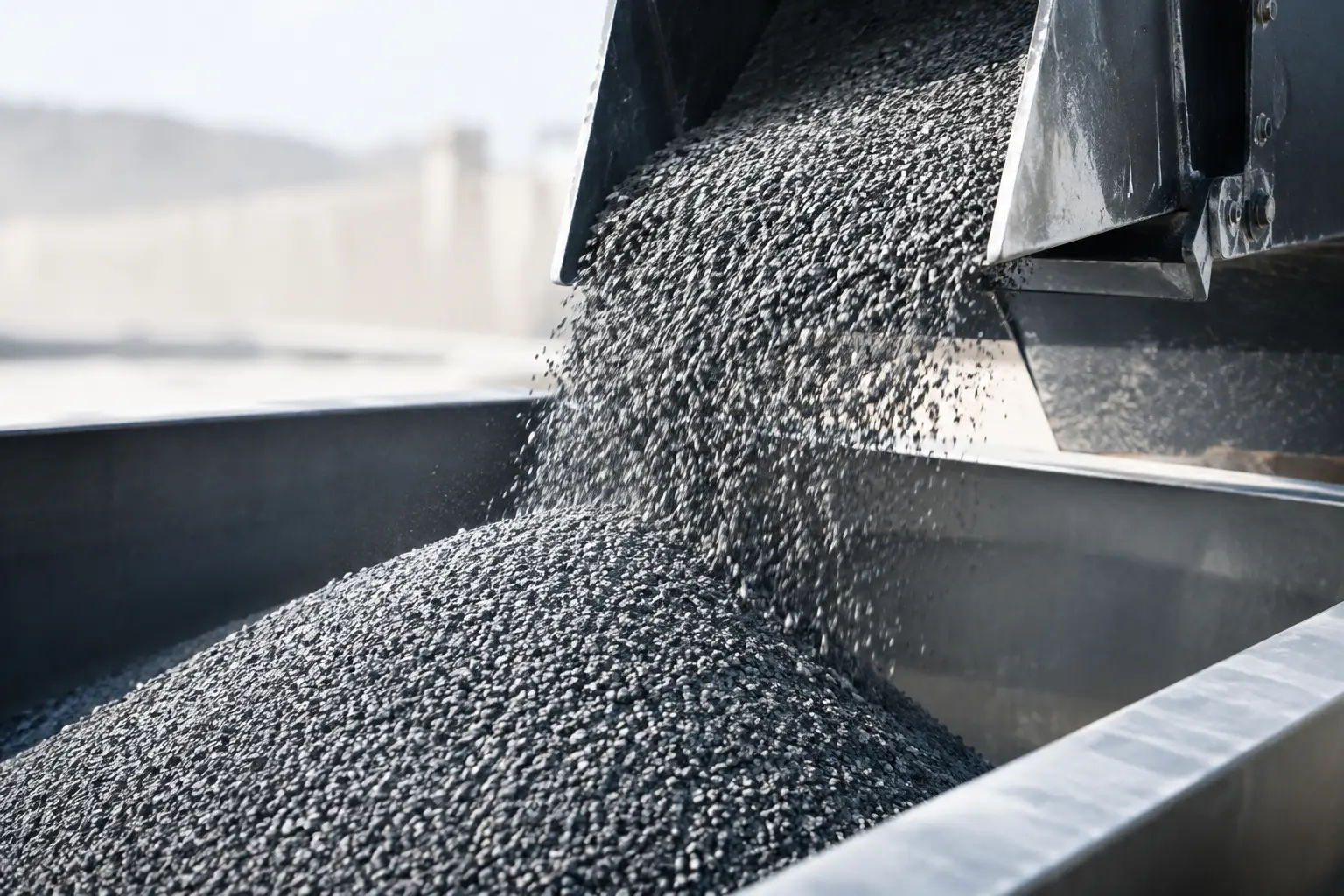
A powder can leave the dryer, blender, or classifier with acceptable flow properties and still become difficult to discharge weeks later. Understanding why powders cake during storage requires looking beyond the material itself. Caking is usually the result of an interaction among powder properties, environmental conditions, storage time, and the mechanical loads imposed by the bin, package, or bulk container.
For manufacturers, the consequence is not limited to a blocked outlet. Caking can create erratic feeder performance, inaccurate dosing, blend segregation, line downtime, excess operator intervention, and inconsistent finished-product quality. In regulated or high-value applications, it can also introduce a significant batch-release and traceability problem.
What Powder Caking Actually Means
Caking occurs when individual particles that should separate and flow freely develop bonds strong enough to form agglomerates or a consolidated mass. Some agglomerates may break apart under mild vibration or shear. Others form stable, hardened structures that bridge over hopper outlets, resist pneumatic conveying, or require manual breakup before processing can resume.
The severity of caking depends on bond strength and the degree of consolidation. A slightly cohesive food powder may still discharge reliably through a properly designed hopper. A hygroscopic pharmaceutical excipient or mineral powder may absorb enough moisture to form solid bridges between particles, making controlled feeding impossible without intervention.
Caking should not be confused with every flow problem. Fine powders may be cohesive because of electrostatic attraction, irregular particle shape, or high surface area even when they have not formed a cake. Segregation, rat-holing, flooding, and arching are also distinct failure modes. They can occur alongside caking, but each requires a different engineering response.
Why Powders Cake During Storage: The Main Mechanisms
Moisture absorption and liquid bridges
Moisture is the most common driver of powder caking. Hygroscopic materials absorb water vapor from surrounding air. Once moisture accumulates at particle contact points, it can form liquid bridges. These bridges create capillary forces that pull particles together.
Over time, the absorbed moisture may dissolve small amounts of soluble material. When conditions change, such as a temperature drop or a reduction in humidity, the dissolved material can recrystallize at contact points. The result is a solid bridge that is substantially stronger than the original liquid bridge.
This mechanism is common in sugar-containing ingredients, salts, fertilizers, detergent powders, nutraceutical blends, and many chemical products. However, even materials not generally considered hygroscopic may cake if they are stored in a humid environment after being processed at an elevated temperature.
Temperature cycling and condensation
Temperature changes can cause caking even when the average humidity appears acceptable. A warm powder placed in a cooler warehouse can create temperature gradients within a container or silo. As air cools, its capacity to hold water vapor declines. If the local temperature reaches the dew point, condensation can occur on vessel walls or within the powder bed.
Daily temperature swings are especially problematic in unconditioned storage areas, outdoor bulk storage, and facilities where products move between heated processing rooms and cooler distribution areas. A small amount of intermittent condensation can be enough to initiate liquid bridging and subsequent hardening.
Thermally sensitive products introduce an additional concern. Excessive heat may soften fats, waxes, polymers, or amorphous components, allowing particles to deform and adhere. When the product cools, those contact points can set into a more stable mass.
Particle size, shape, and surface area
Fine particles cake more readily because they have a high surface-area-to-mass ratio. More surface area means more potential sites for moisture adsorption, van der Waals attraction, and interparticle contact. Powders with a high proportion of fines often exhibit lower permeability and retain moisture longer than coarser, more uniform materials.
Particle shape matters as well. Irregular, plate-like, fibrous, or fractured particles can mechanically interlock. A broad particle-size distribution may fill void spaces efficiently, producing a dense bed with limited airflow and greater contact area between particles. That can improve packing density, but it may reduce flowability and increase consolidation risk.
The right particle-size target is therefore not always the finest achievable result. Milling and classification should be selected around the product’s functional requirements, including dissolution, reactivity, blend uniformity, handling behavior, and final packaging performance.
Storage pressure and time under load
Powder at the bottom of a tall silo or supersack experiences the weight of all material above it. During storage, that pressure brings particles into closer contact and increases the number and strength of bonding locations. Vibration from nearby equipment, truck movement, or normal plant activity can further compact the material.
Longer storage times generally increase risk because moisture migration, recrystallization, and consolidation mechanisms have more time to develop. This is why a product may run successfully during a short production campaign but fail after extended warehousing or after a seasonal demand slowdown.
Container geometry also affects the outcome. A poorly designed hopper can impose stagnant zones and excessive head pressure near the outlet. A package may protect the product from ambient humidity but still permit caking if its fill conditions, headspace, or stacking load are not controlled.
Composition changes and ingredient interactions
Multi-component formulations can cake because one ingredient acts as a moisture source, binder, or reactive component for another. Oils, fat-containing ingredients, syrups, flavor carriers, and poorly dispersed liquid additions can create localized wet zones. In other cases, a small amount of a highly hygroscopic ingredient raises the moisture sensitivity of the entire blend.
Particle coatings and flow aids can help, but their effect depends on formulation chemistry and blending quality. An anti-caking agent that performs well in a dry, free-flowing base material may not overcome moisture uptake, high compaction, or fat migration during storage. It may also be unsuitable for the product’s regulatory, labeling, or performance requirements.
How to Diagnose the Actual Cause
The most effective caking investigation connects material data with the conditions the product experiences from processing through use. A single angle-of-repose result or a visual inspection of a hardened bag is not enough to establish root cause.
Start by documenting where and when the material first loses flow. Determine whether caking begins after drying, after blending, during bulk transfer, inside a storage bin, in finished packages, or at the point of feeder discharge. Compare affected and unaffected lots for moisture content, water activity where relevant, particle-size distribution, bulk density, temperature, storage duration, and packaging history.
Environmental data is equally valuable. Record warehouse humidity, ambient temperature, vessel-wall temperature, and temperature cycling during storage and transport. For materials stored in silos or intermediate bulk containers, assess residence time, fill sequence, discharge pattern, and load imposed on the powder bed.
Representative testing should include flow function, compressibility, permeability, shear behavior, and moisture sorption where appropriate. The goal is not simply to label a powder as cohesive. It is to determine the stress, humidity, and time conditions at which the material changes from reliably flowable to operationally unacceptable.
Engineering Controls That Reduce Caking Risk
Caking control begins with the product, but it must extend through the complete material-handling system. Drying to a target moisture level is useful only if the powder is protected from reabsorption before filling and during storage. Likewise, a well-designed hopper cannot fully compensate for a formulation that hardens into a consolidated mass.
For moisture-sensitive materials, manufacturers may need dehumidified conveying air, conditioned storage rooms, sealed transfer paths, insulated vessels, or controlled cooling before packaging. The appropriate solution depends on the material’s sorption behavior and the site’s climate. In some cases, reducing temperature variation is more valuable than lowering average room humidity.
Storage equipment should be designed around measured bulk-solid behavior rather than nominal capacity alone. Mass-flow hopper geometry can reduce stagnant regions and provide more uniform residence time. Proper outlet sizing, wall materials, and wall angles help limit arching and rat-holing, while controlled discharge devices can manage cohesive materials without excessive product degradation.
Mechanical flow aids require careful selection. Vibration, aeration, agitators, bin activators, and live-bottom feeders can restore discharge, but they are not interchangeable. Excess vibration can compact certain powders. Incorrect aeration can fluidize fines, cause segregation, or introduce moisture if the air supply is not properly conditioned. An agitator that solves bridging may damage friable particles or disrupt a sensitive blend.
Where formulation changes are feasible, particle engineering may offer a more durable solution. Agglomeration, granulation, controlled milling, removal of excess fines, or adjustment of liquid-addition sequence can improve permeability and reduce cohesive contact. These changes must be evaluated against product specifications, dissolution behavior, density targets, and downstream processing needs.
Treat Storage as Part of the Process
Too many caking problems are addressed only after a bin stops discharging. By then, operations is managing a symptom that may have originated in drying, cooling, blending, transfer, packaging, or warehouse conditions.
A better approach treats storage as an engineered process step with defined material conditions, environmental limits, residence-time expectations, and discharge requirements. That perspective allows the production system to be designed around how the powder will behave after days or months under real operating conditions, not only how it performs when freshly produced.
For complex materials, Proc-X applies this system-level view across powder preparation, transfer, storage, feeding, and packaging. The practical objective is clear: preserve material flow so that downstream equipment receives a consistent product at a controlled rate.
The next time a powder hardens in storage, investigate the full path rather than adding a flow aid by default. The strongest corrective action is usually the one that prevents particle bonding before the material reaches the hopper outlet.