A conveyor that looks right on a layout can still fail on day one. Material floods a transfer point, a feeder starves the next process, dust control falls short, or a downstream mixer sees feed variation that no controls strategy can fully correct. That is why bulk material handling system design has to start with process reality, not just equipment selection.
In demanding manufacturing environments, bulk handling is not a utility in the background. It directly affects throughput, blend uniformity, yield, housekeeping, maintenance labor, and compliance risk. When the system feeds milling, mixing, extrusion, thermal processing, or packaging, every upstream design decision carries downstream consequences.
What bulk material handling system design actually controls
At its core, bulk material handling system design governs how material moves, how consistently it moves, and what condition it is in when it reaches the next unit operation. That sounds straightforward until the material itself starts changing behavior under pressure, vibration, temperature, humidity, or residence time.
A free-flowing resin behaves differently than a cohesive powder. A fragile agglomerate cannot be treated like a mineral. Hygroscopic ingredients may bridge in storage and then overfeed once flow breaks loose. Abrasive products will shorten component life in places that may not be obvious during early concept work. Good design accounts for these realities at the start, because retrofits after commissioning are usually more expensive than the original decision that caused the problem.
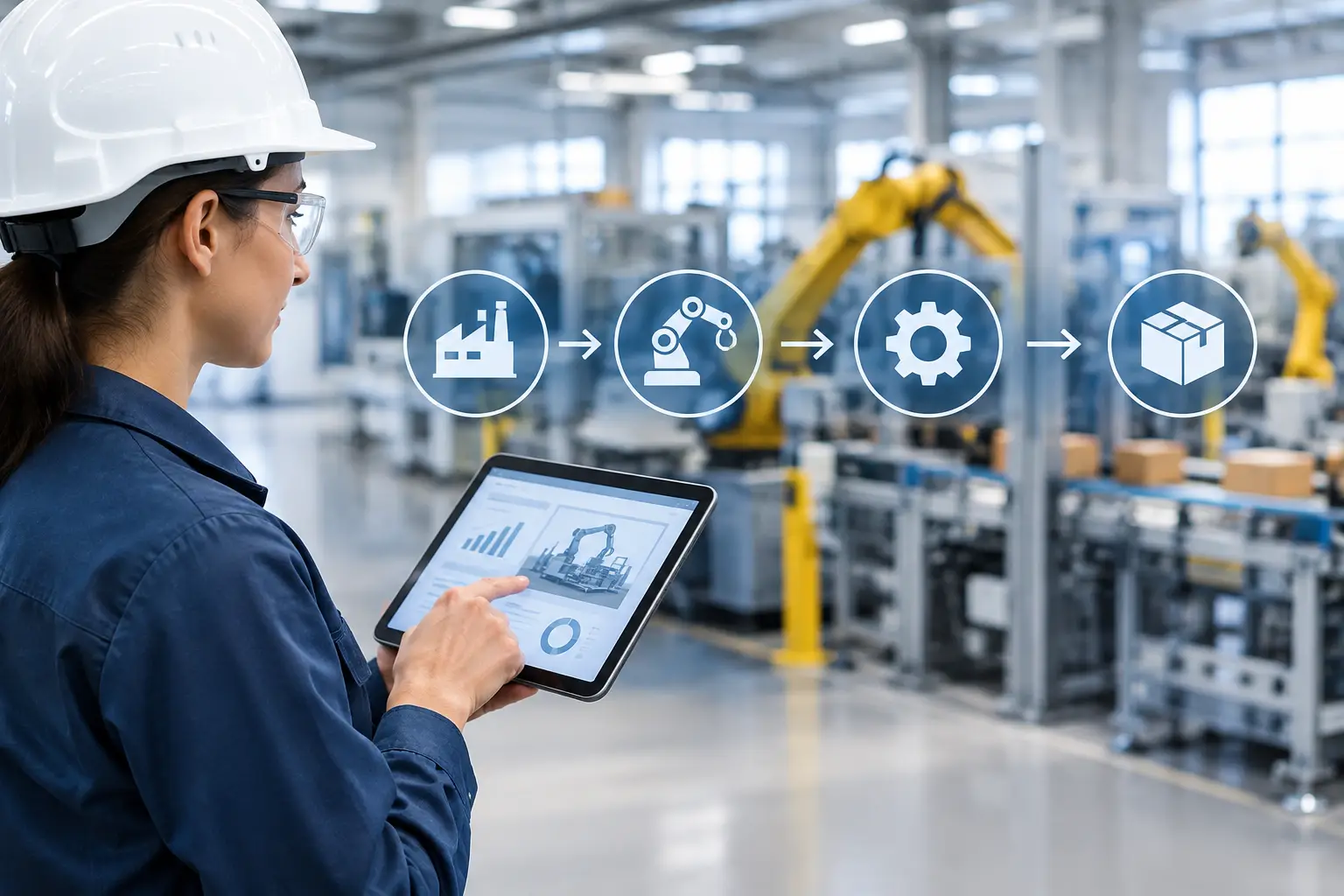
This is also where many projects separate into two paths. One path treats handling equipment as a collection of individual machines. The other treats the system as part of a complete production line. The second path is usually the stronger one, because line performance depends on interactions between storage, discharge, transfer, dosing, controls, dust collection, and downstream process demand.
Start with material behavior, not equipment catalogs
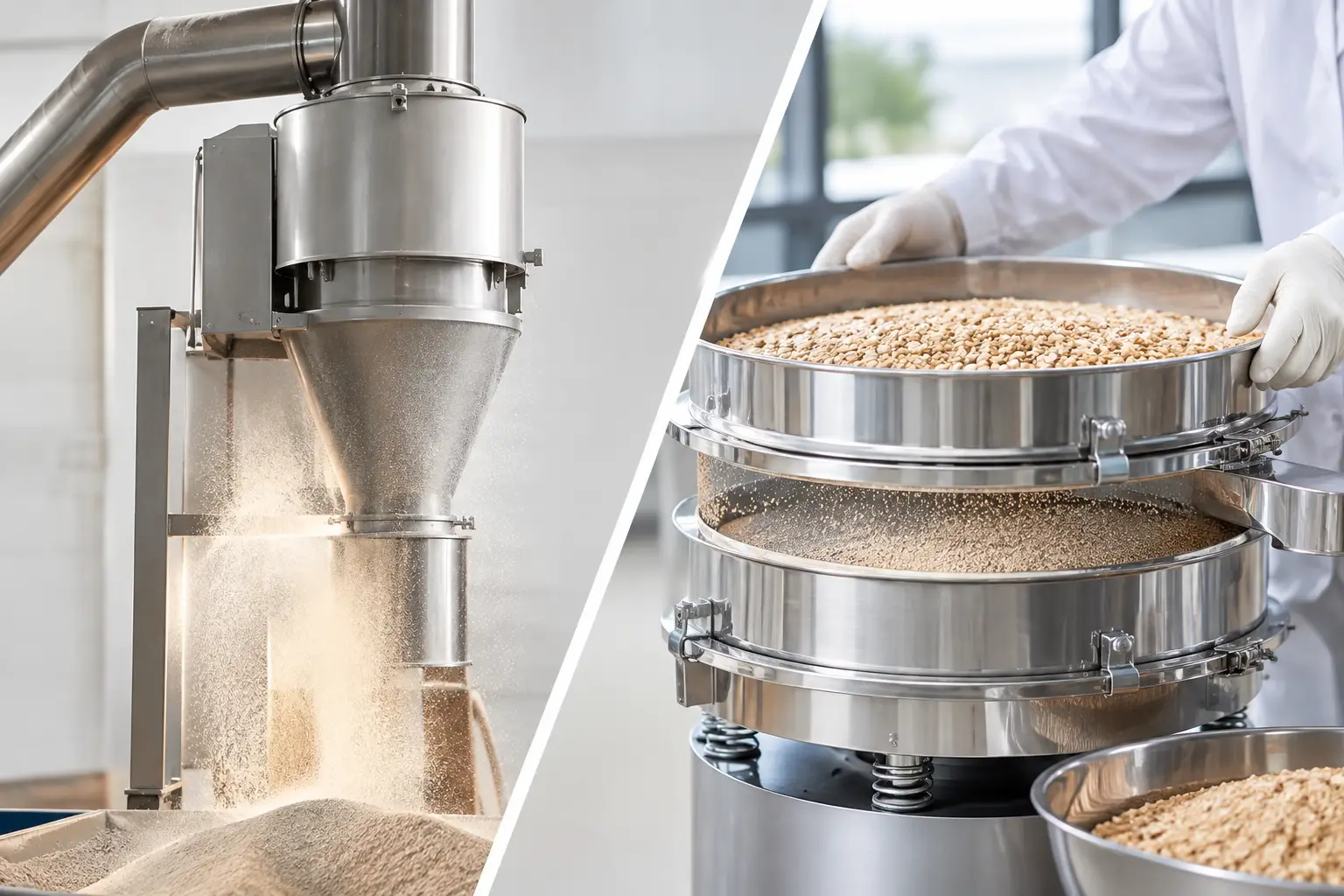
The first serious question is not which conveyor to use. It is what the material actually does in real operating conditions. That includes bulk density, particle size distribution, moisture sensitivity, compressibility, friability, segregation tendency, angle of repose, and flow function. It also includes how those properties may shift between receiving, storage, batching, and continuous feeding.
This matters because the same material can require different handling strategies at different stages of the process. A powder that transfers well in dilute phase may compact in a hopper. A blend that discharges cleanly from a bin may separate during conveying. A heat-sensitive ingredient may tolerate one transfer method but degrade under another. If those behaviors are not understood early, the system may be mechanically complete and still operationally unstable.
For regulated industries, that analysis extends beyond flow. Cleanability, containment, traceability, and product contact surface requirements can drive core design choices. In those settings, the lowest equipment cost often does not produce the lowest lifecycle cost.
Equipment selection is only one layer of the design
Once material behavior is defined, equipment selection becomes much more disciplined. Conveyors, feeders, hoppers, bins, pneumatic transfer systems, and discharge devices should be chosen based on the required process outcome, not on familiarity or standard preference alone.
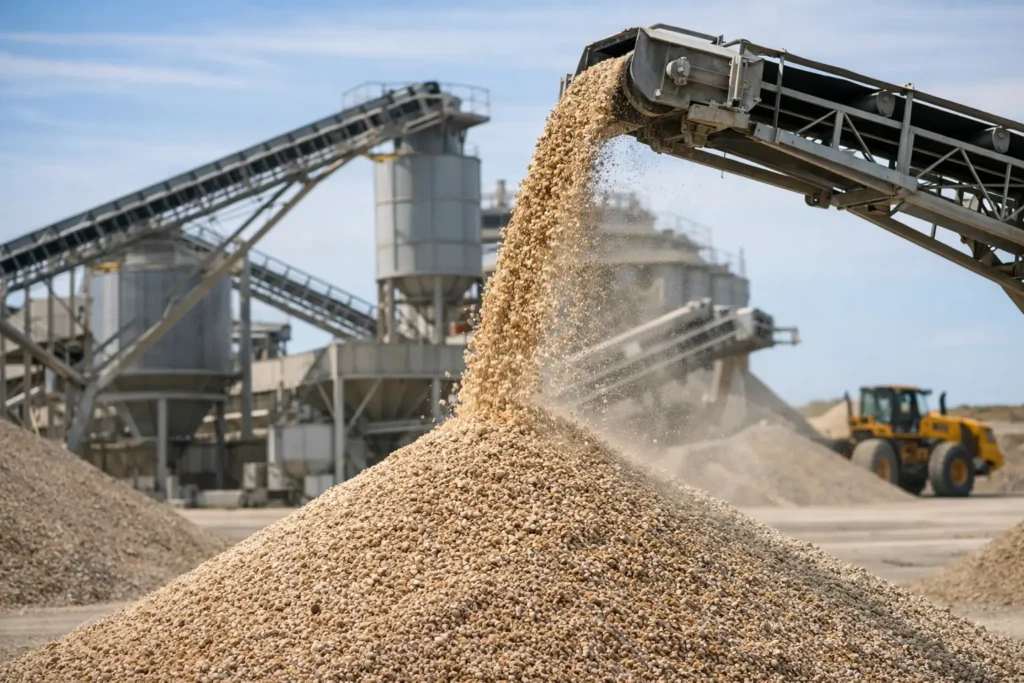
That is where trade-offs become real. Mechanical conveying may reduce product degradation and simplify maintenance access, but routing flexibility can be limited. Pneumatic conveying can support cleaner layouts and enclosed transfer, but air velocity, pickup conditions, and receiver design have to match the product. Screw feeders offer precise control in many applications, but they are not ideal for every fragile or segregation-prone material. Belt systems can handle high capacities well, yet they may demand more attention at transfer points and dust management zones.
The right answer depends on process priorities. If the line depends on highly accurate ingredient delivery, feeder stability may matter more than transfer speed. If plant space is constrained, vertical integration and routing flexibility may dominate. If dust explosion risk is a concern, containment and hazard mitigation can reshape the entire system architecture.
Why integration matters more than individual machine performance
A bulk handling line rarely fails because one machine was built poorly. More often, it fails because the machines were never engineered to operate as one coordinated system. A feeder may be technically capable of its rated output, but not when the hopper above it causes inconsistent head pressure. A transfer conveyor may have sufficient capacity, but not enough margin for upset conditions during startup or changeover. A dust collection system may meet airflow targets and still pull product from the wrong location.
This is the core advantage of integrated engineering. When one team designs the material path, controls logic, structural interfaces, access strategy, and downstream process coordination together, compatibility issues are reduced before fabrication starts. That shortens commissioning and improves predictability at startup.
For manufacturers investing in a full production line, this is not a minor detail. Separate vendors can each meet their own scope and still leave the owner managing gaps between those scopes. In complex environments, those gaps become schedule delays, change orders, and recurring operating problems.
Designing for steady flow, not just peak capacity
One of the most common errors in bulk material handling system design is sizing around theoretical maximum throughput while underestimating the value of stable flow. A system that can hit a high nameplate rate for short periods may still underperform if flow pulses, surges, or starves downstream operations.
Steady flow protects process quality. It improves dosing accuracy, stabilizes thermal loads, supports consistent mixing, and reduces control system compensation. In continuous processes, that stability often matters more than headline capacity.
This is why hopper geometry, mass flow versus funnel flow behavior, feeder interface design, and refill logic deserve close attention. The handoff from one piece of equipment to the next is often where performance is won or lost. Transfer points need to manage direction changes, containment, and wear. Storage zones need to discharge predictably across the expected operating window. Feed devices need to respond consistently as material characteristics shift.
Design margin matters too, but excessive margin can create its own problems. Oversized equipment may increase residence time, reduce control accuracy, or expose product to unnecessary mechanical stress. The design target should be practical operating range, not just maximum possible output.
Controls, automation, and accountability in system design
Mechanical design alone does not create a reliable handling system. Automation architecture is just as important. Start-stop sequencing, level management, interlocks, alarm philosophy, recipe control, and data visibility all affect how the system behaves during normal production and upset recovery.
A well-engineered controls strategy prevents minor disturbances from becoming line-wide interruptions. It also gives operators clear process visibility instead of forcing them to diagnose issues machine by machine. In integrated plants, that visibility is critical. Material handling has to respond to upstream supply conditions and downstream demand in real time.
That is another reason single-source responsibility has practical value. When the mechanical systems and controls architecture are engineered together, response logic can be built around actual system behavior instead of patched together during commissioning. For companies scaling production or modernizing aging lines, that coordination reduces operational ambiguity and puts accountability in one place.
Reliability, maintenance, and lifecycle performance
Design decisions that look efficient on paper can become expensive in service. Access for inspection, cleanout, wear component replacement, and routine maintenance should be treated as design requirements, not late-stage add-ons. If a transfer chute cannot be safely reached, or a feeder cannot be serviced without shutting down adjacent equipment, uptime will suffer regardless of nameplate quality.
Wear patterns also deserve more attention than they often get. Abrasion, impact loading, material buildup, and dust ingress affect long-term performance differently across industries and products. Chemical compatibility and contamination control may be just as important as mechanical durability. The best systems are designed for the actual production environment, not generic operating assumptions.
For this reason, experienced manufacturers increasingly evaluate bulk handling around total lifecycle performance. That includes startup speed, process consistency, spare parts standardization, service support, and expansion readiness. Proc-X approaches these systems as part of a complete production platform, where long-term line performance matters more than isolated equipment handoffs.
A better standard for bulk material handling system design
The strongest projects begin with a simple principle: material handling is process-critical infrastructure. It should be engineered with the same discipline applied to the core production technology it serves. That means validating material behavior, designing interfaces between operations, coordinating controls from the start, and assigning clear accountability across the full system.
For technical buyers, that approach reduces more than risk. It improves startup confidence, operating stability, and the ability to scale without rebuilding the line around early compromises. When bulk handling is designed as an integrated system rather than a chain of equipment purchases, the production line has a much better chance of performing the way it was promised.
If a handling system is expected to feed an entire manufacturing process, it should be designed like it carries the performance of that process on its back – because it does.