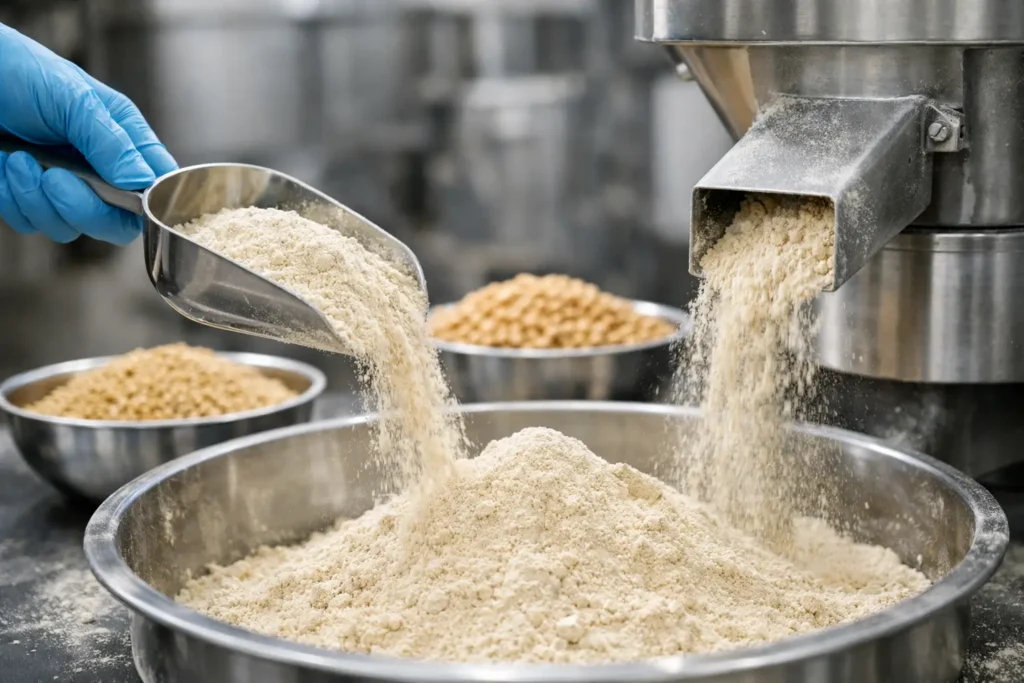
A protein powder that looks acceptable in a sample jar can still create expensive problems once it hits a full production line. Poor flow into feeders, dust generation at transfer points, inconsistent blend behavior, and unstable bulk density often trace back to one issue – protein milling that was treated as a simple size reduction step instead of a controlled process function.
For manufacturers working with whey, casein, soy, pea, collagen, egg, or specialty protein ingredients, milling has a direct effect on throughput, product quality, packaging performance, and line reliability. The target is not just smaller particles. The target is a repeatable particle size distribution that supports the entire production system, from raw material handling through blending, conveying, thermal steps, and final packout.
Why protein milling matters beyond particle size
Protein ingredients behave differently than many conventional powders. Some are heat-sensitive. Some are fat-bearing and prone to smearing. Some are hygroscopic and can shift quickly with ambient conditions. Others fracture easily and create excess fines if the milling approach is too aggressive. That means the right milling strategy depends on more than a nominal micron target.
In practice, protein milling influences four core performance areas. First is flowability. Particle size and shape directly affect how material behaves in hoppers, feeders, and transfer systems. Second is mix uniformity. When proteins must blend with vitamins, flavors, sweeteners, minerals, or functional additives, a poor particle profile can drive segregation or inconsistent dosing. Third is bulk density. Milling can either stabilize packout and storage behavior or create variability that complicates filling and palletizing. Fourth is dust control. Excess fines can increase housekeeping burden, product loss, and combustible dust risk.
This is why protein milling should be engineered as part of a complete process line, not selected as a standalone machine decision.
Protein milling methods and where each fits
There is no single best mill for every protein application. The right solution depends on ingredient characteristics, required capacity, target distribution, sanitation requirements, and how the material must perform in downstream steps.
Impact milling for throughput-driven applications
Impact mills are often used when manufacturers need efficient size reduction at higher capacities and the protein can tolerate the mechanical energy involved. They are effective for breaking down agglomerates and reducing coarser feed material to a more controlled specification.
The trade-off is heat generation and fines production. With sensitive proteins, too much impact energy can affect product behavior and create a broader distribution than the process requires. For some formulations, that may be acceptable. For high-value or tightly specified products, it may not.
Pin milling for tighter control
Pin mills are commonly selected when processors need more refined size reduction and better control over the final particle profile. They are useful in protein applications where deagglomeration and moderate particle reduction need to happen without the more severe action of other technologies.
Pin milling can be a strong fit for applications where consistency matters more than maximum brute-force throughput. Even so, the material’s moisture content, fat level, and inlet condition still determine whether the process remains stable over time.
Air classification and fine milling approaches
When very narrow distributions or finer targets are required, finer milling technologies and classification systems may be necessary. These systems can produce a more precise outcome, especially for specialty nutritional or technical applications where particle behavior drives downstream function.
The trade-off is complexity. Tighter specifications usually require more control points, more attention to system balance, and stronger integration with dust collection, conveying, and automation.
The real variables that affect protein milling results
The same mill can produce very different outcomes depending on upstream and operating conditions. That is where many projects lose consistency.
Moisture is one of the first variables to evaluate. A protein that mills cleanly at one moisture level may smear, compact, or blind screens at another. Temperature also matters. Warmer material can become more elastic or adhesive, while colder material may fracture differently. Fat content changes behavior as well, particularly in proteins that are less free-flowing by nature.
Feed consistency is another major factor. If upstream handling delivers surges, rat-holing, or variable feed density, the mill will not operate at a steady state. That instability shows up as changing particle size, throughput drift, and inconsistent downstream performance. Screen selection, rotor speed, residence time, and air handling all need to be tuned to the specific ingredient, not treated as generic settings.
This is also where scale matters. A lab result can be directionally useful, but full production performance depends on how the material moves through the entire system. Protein milling that works in isolated tests may behave differently once integrated with bulk bag unloading, pneumatic transfer, surge hoppers, metering equipment, and packaging lines.
Designing protein milling as part of an integrated line
For most industrial manufacturers, the biggest risk is not selecting the wrong mill in isolation. It is building a fragmented line where the mill, feeder, dust collector, controls package, and downstream equipment were never engineered to operate as one coordinated system.
A protein milling line should start with the material path. How is raw material received? How is it discharged and conditioned before milling? What feed control is required to maintain stable mill loading? How will the milled product be transferred without degrading the particle profile that was just created? These are process questions, not just equipment questions.
Controls integration is equally important. If the milling system cannot communicate effectively with upstream delivery and downstream packaging or blending equipment, operators are left managing instability manually. That usually leads to more stops, more variability, and more operator dependency than a modern production environment should accept.
Dust collection must also be treated as part of the milling design. Too little air movement can compromise housekeeping and safety. Too much can strip yield, alter product behavior, or upset the balance of the process. The correct answer depends on the powder, the environment, and the line architecture.
In regulated industries, sanitation and cleanability cannot be added later. Access, changeover design, material contact surfaces, and validation requirements should shape the system from the beginning.
Common failure points in protein milling projects
Many protein milling issues are predictable. One of the most common is over-milling to chase a finer target than the application actually needs. That can increase dust, reduce flowability, and create handling problems downstream. Another is underestimating the effect of feed variability. A well-specified mill cannot compensate for poor upstream material presentation.
A third failure point is ignoring bulk density shift. Milling often changes how a protein fills containers, behaves in storage, and responds to conveying. If packaging equipment was set based on raw ingredient behavior, post-mill performance may not match assumptions.
There is also the accountability problem. When the mill comes from one vendor, the feeder from another, the controls from a third, and the transfer system from a fourth, troubleshooting becomes fragmented quickly. Each supplier can point to another part of the line. Meanwhile, production loses time and the process remains unstable.
That is why many manufacturers now prefer a single engineering partner with responsibility for the entire process architecture. It reduces interface risk and improves the likelihood that the milling step will perform as intended under real operating conditions.
What to evaluate before specifying a protein milling system
A sound specification starts with the product and the business case together. The technical target should define required particle size distribution, throughput, temperature sensitivity, dust tolerance, sanitation requirements, and acceptable yield loss. The business case should define uptime expectations, recipe flexibility, future expansion, and serviceability.
From there, the right questions become more precise. Does the application require deagglomeration or true particle reduction? Is the protein friable, adhesive, heat-sensitive, or fat-bearing? How many recipes will run through the same system? What cleaning frequency is expected? Does the process need to support multiple packaging formats or downstream extrusion and blending steps?
It also makes sense to evaluate support over the full lifecycle. Commissioning, controls integration, operator training, spare parts strategy, and long-term technical service all affect whether a protein milling system delivers sustained value or becomes a recurring operational burden.
For companies building or modernizing production capacity, this is where a systems-focused partner adds measurable value. Proc-X approaches these projects with one engineering standard, one coordinated process strategy, and one point of accountability across the line.
Protein milling is a process decision, not a machine purchase
When protein milling is specified correctly, it improves more than particle size. It stabilizes flow, supports blend accuracy, protects downstream equipment performance, and reduces the hidden costs that come from dust, variability, and rework. When it is treated as a disconnected machine decision, those costs usually show up later and at a higher price.
The most reliable path is to engineer the milling step around the behavior of the protein and the demands of the full production system. That approach takes more discipline upfront, but it is what keeps throughput, quality, and accountability aligned once the line is running at scale.