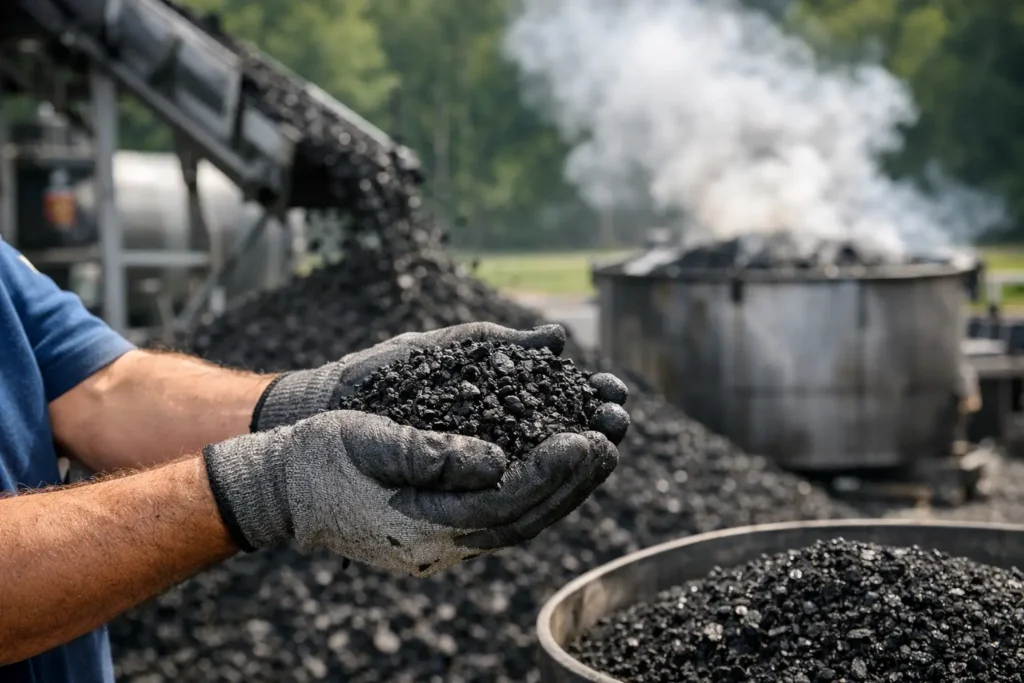
A biochar project rarely fails because of the reactor alone. More often, performance breaks down upstream in feedstock preparation or downstream in cooling, handling, and sizing. That is why biochar processing has to be treated as a complete production system, not a collection of individual machines.
For manufacturers and project teams evaluating commercial-scale production, the real question is not simply how to make biochar. It is how to produce it consistently, safely, and economically with a line that can tolerate feedstock variability, maintain product specifications, and support long-term throughput targets. That requires disciplined engineering across the entire process.
What biochar processing actually includes
At a technical level, biochar is produced by thermally converting biomass in a low-oxygen environment. In practice, commercial biochar processing extends well beyond that conversion step. The full system usually starts with raw material receiving and storage, then moves through size reduction, drying or moisture conditioning, controlled thermal treatment, cooling, discharge, milling or screening, and packaging or bulk loadout.
Each stage affects the next. Feedstock particle size influences heat transfer and residence time. Moisture content affects energy demand and process stability. Cooling design affects product safety and downstream handling. If those elements are engineered in isolation, operators often end up compensating manually for problems that should have been resolved in the system design.
This is especially relevant when biochar is produced for specification-driven markets such as soil amendments, environmental remediation media, animal feed additives, carbon sequestration programs, or advanced material applications. Those markets do not buy a process. They buy a repeatable product.
Why feedstock preparation determines line performance
Most biochar lines live or die on feedstock consistency. Wood waste, agricultural residues, biosolids, nutshells, and other biomass streams may all be viable inputs, but they behave very differently in processing. Bulk density, ash content, fibrous character, contaminant load, and incoming moisture all influence how the material flows, heats, and converts.
That creates an early design decision. A system can be optimized tightly around one feedstock, which usually improves efficiency and control, or it can be designed to accommodate a wider range of inputs, which improves flexibility but adds complexity. There is no universal right answer. It depends on sourcing risk, product targets, and the commercial model behind the operation.
Size reduction is a good example. If the feedstock enters the thermal stage with broad particle-size distribution, conversion becomes uneven. Oversized material may remain partially carbonized, while fines can overprocess or create dust-handling issues. The result is inconsistent product quality and unstable throughput. Proper milling, screening, and material conditioning help narrow that variability before the feed reaches the reactor.
Moisture matters just as much. Wet biomass can be processed, but the thermal system then spends more energy driving off water rather than supporting conversion. In some operations, predrying is essential. In others, feed blending or process adjustments may be enough. The right answer depends on incoming moisture swings, available utilities, and economics.
The thermal core of biochar processing
The heart of biochar processing is the thermal conversion stage, whether the technology uses pyrolysis, carbonization, torrefaction, or a closely related approach. Different process configurations offer different advantages in throughput, residence time control, energy recovery, and sensitivity to feedstock variation.
This is where many projects focus first, but reactor selection should follow the broader process definition rather than lead it. A thermal unit that performs well in a pilot environment may create operational problems at production scale if the upstream handling system cannot feed it uniformly or if the downstream discharge system cannot cool and transfer product safely.
Temperature profile, oxygen control, retention time, and solids movement all shape final product properties. Higher processing severity can increase fixed carbon content and change pore structure, but it may also reduce yield or alter physical characteristics in ways that do not fit the intended market. A lower-severity process may preserve yield yet miss adsorption or stability targets required by the end use. Product objectives must drive process settings.
For that reason, scale-up should be based on both thermal performance and integrated line behavior. Throughput claims are only meaningful when the entire system can sustain them, including material infeed, gas management, cooling, and finished product handling.
Cooling, handling, and dust control are not secondary issues
Freshly produced biochar is hot, friable, and often dusty. If cooling and discharge are treated as afterthoughts, operators can face fire risk, material degradation, and serious housekeeping problems. Biochar can also be difficult to convey consistently depending on particle size distribution and moisture pickup after processing.
A well-engineered line controls the product temperature before transfer to storage, screening, milling, or packaging. The exact cooling method depends on throughput, product sensitivity, and plant layout, but the objective is constant: stabilize the material without creating bottlenecks or compromising quality.
Dust management deserves equal attention. Fine carbonized materials can create combustible dust hazards, product loss, and maintenance burdens if collection and containment are inadequate. In high-throughput environments, this is not only a safety issue. It is a reliability issue that affects uptime, cleanliness, and labor demand.
Material transfer design also matters more than many teams expect. The wrong conveyor or feeder arrangement can break down product, generate excess fines, or create plugging. This is one reason integrated system engineering matters. The line should be designed around the behavior of biochar as a processed material, not just around general bulk solids assumptions.
Product finishing and specification control
Many biochar applications require post-processing before the material is commercially usable. That may include screening to remove oversize particles, milling to reach a target top size, blending to standardize characteristics, densification for handling or transport, or packaging configured for retail, industrial, or bulk markets.
This is where a production line shifts from making biochar to manufacturing a product. If the end market requires controlled particle size, defined moisture range, or specific bulk density, those attributes must be built into the process design. They cannot be left to operator adjustment after startup.
Sampling and quality verification should be part of the line strategy as well. Carbon content, ash level, pH, particle size distribution, and contaminant thresholds may all be relevant depending on the application. For higher-value markets, process control and traceability become increasingly important.
Integration is the difference between a functioning line and a dependable one
A fragmented approach to biochar processing often looks acceptable on paper. One vendor supplies size reduction equipment, another provides the reactor, a third handles dust collection, and a fourth packages the product. The problem appears later, when controls do not communicate properly, commissioning schedules slip, and no single supplier owns the performance of the complete line.
That accountability gap is expensive. When throughput falls short or quality drifts, operations teams are left managing disputes between vendors rather than solving process issues. For industrial manufacturers, the safer model is a coordinated processing platform engineered to common standards, with material handling, thermal processing, controls, and downstream finishing designed as one system.
That is where a single-source engineering approach has practical value. It reduces compatibility risk, simplifies startup, and creates one point of responsibility for system performance. For organizations entering or expanding biochar production, that structure can make the difference between a line that technically runs and one that consistently meets business expectations.
What to evaluate before scaling up
Before moving forward, manufacturers should define three things with precision: the feedstocks they can reliably secure, the product specifications the market will actually pay for, and the operating model required to meet volume and cost targets. Those inputs should shape the equipment architecture, not the other way around.
It is also worth pressure-testing assumptions around variability. How much can feed moisture swing before throughput is affected? What happens if the particle-size distribution drifts? How will the line respond to upset conditions during startup, shutdown, or product changeover? Mature process design accounts for those realities early.
In commercial biochar production, the strongest projects are usually the ones that respect complexity without overcomplicating the solution. A well-designed line should not depend on constant operator intervention to maintain stability. It should be engineered to absorb normal process variation, protect product quality, and support predictable output over time.
Biochar has real commercial potential, but only when the manufacturing system behind it is built for repeatability. The companies that succeed will be the ones that treat process integration as a core requirement from day one.