PROC-X MANUFACTURING GROUP / QUANTUMX
Industrial Mixing & Blending Systems
Consistency starts with the blend.
Compare mixing actions, working volumes and processing options for powders, granules and demanding pastes.
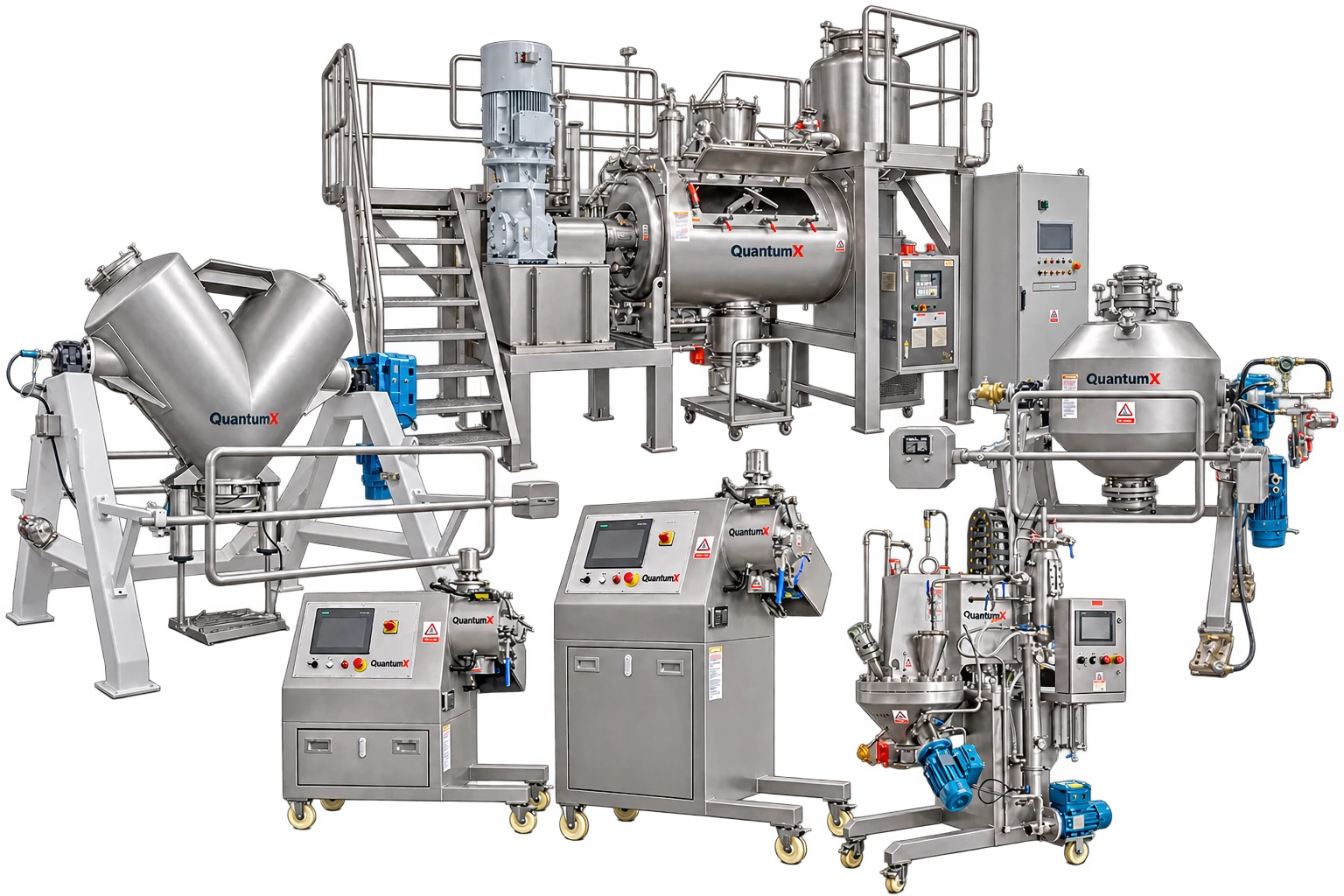
Specialist equipment. Connected process thinking.
Find your mixing technology.
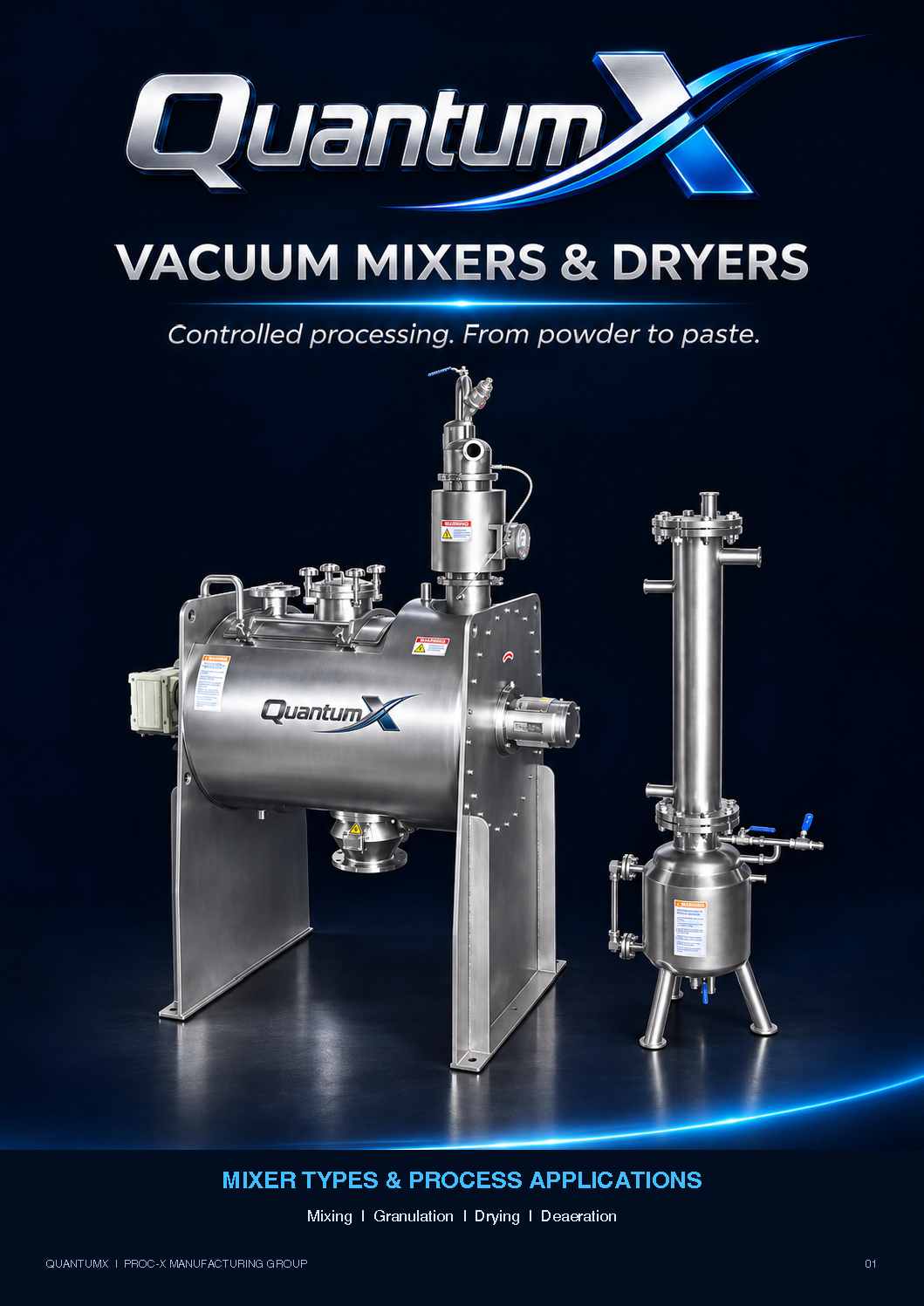
QuantumX
Vacuum Mixers & Dryers
Vacuum mixers & dryers for powders, granules and selected pastes. Build the blend around your batch size, ingredient behavior and production cycle.
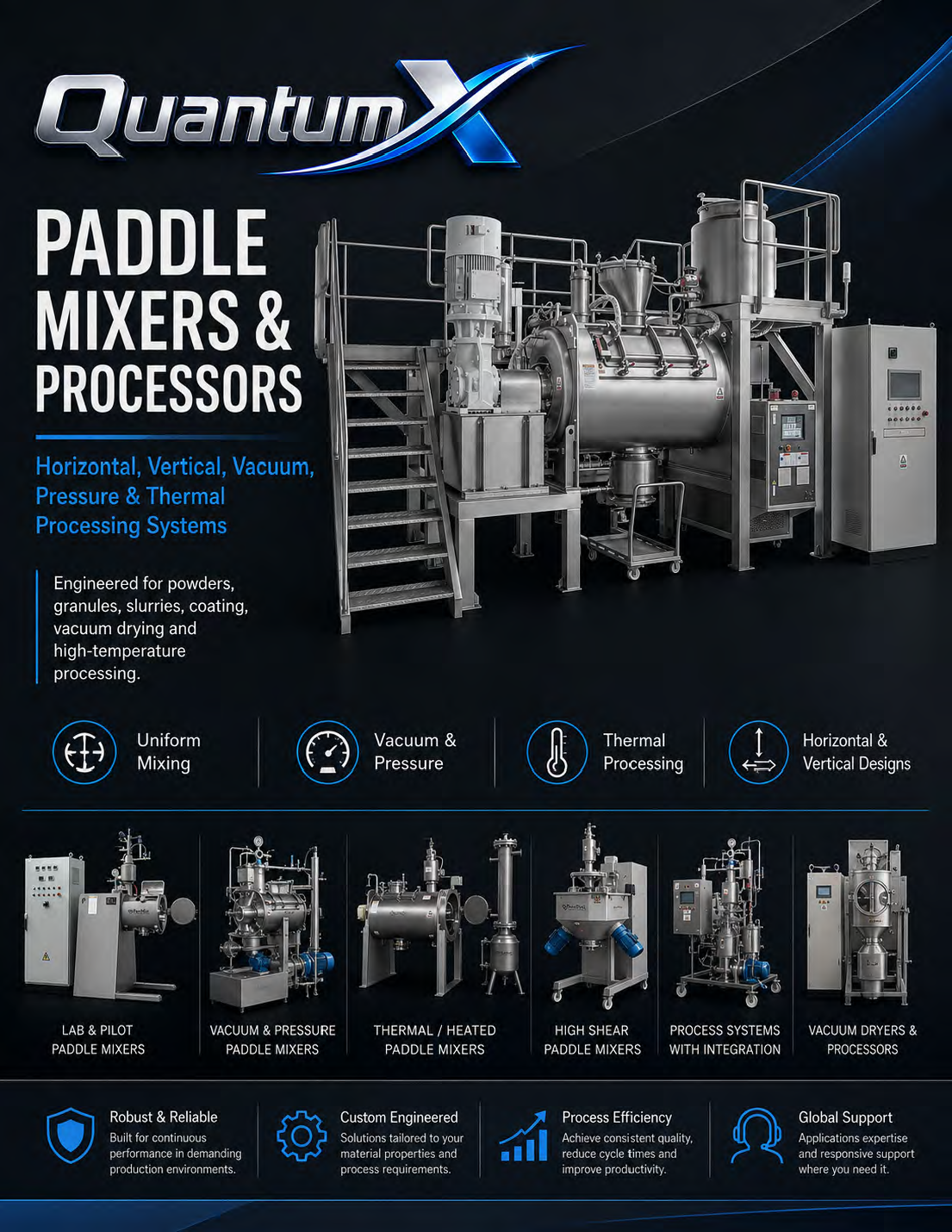
QuantumX
Paddle Mixers & Blenders
Explore single-shaft PFBS and dual-shaft PFB fluidized-zone mixing. Compare the configuration, working volume and material response for your powder-blending duty.
QuantumX
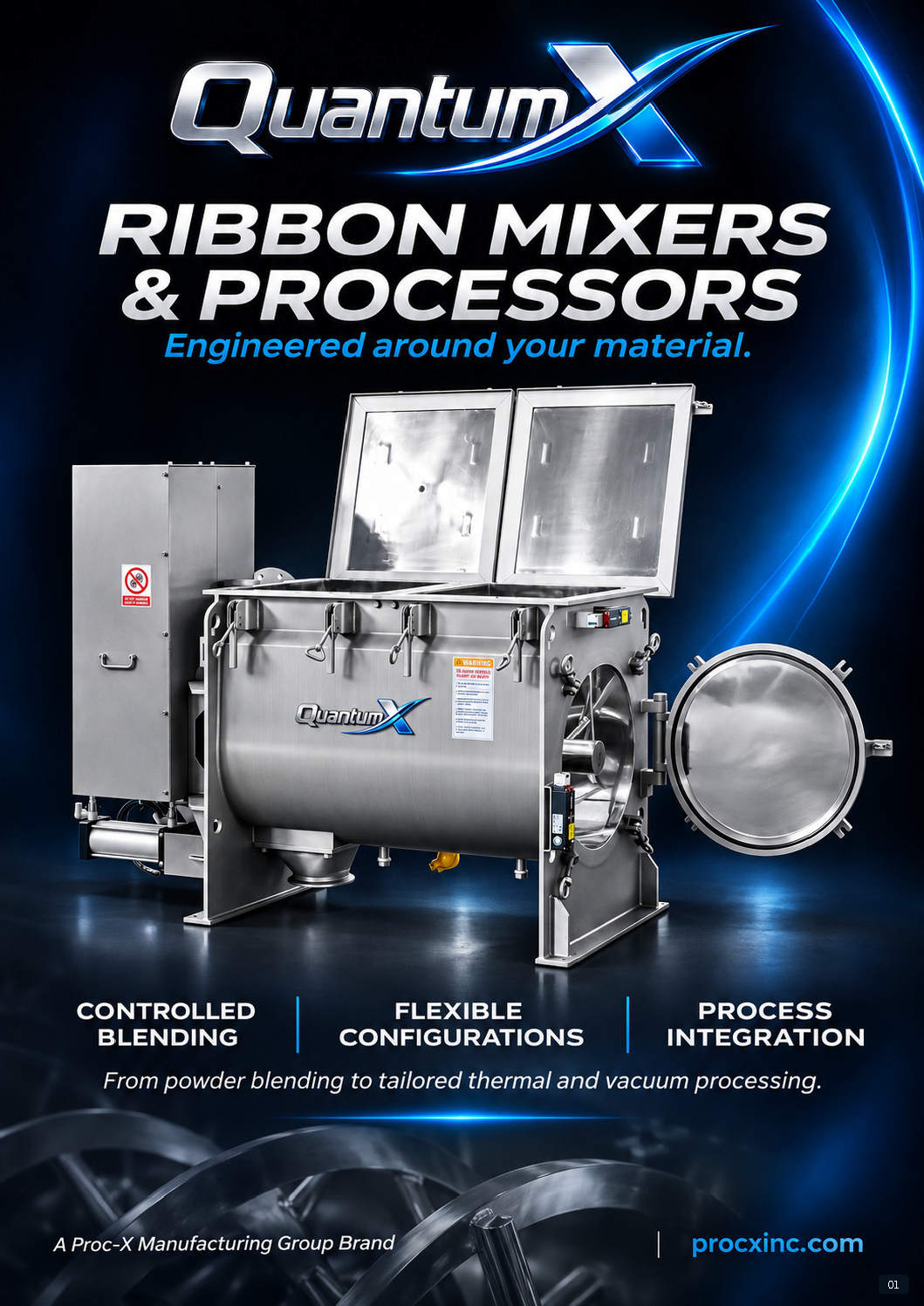
Ribbon Mixers & Blenders
Horizontal and vertical ribbon mixers for powders, granules and selected pastes. Build the blend around your batch size, ingredient behavior and production cycle.
QuantumX
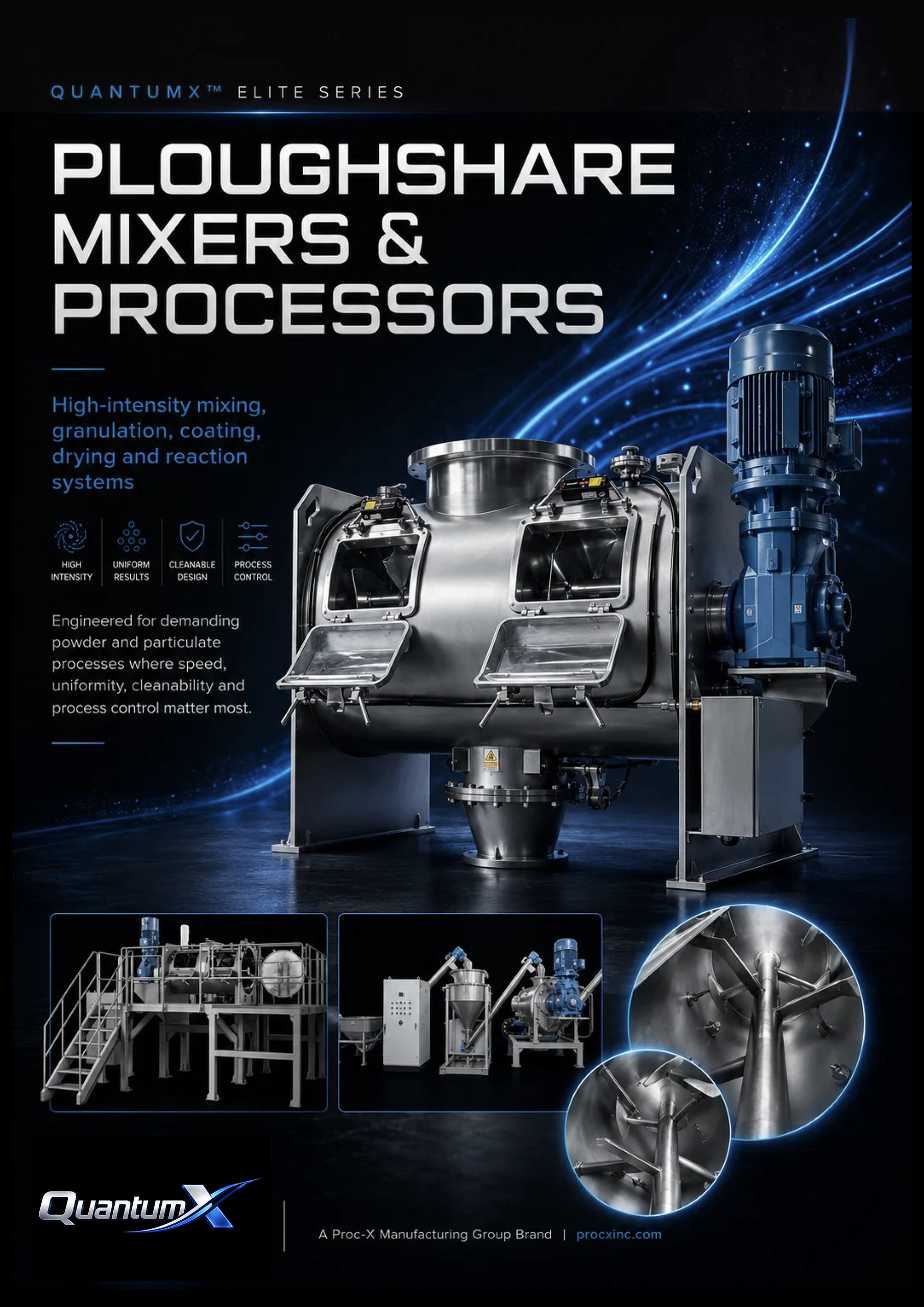
Ploughshare Mixers & Processors
Ploughshare mixers, also called plow mixers, for intensive powder blending, liquid incorporation, coating and granulation—with processor configurations for thermal and vacuum duties.
QuantumX
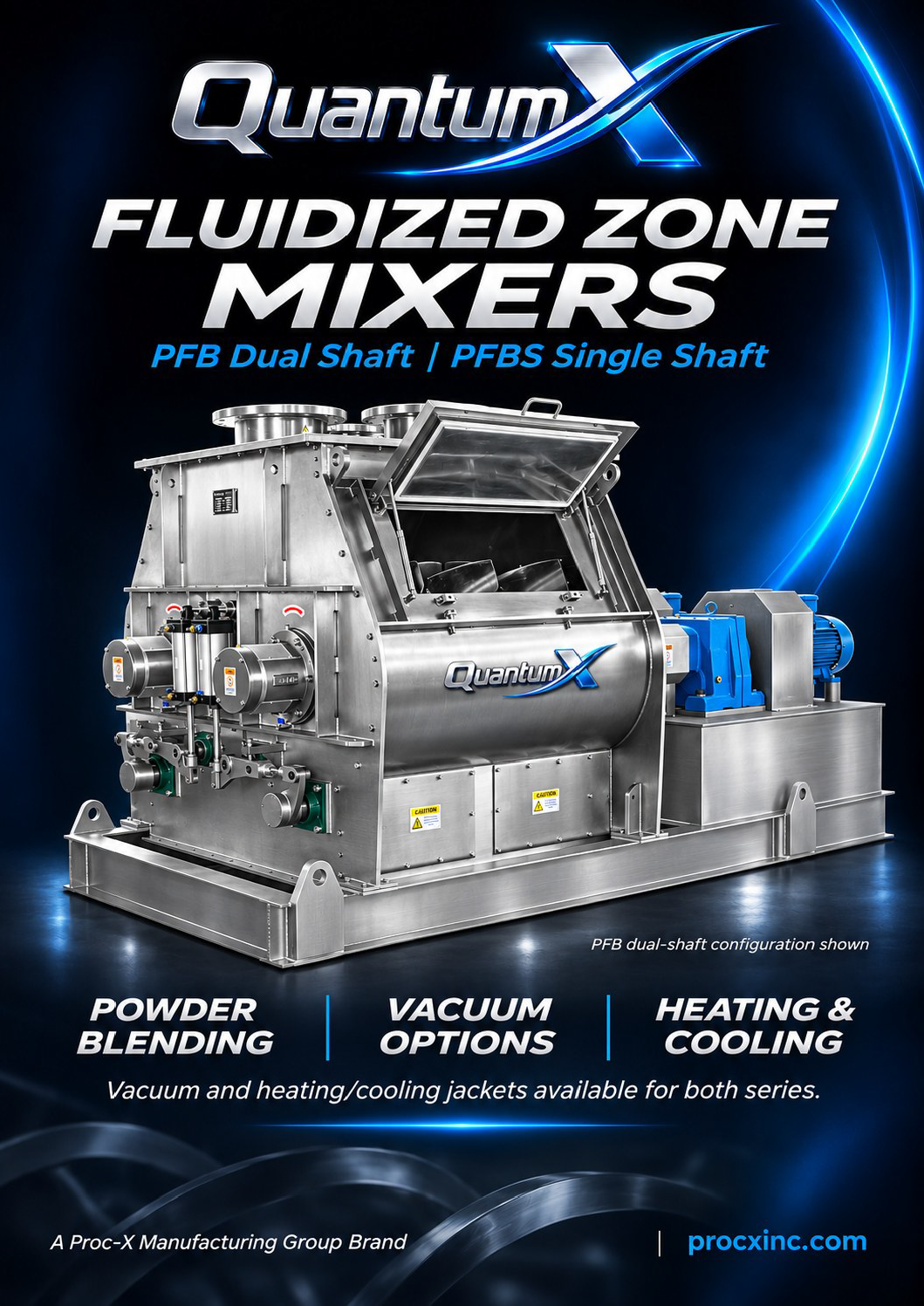
Fluidized Zone Mixers
Single-shaft and twin-shaft fluidized zone mixers for powder blending and selected powder-liquid duties, with vacuum mixer/dryer variants for integrated processing.
QuantumX
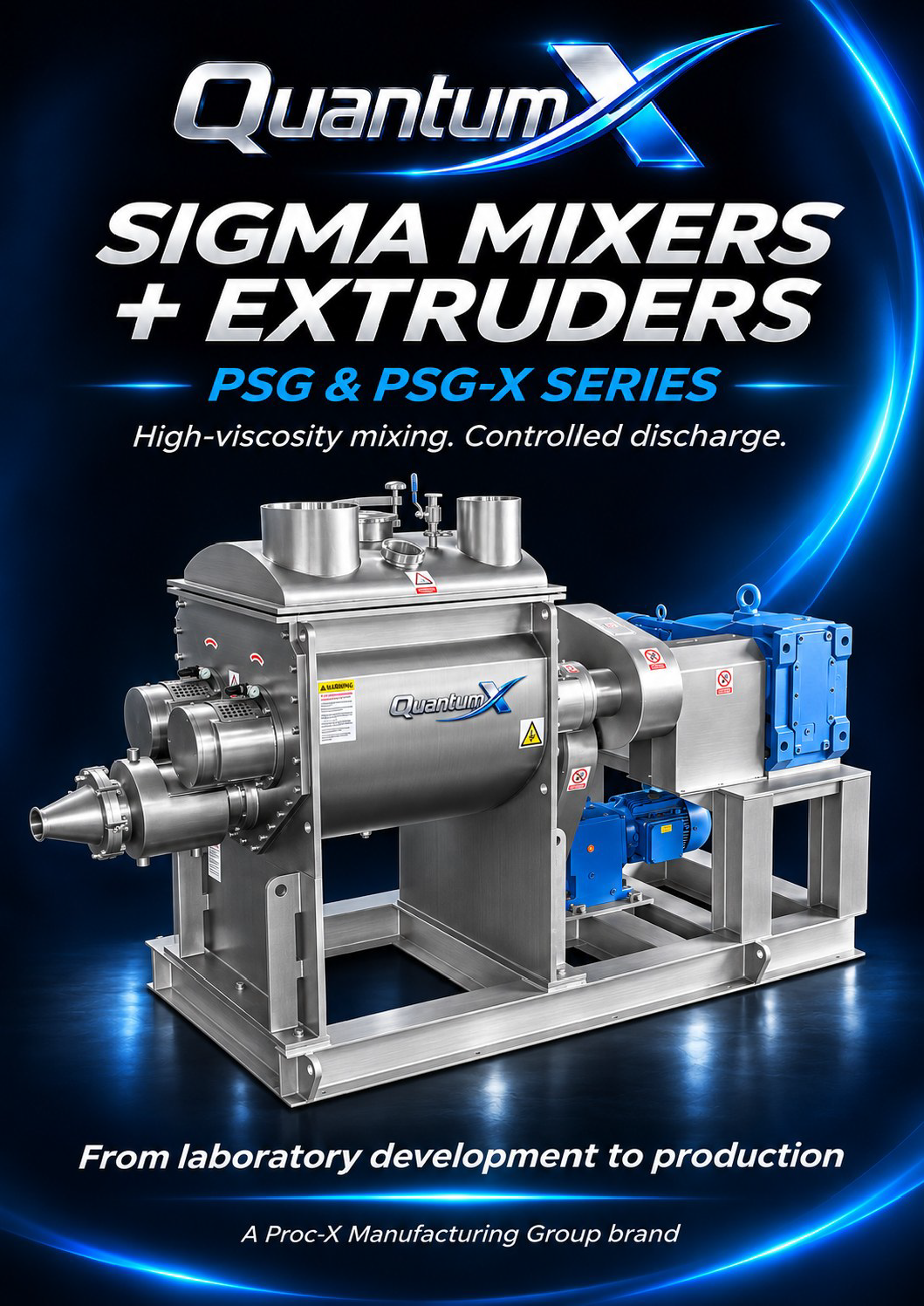
Sigma Mixers & Extruder Discharge
Double-arm kneaders for sticky, high-viscosity compounds—with tilting, bottom-discharge and screw-extruder options to connect mixing with the next process step.
Solutions for your application.
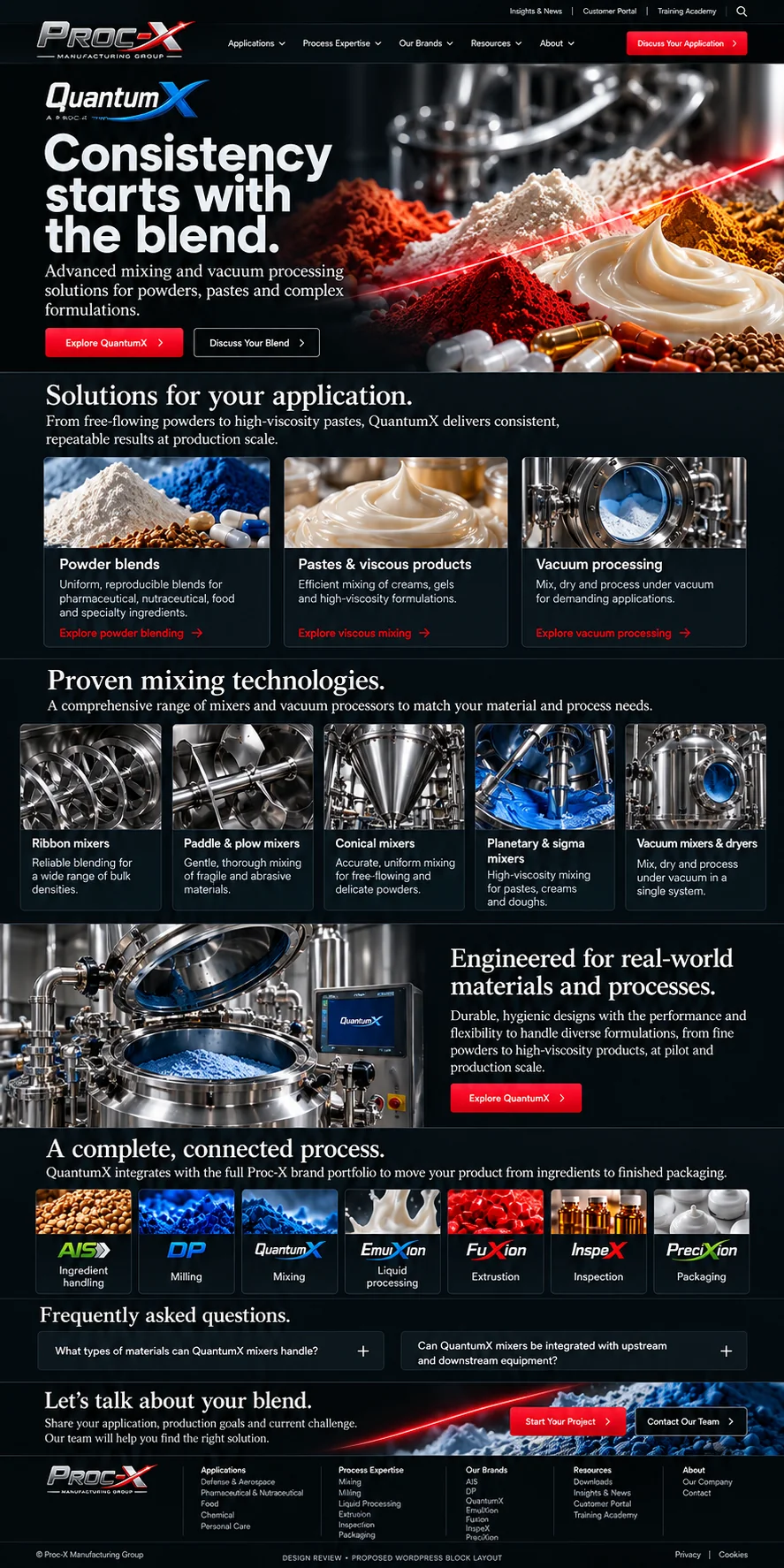
Powder blends
Ribbon and paddle configurations provide different circulation and handling characteristics.
Pastes & viscous products
Vacuum mixing and drying introduce requirements beyond blending.
Vacuum processing
Charging, mixing, discharge and cleaning determine practical production capacity.
Technologies matched to your process.
Paddle & plow mixers
Evaluate mixing action, ingredient sensitivity and liquid addition.
Planetary & sigma mixers
Mixing options for pastes, doughs and viscous formulations.
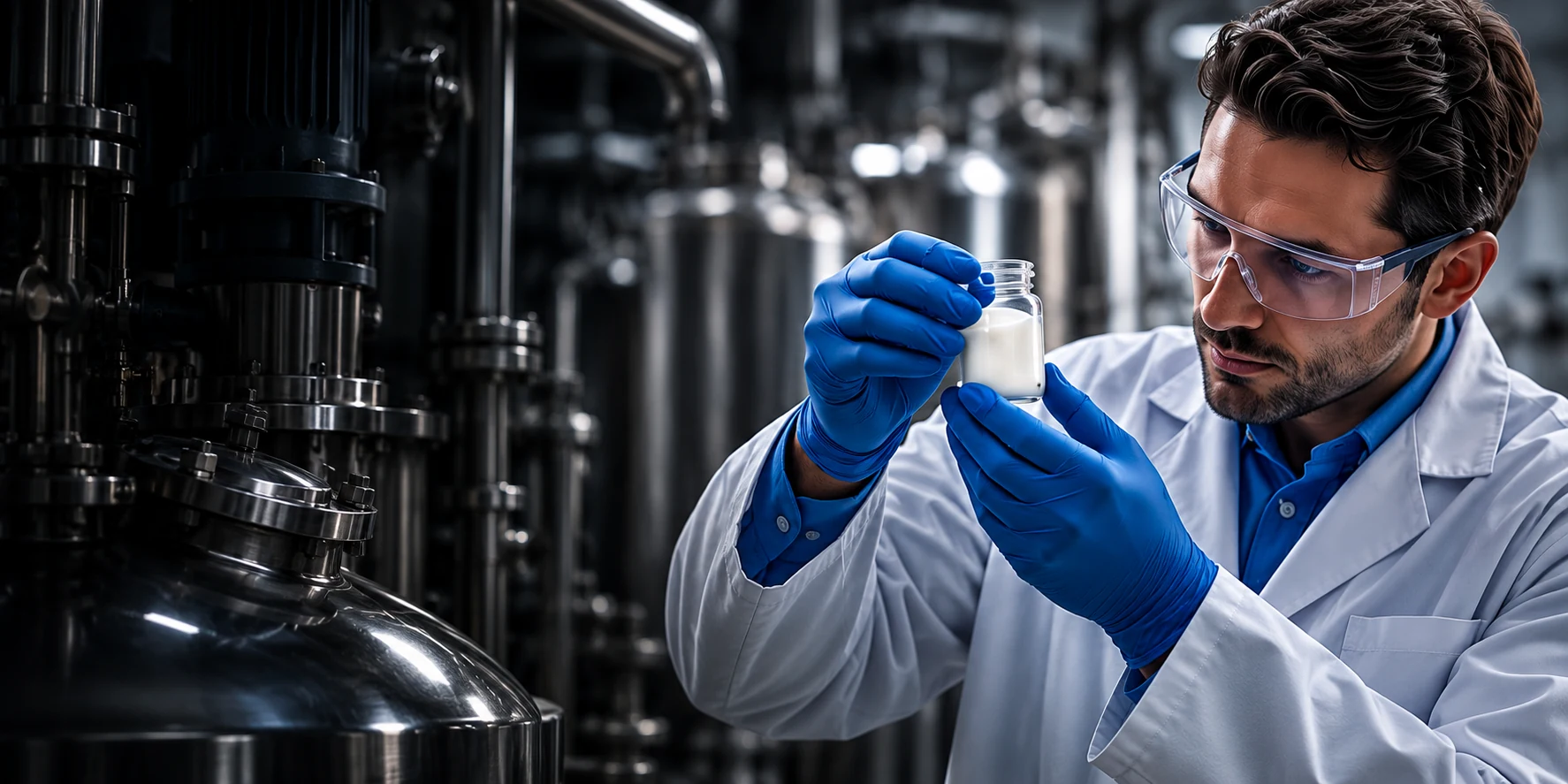
Engineered for real-world materials and processes.
Match the technology to your product characteristics, working capacity, cleaning expectations and connected process stages. Our discussion starts with the material and the outcome you need.
Seven specialists. One coordinated team.
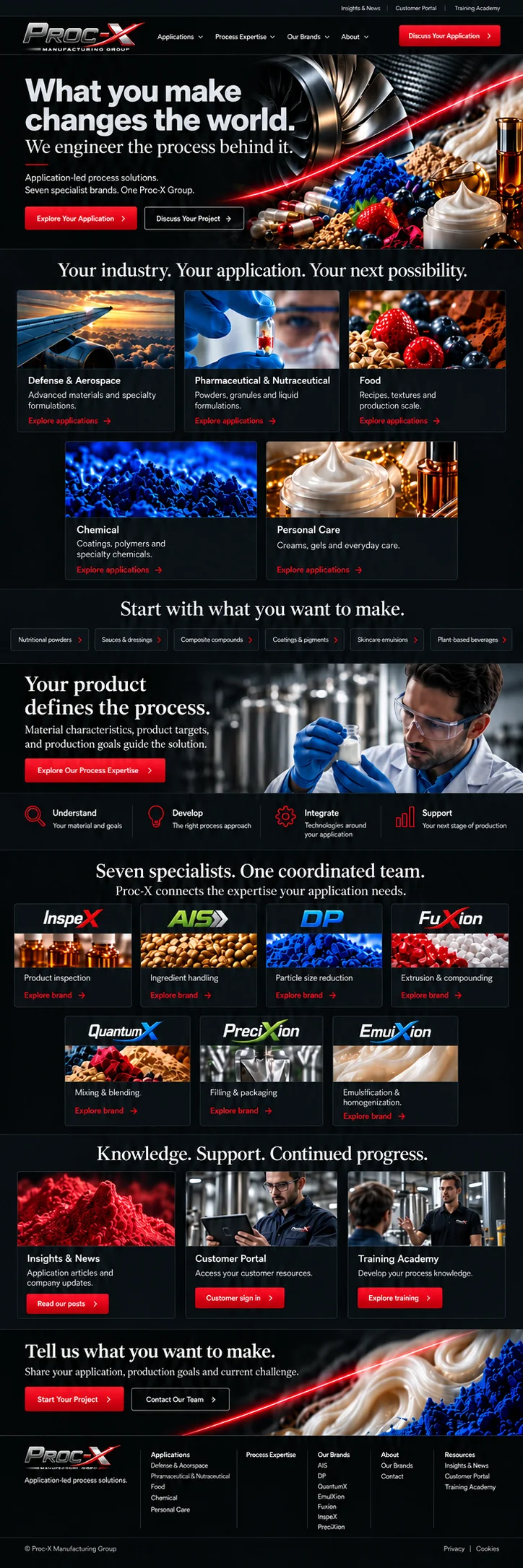

Choose the Mixing Action Your Material Needs
Powder blending, cohesive solids and viscous pastes place different demands on a mixer. Start with the formulation, minimum and maximum batch sizes, allowable shear and the criterion used to decide that the batch is ready.
| Mixer family | Selection starting point | Key questions |
|---|---|---|
| Horizontal ribbon — PRB / PRBD | Bulk circulation for suitable powder, granule and selected paste duties. | Does the formulation circulate at the proposed fill level? What are the startup torque, liquid addition and discharge requirements? |
| Vertical ribbon — PVR / PVRD | Vertical circulation where vessel layout, product flow and discharge must be considered together. | What is the useful operating volume? How will cohesive material, residue and cleaning access be handled? |
| Ploughshare — PTS / PTSD | Intensive powder movement, with configurations for liquid incorporation, coating and processing. | What shear is acceptable? Are choppers required? How are additions distributed and agglomerates controlled? |
| Fluidized zone — PFBS / PFB | Mechanically fluidized powder mixing using single-shaft PFBS or dual-shaft PFB arrangements. | What fill range, particle integrity, loading sequence and discharge behavior must the trial demonstrate? |
| Sigma kneader | Double-arm kneading for suitable sticky, high-viscosity formulations. | What torque and heat removal are required? Should discharge tilt, exit through a bottom valve or use an extruder? |
| Liquid mixing and emulsification | Agitation, dispersion and homogenization selected for the liquid system. | What are the viscosity range, solids loading, droplet or dispersion target and temperature constraints? |
D identifies the vacuum dryer variant in the paired ribbon and ploughshare families above. PFBSD and PFBD identify the single- and dual-shaft vacuum versions. Vacuum equipment must be selected against the drying or processing duty; standard mixer motor ratings are not a substitute for a vacuum configuration specification.
Working Volume Comes Before Model Selection
For a powder blend, divide batch mass by the representative bulk density to estimate occupied volume. Then check that volume against the selected mixer’s specified working range. Allow for changes during ingredient addition and processing; nominal vessel volume is not usable batch volume.
Sizing Example
A 500 kg batch at 500 kg/m³ occupies approximately 1 m³, or 1,000 L. This is the estimated material volume—not a recommendation for a 1,000 L nominal mixer. The required vessel size depends on the model’s working fill range and the material’s behavior.
Measure the Full Production Cycle
Uniformity
Agree the marker ingredient, sampling locations, analytical method and acceptance criterion. Check distribution after discharge as well as inside the mixer.
Batch cycle
Include charging, minor-ingredient addition, mixing, discharge and cleaning. A short mixing step alone does not establish hourly production.
Product integrity
Define allowable temperature rise, particle damage, agglomeration and changes in bulk density. Include the lowest-dose ingredient and the most difficult formulation.
Vacuum processing
State the liquid to remove, initial and final content, temperature limit, operating pressure and heating utilities. Condensation, vapor handling and solvent compatibility belong in the process scope.
Technical Resources
Ribbon mixer brochure (PDF) · Ploughshare brochure (PDF) · Fluidized-zone brochure (PDF) · Sigma mixer brochure (PDF)
Explore QuantumX · Compare vacuum mixers and dryers · Plan a mixing trial
Send Us Your Mixing Requirement
Include your formulation type, batch mass, bulk density or viscosity, minimum and maximum batches, liquid additions and required result. We can then discuss the configuration and evidence needed for selection.
Questions about your process.
How is working batch volume calculated?
Batch mass and bulk density provide an initial volume estimate. The selected mixer’s usable fill range and the formulation’s behavior then determine suitability. Nominal vessel volume is not the same as working capacity.
How long will my product take to mix?
Mixing time depends on formulation, geometry, loading sequence and the uniformity criterion. Establish it through relevant experience or testing rather than applying one time to every recipe.
Can liquid ingredients be added to a powder blend?
Yes, where the configuration and formulation support it. Addition rate, distribution, liquid quantity and the risk of agglomeration should be evaluated as part of the mixing duty.
ONE PROCESS. CONNECTED EXPERTISE.
Think Beyond the Machine
Select each operation with its upstream and downstream interfaces in mind. The sequence and equipment depend on your application.
Estimate Your Occupied Batch Volume
Convert batch mass and bulk density into the volume occupied by your material. This is a starting point for an engineering discussion, not a mixer model recommendation.
Occupied volume (L) = batch mass (kg) ÷ bulk density (kg/m³) × 1,000. Nominal vessel size also depends on the model’s usable fill range, material behavior and process duty. For powders, use bulk density rather than particle density.
Tell us what you want to make.
Share your application, production goals and current challenge.