PROC-X MANUFACTURING GROUP
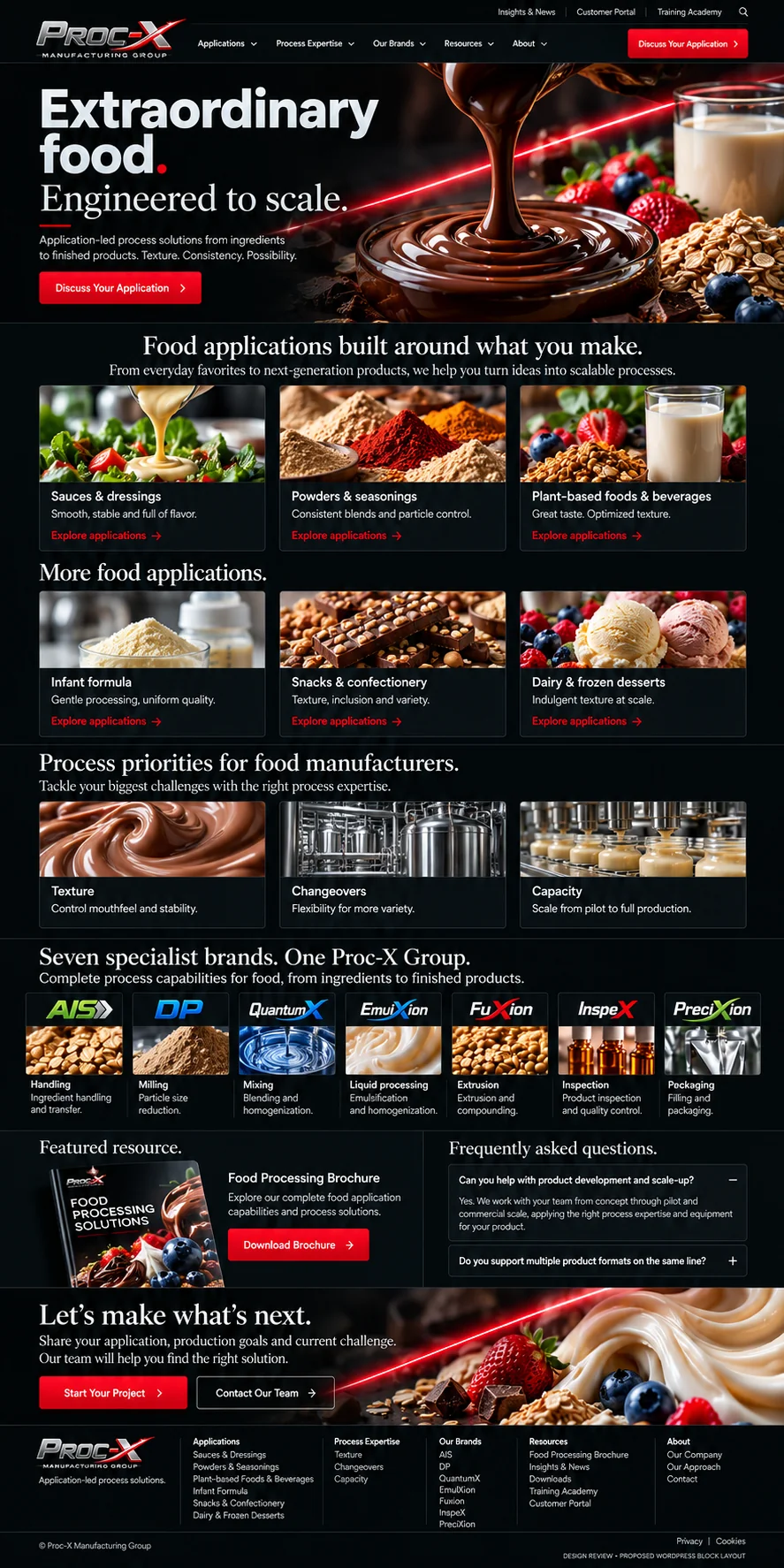
Extraordinary food. Engineered to scale.
Application-led process solutions from ingredients to finished products. Texture. Consistency. Possibility.
Food applications built around what you make.
Sauces & dressings
Mixing, powder hydration and emulsification for your recipe and texture.
Powders & seasonings
Coordinate spice grinding, ingredient dosing and uniform blending.
Plant-based foods & beverages
Review powder incorporation, hydration and the desired mouthfeel.
Infant formula
Discuss ingredient control, cleaning and inspection requirements for your application.
Snacks & confectionery
Review inclusions, viscosity and forming or packaging interfaces.
Dairy & frozen desserts
Consider temperature, shear and transfer alongside your production target.
Engineered for what matters most.
Texture
Control mouthfeel and product structure.
Changeovers
Plan cleaning and recipe flexibility.
Capacity
Coordinate batch cycles with line output.
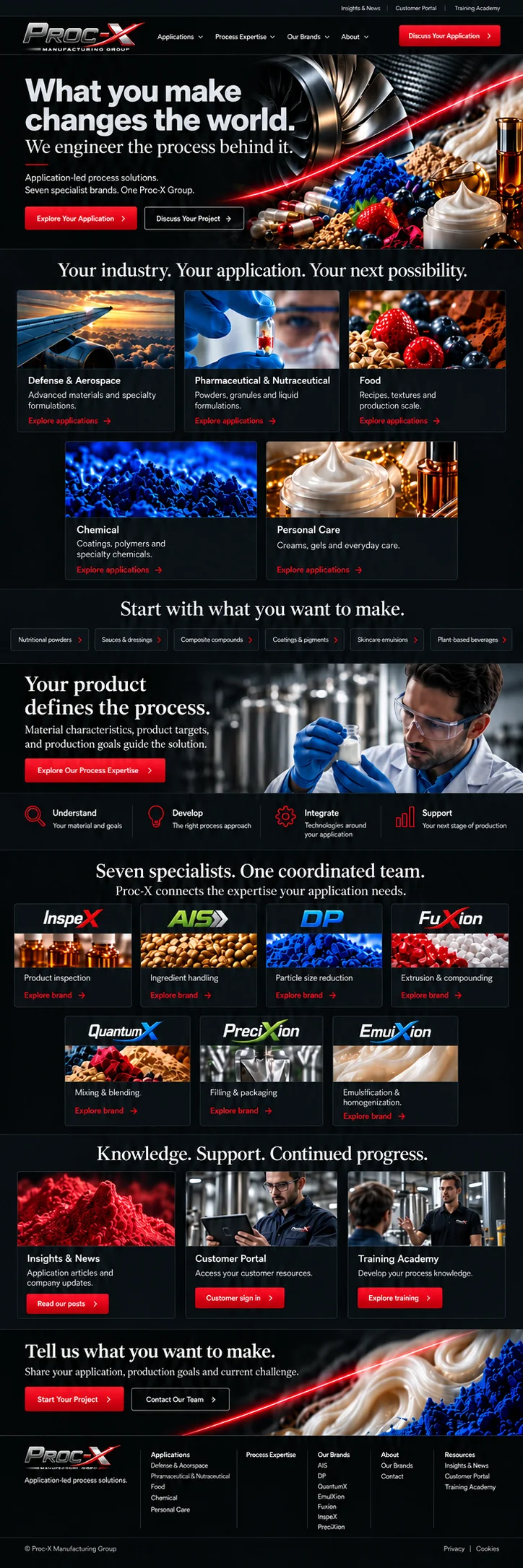
Seven specialists. One coordinated team.

Knowledge for your application.
FEATURED RESOURCE
Food Processing Brochure
Explore the process considerations behind your material, formulation and production requirements.
Food Processing Systems for Powders, Sauces & Ingredients
Sauces, dressings and liquid foods
A sauce line must support the intended texture as well as the required production rate. Powder wetting, oil addition, emulsification, temperature control and transfer can each change the finished product. Smooth dressings and particulate sauces require different treatment: a process that creates a fine emulsion may damage herbs or vegetable pieces. Define the formulation sequence and the ingredients that must retain their structure.
Spice grinding and seasoning blends
Spice and seasoning production connects size reduction with ingredient dosing and blending. Feed moisture, oil content, heat sensitivity and the target particle distribution help guide mill selection. After grinding, differences in particle size and bulk density can affect blend uniformity and segregation during discharge. Consider the complete route from ingredient charging through inspection and bag filling.
Plant-based and nutritional ingredients
Protein powders, fibers, starches and functional ingredients can behave differently during conveying, blending and hydration. Cohesive powders may bridge during feeding, while low-dose ingredients require careful addition and distribution. For liquid products, powder incorporation should be reviewed alongside hydration time, viscosity development and the shear sensitivity of the formulation.
Design for changeovers and downstream production
Identify allergens, product-contact requirements and the planned cleaning method. Cleaning access, residual product, transfer lengths and packaging changeovers affect usable production time. AIS, DP Pulverizers, QuantumX, EmulXion, InspeX and PreciXion can contribute to relevant stages; the combination depends on the product. Share batch size, scheduled operating hours and packaging format so the discussion addresses practical output.
Questions about your process.
How do I specify capacity for a food processing system?
Provide the required finished-product output and the time available to make it. Include charging, processing, discharge, cleaning and changeover time rather than relying only on vessel volume or a machine’s instantaneous rate.
Can one system produce smooth and particulate sauces?
Potentially, but the ingredient-addition sequence, pump selection and shear exposure must suit both products. Identify the largest pieces and the texture that must be preserved so the proposed configuration can be evaluated.
Where should product inspection be installed?
The inspection position depends on the hazard assessment, product format and packaging. Bulk, pipeline and finished-package inspection address different points in the process; selection should include a review of reject handling.
Tell us what you want to make.
Share your application, production goals and current challenge.