PROC-X MANUFACTURING GROUP
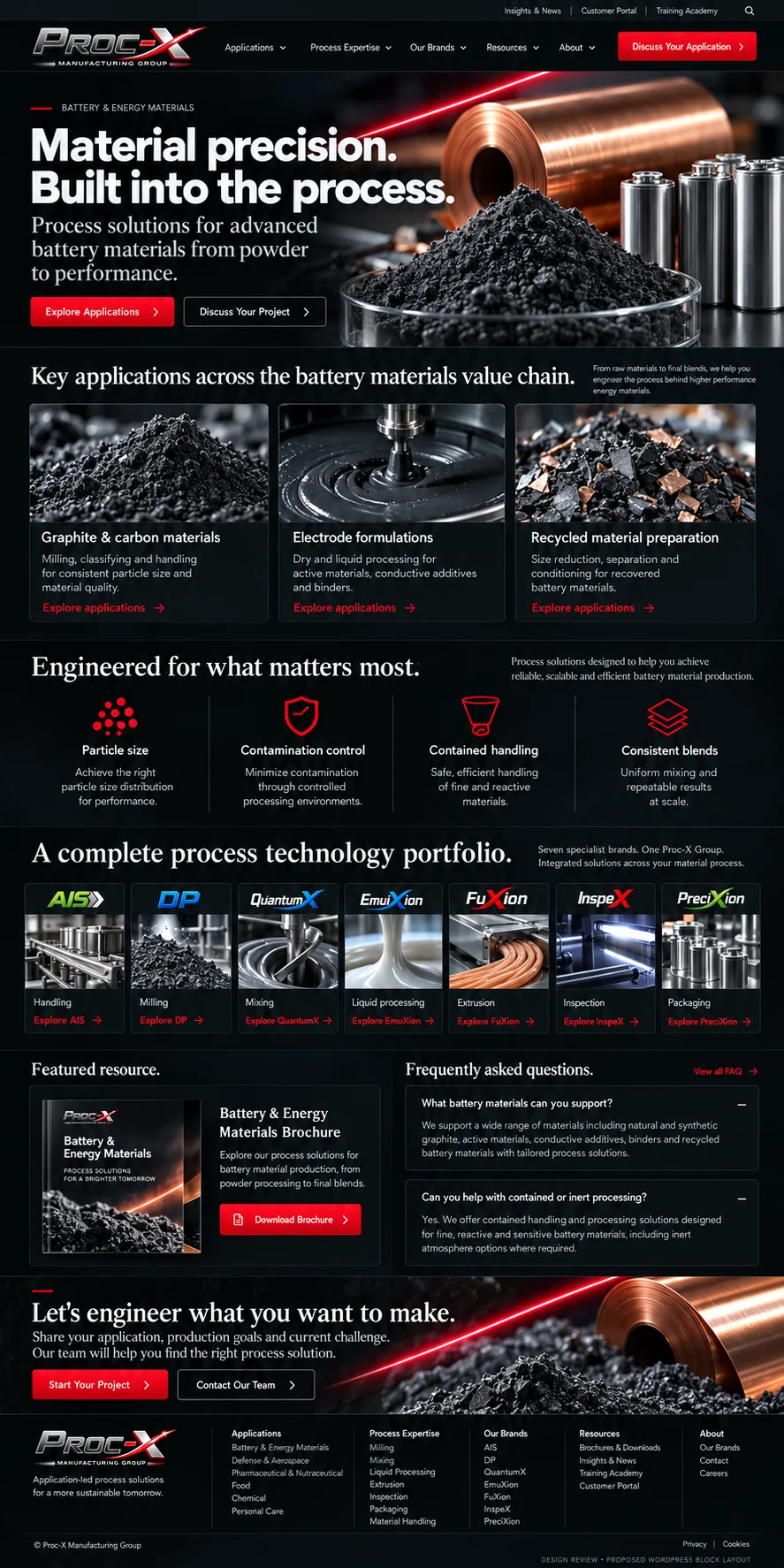
Material precision. Built into the process.
Process solutions for advanced battery materials, from powder to performance.
Applications for Energy & Battery Materials.
Graphite & carbon materials
Discuss milling, classification and handling against particle and purity targets.
Electrode formulations
Dry mixing and liquid dispersion for active materials, additives and binders.
Recycled material preparation
Evaluate variable feedstocks, contamination and the agreed processing boundary.
Engineered for what matters most.
Particle size
Specify distribution and measurement method.
Contamination control
Identify acceptable impurity limits.
Contained handling
Review material-specific handling requirements.
Consistent blends
Address dosing and segregation.
Seven specialists. One coordinated team.
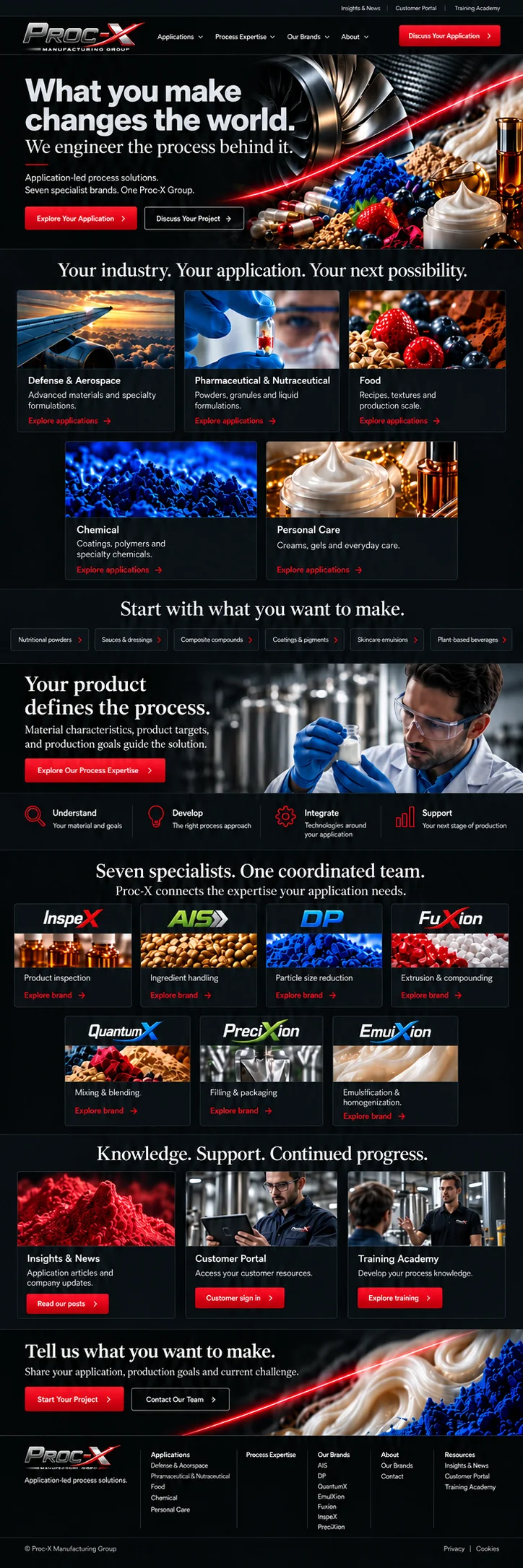

Knowledge for your application.
FEATURED RESOURCE
Battery & Energy Materials Brochure
Explore the process considerations behind your material, formulation and production requirements.
Battery Material Processing: Milling, Feeding & Mixing
Connect material preparation to formulation
Battery-material projects can involve powder preparation, controlled feeding, dry blending or liquid dispersion. The required process depends on chemistry and the next manufacturing operation. Describe incoming material, target particle distribution, solids concentration and acceptable contamination so the equipment discussion remains tied to the material specification.
Graphite and specialty powder processing
Feed variability, abrasiveness and the required fine-particle content influence milling and classification choices. DP Pulverizers technologies can be evaluated alongside AIS handling and feeding. Consider moisture pickup, transfer arrangements and collection requirements as part of the system rather than treating the mill as an isolated machine.
Electrode materials and liquid formulations
Dispersing solids into a liquid can involve powder wetting, agglomerate control and viscosity development. Mixing order, binder behavior and solids loading affect the process. QuantumX and EmulXion technologies can be considered according to the formulation, while Fuxion may be relevant where an extrusion or compounding route is being evaluated. Material testing is needed to establish application-specific results.
Recovered materials and variable feedstocks
Recovered materials may differ from virgin feed in composition, moisture and particle form. Specify the processing boundary and the variability that equipment must accommodate. Discuss sampling, contamination control and wear before defining a configuration. A material-preparation proposal should not be confused with a guarantee of downstream cell performance or a complete recycling process.
Questions about your process.
What particle-size information is useful for a milling inquiry?
Provide the incoming distribution, target distribution, measurement method and throughput. Include limits on fines or oversize where relevant; a single average size may not adequately define the requirement.
Can dry blending and slurry preparation use the same equipment?
They involve different flow behavior and process demands. Selection should reflect the actual recipe, solids content and desired result rather than assume that a powder blender is suitable for a viscous slurry.
Tell us what you want to make.
Share your application, production goals and current challenge.