PROC-X MANUFACTURING GROUP
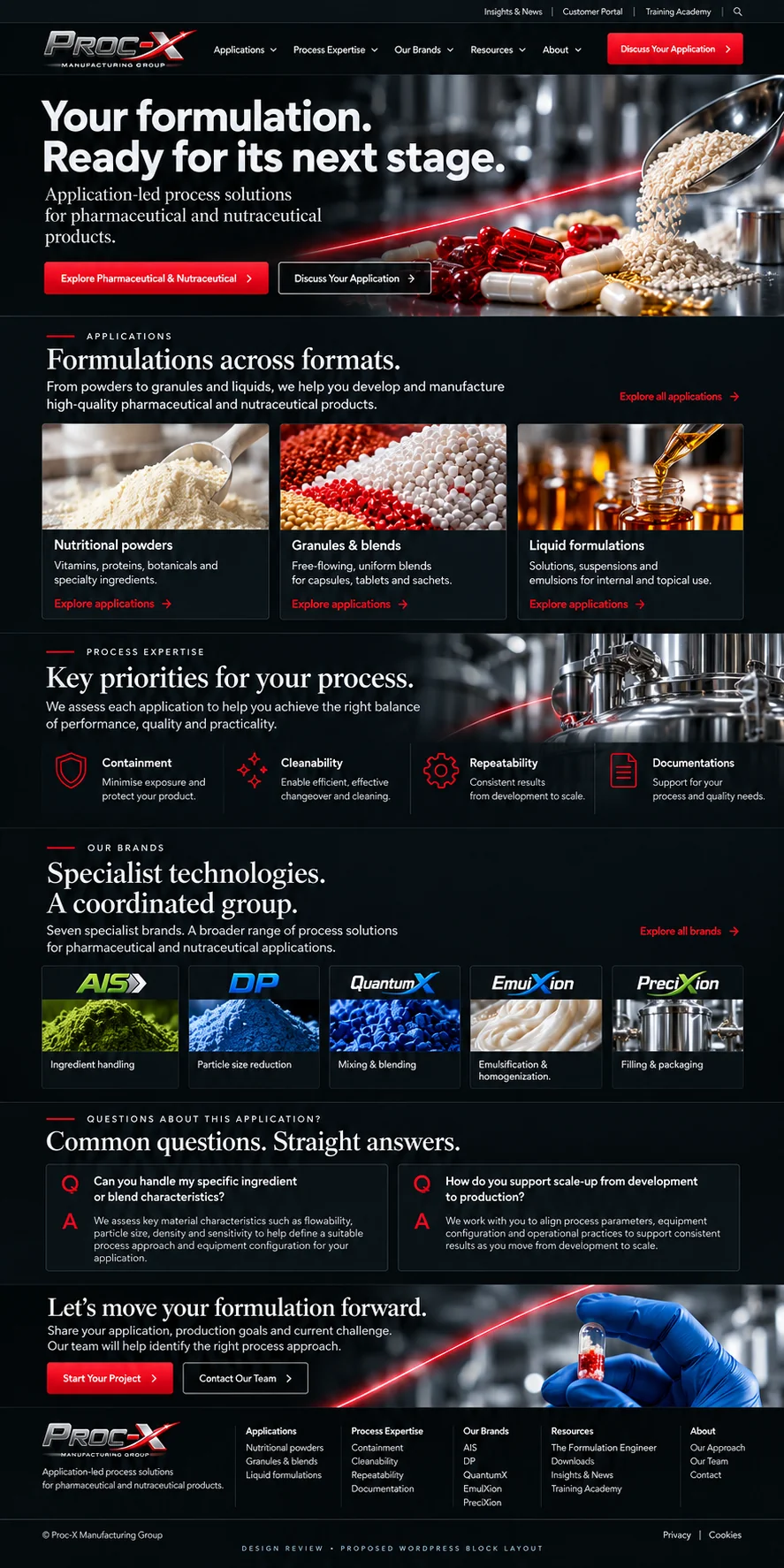
Your formulation. Ready for its next stage.
Application-led process solutions for pharmaceutical and nutraceutical products.
Applications for Pharmaceutical & Nutraceutical.
Nutritional powders
Vitamins, proteins and botanicals: define particle properties and blend requirements.
Granules & blends
Consider dosing, segregation and discharge alongside formulation uniformity.
Liquid formulations
Discuss solutions, suspensions and emulsions with your process requirements.
Engineered for what matters most.
Containment
Define exposure and dust control requirements.
Cleanability
Plan access, changeovers and cleaning.
Repeatability
Specify process parameters and checks.
Documentation
Agree the required project deliverables.
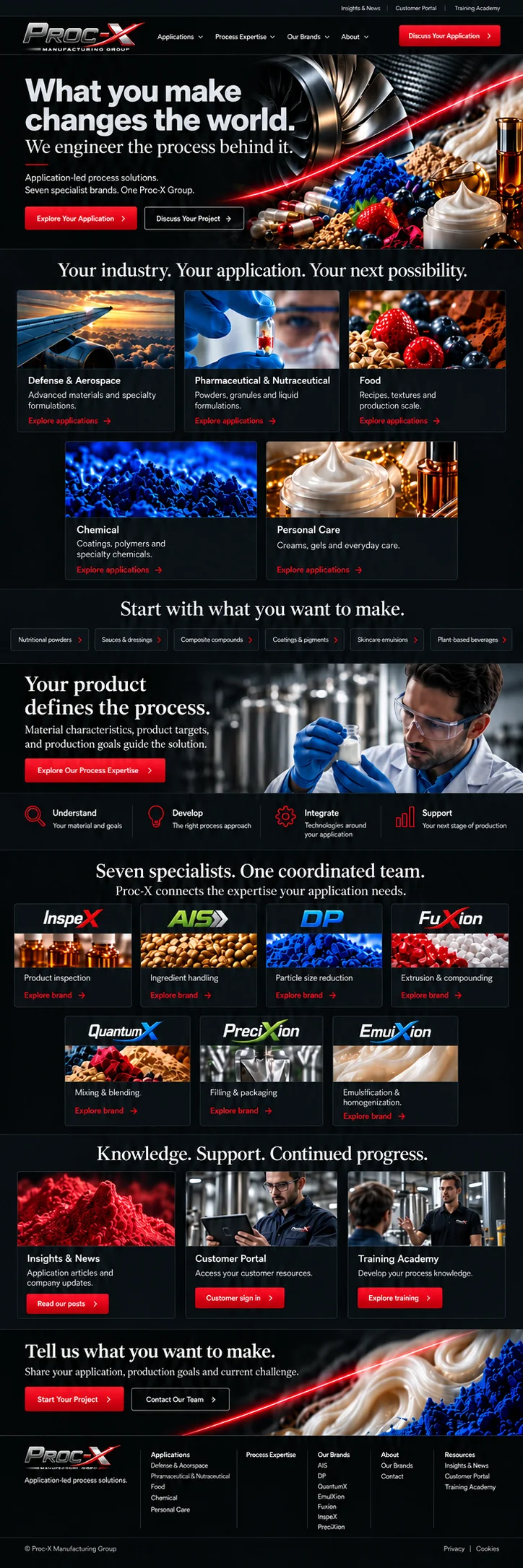
Seven specialists. One coordinated team.
Knowledge for your application.

FEATURED RESOURCE
The Formulation Engineer
Explore the process considerations behind your material, formulation and production requirements.
Pharmaceutical & Nutraceutical Powder Processing Systems
Build the process around formulation requirements
Pharmaceutical and nutraceutical production can involve powder blending, ingredient feeding, size reduction, liquid preparation and inspection. The intended dosage form and material properties determine the appropriate sequence. Define ingredient concentration, batch size, particle characteristics, moisture sensitivity and the controls needed to preserve product quality during charging, mixing and discharge.
Blend uniformity and ingredient segregation
Uniformity depends on more than mixing time. Differences in particle size, density and concentration can influence how ingredients distribute and whether they separate during transfer. Low-dose components may require a defined addition sequence or preblend. Establish a sampling approach and acceptance criteria for the actual formulation rather than assuming that one cycle applies to every product.
Cleaning, containment and documentation
Provide product-contact requirements, cleaning procedures, cross-contamination concerns and any occupational exposure constraints. These inputs affect access, seals, charging arrangements and discharge design. Identify required documentation and qualification support at the specification stage. Equipment configuration alone does not establish regulatory compliance; the manufacturer’s process, procedures and validation remain part of the overall system.
Connect preparation to the next operation
A blending or milling stage should discharge in a form and at a rate suited to the next process. Consider intermediate containers, hold time, dust control and handling between stages. AIS feeding and handling, DP milling, QuantumX mixing, InspeX inspection and PreciXion packaging can be considered within a defined project scope. Include existing equipment interfaces in the initial inquiry.
Questions about your process.
What information is needed to select a powder blender?
Provide formulation characteristics, working batch mass and volume, bulk density, minor-ingredient concentrations, cleaning requirements and the proposed uniformity test. Sensitive or cohesive ingredients may require additional evaluation.
Does a pharmaceutical application automatically require a specific certification?
Requirements depend on the product, jurisdiction and user specification. Identify the applicable standards, documentation and qualification expectations so they can be addressed explicitly in the proposal.
Can the same equipment handle nutraceutical powders and pharmaceutical products?
Suitability depends on product-contact design, containment, cleaning, controls and validation requirements. The assessment must be made for the intended products rather than inferred from the industry label.
Tell us what you want to make.
Share your application, production goals and current challenge.