
Home / Mixing / Ploughshare Mixers & Processors
QuantumX · PROC-X MANUFACTURING GROUP
Ploughshare Mixers & Processors
Mix. Condition. Transform.
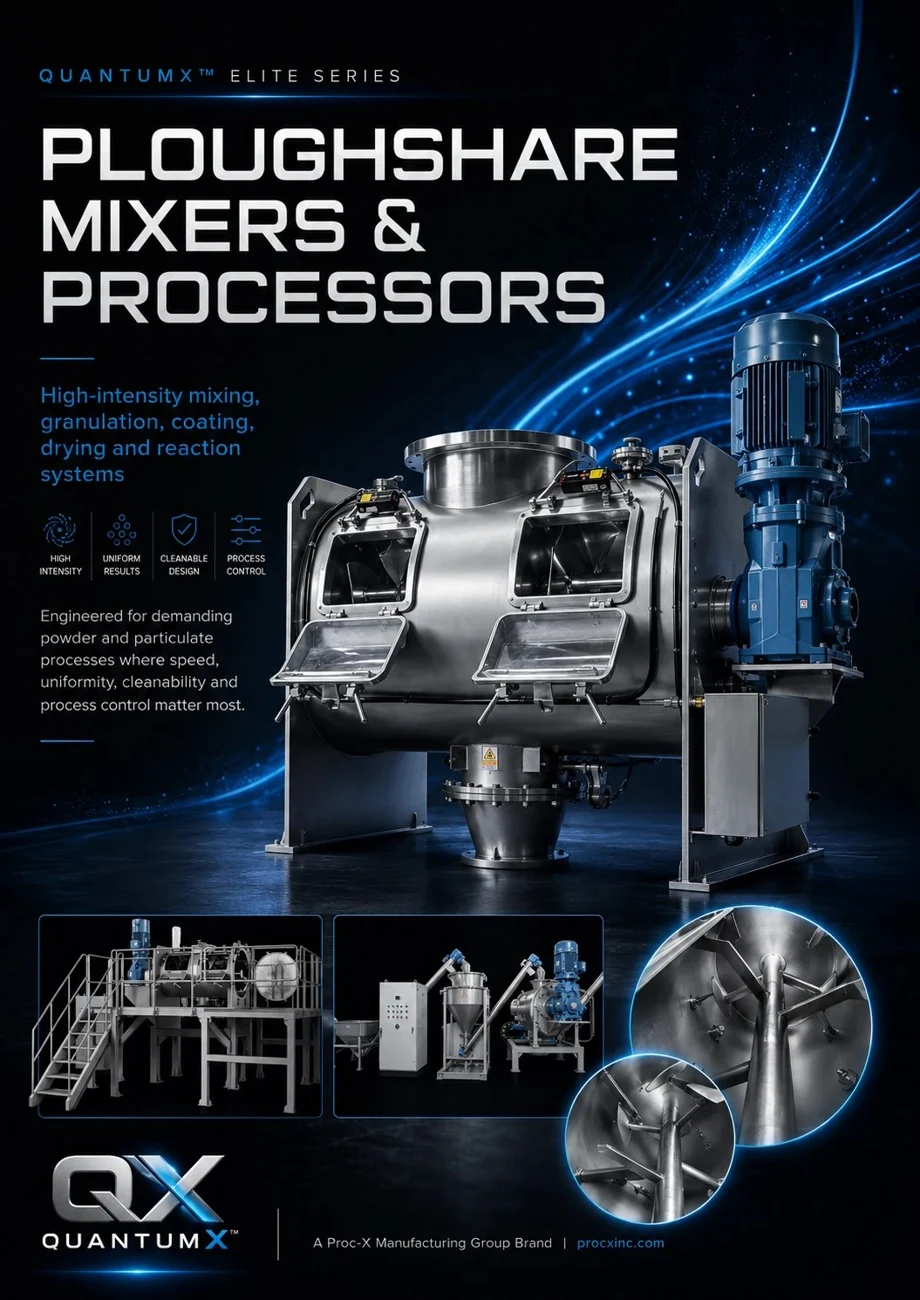
Ploughshare mixers, also called plow mixers, for intensive powder blending, liquid incorporation, coating and granulation—with processor configurations for thermal and vacuum duties.
The process, explained.
01
Lift
Plough tools lift and disperse the charge.
02
Distribute
Liquid sprays and optional choppers control addition and agglomerates.
03
Finish
Configure discharge, thermal treatment or vacuum drying around the endpoint.
Mechanically fluidized mixing
A horizontal shaft carries plough tools that lift, accelerate and disperse powder through a three-dimensional mixing zone. This mechanical movement brings ingredients into repeated contact. Optional high-speed choppers provide localized deagglomeration; the chopper duty should match the desired particle condition rather than simply maximize speed.
Ploughshare mixer models and technical specifications
PTS identifies the ploughshare (plow) mixer; PTSD identifies the ploughshare vacuum mixer/dryer. The letter D denotes the vacuum dryer version. Corresponding models are paired below with their own motor powers, agitator speeds and useful volumes.
The complete range contains 42 paired model configurations across 38 vessel sizes, from 5 to 30,000 L total volume. Laboratory tilting and L-CP configurations are listed separately. Total vessel volume is not the useful batch volume.
Laboratory models — manual tilting discharge
| PTS mixer | PTSD vacuum dryer | Total volume (L) | PTS useful volume 30–70% (L) | PTSD useful volume 30–70% (L) | PTS motor (kW) | PTSD motor (kW) | PTS speed (rpm) | PTSD speed (rpm) | Chopper, both models |
|---|---|---|---|---|---|---|---|---|---|
| PTS-5L * | PTSD-5L * | 5 | 1.5–3.5 | 1.5–3.5 | 1.1 | 1.1 | 365 | 255.5 | Not specified |
| PTS-10L * | PTSD-10L * | 10 | 3–7 | 3–7 | 1.1 | 1.1 | 365 | 255.5 | Not specified |
| PTS-15L * | PTSD-15L * | 15 | 4.5–10.5 | 4.5–10.5 | 1.1 | 2.2 | 280 | 196 | Not specified |
| PTS-20L * | PTSD-20L * | 20 | 6–14 | 6–14 | 1.1 | 2.2 | 280 | 196 | Not specified |
Laboratory L-CP models — manual valve discharge
| PTS mixer | PTSD vacuum dryer | Total volume (L) | PTS useful volume 30–70% (L) | PTSD useful volume 30–70% (L) | PTS motor (kW) | PTSD motor (kW) | PTS speed (rpm) | PTSD speed (rpm) | Chopper, both models |
|---|---|---|---|---|---|---|---|---|---|
| PTS-5L-CP * | PTSD-5L-CP * | 5 | 1.5–3.5 | 1.5–3.5 | 1.1 | 1.1 | 365 | 255.5 | 0.55kW x1 (3000rpm) |
| PTS-10L-CP * | PTSD-10L-CP * | 10 | 3–7 | 3–7 | 1.1 | 1.1 | 365 | 255.5 | 0.55kW x1 (3000rpm) |
| PTS-15L-CP * | PTSD-15L-CP * | 15 | 4.5–10.5 | 4.5–10.5 | 1.1 | 2.2 | 280 | 196 | 0.55kW x1 (3000rpm) |
| PTS-20L-CP * | PTSD-20L-CP * | 20 | 6–14 | 6–14 | 1.1 | 2.2 | 280 | 196 | 0.55kW x1 (3000rpm) |
Production models — pneumatic valve discharge
| PTS mixer | PTSD vacuum dryer | Total volume (L) | PTS useful volume 30–70% (L) | PTSD useful volume 30–70% (L) | PTS motor (kW) | PTSD motor (kW) | PTS speed (rpm) | PTSD speed (rpm) | Chopper, both models |
|---|---|---|---|---|---|---|---|---|---|
| PTS-30 | PTSD-30 | 30 | 9–21 | 9–21 | 2.2 | 4 | 210 | 126 | 1.1kW x1 |
| PTS-45 | PTSD-45 | 45 | 13.5–31.5 | 14–32 | 2.2 | 4 | 210 | 126 | 1.1kW x1 |
| PTS-50 | PTSD-50 | 50 | 15–35 | 15–35 | 3 | 5.5 | 190 | 114 | 1.1kW x1 |
| PTS-60 | PTSD-60 | 60 | 18–42 | 18–42 | 3 | 5.5 | 190 | 114 | 1.1kW x1 |
| PTS-70 | PTSD-70 | 70 | 21–49 | 21–49 | 4 | 7.5 | 175 | 105 | 1.1kW x1 |
| PTS-100 | PTSD-100 | 100 | 30–70 | 30–70 | 5.5 | 11 | 175 | 105 | 2.2kW x1 |
| PTS-150 | PTSD-150 | 150 | 45–105 | 45–105 | 7.5 | 15 | 170 | 102 | 2.2kW x1 |
| PTS-200 | PTSD-200 | 200 | 60–140 | 60–140 | 7.5 | 15 | 155 | 93 | 2.2kW x1 |
| PTS-250 | PTSD-250 | 250 | 75–175 | 75–175 | 11 | 18.5 | 150 | 90 | 2.2kW x1 |
| PTS-300 | PTSD-300 | 300 | 90–210 | 90–210 | 11 | 22 | 150 | 90 | 2.2kW x1 |
| PTS-400 | PTSD-400 | 400 | 120–280 | 120–280 | 18.5 | 30 | 140 | 84 | 2.2kW x2 |
| PTS-500 | PTSD-500 | 500 | 150–350 | 150–350 | 18.5 | 30 | 140 | 84 | 2.2kW x2 |
| PTS-600 | PTSD-600 | 600 | 180–420 | 180–420 | 22 | 37 | 135 | 81 | 2.2kW x2 |
| PTS-700 | PTSD-700 | 700 | 210–490 | 210–490 | 22 | 37 | 135 | 81 | 2.2kW x2 |
| PTS-750 | PTSD-750 | 750 | 225–525 | 225–525 | 22 | 37 | 127 | 76.2 | 2.2kW x2 |
| PTS-800 | PTSD-800 | 800 | 240–560 | 240–560 | 22 | 37 | 127 | 76.2 | 2.2kW x2 |
| PTS-1000 | PTSD-1000 | 1,000 | 300–700 | 300–700 | 22 | 45 | 121 | 72.6 | 2.2kW x2 |
| PTS-1200 | PTSD-1200 | 1,200 | 360–840 | 360–840 | 30 | 45 | 121 | 72.6 | 2.2kW x2 |
| PTS-1500 | PTSD-1500 | 1,500 | 450–1,050 | 450–1,050 | 30 | 45 | 115 | 69 | 2.2kW x2 |
| PTS-2000 | PTSD-2000 | 2,000 | 600–1,400 | 600–1,400 | 37 | 55 | 110 | 66 | 2.2kW x2 |
| PTS-2500 | PTSD-2500 | 2,500 | 750–1,750 | 750–1,750 | 37 | 55 | 102 | 61.2 | 2.2kW x3 |
| PTS-3000 | PTSD-3000 | 3,000 | 900–2,100 | 900–2,100 | 37 | 55 | 102 | 61.2 | 2.2kW x3 |
| PTS-4000 | PTSD-4000 | 4,000 | 1,200–2,800 | 1,200–2,800 | 45 | 75 | 96 | 57.6 | 4kW x4 |
| PTS-5000 | PTSD-5000 | 5,000 | 1,500–3,500 | 1,500–3,500 | 55 | 90 | 85 | 51 | 4kW x4 |
| PTS-6000 | PTSD-6000 | 6,000 | 1,800–4,200 | 1,800–4,200 | 55 | 90 | 75 | 45 | 4kW x4 |
| PTS-7000 | PTSD-7000 | 7,000 | 2,100–4,900 | 2,100–4,900 | 75 | 110 | 75 | 45 | 4kW x4 |
| PTS-8000 | PTSD-8000 | 8,000 | 2,400–5,600 | 2,400–5,600 | 90 | 132 | 67 | 40.2 | 4kW x4 |
| PTS-9000 | PTSD-9000 | 9,000 | 2,700–6,300 | 2,700–6,300 | 110 | 160 | 67 | 40.2 | 7.5kW x5 |
| PTS-10000 * | PTSD-10000 * | 10,000 | 3,000–7,000 | 3,000–7,000 | 132 | 185 | 60 | 36 | 7.5kW x5 |
| PTS-12000 * | PTSD-12000 * | 12,000 | 3,600–8,400 | 3,600–8,400 | 132 | 185 | 60 | 36 | 7.5kW x5 |
| PTS-15000 * | PTSD-15000 * | 15,000 | 4,500–10,500 | 4,500–10,500 | 160 | 200 | 54 | 32.4 | 7.5kW x5 |
| PTS-20000 * | PTSD-20000 * | 20,000 | 6,000–14,000 | 6,000–14,000 | 200 | 250 | 48 | 28.8 | 7.5kW x5 |
| PTS-25000 * | PTSD-25000 * | 25,000 | 7,500–17,500 | 7,500–17,500 | 250 | 300 | 48 | 28.8 | 7.5kW x5 |
| PTS-30000 * | PTSD-30000 * | 30,000 | 9,000–21,000 | 9,000–21,000 | 280 | 315 | 42 | 25.2 | 7.5kW x5 |
Useful-volume limits follow the supplied V2024 sheets. PTS-45 lists 13.5–31.5 L; PTSD-45 lists 14–32 L. These source values are retained separately rather than treating them as identical. Actual usable fill depends on material behavior and process duty.
Chopper entries state the listed power per unit and quantity; they are separate from the main agitator motor. “Not specified” corresponds to “/” in the source sheet and is not a zero-power rating. The L-CP models list one 0.55 kW chopper at 3,000 rpm.
Asterisks (*) are retained where shown in the source model names; the PTSD power and speed headers also carry an asterisk. The supplied sheets do not include its definition. Confirm marked values, final dimensions, weight, shaft sealing and the vacuum system configuration in the project quotation.
Vacuum mixer/dryer duties require the appropriate vessel, heating, vacuum and vapor-handling configuration. Explore vacuum mixers and dryers or discuss your material and batch requirements.
Select around the result.
One platform, several process objectives
The brochure covers dry blending, controlled liquid addition, coating and granulation. Processor configurations can add heating, cooling, vacuum drying and reaction duties. Define whether the objective is to preserve particles, break agglomerates or deliberately build granules: these require different operating strategies.
Batch, continuous or hygienic execution
QX-PTS is the batch configuration, QX-PTSC the continuous configuration, QX-PTSP the processor platform and QX-PTSH the hygienic design. The published range extends from development equipment to production systems exceeding 5,000 liters. Capacity and power are selected for the application; a single nominal volume does not establish throughput.
Cleanability is a design requirement
Options include full-access doors, shaft withdrawal or cantilevered arrangements, spray systems and access to seals and choppers. Specify product-contact materials, finish, cleaning method and inspection requirements at quotation stage. The brochure describes 316L product-contact construction for sanitary configurations, not as a universal standard on every model.
Control the process and document the result
Siemens-based automation, recipes, alarms, liquid-addition skids and process monitoring are available configurations. Agree required records and access controls with the project team. Define blend uniformity, granule distribution, residual moisture or another measurable endpoint for the actual duty, then align testing and acceptance around that result.
Go deeper with QuantumX.
Technical brochure and specialist expertise
Explore the supplied brochure, then discuss the configuration with Proc-X or visit the specialist brand website.
These are the original supplied brochures. Some editions contain earlier contact details or model designations. For current project support, use john.paul@procxinc.com or +1 (872) 260-5071; confirm final specifications in your quotation.
Questions engineers ask.
What is the difference between a ribbon and a ploughshare mixer?
Ribbon agitation circulates material using helices. Plough tools lift and disperse the powder more intensively and can be paired with choppers for deagglomeration and liquid incorporation. Material trials and particle-damage limits guide selection.
Can a ploughshare mixer granulate and dry?
A suitably configured processor can combine binder addition, granulation and vacuum drying. Thermal services, vapor handling, agitation and the product endpoint must be engineered together.
Is a continuous mixer suitable for every recipe?
Continuous operation depends on stable ingredient feeding and residence behavior. Frequent short campaigns or difficult dosing may favor batch processing.
Compare related technologies.
QuantumX
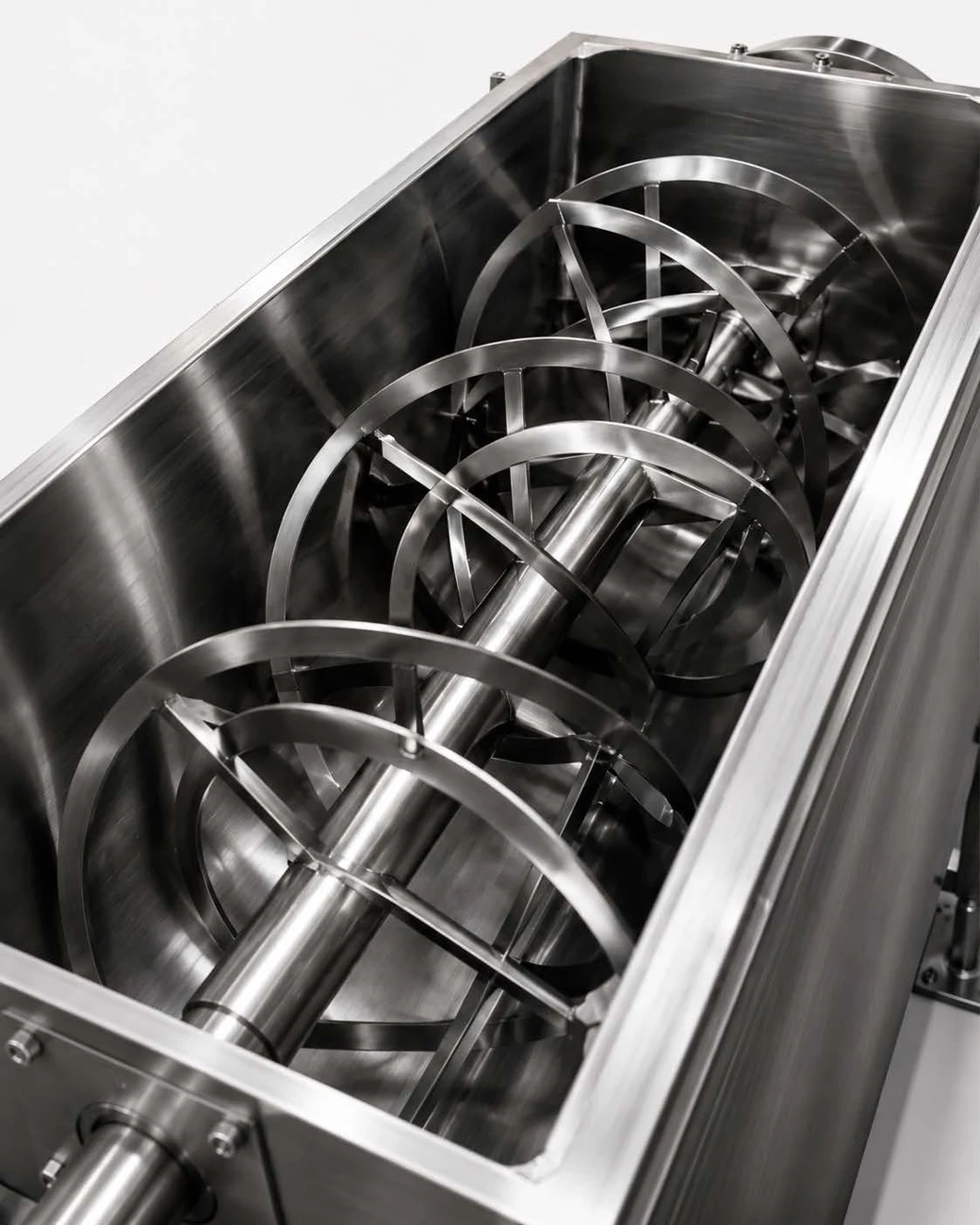
Ribbon Mixers & Blenders
Horizontal and vertical ribbon mixers for powders, granules and selected pastes. Build the blend around your batch size, ingredient behavior and production cycle.
QuantumX
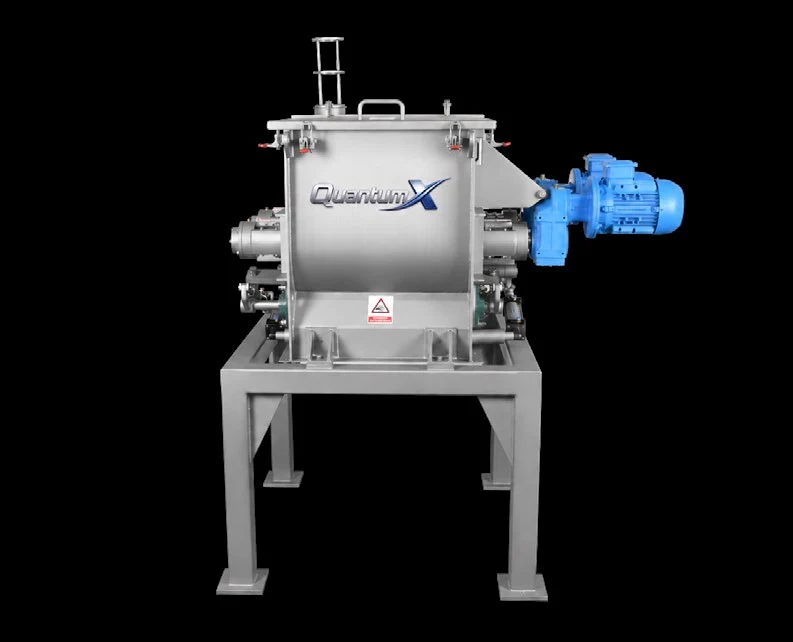
Fluidized Zone Mixers
Single-shaft and twin-shaft fluidized zone mixers for powder blending and selected powder-liquid duties, with vacuum mixer/dryer variants for integrated processing.
QuantumX
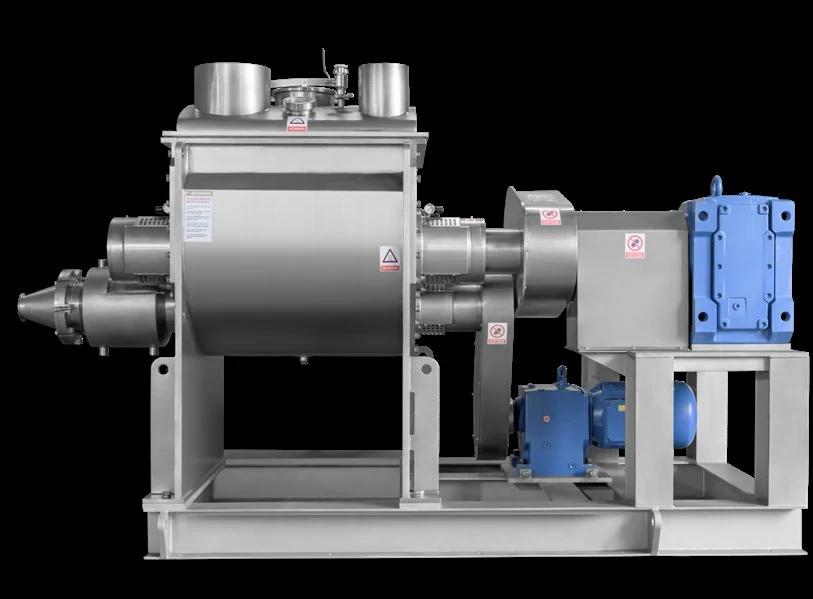
Sigma Mixers & Extruder Discharge
Double-arm kneaders for sticky, high-viscosity compounds—with tilting, bottom-discharge and screw-extruder options to connect mixing with the next process step.
Your material writes the specification.
Tell us what you process, the result you need and the capacity you want to achieve. We will help define the next engineering step.