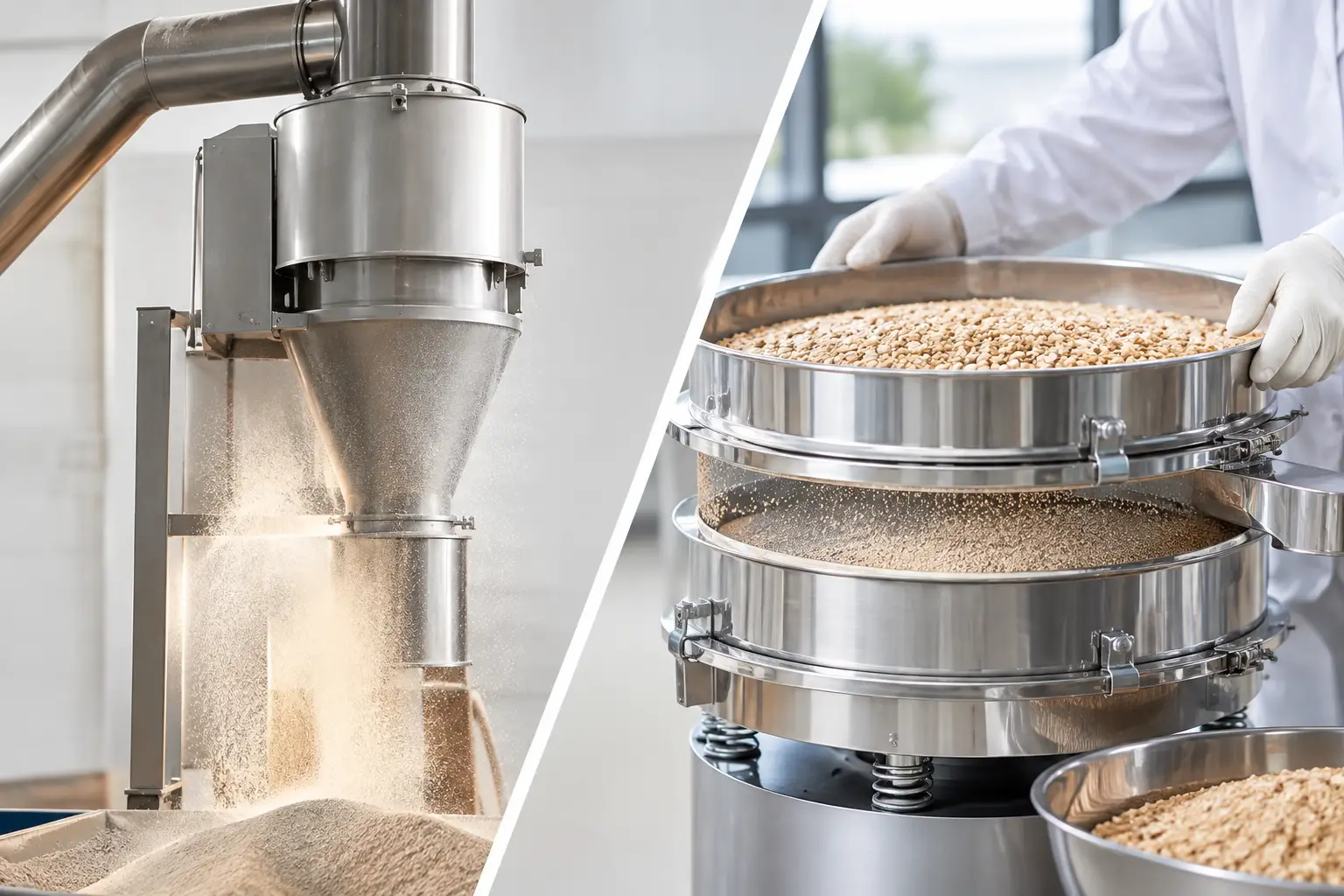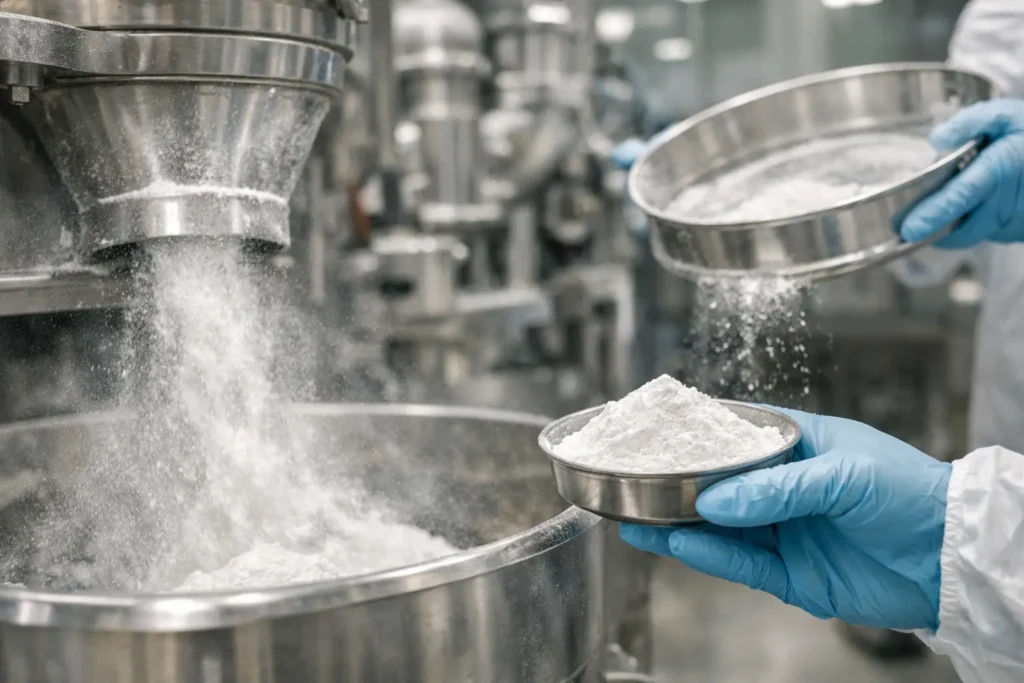
A powder can meet an average particle-size target and still fail in production. Oversized particles can create a gritty food texture, poor tablet compression, inconsistent dispersion, nozzle blockage, or downstream screening losses. Excess fines can affect dust control, flowability, bulk density, and product performance. Air classifying mills address this issue by controlling which particles leave the milling chamber and which particles remain for further reduction.
For manufacturers processing heat-sensitive, abrasive, cohesive, or specification-critical materials, the mill is not simply a size-reduction device. It is part of the process that determines yield, finished-product consistency, containment requirements, and the stability of every operation that follows.
What Air Classifying Mills Do
Air classifying mills combine impact milling with dynamic air classification in a single operating system. Material enters the milling chamber, where a high-speed rotor accelerates particles into impact surfaces or a surrounding liner. Process air carries the reduced material toward an integrated classifier.
The classifier separates particles according to their aerodynamic behavior. Particles that meet the selected cut point pass through the classifier and exit with the air stream to downstream collection. Oversized particles are rejected and returned to the milling zone for additional reduction. This internal recirculation continues until particles are sufficiently fine to leave the mill.
The result is more than a smaller average particle size. Properly configured air classification can limit oversize material and produce a narrower, more repeatable particle-size distribution than a conventional impact mill operating without classification.
The actual performance window depends on the material and the system. Particle density, hardness, moisture, feed consistency, rotor speed, classifier speed, air volume, and the collection system all influence the final distribution. A mill selected only by its nominal micron rating is likely to create avoidable process risk.
Why Particle Classification Changes the Process
Traditional milling approaches often rely on screens to control the final product. Screens are effective in many applications, but they introduce limitations when fine cuts, heat-sensitive products, sticky materials, or strict oversize control are involved. As particle size decreases, screens may blind, wear, or become difficult to maintain. Screen changes also create a validation and change-control consideration in regulated production.
Air classification replaces the physical screen with an adjustable dynamic separation step. In general, increasing classifier speed produces a finer cut, while reducing classifier speed allows coarser particles to pass. That adjustability can support development work, multiple product grades, and production optimization without changing internal screens.
This does not mean an air classifying mill is the correct answer for every milling application. Products that are highly elastic, waxy, fibrous, very wet, or prone to smearing may require another milling principle or upstream conditioning. Some coarse products do not justify the energy use and air-handling infrastructure associated with dynamic classification. The correct decision begins with material behavior, not a preferred machine type.
Key Operating Variables in Air Classifying Mills
Classifier Speed and Cut Point
Classifier speed is the primary control for the upper end of the particle-size distribution. Higher speed increases centrifugal force, making it more difficult for coarse particles to pass through the classifier. The final product becomes finer, although throughput may decrease as more material recirculates.
A finer setting also does not automatically create a better product. Excessive recirculation can raise residence time, increase heat generation, and create more fines than the application can tolerate. The target should be a distribution that performs correctly in the next process step, whether that is blending, dissolution, compaction, coating, extrusion, or pneumatic conveying.
Rotor Speed and Milling Energy
Rotor speed governs impact energy. Higher tip speed generally increases particle breakage, but it also increases power demand, wear, and product temperature. Fragile crystals may fracture cleanly at one operating point and generate excessive fines at another. Abrasive minerals and ceramic materials may achieve the required size but impose a different maintenance profile on the rotor, liner, classifier, and piping.
Material testing should establish the relationship between rotor speed, classifier speed, throughput, temperature, and particle-size distribution. Adjusting one variable without reviewing the others can shift the process away from its intended operating window.
Airflow, Temperature, and Product Handling
Airflow transports material through the mill and classifier, but it also affects heat removal and separation efficiency. Insufficient air can reduce transport velocity and contribute to chamber buildup. Excessive air can change classification behavior, increase pressure drop, and impose unnecessary load on filters and fans.
For heat-sensitive food ingredients, nutraceuticals, pharmaceuticals, polymers, and certain specialty chemicals, inlet-air temperature and residence time require close attention. Ambient air may be adequate for some products. Other applications may require conditioned, cooled, dehumidified, inert, or filtered process gas. When solvent vapors, combustible dust, oxidation risk, or contamination control are factors, the air system must be engineered as part of the mill package rather than treated as an accessory.
Feed Rate and Feed Consistency
An air classifying mill performs best with controlled, stable feed. Surges can overload the grinding zone, shift the product distribution, raise temperature, and increase the amount of coarse material recirculating inside the machine. A loss-in-weight feeder, volumetric feeder, or other metered feed system may be necessary to maintain consistent operation.
Feed condition matters as much as feed rate. Agglomerates, foreign material, variable moisture, and poor bulk flow can affect output before the product reaches the rotor. Upstream delumping, screening, magnetic separation, drying, or conditioning may be required to protect the mill and stabilize the result.
System Design Is Part of Mill Performance
An air classifying mill should be evaluated as a complete process section. The mill, feeder, air mover, cyclone or filter receiver, conveying equipment, controls, and dust-containment strategy operate together. A well-selected mill can still underperform if downstream collection cannot maintain the required airflow or if transfer equipment segregates the finished powder.
For many installations, the system must also account for cleaning access, material changeover, operator exposure, noise, combustible-dust requirements, and maintenance access. In pharmaceutical and nutraceutical applications, cleanability, traceability, material-of-construction requirements, and validation documentation may shape the equipment configuration. In battery, additive manufacturing, and advanced-material applications, containment, inerting, and contamination control can be equally decisive.
Proc-X approaches this equipment as part of an engineered production line, coordinating milling with upstream feeding and downstream collection, transfer, blending, and controls. One coordinated design standard helps prevent the common handoff problems that arise when individually sourced equipment is expected to operate as one process.
Common Selection Mistakes
The most frequent mistake is specifying a target particle size without defining the full distribution. A requirement such as “100 micron product” may refer to a median size, a top-size limit, a screen retention value, or an application-specific performance measure. Those are not interchangeable specifications.
Another mistake is basing capacity on a supplier trial without matching actual feed material. Small differences in moisture, density, crystal structure, hardness, or lot condition can materially change throughput. Production capacity should be confirmed against representative material and the required product specification, not only an optimistic development sample.
It is also common to underestimate wear. Abrasive materials may require hardened, ceramic-lined, or specialized alloy contact surfaces. The right configuration depends on acceptable contamination levels, expected service life, maintenance practices, and the cost of downtime. A lower initial equipment cost can become more expensive if critical wear components require frequent replacement or if product contamination becomes a quality concern.
Finally, do not separate milling decisions from dust and safety decisions. Fine powders can create exposure, housekeeping, ignition, and collection challenges. The equipment selection process should establish the material’s dust characteristics, the required hazard evaluation, and the design basis for containment and protection before the system is finalized.
A Better Basis for Specification
A productive air classifying mill project starts with evidence: representative material, a defined feed condition, a measurable finished-product specification, and a realistic production-rate requirement. Testing should measure not just size distribution, but temperature, yield, power use, flow characteristics, and the condition of the collected product.
The finished powder should then be evaluated in its intended downstream operation. Does it blend uniformly? Does it disperse at the required rate? Does it convey without segregation? Does it compact, coat, dissolve, or sinter as intended? Those answers determine whether the milling result is operationally useful.
The right air classifying mill is the one that produces the required distribution at a sustainable rate while fitting the larger process, safety, cleaning, and maintenance requirements. When that standard guides selection, particle-size control becomes a dependable production capability rather than a recurring source of adjustment and rework.