A choice between an air classifier vs vibratory sieve is not a simple question of which machine produces a finer product. These technologies separate material by different physical principles, impose different demands on upstream and downstream equipment, and respond very differently to moisture, particle shape, density, and contamination risk. Selecting the wrong method can create recirculating loads, excessive screen changes, lost yield, poor cut accuracy, or a process that performs well only under ideal conditions.
For process engineers and plant teams, the correct decision starts with the required particle-size distribution and ends with the full production system: feed conditioning, dust collection, conveying, controls, product containment, cleaning, and quality verification.
Air Classifier vs Vibratory Sieve: The Core Difference
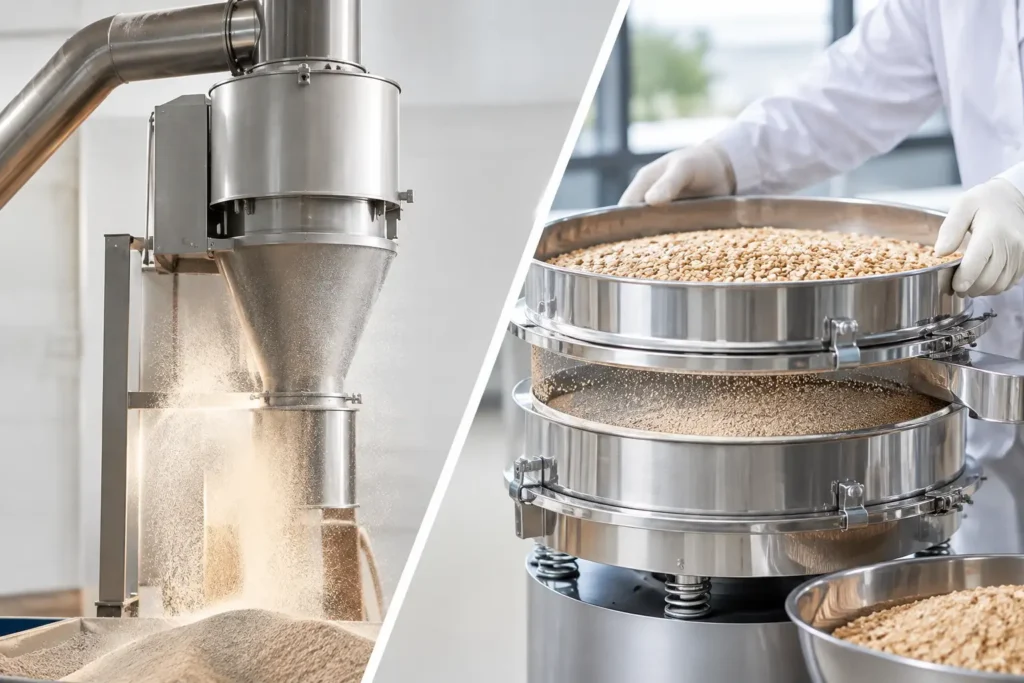
A vibratory sieve makes a physical separation through one or more screens. Material enters the screen deck, vibration stratifies the feed, and particles smaller than the screen openings pass through. Oversize material remains on the screen and discharges separately. The separation is direct and easy to understand: if a particle cannot orient and pass through the opening, it reports to oversize.
An air classifier separates particles within an air stream. The feed enters a controlled airflow and rotating classifier wheel or other aerodynamic separation zone. Fine particles follow the air to the fines discharge, while coarser or denser particles are rejected. The effective cut point is controlled by factors such as wheel speed, airflow, feed rate, and the material’s aerodynamic behavior.
That distinction matters. A sieve is primarily separating by geometric size. An air classifier separates by the combined effect of particle size, density, shape, and drag. Two particles with similar dimensions may not follow the same path in a classifier if one is dense and rounded while the other is thin, irregular, or plate-like.
When a Vibratory Sieve Is the Better Process Choice
Vibratory sieving is often the practical choice for scalping, safety screening, and relatively defined separations where the required cut is within the usable range of screen media. It is widely applied to remove foreign material, agglomerates, packaging fragments, oversize granules, or milling debris before blending, filling, extrusion, or downstream processing.
For many food, nutraceutical, pharmaceutical, and specialty chemical applications, the ability to inspect the separation surface is a meaningful operational advantage. Screen integrity procedures can be built into quality systems, and the resulting oversize fraction is readily understood by operators and quality teams. When product specifications call for removing material above a specific aperture size rather than generating a precise fine cut, a sieve can be direct and economical.
A sieve also supports multi-deck operation when a process needs several discrete fractions. For example, a granulated product may need fines removed, an on-spec center fraction recovered, and oversize retained for rework. This is possible in one compact separation step if the material flows freely and the screen area is adequate.
Its limitations are equally important. Fine screens reduce open area and can become rate-limiting. Cohesive powders, products with elevated moisture, electrostatic materials, and soft or irregular particles can blind the screen surface. Ultrasonic assistance, ball decks, air rings, or other deblinding methods may help, but they do not change the underlying material behavior. A screen that requires constant intervention is usually signaling a process mismatch, not just a maintenance issue.
When an Air Classifier Has the Advantage
Air classification is typically favored when the objective is a fine, controlled cut without relying on very fine mesh screens. It is especially relevant for dry powders that must be separated in ranges where screen capacity, blinding, and screen durability become concerns. Industrial minerals, battery materials, powdered metals, ceramics, additives, pigments, and fine chemical products are frequent candidates.
Because the cut point can be adjusted through operating parameters, air classifiers offer useful process flexibility. A manufacturer developing several grades may be able to establish different particle-size targets through controlled changes in wheel speed, airflow, and feed rate rather than changing screen media. That flexibility must be supported by validated operating windows. A setting that achieves the desired distribution at pilot scale may shift when feed rate, temperature, or upstream mill performance changes.
Air classification is also commonly paired with fine grinding. In a closed-loop milling circuit, the classifier separates product that has reached specification and returns coarse material for additional size reduction. This protects the finished fraction from unnecessary milling and can improve overall control of the particle-size distribution.
The trade-off is that an air classifier is a system, not an isolated separator. It requires a stable air-management strategy, properly sized fan capacity, product collection equipment, and effective dust containment. Airflow leaks, filter loading, inconsistent feed, or changes in material moisture can affect the result. For combustible powders, the entire circuit must also be evaluated for dust hazard, containment, explosion protection, grounding, and safe material handling.
Cut Accuracy Is Not the Only Performance Measure
It is tempting to compare equipment by the nominal cut size alone. That comparison is incomplete. The useful question is whether the machine can consistently produce the required distribution at the required rate while maintaining acceptable yield and operating cost.
A vibratory sieve can make a highly repeatable coarse separation when the feed is dry, free-flowing, and compatible with the selected mesh. Yet particle near the aperture size may either pass or remain based on orientation, vibration settings, and residence time. Long, fibrous, or plate-shaped particles are especially likely to behave differently than their measured equivalent diameter suggests.
An air classifier can produce a sharp separation in the right application, but its cut is influenced by particle density and morphology. It may separate a low-density flake as a fine even when its largest physical dimension is greater than that of a dense granular particle reporting to coarse. If the specification is based on sieve analysis alone, that difference requires careful evaluation during process development.
The test method used to release the product should therefore align with the process objective. Laser diffraction, air-jet sieving, mechanical sieve analysis, image analysis, and sedimentation methods do not describe particles in exactly the same way. Equipment selection without agreement on the measurement method can lead to avoidable disputes between production, R&D, and quality.
Feed Condition Determines Whether Either Technology Will Work
Neither technology corrects unstable upstream conditions. Lumps entering a sieve can overload the screen and reduce effective area. A classifier receiving broad, erratic mill discharge will show changing yield and inconsistent coarse recycle. Controlled feeding is often the difference between a machine that meets its specification and one that produces variable results.
Evaluate bulk density, flowability, moisture, temperature, particle shape, abrasiveness, friability, and electrostatic behavior before selecting equipment. A warm powder may cool and absorb moisture as it moves through a pneumatic line. A friable product may generate fines under aggressive vibratory conditions or during recycle conveying. An abrasive mineral can shorten screen life and wear classifier components, affecting both maintenance intervals and product consistency.
Material containment also deserves early attention. Sieves can be configured for enclosed operation, but cover design, gasket selection, screen-change access, and cleanability need to match the plant’s hygiene and exposure-control requirements. Air classification demands particular attention to dust collection and pressure balance. The fines collector, airlock, ductwork, filters, and fan must operate as a coordinated circuit.
Throughput, Maintenance, and Lifecycle Cost
A low initial equipment price does not establish the lowest cost of ownership. A sieve may have fewer auxiliary components, but frequent screen replacement, cleaning downtime, labor-intensive inspections, or low usable capacity can outweigh that simplicity. Conversely, an air classifier may involve higher capital cost and more support equipment, while reducing dependence on fine screens and enabling valuable closed-loop milling control.
Maintenance planning should focus on the wear points that matter for the material. For sieves, these include screen media, gaskets, clamps, vibration mounts, and drive components. For classifiers, assess wheel wear, internal liners, bearings, airlocks, filters, fan performance, and access for inspection. Abrasive or high-value products often justify design choices that reduce cross-contamination, simplify changeover, or extend component life.
Plant footprint is another practical consideration. A compact sieve may fit directly below a bag dump station or above a blender. An air classifier installation needs room for air handling, collection, access, and safe maintenance. The best layout also considers how product enters and leaves the separator. Poor transitions can cause segregation, dust release, bridging, or unnecessary pneumatic degradation.
Specify the Separation System, Not Just the Machine
The procurement specification should define more than a desired mesh size or classifier cut point. It should state the material properties, production rate, feed particle-size distribution, allowable oversize and fines, moisture range, cleaning requirements, construction materials, containment needs, utility limits, and acceptance criteria. If the separator connects to milling, blending, conveying, or packaging, those interfaces must be engineered as part of the scope.
A representative material trial is often the fastest way to reduce risk. It should test normal material and credible operating extremes, not a single ideal sample. Review throughput, yield, particle-size distribution, energy use, screen condition or classifier stability, dust behavior, and cleaning time. For regulated products, the trial plan should also consider traceability, validation requirements, and the practical ability to inspect product-contact areas.
Proc-X approaches separation decisions from the full process perspective: one manufacturer, one engineering standard, and one point of accountability across equipment interfaces. That approach is particularly valuable when classification performance depends on how the material is milled, fed, conveyed, collected, and controlled.
The right separator is the one that keeps the finished product within specification on an ordinary production day, not only during a demonstration. Define the material, verify the operating window, and select the equipment around the process conditions that the plant must actually sustain.