A milling decision is rarely limited to selecting a mill. Wet dry milling changes how material moves through the facility, how particle size is controlled, where heat is generated, what must be cleaned, and whether downstream drying becomes the production constraint. For process teams, the correct route begins with the finished-product requirement, then works backward through material behavior, production rate, containment, and validation needs.
A dry process may appear simpler because it avoids slurry handling and drying. A wet process may deliver finer particles, better dispersion, and less airborne dust. Neither approach is inherently superior. The right choice depends on the material and on the complete production system required to turn it into a consistent, production-ready product.
What Wet Dry Milling Means in Manufacturing
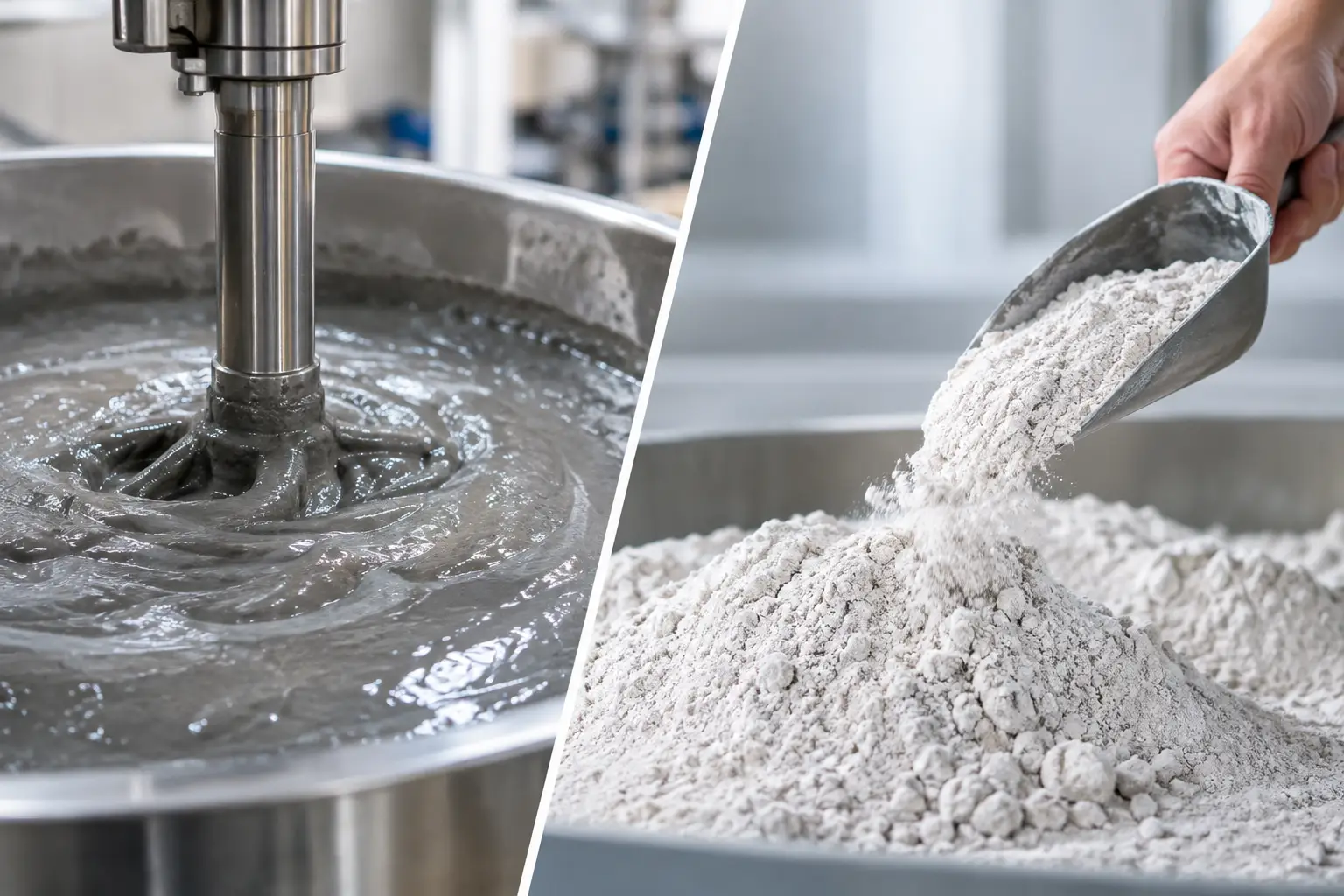
Wet milling reduces particles in the presence of a liquid carrier. The material may enter as a premix, suspension, slurry, emulsion, or paste. Depending on the application, particle reduction can occur through rotor-stator shear, media milling, colloid milling, high-pressure homogenization, or other liquid-phase technologies. The liquid can improve flow through the equipment, support dispersion, and help manage dust, but it also creates requirements for pumping, tankage, cleaning, and often solvent recovery or drying.
Dry milling reduces solid material without a liquid carrier. Common approaches include impact milling, pin milling, hammer milling, air-classifier milling, jet milling, roller milling, and screen-based size reduction. A dry line typically includes controlled feeding, milling, classification or screening, dust collection, conveying, and storage or packaging. It can be an efficient route when the material is free-flowing enough to feed consistently and the target particle-size distribution is achievable without excessive heat or degradation.
The distinction matters because the mill is only one component. A wet process may need premix vessels, high-shear dispersion, recirculation, temperature control, deaeration, and drying. A dry process may need bulk-bag unloading, loss-in-weight feeding, explosion protection, pneumatic transfer, dust capture, and segregation controls. Equipment selection without system-level engineering often moves the problem downstream.
The Operating Factors That Determine the Best Route
Particle size is only part of the specification
A target median size, such as D50, is useful but incomplete. Engineers should define the full particle-size distribution, including coarse-particle limits, fines generation, particle shape, agglomeration behavior, and batch-to-batch variability. In many applications, the question is not simply how fine the material must become. It is how consistently the process can hold that distribution at production scale.
Wet milling can be effective when very fine particles or narrow distributions are required and the material disperses well in a carrier. It may also help break soft agglomerates that resist dry processing. However, wet processing does not automatically produce a tighter result. Media selection, residence time, slurry viscosity, solids loading, recirculation rate, and temperature all affect the final distribution.
Dry milling can provide excellent control when feed rate, air flow, classifier speed, and screen or rotor configuration are properly matched to the material. It is often favored for dry powders where retaining a dry product is operationally valuable. Yet very fine dry milling can increase heat, static charge, dust loading, and the risk of broadening the distribution through over-processing.
Material behavior sets the practical limits
Moisture content, hygroscopicity, fat content, hardness, friability, abrasiveness, and flowability should be evaluated before choosing a route. A brittle mineral may respond well to impact or jet milling. A waxy, heat-sensitive ingredient may smear or coat internal surfaces in a dry mill. A cohesive powder may bridge at the feeder long before the mill reaches its rated capacity.
Wet milling can reduce some feedability concerns because the material is suspended and pumped rather than metered as a loose solid. But a highly viscous slurry creates its own limitations. Pumpability, pressure drop, tank agitation, line velocity, and cleanup time become central design variables. For abrasive materials, wet milling may also introduce wear considerations for pumps, seals, piping, and grinding media.
The process should be designed around measured material properties, not a nominal product name. Two grades sold under the same chemical or ingredient category can perform very differently because of moisture variation, crystal structure, particle morphology, or supplier changes.
Heat can protect or compromise product quality
Every size-reduction method converts part of its input energy into heat. In dry milling, heat can alter flavors, degrade active ingredients, soften polymers, drive off volatiles, or create buildup inside the mill. Cooling air, controlled feed rates, cryogenic assistance, or a different mill principle may be required when thermal exposure is limited.
Wet processing can moderate temperature through the liquid phase and jacketed vessels, heat exchangers, or recirculation control. That advantage is meaningful for heat-sensitive formulations, but it comes with a trade-off: the liquid must be acceptable for the formulation and compatible with downstream processing. If the product must ultimately be dry, the energy and residence time required for drying may outweigh the thermal benefit gained during milling.
Contamination, containment, and cleanability are design requirements
For pharmaceutical, nutraceutical, food, battery, specialty chemical, and advanced-material applications, contamination control cannot be treated as an accessory requirement. Product-contact materials, seal design, media wear, filter selection, clean-in-place capability, and cleanout verification must be evaluated early.
Wet milling can reduce airborne dust exposure and simplify containment at the mill itself. It may also increase cleaning complexity, especially where product dries in dead legs, valves, pumps, or transfer lines. Dry milling avoids liquid waste and can support dry cleanout strategies, but it demands effective dust collection, pressure management, and containment for potent, combustible, or cross-contamination-sensitive powders.
In either route, the specification should address more than material of construction. It should define acceptable carryover, cleaning method, access requirements, changeover frequency, validation expectations, and maintenance access. These decisions influence the complete layout, not just the mill body.
Wet Dry Milling and Downstream Process Economics
A wet mill can achieve the required particle condition quickly, then create a bottleneck in filtration, evaporation, spray drying, vacuum drying, or solvent recovery. Conversely, a dry mill may be mechanically straightforward but require extensive air handling, explosion isolation, or fine-powder collection. Capital cost should therefore be evaluated with operating cost, yield, cleaning labor, utilities, maintenance, and floor-space requirements.
For example, a slurry-based process may be the better technical solution for pigment dispersion, ceramic slip preparation, cosmetic emulsions, battery coatings, or highly cohesive materials. The economics improve when the product remains liquid or paste-like through filling or subsequent reaction. If the material must be dried and later redispersed, the process may be carrying unnecessary unit operations unless those steps serve a specific product-quality purpose.
Dry milling is often attractive for ingredients, minerals, polymers, fertilizers, additive-manufacturing powders, and dry pharmaceutical intermediates because it preserves a dry product path. It can also reduce the need for tanks and wastewater handling. Its success depends on reliable feeding, controlled particle classification, dust management, and an equipment configuration that does not damage the material or create excessive fines.
Build the Decision Around the Full Production Line
The most reliable wet dry milling projects start with representative trials and a defined process window. Test work should examine achievable particle-size distribution, throughput, temperature rise, energy use, material recovery, wear, cleaning response, and behavior after downstream handling. A successful lab result is not enough if the material cannot be fed, transferred, dried, packaged, or validated at commercial scale.
Process engineers should also identify where control belongs. Feed rate, mill speed, classifier settings, slurry solids, pressure, temperature, recirculation time, and final particle-size verification may all need to be connected through a common control strategy. Automation is not only about reducing operator involvement. It provides traceability, repeatability, alarm response, and the data needed to maintain a qualified operating range.
Proc-X approaches milling as part of an integrated process, coordinating material intake, feeding, size reduction, transfer, classification, blending, drying, and packaging around the product requirement. That structure creates one engineering standard across interfaces that are often treated as separate purchases.
The practical question is not whether wet or dry milling is the more advanced method. It is which process produces the required particle characteristics with the least operational risk over the life of the line. When that decision is made from material data, downstream requirements, and plant realities, the mill becomes a controlled production asset rather than an isolated point of failure.