A milling problem often begins with a temperature problem. When polymers smear, spices lose volatile oils, elastomers resist fracture, or active ingredients degrade under mechanical energy, conventional ambient grinding can produce inconsistent results. Cryogenic mills address this limitation by conditioning material at very low temperatures before and, in some designs, during size reduction. The objective is not simply colder milling. It is to create a material state that fractures predictably and supports the required particle-size distribution, throughput, and finished-product performance.
For manufacturers, the decision should be evaluated as a process design question rather than a standalone equipment purchase. Cryogenic size reduction affects upstream feeding, cooling-media handling, dust collection, classification, controls, safety practices, and downstream transfer. The best result comes from matching the mill and the full process arrangement to the material.
What Cryogenic Mills Change in the Grinding Process
Most size-reduction equipment transfers mechanical energy into a material through impact, shear, compression, or attrition. A portion of that energy becomes heat. For free-flowing, brittle materials with adequate thermal stability, that heat may be acceptable. For temperature-sensitive or elastic materials, it can be the factor that limits capacity, particle quality, or both.
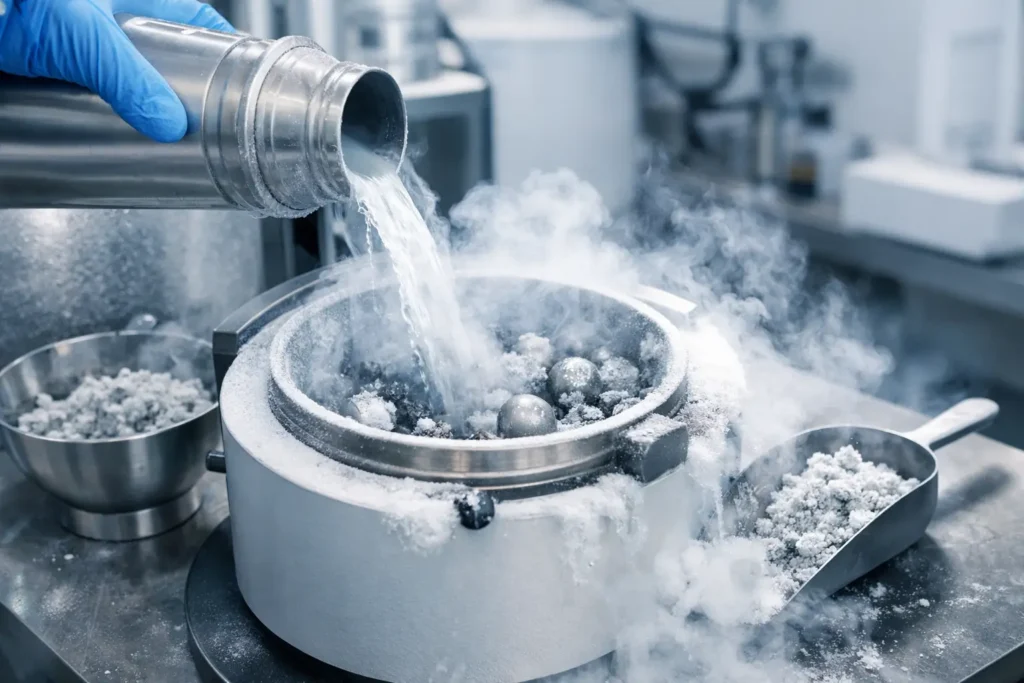
Cryogenic milling commonly uses liquid nitrogen to reduce material temperature below its glass-transition point or another temperature at which the material becomes sufficiently brittle to fracture. The cooled product enters a suitable mill, such as an impact mill, pin mill, hammer mill, or fine-grinding system. Because the material fractures rather than bends, smears, or agglomerates, the process can achieve a more controlled reduction with less thermal damage.
The relevant temperature is material-specific. A polymer may require deep cooling to become brittle, while a spice or oily food ingredient may need only enough cooling to protect flavor compounds and prevent mill fouling. There is no universal setpoint or nitrogen consumption rate. The correct operating window must be established through material testing and process trials.
Where Cryogenic Milling Delivers Value
Cryogenic processing is most useful when ambient milling creates a visible or measurable process limitation. Elastomers and rubber, for example, can deform under conventional impact rather than break cleanly. Cooling enables finer rubber crumb or powder with more efficient fracture behavior. Thermoplastics, engineered resins, adhesives, and composite materials may similarly benefit when heat causes softening, sticking, or poor particle shape.
In food and nutraceutical production, cryogenic conditions can help preserve aromatic oils, color, and flavor in spices, herbs, and other heat-sensitive ingredients. The benefit is not automatic. Product quality also depends on residence time, oxygen exposure, sanitation design, moisture control, and how the powder is handled after milling. Still, temperature control can remove a major source of quality loss.
Pharmaceutical, battery, additive manufacturing, and specialty chemical applications may use low-temperature milling to manage heat-sensitive compounds, improve breakage behavior, or limit agglomeration. These applications require particular attention to contamination control, cleanability, inerting requirements, containment, validation, and particle-size verification. A fine powder that meets a nominal size target but contains unacceptable contamination or a broad distribution is not a successful outcome.
The Trade-Off: Better Fracture Has a Cost
Liquid nitrogen is a consumable, and cryogenic operation introduces equipment, infrastructure, and safety requirements beyond those of an ambient mill. Storage vessels, insulated piping, injection or cooling systems, ventilation, oxygen monitoring where required, and operating procedures must be considered as part of the capital and operating model.
Energy and nitrogen use must be balanced against the value of the improved product. If an ambient system can meet the required particle size, throughput, yield, and quality specifications, cryogenic milling may add unnecessary complexity. If ambient milling produces excessive screen blinding, poor yield, melted particles, flavor loss, or frequent cleaning interruptions, the higher operating cost may be justified by more stable production.
Overcooling can also be inefficient. Excessive nitrogen use does not necessarily improve particle size or capacity once the material is already within its effective brittle-fracture range. Good system design controls temperature at the point that matters: the condition of the material entering and moving through the grinding zone.
How to Select a Cryogenic Milling System
The mill itself matters, but it should be selected after defining the production requirement. Start with the incoming material and the finished powder specification. Material form, feed size, bulk density, moisture, oil content, abrasiveness, friability, and thermal behavior all influence the appropriate equipment configuration.
A complete evaluation should establish four operating questions:
- What particle-size distribution is required, not only the top-size limit?
- What hourly production rate must be sustained under normal operating conditions?
- What temperature range produces clean fracture without excessive cooling-media use?
- What quality, regulatory, containment, and sanitation requirements apply to the process?
Particle-size targets should include the allowable coarse fraction, fines content, and distribution width. A screen size alone does not define finished-product performance. Depending on the material and application, the system may require an air classifier, secondary milling stage, screening step, or recycle loop to hold the distribution within specification.
Feed consistency is equally important. Large variation in incoming temperature, moisture, particle size, or feed rate creates variation in cooling demand and mill performance. Controlled feeding, often with loss-in-weight dosing or a metered screw feeder, helps maintain a stable product-to-nitrogen relationship. For cohesive materials, hopper design, agitation, conditioning, and feeder selection deserve the same attention as the mill.
System Integration Determines Operating Stability
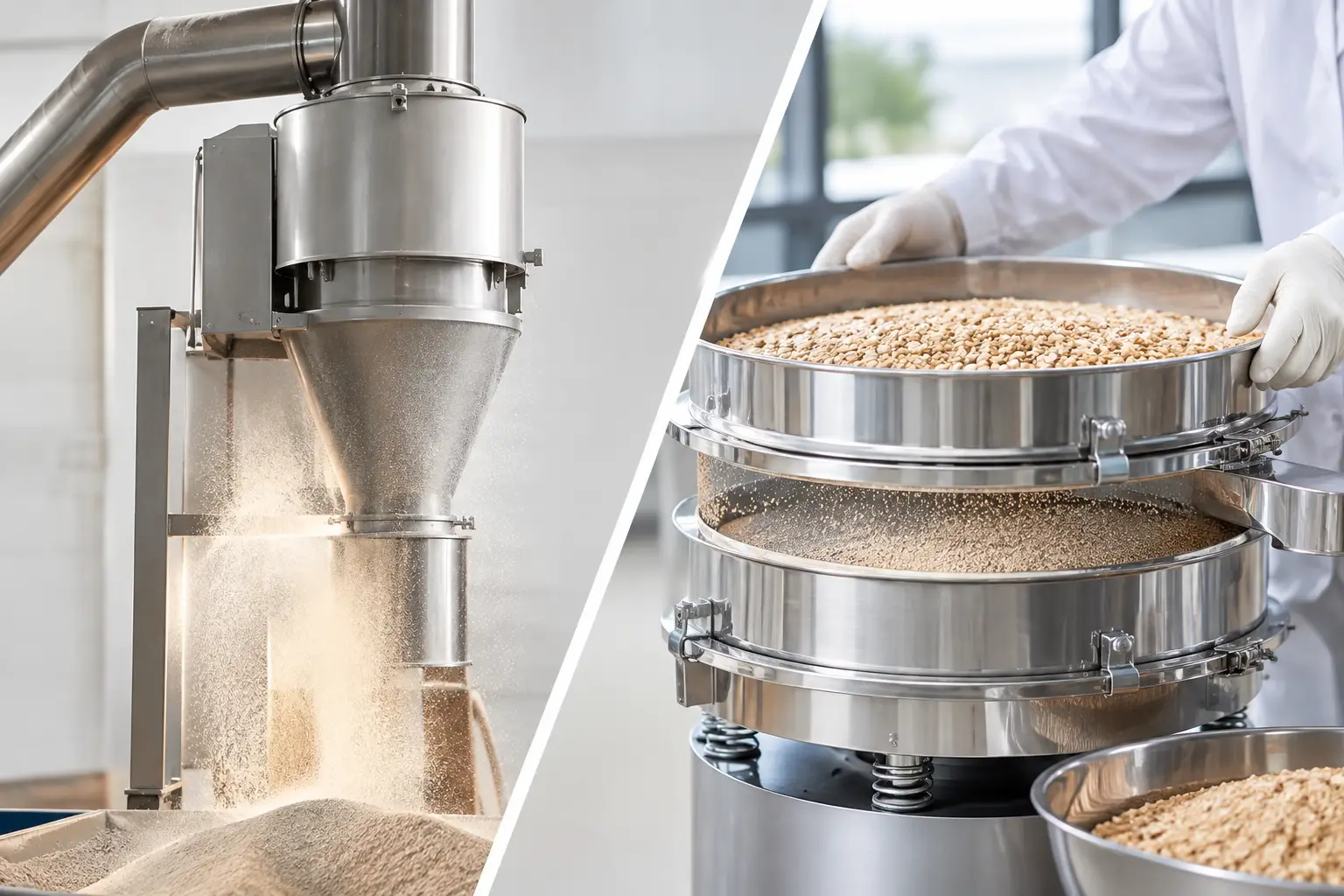
A cryogenic mill should be engineered as one section of a controlled material-processing line. Upstream, the system may include bulk bag unloading, storage, screening, metal detection, pre-sizing, and automated feeding. The cooling stage must deliver consistent contact between the material and the cooling medium while preventing bridges, plugs, or uncontrolled nitrogen release.
Downstream, the powder may require classification, collection, inert transfer, blending, packaging, or conveyance to another process. The collection system must be designed for the powder’s particle size, dust characteristics, temperature, and flow behavior. Cold material can introduce condensation risks if it encounters humid air, which can affect flowability, product moisture, and equipment cleanliness.
Controls are central to repeatability. Monitoring feed rate, mill load, material temperature, nitrogen flow, classifier conditions, and differential pressure provides the operating data needed to maintain performance. Interlocks should protect personnel and equipment if ventilation, oxygen concentration, cooling supply, dust collection, or critical temperatures move outside approved limits.
For regulated production, controls and documentation should also support batch traceability, recipe management, alarm history, and validation requirements. The appropriate level of automation depends on the process, but manual adjustment of cooling and feed conditions is rarely the best long-term approach for a product with narrow specifications.
Safety and Maintainability Cannot Be Added Later
Liquid nitrogen is nonflammable, but it can displace oxygen rapidly. Facility layout, ventilation, oxygen-deficiency monitoring, relief provisions, insulated equipment surfaces, and operator training must be built into the project scope. The specific safeguards depend on room volume, nitrogen storage capacity, process flow, local codes, and the facility’s broader safety program.
Maintenance planning should account for wear components, seals, bearings, screens, classifier elements, dust collector performance, and access for cleaning. Abrasive powders may require wear-resistant materials and a realistic replacement plan. Food, pharmaceutical, and high-purity applications may prioritize sanitary construction, rapid disassembly, clean-in-place capability, or validated cleaning procedures. These requirements can change the preferred mill design and should be defined before fabrication.
Proc-X approaches cryogenic milling as an integrated manufacturing requirement: one engineering standard across feeding, cooling, size reduction, classification, collection, controls, and downstream handling. That coordinated approach reduces the risk of optimizing a mill while leaving the rest of the process unable to support it.
The right cryogenic system is the one that delivers the specified powder at the required rate with measurable control of temperature, particle size, yield, and operating risk. Before committing to equipment, test the actual production material, define the full process boundary, and use the results to engineer a line that performs beyond the first successful trial.