A production line rarely fails because one machine cannot perform its assigned task. It fails at the handoffs: a feeder that cannot maintain a stable rate, a transfer system that separates a blend, a mixer that receives inconsistent ingredients, or controls that cannot prove what occurred in a batch. Integrated production line design addresses those handoffs as engineered process decisions, not afterthoughts.
For manufacturers processing powders, granules, liquids, pastes, slurries, or high-viscosity materials, the line must do more than move product from one operation to the next. It must preserve product attributes, meet the required output, protect operators, support cleaning and maintenance, and generate the level of process evidence the application requires. Those objectives must be resolved together.
What Integrated Production Line Design Actually Means
Integrated production line design is the coordinated engineering of equipment, material flow, utilities, controls, safety systems, containment, and operating procedures around a defined manufacturing objective. A mixer, mill, dryer, extruder, filler, or packaging machine may be individually well specified and still perform poorly as part of a line if its interfaces were not designed around the material and the process.
The starting point is therefore not an equipment list. It is a process definition: what enters the line, what transformations must occur, what quality attributes must be controlled, and what the finished product must look like at discharge. Production rate matters, but rate alone is an incomplete design basis. Batch size, campaign length, changeover frequency, yield targets, particle-size limits, moisture limits, temperature exposure, and allowable variability all shape the correct system.
For example, a high-output blending system may appear to solve a capacity constraint. If upstream ingredient delivery cannot replenish the blender within the required cycle time, or downstream packaging cannot accept product at the same rate, the plant still loses throughput. Integration makes the constraint visible before equipment is installed.
Start With the Material, Not the Machine
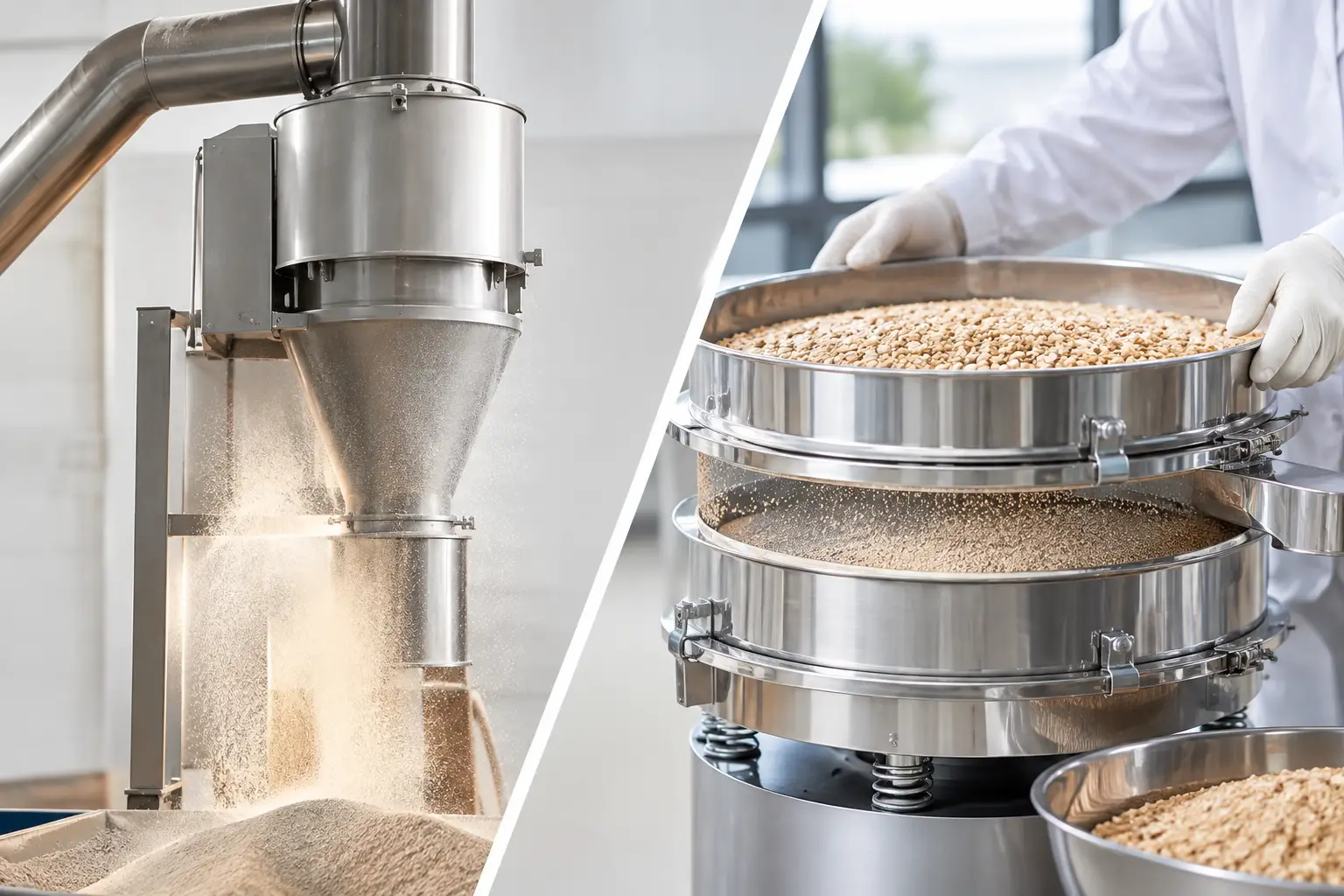
Material behavior determines how the line should be arranged and controlled. Bulk density, particle-size distribution, flowability, moisture content, electrostatic behavior, abrasiveness, friability, and heat sensitivity affect nearly every design choice. Cohesive powders may bridge in storage or feeders. Fragile agglomerates may degrade during pneumatic conveying. Hygroscopic materials may require controlled air conditions and closed transfer paths. A viscous paste may need positive-displacement transfer rather than a pump selected for a lower-viscosity liquid.
These characteristics are not minor details for a data sheet. They determine hopper geometry, agitation requirements, feeder type, conveying velocity, filter selection, equipment surface finish, cleanout strategy, and control logic. They also influence where a process should be isolated from ambient humidity, where dust collection is required, and where product sampling produces meaningful information.
Material testing and process trials can reduce uncertainty early. This is especially valuable when scaling a new formulation, changing a raw material source, or moving from manual handling to automated feeding. A line designed around assumptions may require costly modifications once real production behavior exposes them.
Design the Process as a Connected System
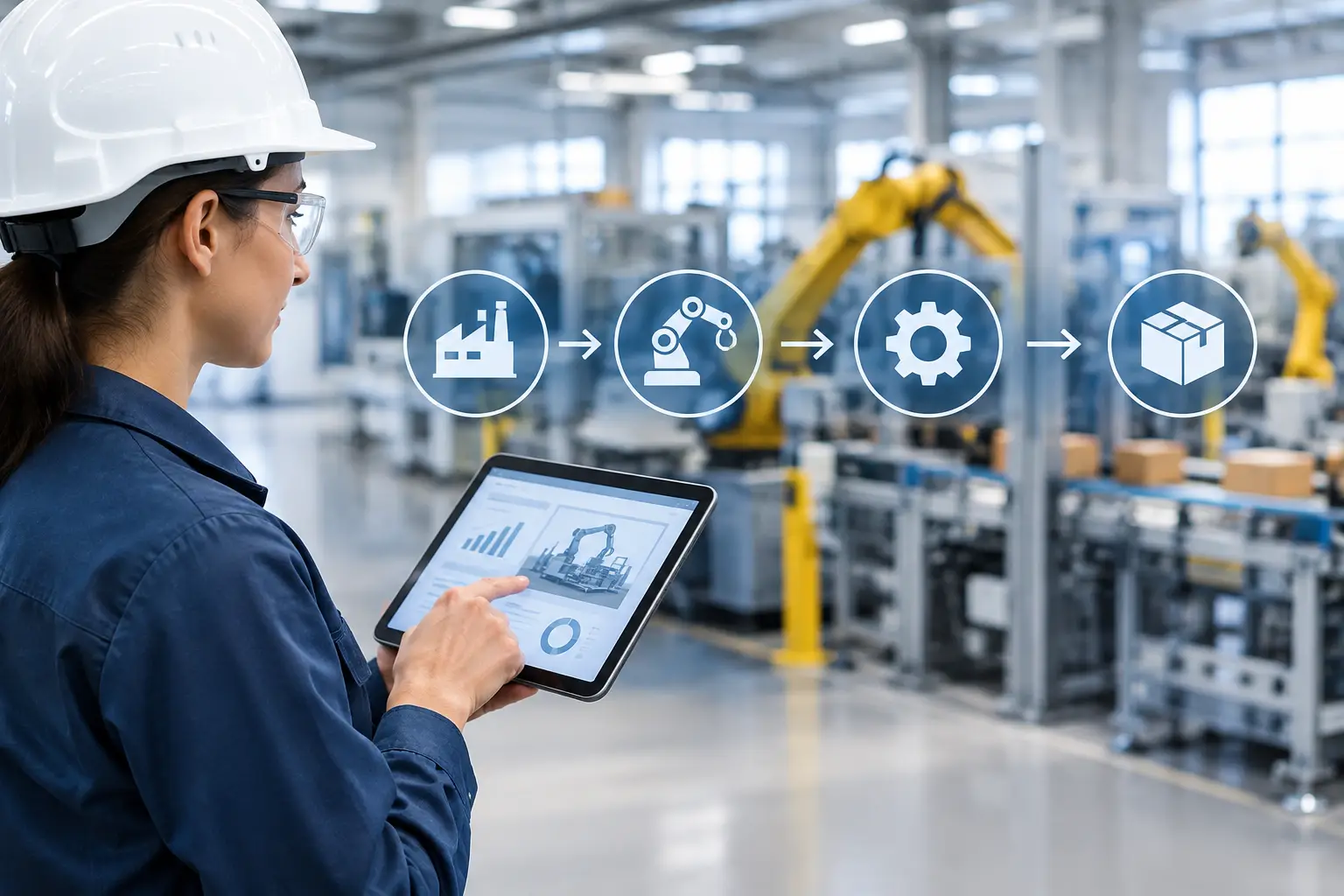
A connected system begins with a process flow diagram and develops into a functional design that assigns responsibility to every transfer, control point, and exception condition. The question is not simply whether product can move from vessel A to vessel B. The better question is whether it can move at the required rate, with the required accuracy, without segregation, contamination, degradation, excessive residuals, or operator intervention.
Match Capacity Across the Entire Line
Nameplate capacity is often misunderstood. A mill rated for a specific throughput does not establish line output if feeding, screening, blending, drying, cooling, filling, or palletizing creates a lower practical limit. The true capacity is determined by the slowest sustained operation, including cleaning, replenishment, inspection, and planned maintenance.
Batch and continuous systems require different thinking. A batch line needs adequate buffer capacity and scheduling logic to prevent equipment from waiting on the prior step. A continuous line requires stable feed rates, residence-time control, and instrumentation that can detect drift before nonconforming product accumulates. Hybrid systems need careful synchronization at the point where a continuous upstream process supplies a batch operation, or the reverse.
Engineer Transfers as Carefully as Processing Steps
Transfer equipment is often treated as supporting infrastructure. In many plants, it is where product quality and available capacity are lost. Pneumatic conveying can be efficient and contained, but excessive velocity may damage fragile particles or create wear with abrasive materials. Mechanical conveying may reduce particle damage but can introduce cleanability, access, or layout considerations. Gravity flow can be effective, provided elevation, flow properties, and segregation risk support it.
The same discipline applies to intermediate storage. Surge bins, receivers, and hoppers must be sized for actual operating variability, not only nominal flow. Their discharge behavior must suit the product. Poorly designed storage can create rat-holing, bridging, segregation, uncontrolled refill cycles, or difficult cleaning conditions that spread problems through the rest of the line.
Make Automation Part of the Process Design
Controls are not a layer added after mechanical design. They define how the line maintains repeatability. Integrated controls coordinate recipe execution, weighing and dosing, equipment sequencing, interlocks, alarms, batch records, material tracking, and data collection across the process.
The appropriate automation level depends on the product and operating model. A high-value pharmaceutical or nutraceutical batch may require detailed electronic records, controlled access, and validation documentation. A specialty chemical line may prioritize accurate dosing, hazardous-area requirements, temperature control, and traceability. A high-volume food application may place greater emphasis on sanitation cycles, rapid changeovers, and packaging coordination.
In each case, control architecture should support troubleshooting as well as operation. Operators and maintenance teams need clear status information, defined permissives, useful alarm priorities, and access to trend data that helps isolate recurring causes. More screens do not equal better automation. Clear control philosophy does.
Build Quality, Safety, and Maintainability Into the Layout
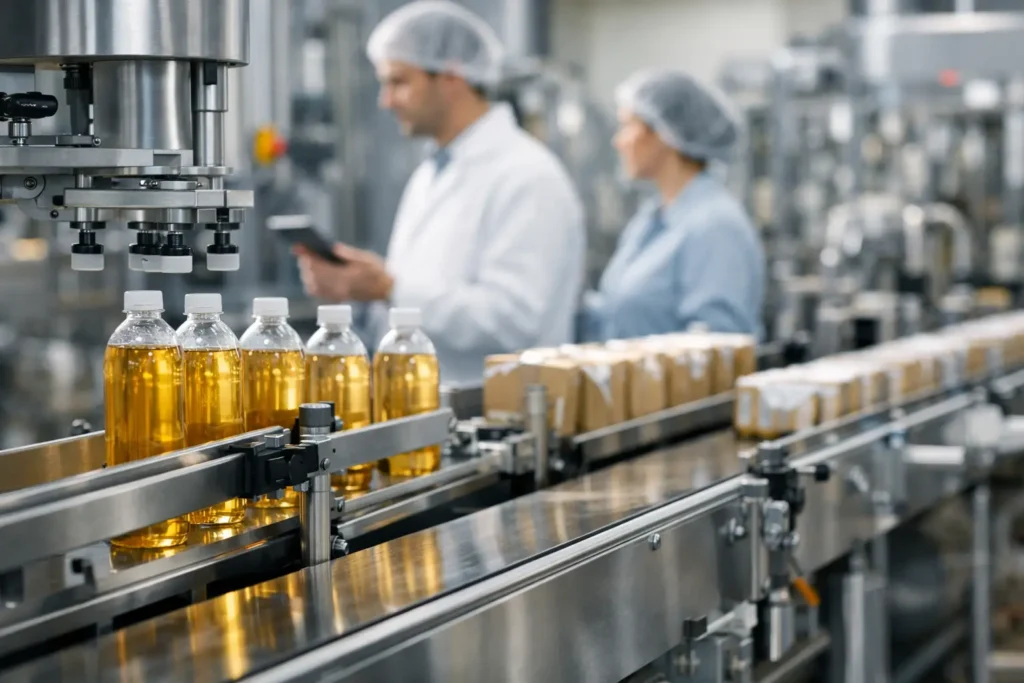
Quality cannot be inspected into a product after an unstable process has made it. The line should include the points where quality can be controlled or verified: ingredient identification, dosing confirmation, temperature monitoring, particle-size control, moisture measurement, metal detection, checkweighing, sampling, and final package inspection. The exact combination depends on risk, regulation, and product requirements.
Safety design must account for the actual materials and operating environment. This may include dust hazard evaluation, explosion protection, containment, ventilation, hygienic design, pressure relief, guarding, lockout access, and ergonomic provisions for manual tasks that cannot be eliminated. These measures should be integrated into the process layout rather than fitted around equipment after commissioning.
Maintainability deserves equal attention. A system that produces well but requires excessive disassembly, difficult access, or extended cleaning periods will underperform over its lifecycle. Design reviews should examine access to filters, seals, drive components, instrumentation, and wear surfaces. They should also define how residual material is removed between products and how the line is returned to service after maintenance.
One Engineering Standard Reduces Project Risk
Multi-vendor projects can succeed, but they require clear ownership of interfaces. Without it, equipment suppliers may each meet their scope while gaps remain in structural supports, utilities, controls, transfer connections, safety circuits, commissioning responsibilities, or performance acceptance criteria.
A coordinated project structure establishes one process basis, one control philosophy, and one accountable view of system performance. At Proc-X, specialized processing technologies can be engineered as part of a complete line under that unified approach. The value is not simply fewer purchase orders. It is reduced interface risk and a clearer path from design intent to production reality.
Factory acceptance testing, site acceptance testing, commissioning plans, and operator training should be defined early, not reserved for the final weeks of a project. Acceptance criteria need to be measurable: output rate, dosing accuracy, blend uniformity, particle-size range, moisture target, product temperature, package weight, yield, or cleaning performance. When the criteria are agreed before fabrication, decisions remain tied to the outcome the plant needs.
Design for Change, Not Just Startup
Most production lines will process more than the first product contemplated during project approval. New package formats, alternate ingredients, higher capacity targets, additional shifts, and tighter documentation requirements are common. Designing for reasonable expansion may involve leaving space for another feeder, selecting controls with available capacity, providing utility allowances, or arranging equipment so a future module can be added without rebuilding the line.
That does not mean every plant should overinvest in maximum flexibility. Flexibility has a cost in capital, footprint, controls complexity, and cleaning burden. The right decision depends on the product roadmap and the cost of future disruption. A stable, single-product process may benefit from a highly optimized dedicated line. A contract manufacturer or rapidly evolving formulation business may gain more from modularity and faster changeover.
The strongest production lines are not collections of machines that happen to be connected. They are operating systems built around the material, the product specification, and the way people must run and maintain the plant. Define those realities early, test the assumptions that carry the most risk, and make every interface accountable to the finished product.