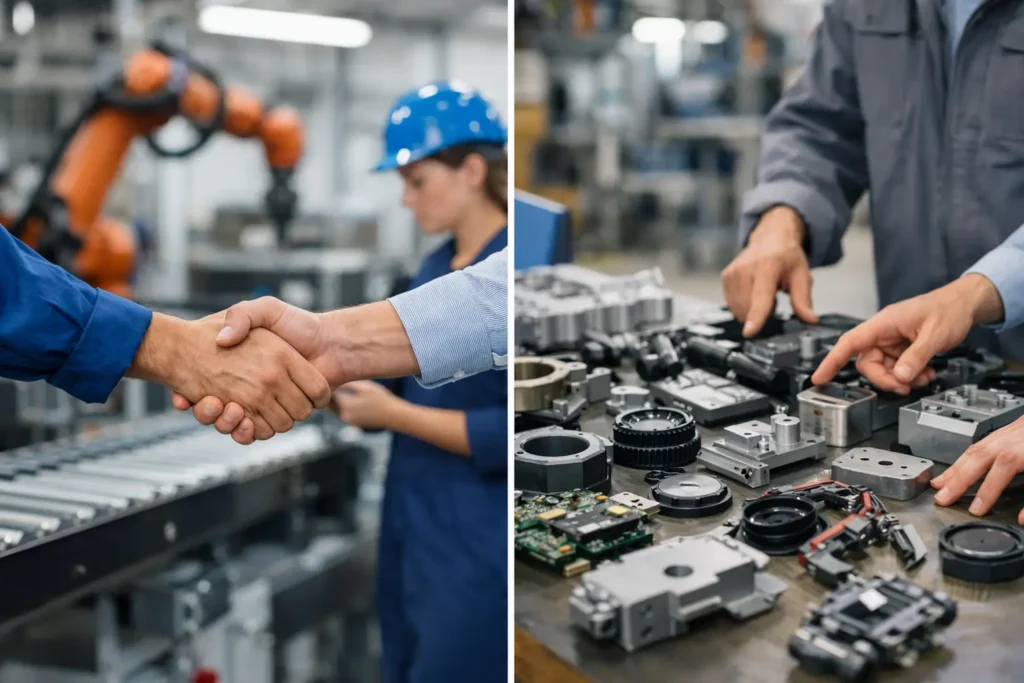
When a production line misses startup targets, the root cause is rarely a single machine. More often, the problem sits in the spaces between equipment – controls that do not communicate cleanly, mechanical interfaces that require field modification, utility demands that were not aligned early, or vendors who each own their component but not the system result. That is why the single source vs multi vendor manufacturing decision matters long before installation begins.
For complex process environments, this is not simply a sourcing preference. It is a system architecture decision with direct impact on schedule, commissioning, performance, support, and long-term operational risk. Procurement may see supplier strategy. Engineering sees integration burden. Operations sees uptime. Leadership sees capital efficiency and accountability. All of them are right.
What single source vs multi vendor manufacturing really means
In single source manufacturing, one partner takes responsibility for the engineered production system as a whole. That does not mean one machine or one narrow product line. It means one manufacturer or integrated engineering partner designs, coordinates, and stands behind the full process platform – from upstream material handling through processing, transfer, controls, and downstream packaging or finishing integration.
In a multi vendor model, the line is assembled from separate suppliers, often selected by equipment category. One company may provide milling, another mixing, another extrusion, another conveying, and a separate integrator may be expected to connect controls and utilities. This can appear flexible on paper, especially if a team wants to select what it believes are best-in-class components.
The distinction becomes significant when the project moves from procurement to execution. Buying machines is not the same as delivering a functioning manufacturing system.
Why multi vendor projects become harder in practice
A multi vendor approach can work, particularly when a facility has strong in-house engineering resources, established standards, and enough time to manage interface risk. But it transfers a large share of coordination responsibility to the owner or a third-party integrator.
That burden shows up early. Layout assumptions may differ between suppliers. Mechanical handoff points may shift. PLC strategies may not align. Safety architecture, documentation standards, and validation expectations can vary widely. None of these issues are unusual. The issue is who resolves them, how quickly, and at whose cost.
By the time equipment arrives on site, the owner may be managing multiple schedules, multiple FAT expectations, multiple support teams, and multiple interpretations of scope. If startup falls behind, each vendor can credibly claim its equipment is performing as specified. That still leaves the manufacturer with a line that is not hitting throughput, yield, or reliability targets.
This is where accountability gaps become expensive. In regulated and performance-critical industries, delays are not just inconvenient. They affect launch timing, labor planning, working capital, customer commitments, and, in some cases, qualification timelines.
Where the single source model creates operational advantage
The value of a single source model is not that it removes all project complexity. Complex production systems remain complex. The advantage is that complexity is managed within one coordinated engineering structure rather than across disconnected suppliers.
With a single source partner, equipment is developed to work within a shared process strategy, controls philosophy, and project execution plan. Utility requirements are coordinated earlier. Interfacing components are engineered with common standards. Documentation is more consistent. Commissioning follows a unified sequence rather than a negotiated one.
Most important, there is one point of accountability for system performance. If a transfer issue affects feed consistency into downstream processing, or if control logic creates instability between process stages, the owner does not have to mediate between vendors. The responsibility stays with the system provider.
For manufacturers building integrated lines, that difference can compress timelines and reduce the hidden cost of owner-managed integration. It also improves the likelihood that the line performs as designed under actual production conditions, not just during isolated equipment tests.
Cost is not just purchase price
The single source vs multi vendor manufacturing debate often starts with capital cost. On an equipment-by-equipment basis, a multi vendor model may appear less expensive, especially when procurement is comparing quoted prices without fully assigning integration cost, schedule exposure, and startup risk.
That comparison is incomplete.
The true cost of a manufacturing line includes engineering hours spent coordinating suppliers, controls integration effort, field modifications, installation inefficiencies, extended commissioning, delayed ramp-up, and long-term service complexity. It also includes the cost of underperformance. A line that runs below target capacity or requires repeated intervention is more expensive than its original purchase order suggests.
Single source systems may not always present the lowest line-item equipment cost. They often deliver lower total cost of ownership because the project is engineered as one manufacturing platform rather than assembled as a collection of individual assets.
For operations leaders, that distinction matters more over five to ten years than it does during bid tabulation.
When multi vendor manufacturing still makes sense
There are situations where multi vendor manufacturing is a rational choice. A plant with deep internal process engineering capability may prefer to specify each subsystem independently. A manufacturer standardizing globally on a specific controls platform or existing equipment family may need to integrate new assets selectively. Brownfield expansions also sometimes favor multi vendor strategies because legacy constraints dictate equipment choices.
The key is honesty about what the owner is taking on.
If your team has the technical bandwidth to manage interoperability, testing strategy, validation alignment, startup coordination, and long-term service across suppliers, the model can work well. If not, the apparent flexibility of multi vendor procurement can become a source of recurring execution risk.
In other words, multi vendor is not wrong. It is simply less forgiving.
How to evaluate single source vs multi vendor manufacturing for your facility
The best choice depends on process criticality, internal engineering capacity, project speed, and tolerance for interface risk.
If the line includes tightly linked unit operations where changes in one stage affect throughput or quality in the next, a single source model usually creates stronger control over performance. The same is true when startup schedule is critical, when validation requirements are strict, or when post-installation downtime carries high financial consequence.
If the project is relatively modular, the plant has proven in-house integration resources, and there is low operational penalty for prolonged tuning after installation, a multi vendor approach may be acceptable.
A practical evaluation usually comes down to five questions. Who owns integration design? Who owns controls coordination? Who owns startup sequencing? Who owns service after handoff? And if the line misses target performance, who has both the authority and obligation to fix it?
If those answers point to several different parties, the manufacturer is likely carrying more risk than the procurement structure suggests.
Why accountability matters more as systems become more integrated
Modern production lines are more interconnected than many capital planning models assume. Mechanical design, process control, material behavior, thermal conditions, operator interaction, data architecture, and downstream packaging all influence final output. The more integrated the process, the less useful it is to think in terms of isolated machine responsibility.
That is why system accountability has become a strategic advantage, not just a project management preference. One manufacturer. One engineering standard. One point of accountability. In demanding environments, that model improves clarity during design, speed during execution, and confidence after startup.
This is especially true in industries where consistency and traceability matter as much as throughput. When manufacturers need reliable scale-up, coordinated controls, and lifecycle support across the full line, fragmented responsibility creates friction that does not show up clearly in early purchasing documents.
An integrated partner such as Proc-X is built around that reality. The objective is not simply to supply equipment. It is to engineer and support a complete production system that performs as a unified whole.
The better question is not which model is cheaper
The better question is which model gives your organization the highest confidence in startup, performance, and long-term support.
For simple purchases, supplier count may not matter much. For integrated processing lines, it matters a great deal. Single source vs multi vendor manufacturing is ultimately a decision about who carries the burden of making the system work together in the real world. If that burden cannot sit comfortably inside your own organization, it should sit with a partner structured to own it fully.