Home / Milling / Jet Mills & Micronization Systems
DP Pulverizers · PROC-X MANUFACTURING GROUP
Jet Mills & Micronization Systems
Precision at the particle level.
Fluid-energy milling for brittle powders requiring fine or ultrafine particle-size control. Match gas supply, material behavior and collection to the micronization target.
The process, explained.
01
Accelerate
High-velocity gas jets accelerate the particles.
02
Collide
Particle interactions cause breakage in the grinding chamber.
03
Separate
Classification behavior controls the material leaving the mill.
How jet milling works
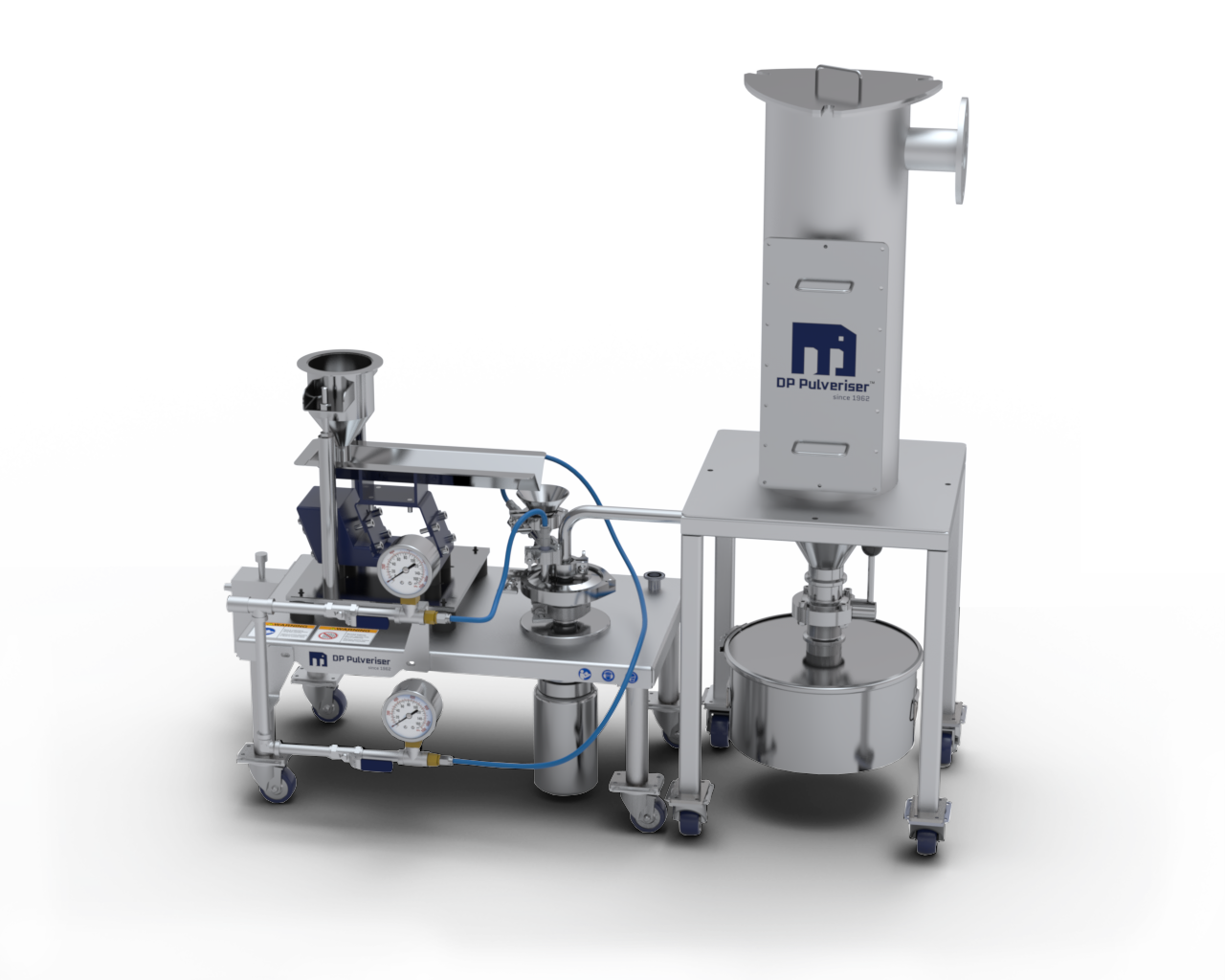
Jet milling uses compressed gas to accelerate particles and drive particle-to-particle collisions. Spiral and fluidized-bed arrangements use different flow and classification approaches. The gas circuit, feed system and collection equipment are integral to performance. Confirm which arrangement best suits the material, specification and available utilities.
Technical data and configuration
| Selection parameter | Brochure reference / engineering basis |
|---|---|
| Typical D50 | 1–10 µm; material-dependent |
| Typical D90 | 3–25 µm; material-dependent |
| Size range discussed | 1–42 inch designs; confirm configuration |
| Contact-material options | 304 / 316 stainless steel; duty-specific liners |
| Critical utilities | Gas pressure, flow, quality and collection system |
Source: supplied jet-milling brochure, PDF pages 4–6. D50 and D90 describe different points in a distribution. No throughput or purity guarantee is implied by these indicative ranges.
Select around the result.
Specify the particle-size distribution
The supplied jet-milling brochure lists typical D50 values of 1–10 microns and D90 values of 3–25 microns. These are indicative ranges for suitable applications, not a simultaneous performance guarantee for every material. State the required distribution metric and measurement method, including any upper-size or fines limit.
Material suitability and limitations
Brittle, crystalline materials are natural candidates for jet milling. Fibrous, elastic, sticky or moisture-sensitive materials can be more difficult and may require conditioning or another technology. The milling gas and feed condition need to be compatible with the product. A finer target can change throughput and gas consumption substantially.
Purity, wear and thermal behavior
Jet milling avoids a conventional mechanical impact rotor in the grinding zone, but product-contact surfaces and any classifier still require wear and contamination review. The brochure describes stainless steel and liner options including alumina and silicon carbide. Low thermal loading can be useful for sensitive ingredients, but confirm actual product temperature and impurity limits by testing.
Engineer the utilities and scale-up
Compare compressed-gas pressure, flow, quality and supply cost alongside the mill itself. Include product recovery, filtration, conveying and cleaning in the scope. The brochure discusses a size range from 1 to 42 inches; final model selection should use material performance data rather than assuming capacity scales directly with chamber diameter.
Go deeper with DP Pulverizers.
Technical brochure and specialist expertise
Explore the supplied brochure, then discuss the configuration with Proc-X or visit the specialist brand website.
These are the original supplied brochures. Some editions contain earlier contact details or model designations. For current project support, use john.paul@procxinc.com or +1 (872) 260-5071; confirm final specifications in your quotation.
Questions engineers ask.
Is jet milling contamination-free?
No process should be assumed to have zero contamination. Select contact materials, liners and gas quality, then assess wear and product purity against the application requirements.
What is the difference between D50 and D90?
D50 and D90 identify the particle sizes below which 50% and 90% of the measured distribution fall. The measurement basis and method must also be specified.
When should I compare jet milling with an ACM?
Compare them when both could meet the required powder specification. Include particle distribution, capacity, temperature, wear and utility cost in the evaluation.
Compare related technologies.
DP Pulverizers
Air Classifier Mills
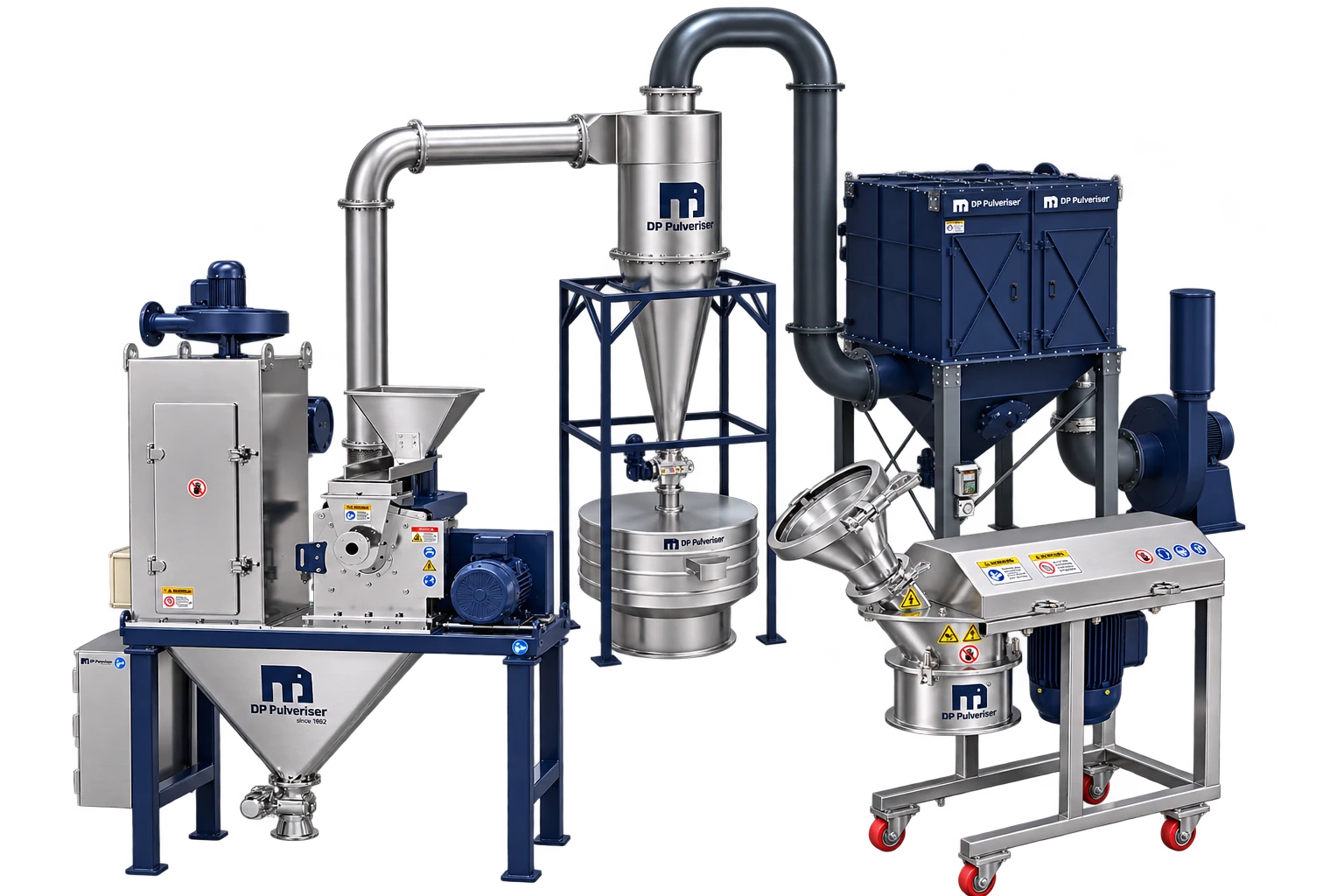
Integrated impact grinding and dynamic air classification for controlled fine powders. Engineer the mill, airflow, feeding and collection as one process.
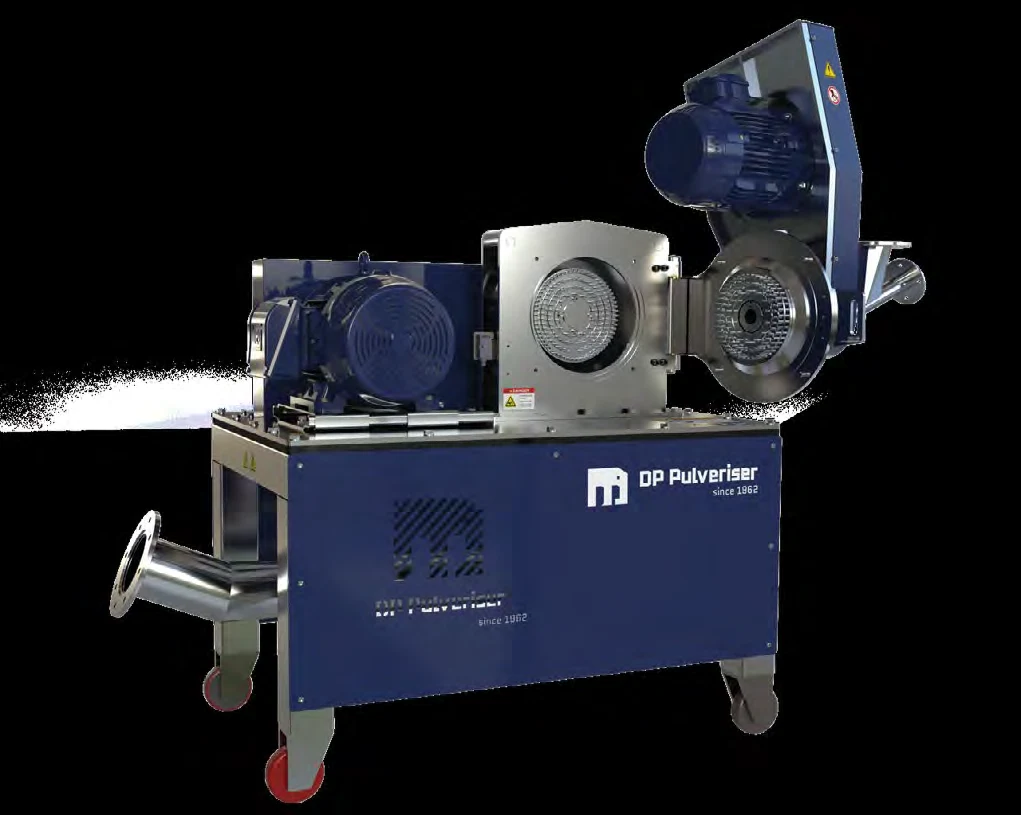
DP Pulverizers
Cryogenic Mills & Grinding Systems
Liquid-nitrogen-assisted grinding for materials that soften, smear or lose important properties during conventional milling—from spices to polymers and elastomers.
Your material writes the specification.
Tell us what you process, the result you need and the capacity you want to achieve. We will help define the next engineering step.