Home / Milling / Cryogenic Mills & Grinding Systems
DP Pulverizers · PROC-X MANUFACTURING GROUP
Cryogenic Mills & Grinding Systems
Control temperature. Change the grind.
Liquid-nitrogen-assisted grinding for materials that soften, smear or lose important properties during conventional milling—from spices to polymers and elastomers.
The process, explained.
01
Pre-cool
Condition material toward a suitable embrittlement temperature.
02
Grind
Apply impact while controlling temperature and feed.
03
Recover
Collect the powder and manage its return to downstream conditions.
What is cryogenic grinding?
Cryogenic milling uses cooling, commonly with liquid nitrogen, to change how a material responds to impact. Elastic or sticky products may become more brittle, while cooling can help limit temperature-related quality loss. The required processing temperature depends on the material; liquid nitrogen temperature is not itself the product operating setpoint.
Technical data and configuration
| Process item | Selection basis |
|---|---|
| Cooling method | Liquid-nitrogen pre-cooling and controlled injection |
| Grinding arrangement | Contra pin technology described in the brochure |
| Indicative particle-size range | 10–500 µm; material and duty dependent |
| Control variables | Feed rate, rotor speed and temperature |
| Operating-cost inputs | Nitrogen use, capacity, recovery and cleaning |
Source: supplied cryogenic-milling brochure, PDF pages 3, 6 and 7. No fixed nitrogen consumption, operating temperature or throughput is promised; these require material-specific evaluation.
Select around the result.
How the DP system is configured
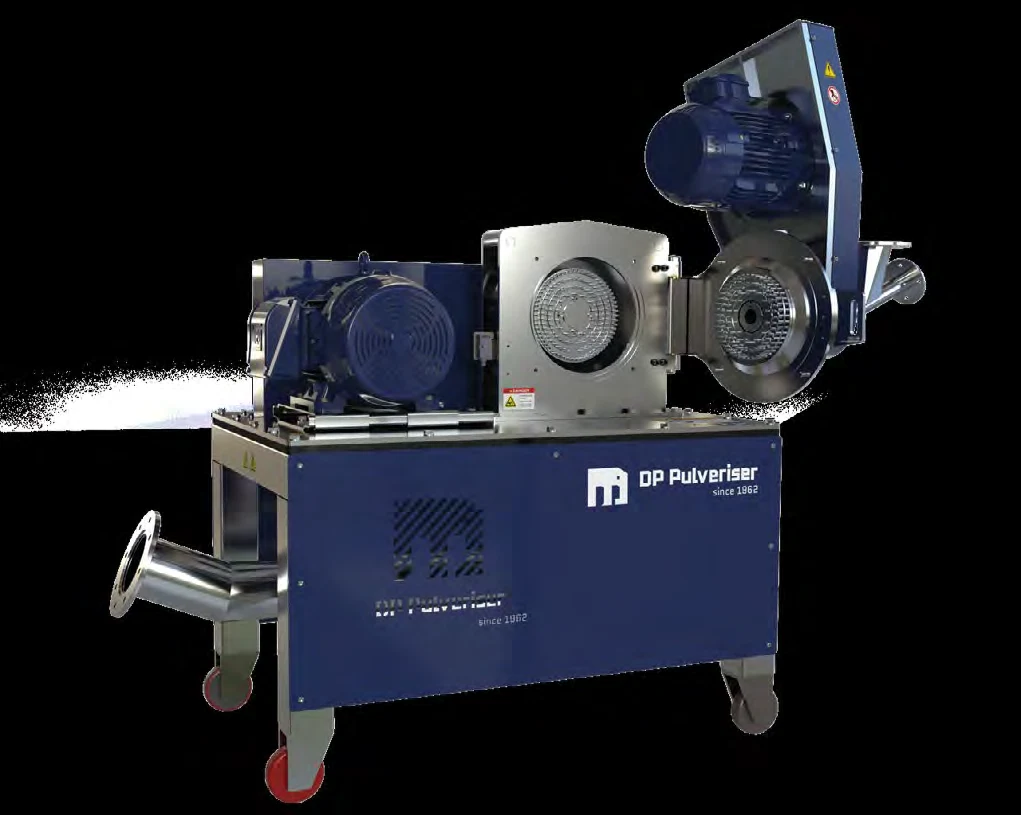
The supplied brochure describes pre-cooling, controlled feeding, contra-rotating pin-disc grinding, ongoing temperature control and product discharge. Proc-X coordinates the cooling duty with feeding, milling, collection and controls. The right configuration follows the feed behavior and finished-product target.
Applications that benefit from temperature control
Evaluate cryogenic grinding for spices, high-fat ingredients, selected nutraceutical materials, polymers and elastomers. Relevant objectives can include limiting smearing, protecting aroma or producing a more usable particle distribution. Improvements in aroma, active content or powder handling must be assessed on the actual material rather than assumed.
Particle size and operating cost
The brochure describes a broad 10–500 micron application range. Define the required distribution metric and measurement method before assessing suitability. Nitrogen consumption, throughput, product recovery and cleaning contribute to operating cost. An ambient-versus-cryogenic trial can help establish whether cooling delivers a worthwhile process advantage.
Integrate cooling with the plant
Provide feed temperature, moisture, bulk density, expected throughput and the maximum acceptable product temperature. Review nitrogen supply, ventilation, oxygen monitoring, insulation, moisture ingress and downstream handling as part of the installation scope. Plan collection and packaging conditions so product quality is maintained after grinding.
Go deeper with DP Pulverizers.
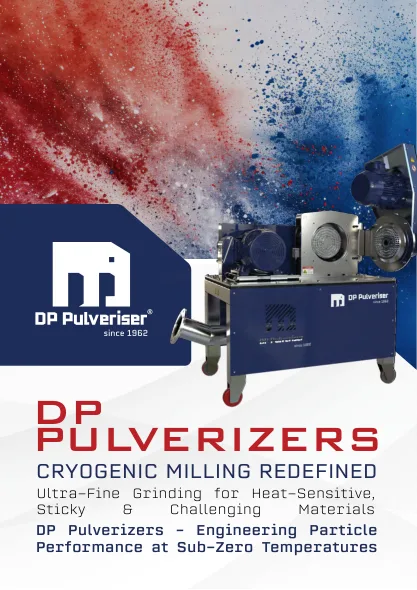
Technical brochure and specialist expertise
Explore the supplied brochure, then discuss the configuration with Proc-X or visit the specialist brand website.
These are the original supplied brochures. Some editions contain earlier contact details or model designations. For current project support, use john.paul@procxinc.com or +1 (872) 260-5071; confirm final specifications in your quotation.
Questions engineers ask.
Why use cryogenic grinding for spices?
Cooling can help limit temperature rise, smearing and loss of volatile constituents. Compare the finished powder, aroma retention, capacity and nitrogen cost using representative material.
Can cryogenic milling grind rubber or polymers?
It can be appropriate where cooling makes the selected material sufficiently brittle. Embrittlement behavior and the target distribution must be evaluated before specifying the system.
Does cryogenic grinding eliminate heat generation?
No. Mechanical grinding generates heat. Cooling removes heat and controls product temperature; the required cooling duty depends on the process.
Compare related technologies.
DP Pulverizers
Air Classifier Mills
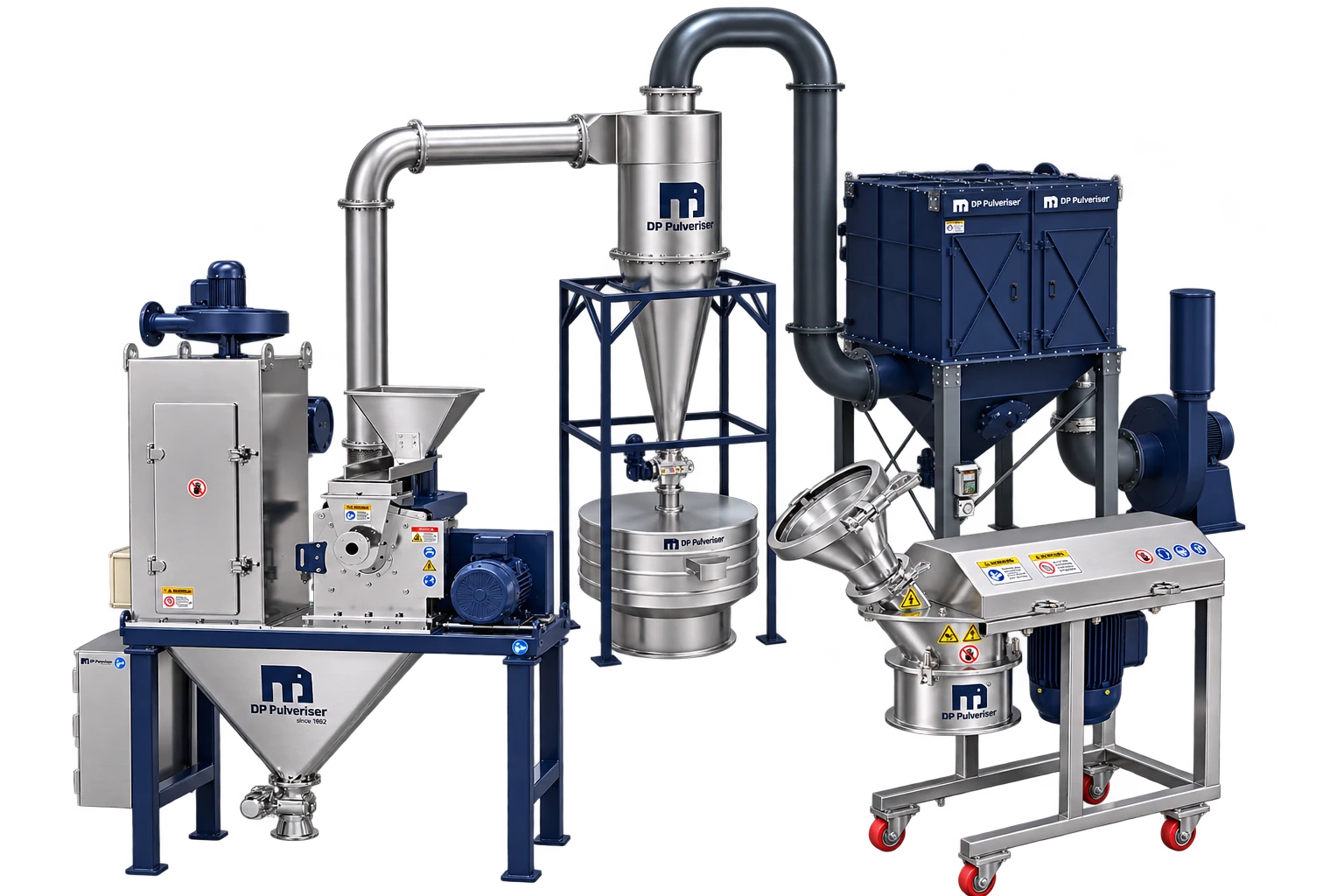
Integrated impact grinding and dynamic air classification for controlled fine powders. Engineer the mill, airflow, feeding and collection as one process.
DP Pulverizers
Jet Mills & Micronization Systems
Fluid-energy milling for brittle powders requiring fine or ultrafine particle-size control. Match gas supply, material behavior and collection to the micronization target.
Your material writes the specification.
Tell us what you process, the result you need and the capacity you want to achieve. We will help define the next engineering step.