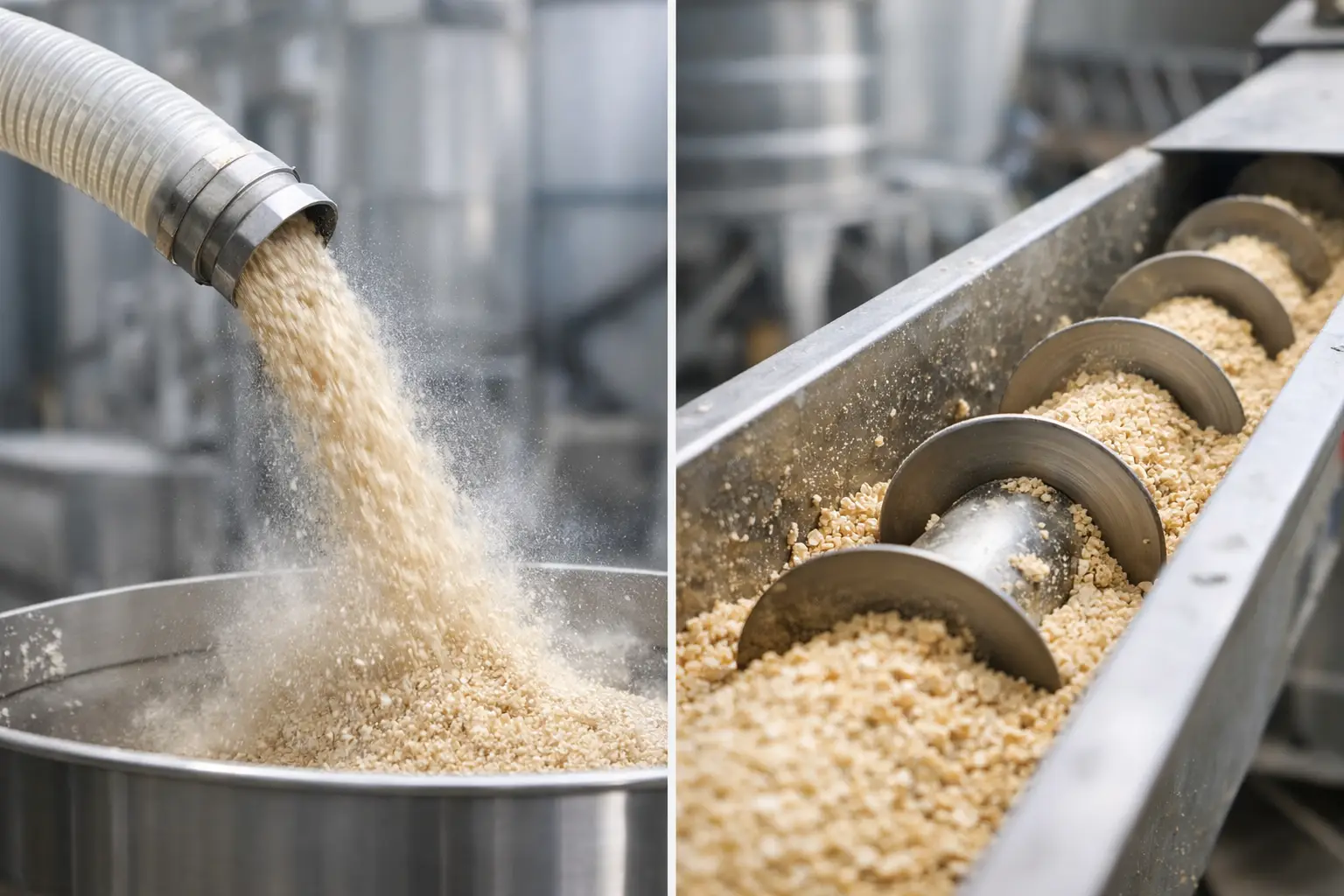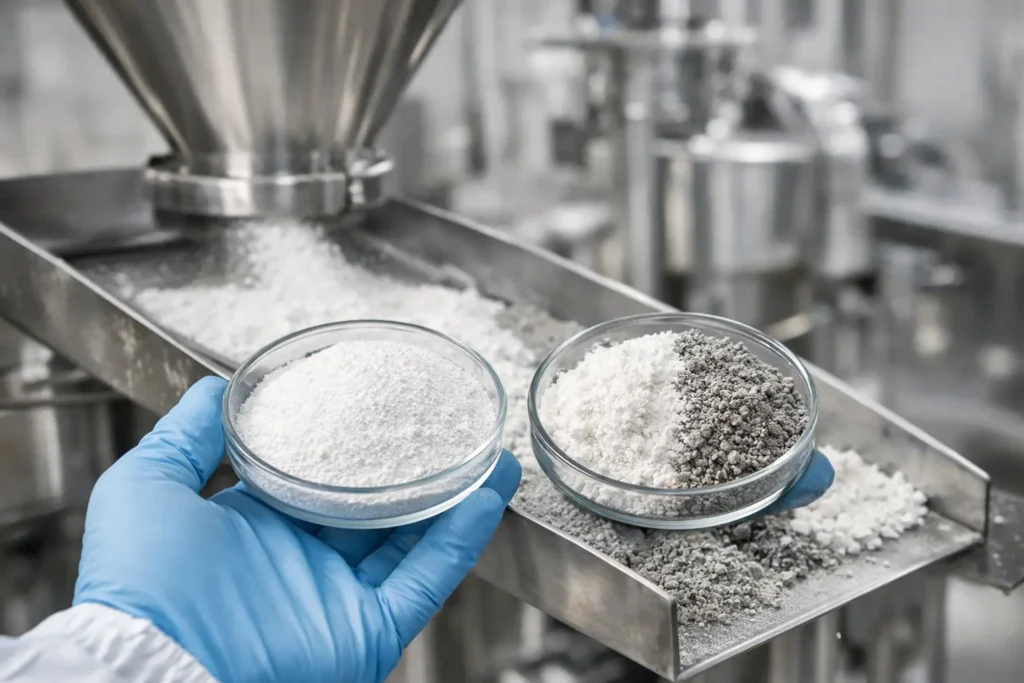
A blend that meets specification at the discharge of a mixer can become nonuniform before it reaches the next process step. A few feet of pneumatic conveying, a poorly designed hopper, or repeated filling and emptying can separate fine particles from coarse particles, alter active-ingredient concentration, and create costly variation. Knowing how to prevent powder segregation starts with treating the process as one connected material-handling system, not a series of independent machines.
For food, pharmaceutical, chemical, mineral, battery, and advanced-material producers, segregation control protects more than blend uniformity. It affects product performance, batch release, dosing accuracy, yield, dust control, and customer confidence. The right solution depends on the powder’s physical behavior and the way it moves through the plant.
Why Powder Segregation Occurs
Powder segregation is the separation of particles within a mixture based on differences in size, density, shape, surface texture, or flow properties. It is most common when a blend contains free-flowing particles with a broad particle-size distribution or meaningful density differences. A formulation can be correctly proportioned by weight and still deliver inconsistent material at a feeder, tablet press, packaging machine, or reactor.
Several mechanisms can act alone or together. Sifting occurs when fine particles migrate through voids between larger particles. Fluidization segregation occurs when air entrains or lifts fines while heavier particles settle. Rolling segregation happens when larger, rounder particles travel farther down a pile during filling. Impact and vibration can also rearrange a mixture during conveying, bin discharge, or transport.
The practical implication is straightforward: the location where segregation becomes visible is not always the location where it began. A packaging line may show weight or composition variation, while the root cause may be an upstream transfer line, bin geometry, or feed sequence.
Start With Material Characterization
Equipment selection should not begin with a generic assumption that a powder is “free flowing” or “difficult.” Those descriptions are too broad to support reliable process design. Characterize individual ingredients and the finished blend under the temperatures, humidity conditions, and production rates expected in operation.
Particle-size distribution, bulk density, true density, particle shape, moisture content, permeability, flow function, compressibility, electrostatic behavior, and friability all matter. The difference between components matters as much as the absolute value of each property. A low-dose, fine active ingredient combined with a much coarser carrier presents a different risk than a blend of similarly sized particles with modest density variation.
Testing should also account for how the material changes during processing. Some products absorb moisture, agglomerate, degrade under shear, or generate fines during conveying. Others segregate only after aeration in a pneumatic line or after sitting in a storage hopper. Representative trials establish whether the process must preserve particle size, deaerate the material, minimize drops, or maintain a controlled level of consolidation.
Define the Uniformity Requirement
Segregation prevention must be tied to an acceptance criterion. For some products, a small bulk-density shift is acceptable. For pharmaceutical, nutraceutical, specialty chemical, and battery applications, component concentration or particle distribution may require tightly controlled limits.
Define where samples will be taken and what they must demonstrate: mixer discharge, intermediate storage, feeder inlet, final package, or all of these points. This turns segregation control from a subjective observation into an engineering requirement that can guide equipment design, controls, and validation.
Design Transfer to Preserve the Blend
The most effective way to prevent powder segregation is often to reduce the opportunities for separation after blending. Every transfer should be evaluated for free fall, velocity, air entrainment, impact, and residence time.
Long vertical drops are a common source of rolling and impact segregation. Use controlled-chute geometry, mass-flow inserts, or other transfer arrangements that reduce particle acceleration and prevent the formation of large conical piles. Where practical, keep the material stream compact and deliver it near the center of the receiving vessel without creating a high-energy impact point.
Pneumatic conveying requires particular attention. Dilute-phase systems can be appropriate for many materials, but high gas velocities, excessive elbows, and uncontrolled line pickup may create fines, classify particles, or fluidize a blend. Dense-phase conveying, lower-velocity operation, shorter routes, and properly designed receiving vessels may reduce these risks. The correct approach depends on conveying distance, product sensitivity, throughput, cleaning requirements, and the degree of segregation risk.
Mechanical conveying can also be beneficial when it provides gentle, predictable transport. However, screw conveyors can generate shear, alter particle size, and create residence-time variation if poorly matched to the material. Belt, vibratory, tubular drag, and flexible screw systems each impose different stresses. The question is not which conveyor is universally best, but which method preserves the relevant properties of the actual blend.
Control Hopper and Bin Behavior
A well-mixed powder can segregate in storage if the hopper promotes funnel flow. In funnel flow, material moves through a central channel while material near the vessel wall remains stagnant. This can cause material deposited at different times or positions to discharge unevenly, particularly when the bin is repeatedly filled and partially emptied.
Mass flow is generally preferred when blend uniformity is critical. In a mass-flow hopper, material moves across the full cross-section of the vessel as it discharges. Achieving this condition requires the right wall angles, surface finish, outlet size, and flow aids for the material. It cannot be assumed from hopper shape alone.
Flow aids should be selected carefully. Vibration, air pads, fluidizing devices, and mechanical agitators can restore flow, but they can also promote classification, aeration, or particle damage. A flow aid that solves bridging while worsening component separation is not a process solution. Test it under realistic fill levels and discharge rates before committing it to production.
Avoid Excessive Inventory and Rehandling
Intermediate storage creates flexibility, but it also creates risk. Long residence times, repeated refill cycles, and multiple transfer steps increase the chance that a blend will change between the mixer and the point of use. Where production strategy allows, reduce the number of handling events and size surge capacity around the actual operating need.
When storage is necessary, use controlled fill patterns, first-in/first-out logic where applicable, and level management that avoids extreme empty or full conditions. A consistent inventory profile supports more consistent discharge behavior.
Match Mixing to the Downstream Process
A more aggressive mixing cycle is not always the answer. Overmixing can create fines, break fragile particles, promote electrostatic charging, or alter the very size distribution that makes a blend stable. The target is sufficient homogeneity at the mixer discharge and sufficient stability through all subsequent process steps.
Mixer type, fill level, rotation speed, mixing time, and ingredient addition sequence should be developed with downstream handling in mind. Minor ingredients may require preblending, controlled dosing, or a carrier strategy to distribute evenly. Liquid additions may reduce dust and improve cohesion in some formulations, while creating lumps or wall buildup in others.
Scale-up deserves the same discipline. A blend that performs well in a pilot mixer may respond differently in a full-scale vessel because fill geometry, shear, discharge pattern, and transfer distance change. Production trials should follow the complete material path, including storage, conveying, feeding, and packaging.
Use Feeding and Controls to Catch Variation
Loss-in-weight feeders, gravimetric dosing systems, level controls, and integrated automation do not eliminate segregation by themselves. They do, however, make process behavior measurable and controllable. Stable refill sequences, controlled feeder inventory, and accurate mass-flow feedback reduce the effect of changing bulk density and inconsistent hopper discharge.
Trend feeder speed, refill frequency, weight loss, line pressure, conveying air, and product quality data together. A shift in feeder performance can be an early indicator of aeration, ratholing, bridging, or segregation upstream. This information is most valuable when controls, mechanical design, and quality sampling are considered as one operating strategy.
For complex lines, Proc-X applies this systems view from material evaluation through mixing, transfer, storage, feeding, and end-of-line integration. One engineering standard across the process helps prevent interfaces between equipment from becoming uncontrolled sources of variation.
Verify Performance Under Real Conditions
A successful factory acceptance test is useful, but it does not replace production verification. Segregation may appear only after long runs, routine cleaning cycles, variable ambient humidity, ingredient-lot changes, or normal operator interventions. Establish a sampling plan that tests the beginning, middle, and end of runs, as well as conditions after refills and planned stops.
When variation appears, resist the urge to change several variables at once. Trace the material path, identify the point where composition shifts, and test one controlled modification at a time. That may mean changing a chute, reducing a conveying velocity, revising a hopper outlet, or tightening a feeder refill sequence.
The most reliable powder process is not the one with the most equipment. It is the one in which material behavior, equipment geometry, transfer conditions, and controls are designed to protect the blend from the first ingredient addition to the final package.