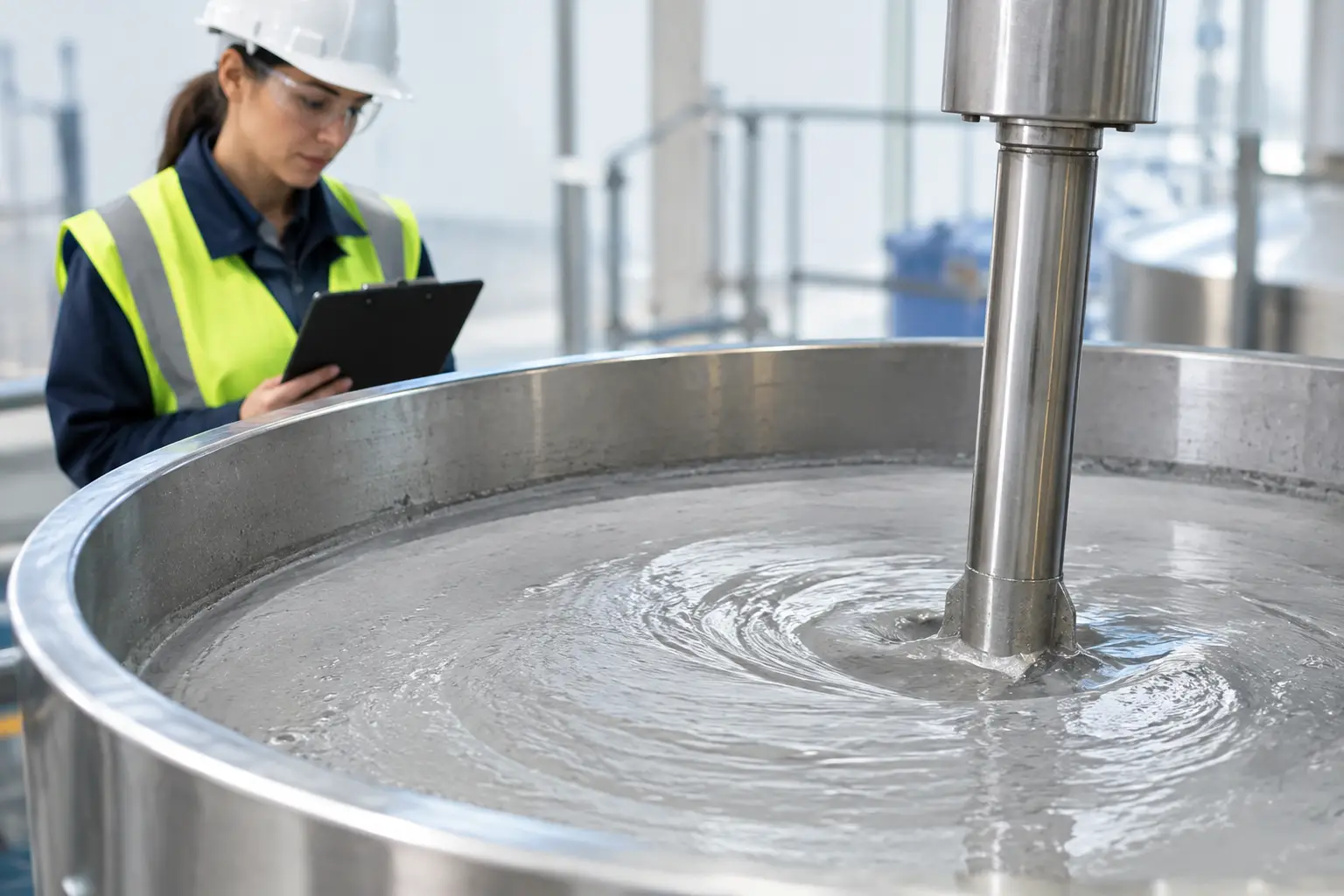
A slurry that appears uniform at the top of a vessel can still contain settled solids, agglomerates, air pockets, or concentration gradients below the surface. Those hidden variations become visible later as coating defects, inconsistent particle distribution, unstable viscosity, filtration problems, off-spec density, or uneven downstream drying. Effective slurry mixing is therefore not a matter of selecting the highest-speed agitator. It is an engineered process that must keep every batch within a defined operating window.
For manufacturers processing battery materials, ceramics, specialty chemicals, food systems, pharmaceuticals, mineral products, or advanced composites, the mixing step often determines whether the rest of the line can run predictably. The objective is not simply movement in a tank. It is controlled wetting, dispersion, suspension, homogenization, and transfer of a material with known properties.
Why Slurry Mixing Fails in Production
Many slurry problems begin with an equipment decision made before the material is fully characterized. A mixer may perform well during a small development batch, then lose effectiveness when solids loading increases, viscosity changes with temperature, or vessel geometry changes at production scale. The result is a process that works intermittently rather than one that is repeatable by design.
Settling is a common example. If the impeller does not generate sufficient flow at the vessel bottom, dense particles can accumulate in zones that are difficult to observe and even harder to recover. Increasing speed may help in some cases, but it can also introduce air, raise product temperature, damage fragile particles, or create a surface vortex without improving bottom suspension.
Poor powder incorporation creates another frequent failure point. Powders introduced too quickly or into the wrong liquid flow pattern can form fisheyes, lumps, or partially wetted agglomerates. Once formed, these structures may resist conventional agitation. A batch can meet a simple visual inspection while still containing unmixed material that disrupts coating, pumping, extrusion, filling, or final-product performance.
The correct solution depends on the process objective. Some materials require gentle bulk circulation to maintain suspension. Others need high shear to deagglomerate fine particles, distribute binders, or develop a stable dispersion. Many demand both functions, delivered in sequence or through a combined mixing configuration.
Start With Material Behavior, Not Mixer Type
A slurry is not a single material category. It is a system of solids, liquids, additives, entrained gas, and often time-dependent rheology. The engineering questions that matter most are tied to how that system behaves under real production conditions.
Solids concentration affects viscosity, power demand, suspension requirements, and pumping behavior. Particle size and density influence settling velocity and the energy needed to lift solids from the vessel floor. Particle shape, surface area, and moisture condition can change wetting behavior significantly. Fine, cohesive powders may resist incorporation even where coarser grades of the same chemistry disperse readily.
Rheology is equally important. Newtonian slurries respond predictably as shear rate changes. Shear-thinning materials may become easier to circulate near the impeller while remaining relatively stagnant elsewhere in the vessel. Yield-stress materials can form caverns around a high-speed mixer, leaving large volumes outside the actively mixed zone. Thixotropic systems may change viscosity over the course of a batch, so a suitable early-stage mixing condition may not be appropriate during final homogenization.
A well-defined slurry mixing project should establish, at minimum, the following process inputs:
- Solids loading and allowable concentration range
- Particle-size distribution, density, shape, and abrasiveness
- Liquid phase properties, including temperature sensitivity
- Viscosity and yield stress across expected shear rates
- Required batch size, production rate, and batch cycle time
- Quality targets for dispersion, particle integrity, temperature, and entrained air
These inputs give process engineers a basis for selecting equipment and controls that address the material rather than relying on general mixer classifications.
Selecting the Right Mixing Mechanism
Low-speed axial-flow agitation is often effective where the primary need is bulk circulation, uniform temperature, and suspension of solids that do not require aggressive deagglomeration. Proper impeller diameter, blade design, off-bottom clearance, and baffle configuration are critical. A properly sized axial impeller can create strong top-to-bottom turnover, but it is not automatically the right answer for cohesive powders or high-viscosity pastes.
High-shear rotor-stator mixing applies concentrated energy to a localized processing zone. It is often used for powder wet-out, emulsification, particle deagglomeration, and rapid dispersion of additives. The trade-off is that high shear can increase temperature, alter particle morphology, or entrain air if operating conditions are not controlled. For sensitive materials, the required energy must be delivered without exceeding thermal or mechanical limits.
For high-viscosity, yield-stress, or wall-adhering materials, close-clearance agitators such as anchors, helical ribbons, or planetary systems may be required. These designs sweep more of the vessel volume and can move material that would remain stagnant under a conventional turbine. They are frequently paired with a high-speed disperser or rotor-stator head when both macro-mixing and localized shear are needed.
The strongest solution is often a staged process rather than a single mixing event. Liquid may be charged and conditioned first, followed by controlled powder induction, high-shear dispersion, low-shear homogenization, vacuum deaeration, and final transfer. Each stage serves a defined purpose and should be evaluated against measurable acceptance criteria.
Vessel Geometry Is Part of the Process
An agitator cannot compensate indefinitely for a vessel that does not support the required flow pattern. Tank diameter, liquid height, bottom geometry, baffle design, and outlet location all affect circulation and cleanout. A tall, narrow vessel behaves differently from a wide, shallow vessel at the same nominal volume. The geometry also changes as batch fill level changes.
Bottom shape is especially significant for settling slurries. Conical, dished, and flat-bottom vessels each present different suspension and discharge characteristics. A vessel designed only for easy draining may not deliver adequate recirculation near the bottom. Conversely, a design optimized for suspension may need additional attention to complete product recovery and cleaning.
Dead zones must be considered beyond the tank itself. Valves, transfer lines, recirculation loops, filters, sampling points, and feed ports can all retain concentrated solids or incompletely mixed material. In regulated or high-value applications, poor drainability and difficult cleanability increase both product risk and turnaround time.
Control the Addition Step
A significant share of slurry variability is created before the mixer has an opportunity to correct it. Powder feed rate, addition location, liquid level, and surface conditions determine whether solids enter the process as individual particles or as agglomerates.
Controlled feeding systems can meter powder into a high-energy zone at a rate the liquid can accept. This approach reduces floating rafts, dust generation, lump formation, and operator-dependent variability. For materials prone to bridging or inconsistent flow, feeder design and agitation at the feed source are as important as the mixer in the vessel.
Closed powder induction can also improve containment and housekeeping where materials are hazardous, moisture-sensitive, or costly. Depending on the application, the system may incorporate loss-in-weight feeding, vacuum conveying, liquid recirculation, inline dispersion, or automated recipe management. The right architecture depends on batch size, required containment, cleaning requirements, and the value of eliminating manual handling.
Scale-Up Requires More Than Matching RPM
Scaling a slurry process from laboratory development to commercial production is not achieved by maintaining the same agitator speed. Mixing performance is influenced by power per unit volume, impeller tip speed, flow rate, shear rate, Reynolds number, and the changing relationship between vessel dimensions and impeller diameter. No single scale-up rule applies to every slurry.
For a shear-sensitive material, maintaining tip speed may protect the product but may not provide sufficient bulk circulation at larger scale. For a dispersion-limited formulation, matching power density may deliver the necessary energy but create too much heat. In highly viscous systems, torque and drive capability can become the limiting factors before nominal motor power does.
This is why pilot testing and application-specific engineering matter. A representative trial should evaluate not only final viscosity or appearance, but also powder addition time, temperature rise, dispersion quality, solids distribution, air content, cleaning effort, and transfer behavior. The production system should then be designed around the demonstrated process window, with reasonable allowances for normal raw-material variation.
Design for the Equipment Around the Mixer
A mixing vessel is only one element in the production system. The slurry must enter consistently, remain controlled through processing, and transfer without separation or loss of quality. Pumps must tolerate the viscosity, abrasiveness, and solids content. Piping velocity must prevent settling without creating unnecessary shear or pressure drop. Transfer lines may require flush capability, recirculation, heat tracing, or agitation at intermediate holding points.
Automation should manage the variables that have direct impact on repeatability: ingredient sequencing, feed rates, mixer speed, batch time, temperature, vacuum level, vessel weight, and process alarms. For critical products, electronic batch records and trend data can provide the evidence needed to identify drift before it becomes a quality event.
Proc-X approaches slurry systems as connected production processes, combining mixing technology with material handling, dosing, transfer, controls, and downstream integration under one engineering standard. That coordination reduces the risk of solving a vessel-level problem while creating a bottleneck somewhere else in the line.
The most dependable slurry process is one that makes variation visible and manageable. When material behavior, mixing energy, vessel geometry, addition control, and automation are engineered as one system, operators gain a process they can run with confidence from the first batch through sustained production.