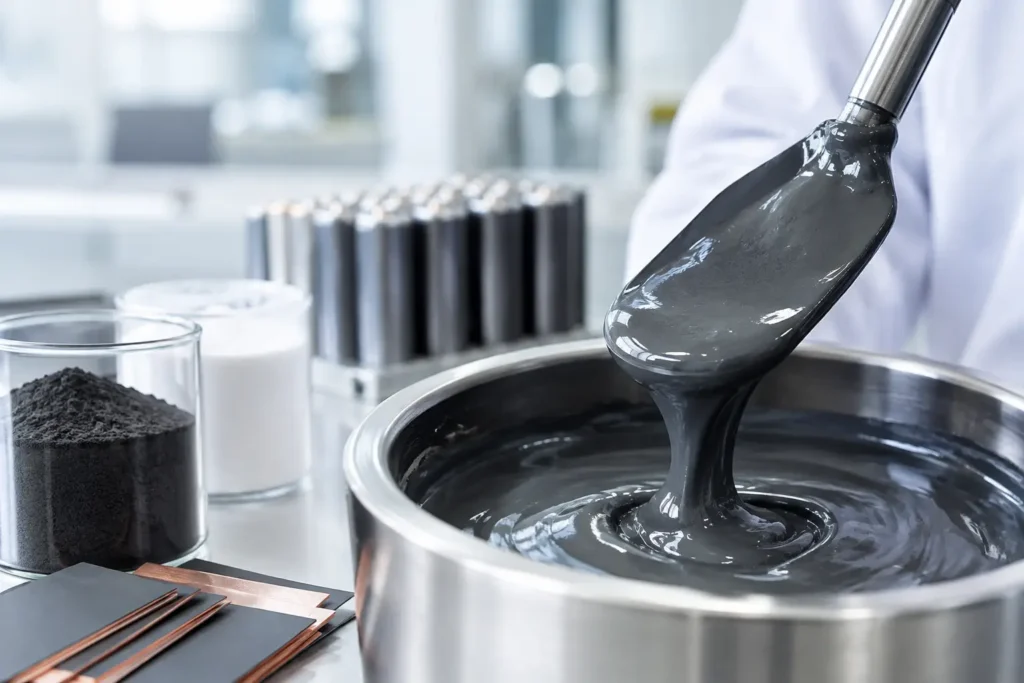
A battery slurry mixing case study rarely begins with a mixer selection. It begins when an electrode coating line shows variation that cannot be explained by the coater alone: inconsistent viscosity between batches, agglomerates in the dispersion, unstable solids loading, trapped air, or electrode properties that shift after drying and calendering. In battery manufacturing, these symptoms are often connected to how materials enter, disperse, circulate, and leave the mixing system.
The representative case below illustrates a scale-up challenge common to lithium-ion electrode production. It is not a claim about a single customer installation. It is a practical engineering view of how a slurry process can be evaluated as an integrated production system, from raw-material handling through controlled discharge to the coater.
The Production Problem Was Not Just Mixing
The operation was increasing capacity for a high-solids cathode slurry containing active material, conductive carbon, polymer binder, and solvent. At pilot scale, the formulation met viscosity and coating targets. At production scale, however, batches required excessive adjustment. Some reached the target viscosity quickly but showed poor dispersion stability. Others required longer mixing cycles, reducing line availability and making batch-to-batch scheduling difficult.
The first assumption was that additional mixing time would correct the issue. It did not. More time increased energy input and could raise slurry temperature, but it did not consistently break down conductive-carbon agglomerates or prevent localized binder concentration during powder addition.
That distinction matters. A slurry can appear homogeneous in the vessel while still containing poorly wetted powder, conductive additive clusters, or entrained air. The material may then reveal its variability later – at filtration, coating, drying, or electrochemical testing. The process objective is not simply to turn an agitator for a specified number of minutes. It is to produce a repeatable slurry with controlled rheology, dispersion quality, solids concentration, temperature, and air content at the point of coating.
Battery Slurry Mixing Case Study: Finding the Constraints
The engineering review examined four connected areas: material behavior, addition sequence, mixer energy distribution, and transfer conditions. Looking at these together prevented a common scale-up error – solving one visible bottleneck while introducing another downstream.
Material behavior changed during each batch
The conductive carbon had low bulk density, high surface area, and a strong tendency to form airborne dust and soft agglomerates. The active material had a very different bulk density and flow response. The binder solution introduced a separate challenge because its wetting behavior and viscosity changed as solids were incorporated.
These differences meant that a single, fixed mixing speed could not provide the best result throughout the batch. Early-stage wetting required controlled powder incorporation without floating islands or wall buildup. Dispersion required sufficient localized shear in the appropriate zone. Final homogenization required circulation through the full vessel volume without excessive heat generation or damage to sensitive formulation components.
The review also considered raw-material variability. Even when suppliers meet specification, changes in moisture, particle-size distribution, carbon structure, or packing density can affect feeder performance and wet-out time. A capable production system needs enough measurement and control to manage normal variation without relying on operator judgment for every batch.
Addition order was driving avoidable variation
The original process added a large fraction of dry powder into the liquid phase over a short interval. This created temporary high-solids zones near the feed point. Material that was not immediately wetted could circulate as partially dispersed clusters, extending the time required to reach a stable condition.
The revised approach separated the process into defined stages. A controlled liquid charge established the initial wetting phase. Conductive carbon was introduced at a managed rate under high-energy dispersion conditions, followed by active material additions that matched the vessel’s ability to incorporate solids. The binder and final solvent adjustment were applied according to the formulation’s required sequence, rather than as corrective additions after the batch appeared too thick.
This was not a universal recipe. Water-based and solvent-based systems behave differently, as do anode and cathode formulations. Some products benefit from preparing a binder solution or conductive additive pre-dispersion separately before final blending. Others can be processed efficiently in one vessel. The correct sequence depends on the chemistry, solids target, rheology profile, and quality requirements of the electrode material.
Shear had to be applied where it created value
The production mixer was evaluated as a combination of bulk circulation and high-shear dispersion, not as a single horsepower number. Bulk mixing moved material through the vessel and prevented dead zones. The high-shear zone provided the energy needed to wet and deagglomerate fine powders.
At larger scale, geometry becomes decisive. An impeller that performs well in a pilot vessel may not deliver the same circulation pattern, shear exposure, or wall clearance in a larger tank. Increasing speed alone can create vortexing, air entrainment, or excessive temperature rise. It may also leave poorly processed regions if vessel proportions and impeller placement are not engineered for the material.
The selected process concept used staged speed control and a vessel configuration designed around the slurry’s viscosity range. The objective was repeatable exposure to the dispersion zone while maintaining full-vessel turnover. This reduced dependence on extended batch times and supported a more predictable transition from initial wetting to final homogenization.
Vacuum and Transfer Were Treated as Quality Steps
Entrained air can create more than a cosmetic surface issue. Bubbles may affect density measurement, pumping stability, filtration, coating uniformity, and defect rates. In the representative case, deaeration occurred after the required dispersion had been achieved, using controlled vacuum processing rather than relying solely on settling time.
Vacuum capability must be matched to the slurry and equipment design. Pulling vacuum too aggressively can cause foaming or loss of volatile components in certain systems. Vessel sealing, shaft seals, condenser requirements, and solvent-handling provisions all need to be addressed as part of the design basis. For solvent-based chemistries, the engineering review must also account for electrical classification, vapor management, grounding, containment, and operator safety.
Discharge and transfer were equally important. A well-mixed slurry can lose consistency if it is pumped through an unsuitable line, held too long without agitation, or recirculated through restrictive valves and filters. The final system design coordinated the discharge pump, piping diameter, valve selection, instrumentation, buffer capacity, and coater feed requirements. The goal was to deliver slurry without settling, excessive shear, air pickup, or uncontrolled residence time.
Controls Turned a Recipe Into a Repeatable Process
The improved process used automated weighing and controlled feeding to reduce manual variation at the front end. Load cells verified additions by mass, while feeder controls managed powder introduction according to the vessel’s processing capacity. Rather than asking an operator to judge when a batch “looked right,” the recipe defined operating windows for speed, addition rate, temperature, vacuum level, and hold time.
Process data provided a second benefit: traceability. Mixer torque or power draw, vessel temperature, batch mass, vacuum profile, and viscosity results can help engineering and quality teams identify correlations before they become chronic production problems. If a batch approaches a limit, the response can be defined in the recipe or escalation procedure instead of being improvised under production pressure.
Automation does not eliminate the need for trained operators and process engineers. It gives them better visibility and a controlled method for responding to real material variation. For battery plants moving from development to commercial output, that distinction can determine whether capacity growth produces stable throughput or simply more difficult batches.
Results Should Be Measured Beyond Mixer Runtime
The most meaningful outcome of this type of project is not merely a shorter mix cycle. Performance should be assessed across the electrode manufacturing chain. Key indicators may include slurry viscosity consistency, solids-content accuracy, particle or agglomerate control, deaeration performance, coating stability, scrap reduction, and changeover time.
Maintenance and cleanability also influence the economic result. Fine conductive powders can challenge seals, dust collection systems, and cleaning procedures. Abrasive active materials may affect wear surfaces. A system designed for access, inspection, controlled cleaning, and serviceable components will typically provide more reliable long-term performance than a nominally lower-cost installation built around isolated equipment decisions.
For Proc-X, the engineering question is always broader than which mixer to install. Powder receiving, feeding, dispersion, vacuum processing, transfer, controls, containment, and line integration must work as one manufacturing system. One manufacturer. One engineering standard. One point of accountability.
The practical next step is to define the slurry process with the same discipline applied to the finished cell: characterize the incoming materials, establish measurable quality targets, map each batch stage, and evaluate how every upstream and downstream component affects the slurry delivered to the coater. That is where a scalable battery process begins.