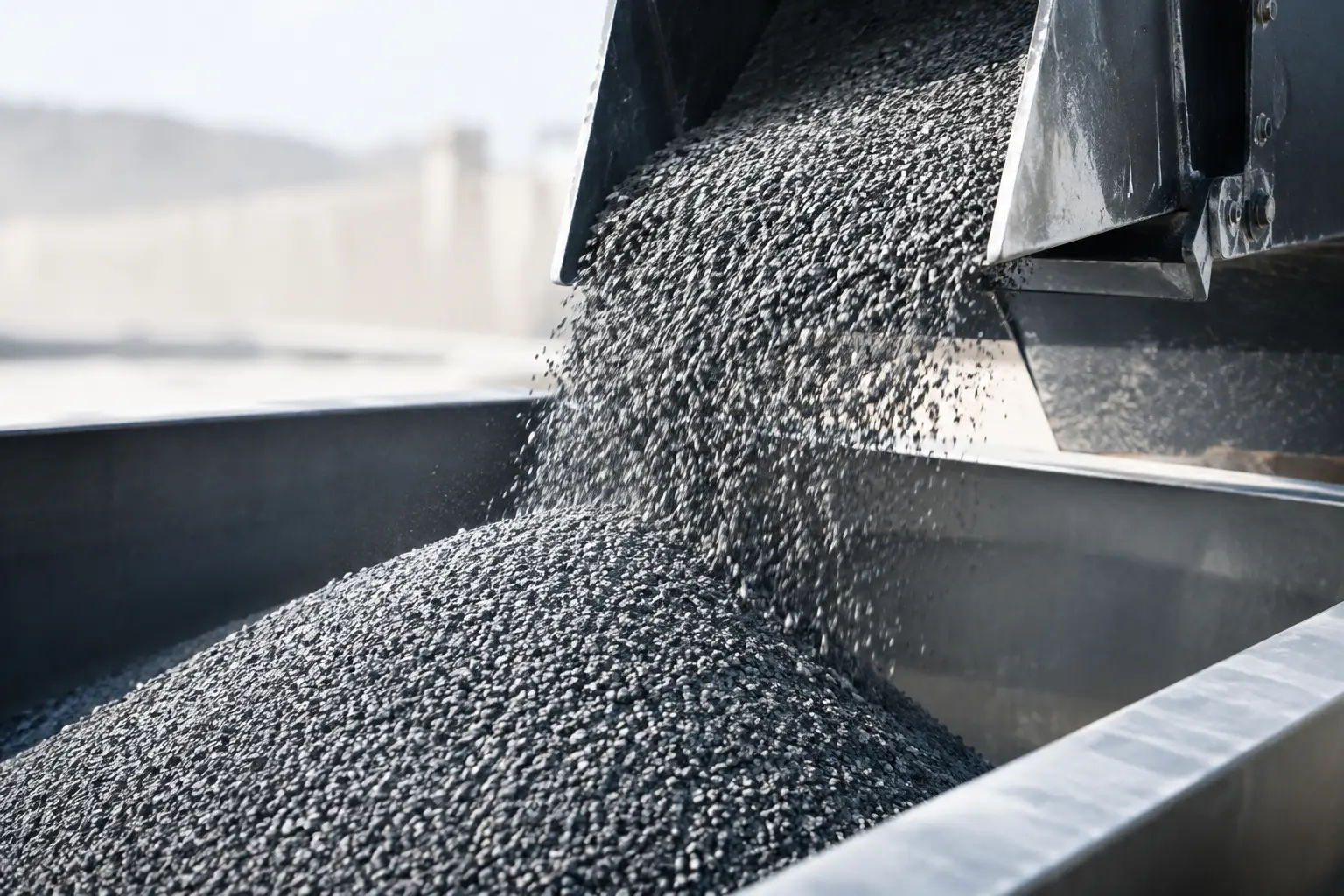
A conveyor that meets the required throughput on a datasheet can still create a production constraint. It may segregate a blend, fracture a friable ingredient, accumulate residue at transfer points, wear through elbows, or become impossible to clean within the available changeover window. Knowing how to select bulk conveying systems starts with a more useful question: what must happen to the material from the moment it leaves one process step until it arrives at the next?
For powders, granules, flakes, pellets, and other bulk solids, conveying is not simply movement. It is a process operation that affects product quality, line availability, worker exposure, maintenance demand, and the performance of upstream and downstream equipment. The right system is therefore selected around the material and the complete process, not around conveyor type alone.
Start With the Material, Not the Equipment
Material data is the foundation of a defensible conveying decision. Bulk density and nominal particle size are necessary inputs, but they do not adequately describe how a material will behave in a real production environment. A powder may appear free-flowing during a short test, then become cohesive after it absorbs humidity, compacts in a hopper, or experiences temperature changes during operation.
Characterize the material across its expected operating range. Consider flowability, particle-size distribution, moisture content, temperature, friability, abrasiveness, electrostatic behavior, and whether the material is hygroscopic, sticky, or prone to agglomeration. For hazardous materials, dust explosibility, toxicity, and containment requirements must be defined early rather than treated as add-on features.
The behavior that matters is often dynamic. A mineral powder may be highly abrasive at high velocity. A food ingredient can bridge or smear when warm. A nutraceutical blend may segregate if fine and coarse particles follow different trajectories through a pneumatic line. Battery materials may demand controlled containment and carefully selected contact materials. These distinctions determine whether the system should prioritize gentle handling, controlled velocity, easy access, wear resistance, or a sealed transfer path.
Test the Actual Product When Risk Is High
Published material properties are useful starting points, but they are not a substitute for testing representative production material. This is particularly true for new formulations, variable recycled feedstocks, blends with low-dose ingredients, or products that have limited operating history at the required rate.
Testing can reveal whether a powder plugs in a line, whether a dense-phase pneumatic system can maintain stable transport, or whether a mechanical conveyor damages product at the selected speed. It also gives engineering teams better data for feeder design, air requirements, filter sizing, and receiver geometry. The cost of early validation is generally far lower than correcting unstable conveying after installation.
Define the Duty Beyond Tons Per Hour
Required capacity is not just an hourly number. The system must be sized for how production actually operates. A line that requires 10,000 pounds per hour on average may need a significantly higher instantaneous rate if material is transferred in batches, equipment is refilled during a short window, or multiple destinations call for product at the same time.
Define the required operating profile: continuous or batch, normal and peak rates, transfer distance, vertical lift, number of pickup and discharge points, and expected operating hours. Also establish whether the conveyor must feed a process continuously, replenish a surge hopper, or transport material between discrete batch steps. Each duty creates different requirements for control response and material inventory.
A conveying system also needs to match the behavior of connected equipment. A feeder cannot maintain dosing accuracy if the receiver above it cycles between empty and overfilled. A mixer may wait for ingredients if the conveying path does not support the required sequence. A packaging line can lose efficiency if finished product is transferred faster than the downstream buffer can accept it. Capacity must be evaluated as part of the production rhythm, not in isolation.
Choose the Conveying Method Around Process Risk
Pneumatic and mechanical conveying systems each offer legitimate advantages. The appropriate choice depends on the material, layout, sanitary or containment objectives, and operating economics.
Pneumatic conveying is often well suited to enclosed transfer over longer distances, through complex routing, or between multiple levels. Vacuum conveying can simplify pickup from drums, bags, bulk bags, and process vessels while helping maintain a contained process. Pressure systems can move material over longer distances or to multiple destinations. The trade-off is that air velocity, pressure, line loading, filtration, and receiver design must be engineered carefully to avoid plugging, attrition, segregation, and excessive energy use.
Mechanical conveying can be advantageous where the route is direct, material is difficult to convey pneumatically, or lower energy demand is a priority. Screw conveyors, flexible screws, tubular drag conveyors, belt conveyors, and bucket elevators each have distinct operating envelopes. A screw conveyor can provide controlled transfer and compact installation, but may be unsuitable for fragile particles or materials that smear and accumulate. A tubular drag conveyor can provide enclosed, lower-velocity handling for some applications, but chain wear and cleanability must be evaluated. Bucket elevators are efficient for vertical lift, yet require attention to dust control, discharge behavior, and maintenance access.
The decision is rarely based on a single factor. A gentle system may be preferable for a friable product even if it has a higher initial cost. A fully enclosed pneumatic solution may be justified where containment, sanitation, or dust exposure creates operational risk. For abrasive materials, a mechanical option may avoid high-velocity wear, or a pneumatic system may require specialized bends and replaceable wear components.
Engineer the Route, Transfers, and Interfaces
Many conveying failures originate at interfaces rather than in the conveyor itself. Material must enter the system consistently, travel through a route that supports its flow behavior, and discharge into a vessel without creating dust, segregation, or poor level control.
Review the full path from source to destination. Identify available headroom, routing constraints, floor penetrations, maintenance clearances, and the number of elevation changes. Long horizontal runs, vertical lifts, and directional changes each affect power demand and material behavior. In pneumatic systems, bends deserve particular scrutiny because they influence pressure drop, particle impact, and wear. In mechanical systems, transfer chutes and inlet conditions often determine whether material builds up or flows reliably.
Source and destination equipment must be included in the design basis. This means evaluating bulk bag unloaders, bag dump stations, hoppers, feeders, mixers, mills, classifiers, bins, process reactors, and packaging equipment as connected parts of one material-handling system. The objective is stable flow from receiving through final use, with no orphaned responsibility at the handoff between machines.
Set Standards for Sanitation, Safety, and Compliance
The operating environment can eliminate otherwise viable conveying options. Food, pharmaceutical, nutraceutical, and cosmetic facilities may require sanitary construction, clean-in-place capability, validated cleaning procedures, specific surface finishes, and documentation supporting their quality systems. Changeover requirements should be translated into measurable design criteria: acceptable residual material, cleaning time, access points, and the components that must be removed or inspected.
For chemical, advanced-materials, and industrial applications, the focus may shift toward corrosion resistance, containment, dust collection, grounding and bonding, and hazardous-area requirements. Combustible dust hazards require a system-level approach that considers the material, enclosure, dust collector, isolation strategy, venting approach, and applicable codes. Equipment selection should follow a documented hazard assessment, not assumptions based on material category alone.
Access is a safety and reliability issue as well. Filters, wear parts, seals, chains, drives, and instruments need to be inspected and serviced without exposing personnel to unnecessary risk or requiring major disassembly. A system that is difficult to maintain will eventually be operated beyond its intended condition.
Specify Controls That Protect the Process
Conveying controls should do more than start and stop a motor. They need to coordinate material demand, prevent overfills, confirm successful transfer, manage line clearing where required, and provide operators with useful fault information.
At minimum, define the control philosophy for source permissives, destination availability, level detection, vacuum or pressure status, dust collection interlocks, and alarm handling. For multi-ingredient systems, controls may also need recipe management, lot traceability, automated sequencing, weighing verification, and integration with plant supervisory systems. The level of automation should reflect the consequences of an error. Manual flexibility may be appropriate for a low-volume process, while an automated high-throughput line requires repeatable logic and clear operating states.
Instrumentation must be selected for the actual environment. Fine powders can foul certain sensors. Vacuum receivers can cycle rapidly. High-temperature materials may limit sensor options. A controls strategy that accounts for these conditions reduces nuisance alarms and improves confidence in production data.
Evaluate Lifecycle Performance, Not Purchase Price
Capital cost matters, but it is only one component of the decision. Compare alternatives using total operating impact: energy consumption, compressed-air demand, replacement parts, filter life, cleaning labor, wear exposure, maintenance access, expected uptime, and the cost of product loss during failures or changeovers.
Ask suppliers to define assumptions rather than only providing a general performance statement. What material properties were used? What rate is guaranteed? How will the system respond to a blocked line, a full destination, or loss of conveying air? Which components are expected to wear, and how are they replaced? Clear answers protect the project team from scope gaps that surface late in commissioning.
Proc-X approaches bulk conveying as part of a complete processing ecosystem, aligning transfer equipment with feeding, mixing, milling, automation, containment, and packaging requirements under one engineering standard. That integrated view is especially valuable when the conveyor must protect product quality while supporting a larger production objective.
The best conveying system is not necessarily the fastest, lowest-cost, or most familiar option. It is the one that moves the real material at the required rate, within the required quality and safety limits, every shift. Select around that standard, and the conveying system becomes a dependable part of production rather than the next source of uncertainty.