A containment failure rarely begins with one visibly defective machine. More often, it develops at the interfaces: a poorly sealed drum discharge, an unbalanced receiving hopper, a filter change performed without proper isolation, or a transfer line that accumulates material and releases it during cleaning. Effective material containment design addresses these interfaces as part of the full process, protecting operators, preventing product loss, and maintaining the conditions required for repeatable production.
For powder, granular, liquid, paste, and high-viscosity processes, containment is not simply an EHS add-on. It directly affects yield, batch integrity, cleaning time, maintenance access, regulatory performance, and the reliability of upstream and downstream equipment. The correct design depends on the material, the exposure risk, the process duty, and how the production line must operate over time.
Material Containment Design Starts With the Material
Containment requirements cannot be selected from a standard equipment catalog alone. A free-flowing mineral powder, a cohesive active ingredient, a hygroscopic nutritional blend, and a fine battery-material powder can all require entirely different containment strategies, even when moved at similar rates.
The engineering basis should begin with the material’s physical behavior. Particle-size distribution, bulk density, moisture sensitivity, electrostatic behavior, dustiness, abrasiveness, flowability, and tendency to agglomerate all influence where material may escape and how it should be controlled. Fine, low-density powders can remain airborne with very little disturbance. Sticky products may not become airborne but can build up around seals, gaskets, valves, and flexible connections. Abrasive materials can progressively compromise sealing surfaces and increase leak potential over the operating life of the equipment.
The required level of containment also depends on the consequence of release. In food and nutraceutical operations, the principal concern may be allergen segregation, foreign-material control, or sanitation. Pharmaceutical and biotechnology manufacturers may need to control operator exposure and prevent cross-contamination between compounds. In chemicals, advanced materials, and battery production, the priority may include dust exposure, atmospheric moisture control, combustible-dust risk, or protection of highly valuable material.
A sound design process defines these conditions before equipment selection. It should establish the material hazards, allowable exposure or emissions targets, cleaning requirements, batch size, throughput, shift pattern, room classification, and operating interventions. Without that information, a nominally enclosed machine can still create an uncontrolled process.
Containment Is a System, Not an Enclosure
An enclosed mixer, mill, screener, feeder, or packaging machine is only one component of the containment system. The system must also account for how material enters, leaves, is sampled, is cleaned, and is serviced. The most effective designs treat every connection and intervention as an engineered containment point.
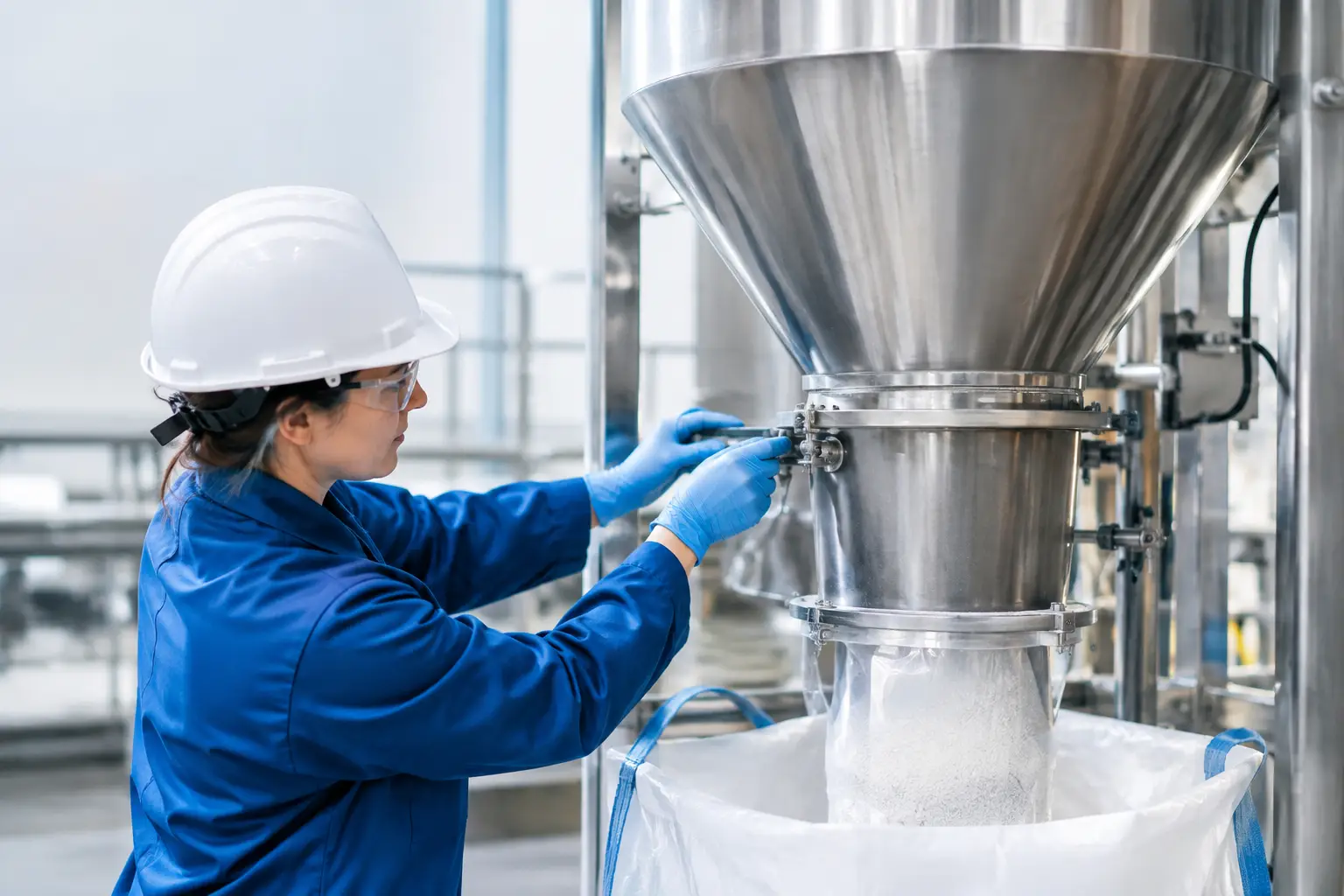
Consider a typical powder process: bulk bags are discharged into a receiving hopper, metered through a feeder, conveyed to a mill or blender, and transferred to packaging. Each step introduces pressure differences, mechanical motion, material displacement, and operator interaction. If the hopper is vented inadequately, powder can escape during filling. If the feeder transition is not sealed correctly, vibration can create dusting at the connection. If the packaging station has insufficient air control, product can migrate into the surrounding room even when the upstream equipment is fully enclosed.
This is why containment design must coordinate equipment geometry, transfer methods, venting, air filtration, dust collection, valves, access points, and operating procedures. One manufacturer. One engineering standard. One point of accountability is especially valuable when those systems must perform together rather than as separate purchased components.
Pressure Control and Air Displacement
Most dust releases are driven by air movement as much as by material movement. When a vessel is filled, displaced air must leave the vessel. When a pneumatic conveying system discharges product, conveying air and entrained fines must be separated and managed. When a container is opened or disconnected, local pressure conditions can determine whether material stays contained or becomes airborne.
Dust collection should therefore be sized and located according to actual process airflow, not based solely on general room ventilation assumptions. Excessive negative pressure can pull lightweight product toward filters, disrupt feeder performance, or increase product attrition. Insufficient capture can allow dust to escape at charging, dumping, and discharge points. The objective is controlled pressure balance that supports both containment and process performance.
Equipment vent filters, local exhaust connections, bag dump stations, enclosed charging systems, and contained discharge valves each serve different purposes. Their selection should reflect the process sequence and the expected operator actions. A high-performing system often relies on several coordinated controls rather than one large dust collector intended to solve every release point.
Transfer Points Deserve the Most Attention
Transfers are where containment designs are tested. Material changes direction, drops through a transition, enters a vessel, passes through a valve, or moves from one containment boundary to another. These areas must accommodate alignment, vibration, cleaning, thermal expansion, and routine disassembly without compromising the seal.
Rigid connections may provide dependable containment where equipment remains fixed and accurately aligned. Flexible connections can accommodate movement and simplify maintenance, but they must be selected for the product, temperature, pressure, cleaning method, and required service life. Poorly chosen flexible sleeves can trap residue, degrade under chemical exposure, or become a recurring maintenance source.
Valve selection is equally consequential. A valve must not only meter or isolate product. It must also maintain an acceptable seal, resist wear, avoid material buildup, and operate predictably with the material’s particle size and flow behavior. For highly cohesive powders, a valve that looks suitable on a general arrangement drawing may bridge, pack, or leak in service. Pilot testing and application-specific review reduce that risk before the equipment reaches the plant floor.
Design for Cleaning, Changeover, and Maintenance
Containment that cannot be cleaned or serviced efficiently can create a different production problem. In multi-product facilities, inaccessible ledges, dead zones, exposed threads, poorly drained liquid paths, and difficult-to-remove filters can extend changeovers and raise cross-contamination concerns.
The right approach depends on the process. Dry-cleaned systems may require access doors, removable contact parts, vacuum cleaning provisions, and geometry that prevents material accumulation. Wet-cleaned or CIP-capable systems require attention to spray coverage, drainage, gasket compatibility, and the ability to verify that cleaning solution reaches all product-contact surfaces. Hygienic requirements should be integrated early, because they affect vessel design, valve selection, instrumentation, supports, and piping layout.
Maintenance access also needs a containment plan. Filter replacement, screen changes, rotor inspection, seal service, and container changeover are predictable interventions. If technicians must break containment to perform them, the equipment should provide practical isolation, safe access, and a defined method for controlling residual material. Designing for those tasks reduces unplanned exposure and helps maintenance teams complete work correctly the first time.
Controls Make Containment Measurable
Mechanical design establishes the containment boundary, but controls make its performance visible. Differential-pressure monitoring across filters can identify blinding or leakage conditions. Airflow indication can confirm capture performance at critical stations. Level sensors, interlocks, and sequence controls can prevent overfilling that forces material through vents or access points.
For contained processing lines, automation should also account for normal and abnormal operating states. A system may need to prevent a discharge valve from opening until downstream collection is available, stop transfer if filter differential pressure exceeds a defined limit, or require verification that a container connection is secured before initiating flow. These functions protect the process as well as the operator.
Data collection becomes particularly valuable in regulated, high-value, or high-hazard applications. Documented alarms, operating trends, batch records, and maintenance events allow plant teams to identify recurring losses or deviations before they become production constraints. The goal is not more instrumentation for its own sake. It is actionable process visibility.
Validate the Design Under Real Operating Conditions
Containment performance should be evaluated during the operating conditions that create the greatest challenge: charging, conveying, filling, discharge, filter pulsing, cleaning, and manual intervention. A system that appears controlled while idle may release material during a high-rate fill or during a container disconnect.
Acceptance criteria should be defined at the project stage. Depending on the application, these may include airborne particulate measurements, surrogate powder testing, visual dust observations, material recovery measurements, pressure stability, cleaning verification, or operator exposure assessment. The method must match the risk. A cosmetic powder application may prioritize color-change cleaning and housekeeping, while a potent pharmaceutical application may require a more formal containment-performance target.
Validation is also an opportunity to refine operating parameters. Conveying velocity, pulse-cleaning settings, feeder speed, fill rate, and local exhaust balance can all influence containment. Commissioning should include enough time to establish those settings with the actual material or a qualified surrogate.
Build Containment Into the Capital Project
Late containment corrections are expensive because they often require changes to room layouts, ductwork, equipment supports, utilities, controls, and operating procedures. Addressing containment during process development and front-end engineering creates more options and avoids forcing a dust-control solution onto equipment that was not designed to support it.
The most reliable projects bring process engineering, operations, EHS, quality, maintenance, and automation into the design discussion early. Each group sees a different failure mode: process engineers evaluate flow and product quality; operators understand real handling steps; maintenance teams identify service constraints; quality teams define sanitation and segregation needs. Their combined input produces a containment strategy that can be operated, cleaned, and maintained at production scale.
A well-engineered containment system does more than keep material inside equipment. It gives the plant a controlled operating envelope: predictable transfers, cleaner work areas, protected product, defined maintenance practices, and fewer variables at the points where processes most often fail. When planning the next line, expansion, or equipment replacement, treat containment as a performance requirement from the first process sketch, not a correction after startup.