A mixer that performs well in a supplier demonstration can still fail to meet plant requirements. The gap is usually not motor horsepower or vessel volume. It is the difference between a controlled trial material and the full operating reality: ingredient variation, fill-level changes, upstream feeding behavior, downstream constraints, sanitation demands, and production schedules. A rigorous industrial mixer selection review closes that gap before capital is committed.
For process engineers and plant leaders, the objective is not simply to select a machine that creates movement in a vessel. It is to establish a repeatable process that produces the required blend uniformity, particle integrity, viscosity, dispersion, temperature profile, and batch-to-batch consistency at the intended production rate.
Start With the Product, Not the Mixer Catalog
Mixer selection should begin with a material and process definition detailed enough to expose the real mixing challenge. A product described only as a powder, slurry, or paste does not provide sufficient engineering information. Materials in the same broad category can behave very differently under shear, compression, heat, and residence time.
For dry materials, bulk density, particle-size distribution, moisture content, flowability, electrostatic behavior, friability, and segregation tendency all affect mixer performance. A free-flowing blend of similarly sized ingredients may require a fundamentally different approach than a formulation containing fine cohesive powders, low-inclusion actives, fibers, or liquid additions.
For liquids and high-viscosity products, the critical factors extend to rheology, yield stress, thixotropic behavior, solids loading, temperature sensitivity, entrained air, and the sequence in which components are introduced. A mixer suitable for low-viscosity liquid blending may not generate the wall turnover or localized shear needed to disperse pigments, wet powders, break agglomerates, or incorporate a viscous phase.
The product definition must also account for normal variation. Incoming raw materials change by lot, season, supplier, storage condition, and particle morphology. Designing around a single ideal sample can create a process with little operating margin. The right design basis identifies the expected range of material properties and confirms that the selected equipment can maintain quality across that range.
Industrial Mixer Selection Review: Define the Required Result
Before comparing mixer types, define how success will be measured. “Uniform mixing” is not a specification. It must be translated into measurable process and product requirements.
For a dry blend, that may mean a defined coefficient of variation at specified sample locations, with controlled segregation through discharge and transfer. For a suspension, it may mean maintaining solids distribution for a prescribed hold time. For an emulsion or dispersion, the requirement may include droplet size, agglomerate reduction, color development, viscosity, or stability after packaging. In pharmaceutical, nutraceutical, food, and specialty chemical applications, the acceptance criteria may also include cleanability, allergen control, traceability, containment, or validated cleaning performance.
Production capacity requires the same discipline. A stated batch size does not equal usable batch capacity. Effective working volume depends on the mixer geometry, impeller or agitator design, product behavior, fill range, charging sequence, and required headspace. Cycle time includes charging, mixing, liquid addition, vacuum or heating steps where applicable, discharge, cleaning, and changeover. A mixer sized only for nominal vessel volume can become the constraint in an otherwise well-designed line.
Match Mixer Mechanics to the Duty
The mixer mechanism should be selected for the work the product requires. There is no universal best mixer, and high intensity is not automatically better. Excess energy can damage particles, raise product temperature, alter crystal structure, aerate a liquid, or create difficult cleaning conditions.
Tumble and convective powder mixers are often effective for free-flowing dry blends that require gentle, efficient movement with limited particle degradation. Their performance depends heavily on ingredient characteristics, fill level, and the design of the charging and discharge system. They may be less suitable when a low-dose ingredient must be distributed through a large batch without an appropriate preblend strategy.
Plow, paddle, and fluidized-zone mixers can provide more active movement for cohesive powders, wet granulations, liquid additions, and formulations requiring rapid distribution. Choppers or high-speed intensifiers may be added when deagglomeration or liquid incorporation is required. That capability brings a trade-off: the process must be evaluated for heat generation, wear, particle attrition, and the ability to clean the high-energy zone.
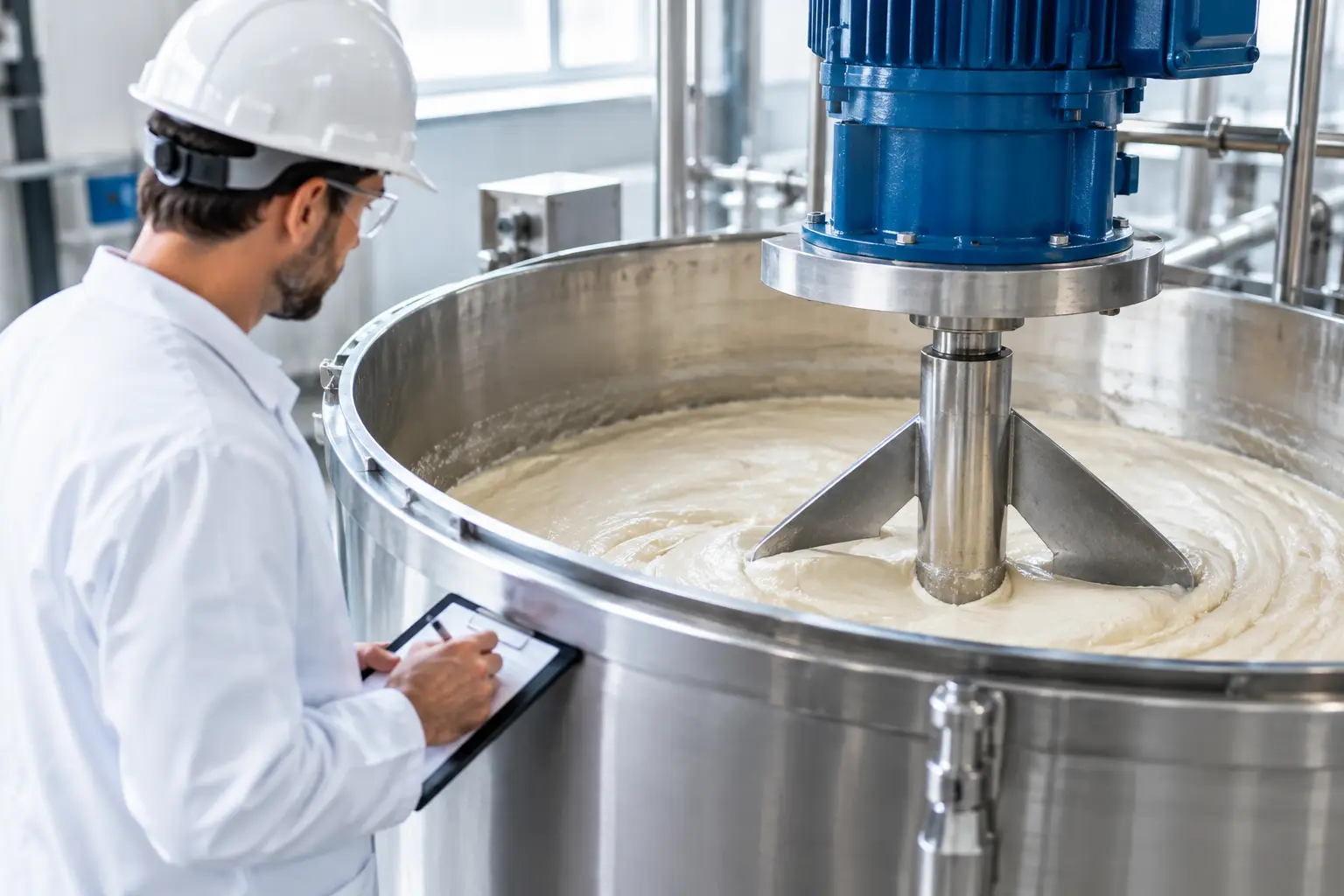
For liquid and semisolid products, agitator geometry, tip speed, power density, vessel shape, and baffle arrangement determine whether the system produces bulk turnover, shear, dispersion, or a combination of these effects. High-shear rotor-stator devices can be necessary for emulsification and powder wet-out, while anchor, helical, or planetary designs may be required to move high-viscosity material from the vessel wall into the active mixing zone. Some duties require staged processing rather than one device attempting to perform every function.
Evaluate the Entire Process Boundary
A mixer does not operate independently of the equipment around it. In many installations, the mixer is correctly specified but the overall process still underperforms because feeding, transfer, discharge, or controls were treated as secondary details.
Consider how ingredients enter the process. Manual dumping can introduce dust, variability, ergonomic risk, and charging delays. Automated weighing and dosing can improve repeatability, but only if feeder selection, refill strategy, material flow, and recipe controls are engineered for the ingredient. Fine powders that bridge or flood in a feeder will create batch variability regardless of the mixer’s capability.
Discharge deserves equal attention. A well-mixed batch can segregate in a hopper, accumulate in a valve, or leave unacceptable residual material in the vessel. For sticky pastes and high-viscosity products, discharge geometry and pumping method can determine whether the mixer is productive or spends excessive time waiting for material to leave the system. Where batch reconciliation is required, residuals must be understood and managed.
Downstream equipment also influences the selection. A mixer feeding an extruder, tablet press, filling line, dryer, or packaging system must deliver material at a controlled rate and condition. The required interface may call for buffer capacity, level control, enclosed transfer, metal detection, inline screening, vacuum conveying, or mass-flow feeding. One manufacturer. One engineering standard. One point of accountability is often the practical advantage when these interfaces must perform as one process.
Build Safety, Cleanability, and Compliance Into the Design Basis
Safety and regulatory requirements should shape the concept at the beginning, not become modifications after mechanical selection. Dust explosion risk, solvent handling, toxic exposure limits, combustible metal powders, product containment, pressure or vacuum operation, and sanitary design can each alter the appropriate mixer configuration.
For food, pharmaceutical, nutraceutical, and cosmetic production, material of construction, surface finish, drainability, gasket design, clean-in-place coverage, and inspection access must align with the product and cleaning validation strategy. A highly polished contact surface alone does not ensure cleanability. Dead zones, spray shadowing, inaccessible seals, and retained product at the discharge can undermine the cleaning process.
For abrasive minerals, ceramics, battery materials, and other wear-intensive duties, the review should address liner selection, agitator wear surfaces, seal life, bearing arrangement, and the effect of wear on product contamination and mixer clearance. For high-value or regulated products, maintenance access and parts traceability are operational requirements, not conveniences.
Use Testing to Reduce Scale-Up Risk
When product behavior is uncertain or quality requirements are demanding, testing is not an optional sales exercise. It is the evidence base for equipment selection. A useful test plan simulates the intended process, including ingredient order, realistic fill level, liquid addition rate, mixing time, and discharge behavior.
The test should measure the attributes that matter to the finished product, not just demonstrate visual uniformity. Sampling plans must account for the possibility of localized nonuniformity and segregation after mixing. For high-shear or thermal-sensitive products, monitor temperature rise, particle-size changes, viscosity, and aeration. For dry blends with low-dose components, analytical testing should verify distribution at the required concentration range.
Scale-up should be based on relevant process variables rather than assuming that a larger version of the same vessel will produce the same result. Depending on the application, those variables may include Froude number, tip speed, power per unit volume, shear rate, residence time, or material turnover pattern. The governing parameter depends on the mixing mechanism and the product objective.
Compare Lifecycle Performance, Not Purchase Price
A lower initial equipment price can be expensive if it increases batch time, cleaning labor, product loss, maintenance frequency, or downtime. The industrial mixer selection review should compare alternatives against total operating impact: throughput, energy use, operator involvement, spare parts, cleaning resources, reliability, and expected useful life.
Controls are central to that evaluation. Recipe management, automated sequencing, load cells, temperature monitoring, motor load trending, vacuum control, data collection, and interlocks can make a process repeatable and easier to troubleshoot. The appropriate level of automation depends on production scale and compliance needs, but poorly integrated controls create as much risk as poorly selected mechanical equipment.
The strongest selection decision is one that documents the material, the required finished-product result, the operating envelope, and the integration requirements before a purchase order is released. That record gives the project team a practical standard for factory acceptance, site commissioning, operator training, and future capacity expansion.
When the process is defined with this level of rigor, the mixer becomes more than a vessel with an agitator. It becomes a controlled production asset that supports consistent quality, predictable output, and accountable plant performance.