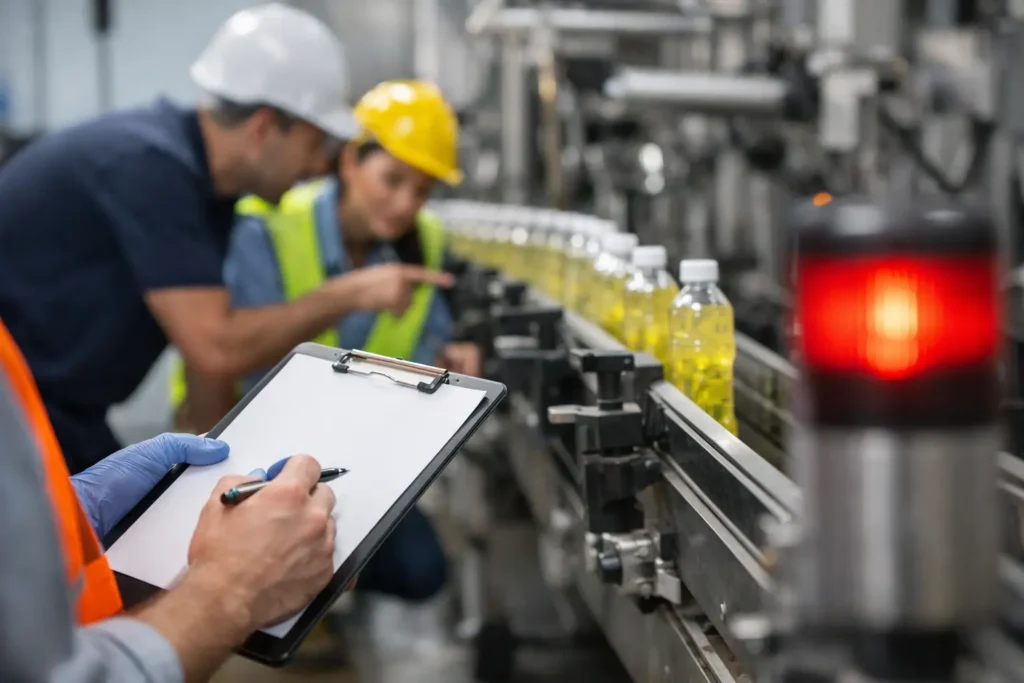
A production line can appear ready at shift start and still lose hours before the first acceptable product reaches packaging. The question, what causes line startup delays, rarely has a single answer. Most delays are created at the handoffs between material preparation, equipment condition, utilities, controls, quality release, and operator readiness. A feeder may be available while the upstream material has not reached the required condition. A mixer may be mechanically sound while its recipe has not been released. A packaging machine may be waiting on a process that has not yet achieved stable density, temperature, moisture, or particle-size performance.
For plant managers and process engineers, the relevant measure is not when equipment powers on. It is when the line produces product at the required rate, specification, and quality standard. Reducing the gap between those two events requires a system-level view of startup.
What Causes Line Startup Delays Across a Process Line?
Startup delays generally fall into two categories: predictable readiness gaps and unplanned process instability. Predictable gaps include incomplete changeover, delayed material staging, unavailable utilities, pending sanitation release, or missing operators. These issues can be designed out or controlled through stronger operating discipline.
Unplanned instability is more complex. It occurs when the line starts but cannot hold its intended operating window. Examples include inconsistent feeder rates, bridging in a hopper, poor powder conveyance, off-spec blend uniformity, excessive air entrainment, temperature drift, or downstream packaging faults caused by variable product behavior. These are often treated as isolated machine problems, even though the root cause may sit elsewhere in the process.
The highest-performing operations distinguish between a delayed start and a failed ramp-up. A delayed start is visible and easy to record. A failed ramp-up can consume more time because equipment runs, operators make adjustments, and material is produced or discarded before stable conditions are achieved.
Material Readiness Is Often the First Constraint
Raw materials determine whether a line can start predictably. Powders and granules may vary in bulk density, moisture, particle-size distribution, flowability, temperature, electrostatic behavior, or tendency to segregate. Liquids, pastes, and high-viscosity materials may require temperature conditioning, deaeration, agitation, or controlled transfer before they can enter the process consistently.
A material that is technically available is not necessarily process-ready. A hygroscopic powder may have absorbed enough moisture during storage to bridge in a hopper or smear during milling. A cohesive ingredient may form stable arches above a feeder outlet. A chilled high-viscosity material may overload a pump or create excessive pressure drop through transfer piping. If these conditions are discovered after startup, the resulting delay is usually attributed to the machine that stopped first rather than the material condition that initiated the failure.
Material staging should therefore include more than inventory confirmation. It should verify lot identity, release status, storage history, conditioning requirements, packaging integrity, and the actual physical condition of the material. For variable or difficult materials, plants benefit from defining acceptable operating ranges, not just incoming material specifications. A bulk density range, for example, can be critical to feeder calibration and batch accuracy.
Equipment Availability Does Not Equal Equipment Readiness
Mechanical availability is necessary, but startup performance depends on whether every component is in its correct operating state. A mill may be available but fitted with the wrong screen. A mixer may be clean but not fully dry. A pneumatic conveying system may have no visible fault but still have a partially blocked filter, leaking connection, or incorrect air balance. A filling system may be ready to cycle while its upstream buffer has not reached a stable level.
These conditions become more common as lines become more integrated. Feeding, transfer, milling, blending, thermal treatment, packaging, dust collection, and controls each have their own permissives, setpoints, and maintenance requirements. One unavailable component can prevent startup. More commonly, several minor conditions combine to create an unstable start.
The practical response is to build readiness checks around functional dependencies. Do not ask only whether a machine is available. Ask whether it can perform its role at the planned production rate with the planned material, recipe, and downstream demand. This shift changes startup verification from a maintenance checklist into an operational control.
Cleaning, changeover, and residual material
Changeovers are a frequent source of hidden startup losses, particularly in food, pharmaceutical, nutraceutical, cosmetic, and specialty chemical operations. Cleaning may be complete, but inspection, drying, line clearance, allergen control, or documentation may still be pending. Residual material can also affect the first production run by changing color, potency, moisture, particle distribution, or formulation composition.
There is a trade-off. Shortening a changeover without protecting cleaning and verification standards creates quality and compliance exposure. The objective is not to rush critical work. It is to separate work that must occur after the prior run from work that can be prepared in advance, such as staging tools, validated components, packaging materials, screens, filters, and approved production instructions.
Controls and Automation Can Delay a Stable Start
Controls problems are not limited to failed sensors or communication faults. Startup can be delayed by incomplete recipes, incorrect setpoints, poorly sequenced permissives, out-of-date parameter management, or automation logic that does not reflect actual process behavior.
A line may technically start while control loops are still finding their operating point. This is especially significant where dosing accuracy, temperature control, vacuum level, pressure, level control, or feed rate determines finished-product quality. Aggressive tuning can cause cycling; conservative tuning can extend ramp-up time. The correct approach depends on the process sensitivity, equipment response time, and consequences of deviation.
Recipe and parameter governance are equally important. Operators need clear control over what can be adjusted during startup, what requires supervisory approval, and what must remain locked. Uncontrolled changes made to recover production can create repeatability problems on the next run. A controlled startup profile, with validated initial setpoints and defined stabilization criteria, reduces this risk.
Utilities and Environmental Conditions Are Process Inputs
Compressed air, electrical power, vacuum, chilled water, steam, dust collection, nitrogen, exhaust capacity, and room conditions are often managed as plant services. In many processes, they are direct production inputs. A pressure drop in compressed air can affect valves, pneumatic conveying, and packaging equipment. Poor dust collection performance can interfere with material transfer and create housekeeping or safety concerns. Inadequate cooling can extend batch cycles or prevent a product from meeting its filling window.
Environmental conditions matter as well. Humidity can change powder flow and static behavior. Ambient temperature can alter viscosity, drying rate, and process heat load. In regulated operations, room pressure cascades and air-handling performance may determine whether production can be released.
Startup planning should include utility verification under load, not merely confirmation that the utility is on. A system may show acceptable pressure with idle equipment and fail once multiple users begin operating.
The Human and Information Handoffs Matter
Many startup delays arise because information is incomplete or fragmented. The outgoing shift may know that a feeder was manually adjusted. Maintenance may have replaced a component without communicating a recalibration requirement. Quality may be waiting for a sample plan or release decision. Warehousing may have staged the correct ingredient but at the wrong location or in the wrong sequence.
These are not simply communication failures. They are failures to define ownership at the point where work passes from one function to another. A reliable startup process identifies who confirms mechanical readiness, material readiness, sanitation status, recipe release, utility availability, and first-product acceptance. It also establishes escalation rules when one requirement is not met.
A short cross-functional startup review is often more effective than a longer end-of-shift report because it resolves dependencies before operators are standing at idle equipment. The review should focus on exceptions and constraints, not repeat routine information that is already visible in the production system.
Build a Startup System, Not a Startup Checklist
Checklists have value, but they cannot compensate for a process line that was engineered as disconnected equipment. A stable startup depends on compatible capacities, appropriately sized buffers, reliable material transfer, accessible cleaning points, usable controls, and instrumentation that shows operators what the process is doing.
For new installations and major upgrades, startup performance should be considered during process design. The questions are practical: Can material be conditioned before the line needs it? Is there enough surge capacity between variable-rate operations? Can equipment be cleaned and inspected within the required turnaround window? Do controls expose the conditions that cause instability? Can operators safely access the points that require adjustment?
Proc-X approaches these questions as integrated process requirements rather than individual equipment selections. One manufacturer, one engineering standard, and one point of accountability can reduce the gaps that emerge when separate systems are expected to perform as one line.
The most useful next step is to measure startup from scheduled release to sustained, in-spec production, then review every lost minute by its actual constraint. That record will show whether the operation needs better staging, stronger controls, equipment modifications, or a more integrated process design – and it gives improvement work a clear operational target.