Air in a high-viscosity product is rarely just a cosmetic defect. It can cause unstable density, poor fill-weight control, voids in extruded profiles, weak coatings, inconsistent heat transfer, oxidation, and customer-visible surface defects. Knowing how to deaerate viscous products requires more than adding a vacuum line to a mixer. The process must account for product rheology, entrained-air source, vessel geometry, agitation energy, vacuum level, temperature, and the downstream equipment that receives the material.
For manufacturers processing pastes, gels, creams, sealants, adhesives, slurries, polymer compounds, battery materials, food fillings, and pharmaceutical formulations, effective deaeration is a controlled unit operation. The target is not simply maximum vacuum. The target is a stable, repeatable product with the specified density, texture, appearance, and performance at the required production rate.
Why Viscous Products Retain Air
Low-viscosity liquids allow bubbles to rise and release relatively quickly. Viscous products behave differently. Their internal resistance slows bubble movement, while yield stress can hold bubbles in place indefinitely. A formulation may look uniform in a vessel but still contain entrained air that becomes apparent during filling, coating, extrusion, curing, or final use.
Air commonly enters during powder induction, liquid addition, high-speed dispersion, recirculation, transfer through poorly designed piping, and filling of partially empty vessels. Some formulations also generate foam because surfactants, proteins, polymers, or fine particles stabilize the air-liquid interface. In these cases, removing air is not only a vacuum challenge. It is a formulation and process-energy challenge.
The bubble size distribution matters. Large bubbles may release under moderate vacuum with slow agitation. Fine dispersed bubbles, particularly in shear-thinning or thixotropic materials, often require controlled product turnover, adequate surface renewal, and sufficient residence time under vacuum. Applying vacuum without moving the material can leave trapped air deep within the batch.
How to Deaerate Viscous Products: Start With the Material
A successful deaeration strategy begins with material characterization. Process teams should understand viscosity across the expected shear-rate and temperature range, density targets, yield stress, vapor pressure, entrained-air level, and sensitivity to heat or shear. A product that flows readily at 120°F may require a very different vacuum and mixing approach at 70°F.
Temperature is often one of the most effective variables. Modest heating reduces viscosity, allowing bubbles to migrate and expand more readily under vacuum. However, heating can also change flavor, color, moisture content, reaction rate, or active-ingredient stability. It can increase vapor load on the vacuum system as well. The usable temperature range must therefore be established from product requirements, not selected solely to improve deaeration speed.
Rheology also determines agitator selection. A conventional high-speed disperser can introduce air into a thick product if the vortex reaches the liquid surface. Conversely, an anchor, gate, helical, or planetary agitator can sweep the vessel wall and move high-viscosity material toward the low-pressure zone with less surface aeration. Many demanding applications require a combination of low-speed bulk movement and high-shear dispersion, sequenced rather than operated at maximum energy throughout the batch.
Use Vacuum as a Controlled Process Variable
Vacuum lowers the pressure above the product, causing entrained gas bubbles to expand and rise. In a viscous mass, that expansion can help release bubbles that would otherwise remain trapped. But deeper vacuum is not automatically better.
If vacuum is applied too quickly, a foaming product can expand sharply, climb the vessel wall, contaminate filters or vacuum lines, and reduce usable vessel capacity. Rapid pressure reduction can also pull volatile ingredients from the formulation or flash moisture from temperature-sensitive products. For reactive, solvent-containing, or regulated materials, the vacuum train must be designed for compatible condensers, filtration, recovery, emissions handling, and safe operation.
A staged vacuum profile is often more effective than a single aggressive pull-down. The operator can first apply moderate vacuum while maintaining slow bulk agitation, allowing the product to expand without overflowing. Once the foam collapses and the material turns over consistently, the system can move toward the final vacuum setpoint. The correct profile depends on the product, batch volume, headspace, vessel geometry, and available vacuum capacity.
Vacuum performance should be measured at the vessel, not assumed from the pump nameplate. Restrictions in piping, undersized valves, clogged filters, condenser loading, leaks, or excessive vapor generation can prevent the vessel from reaching its intended operating pressure. Instrumenting vessel pressure and trend monitoring it through the batch gives engineering and production teams a clearer basis for repeatable control.
Match Agitation to the Deaeration Stage
Agitation has two opposing effects. It exposes fresh material to the vessel surface and helps transport bubbles from the bulk. At excessive speed or with poor impeller submergence, it also folds air into the product. The right approach changes by stage.
During powder wet-out and dispersion, the system may need high shear to break agglomerates and develop the required texture. During final deaeration, lower-speed bulk agitation is generally preferred. The goal is complete turnover without a vortex, splashing, or air entrainment. In highly viscous pastes, wall scrapers and close-clearance agitators are especially valuable because stagnant zones can retain both unmixed ingredients and trapped air.
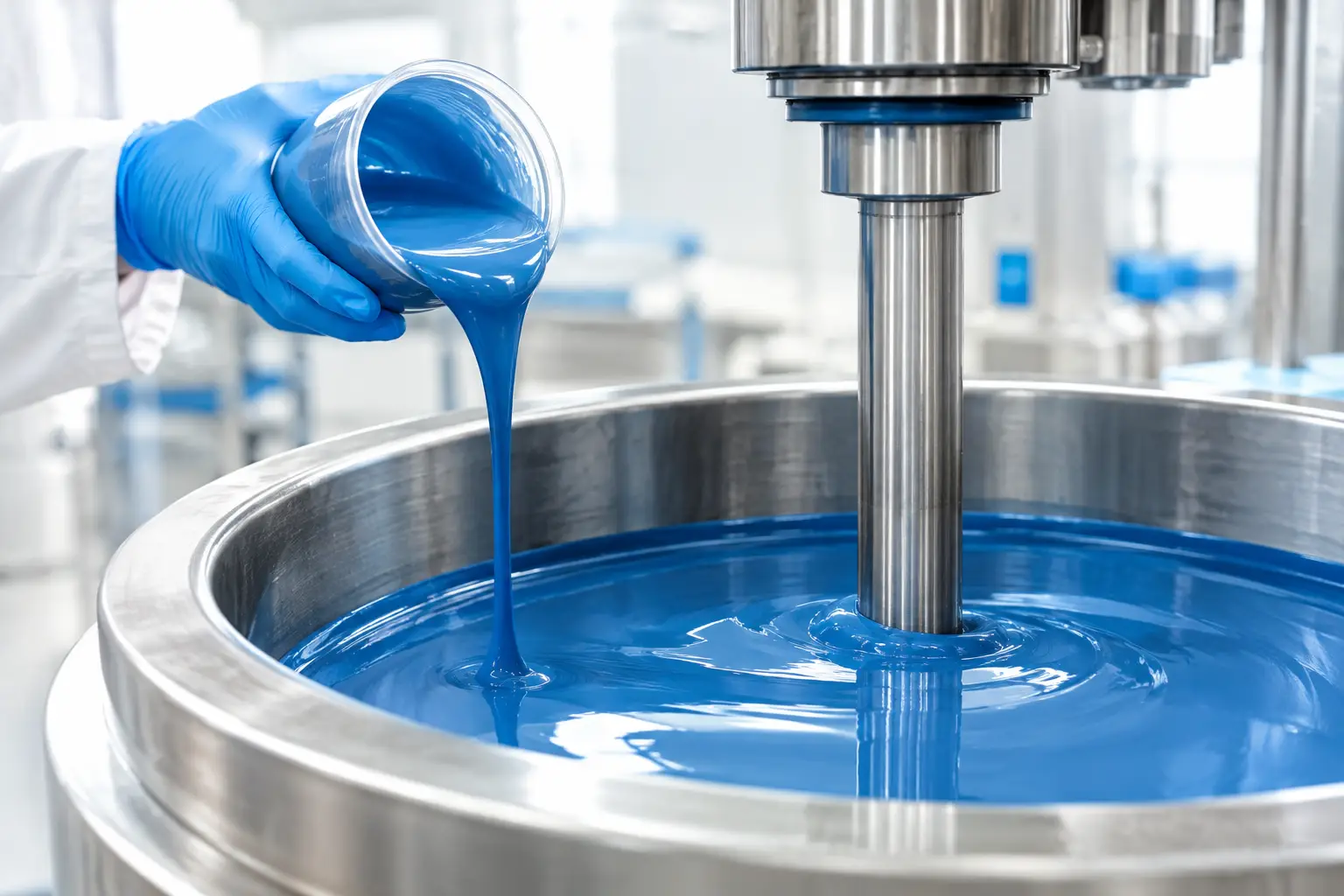
Planetary mixers are frequently selected for very high-viscosity products because their rotating and orbiting tools sweep a large portion of the vessel volume. Vacuum-rated planetary systems can combine mixing and deaeration in a closed vessel, reducing transfers and limiting the opportunity for re-aeration. For lower-viscosity slurries or emulsions, a vacuum-rated batch vessel with properly selected agitators may provide the necessary performance at a more favorable capital cost.
The trade-off is throughput. A mixer designed for gentle final deaeration may require longer cycle times. A more aggressive system can shorten processing time but may increase heat generation or entrained air. The practical answer is usually a validated operating sequence that applies energy only where it adds value.
Design the Full System, Not Just the Vessel
A well-deaerated batch can pick up air again during discharge, transfer, or filling. System design must protect the result from vessel outlet to package or downstream process.
For high-viscosity products, bottom discharge with a positive-displacement pump is commonly more controlled than drawing material through a top-mounted suction line. Short, properly sized piping runs reduce pressure loss and residence time. Avoid sudden expansions, sharp elbows, leaking connections, and pump conditions that promote cavitation or pulsation. Where practical, maintain flooded suction at the transfer pump and use low-shear pumping technology matched to the material.
Filling equipment also requires attention. A nozzle that lifts excessively, a poorly controlled suck-back setting, or a high-velocity fill can introduce air into the package even when the upstream batch meets density requirements. For products requiring precision fill weights, density should be checked at the actual filler feed condition, not only in the process vessel.
An integrated system should coordinate mixer speed, jacket temperature, vacuum setpoint, vacuum ramp rate, discharge pressure, pump speed, and filler demand. This is where process controls provide measurable value. Recipe-based automation reduces operator-to-operator variation, while batch trends create evidence for troubleshooting, scale-up, and quality review.
Verify Deaeration With Product-Relevant Measurements
Visual inspection alone is not enough. Some of the most damaging air content is too fine to see in the vessel. Verification should reflect the critical quality attributes of the finished product.
Useful measures can include bulk density, specific gravity, fill-weight consistency, void content, viscosity, appearance after dispensing, extrusion continuity, coating smoothness, and microscopy where applicable. In pharmaceutical, nutraceutical, food, and other controlled environments, the test method and acceptable range should be established as part of process validation.
When results vary, investigate the process sequence before changing one setting at random. Review raw-material temperature, powder addition rate, agitator speed, vessel fill level, vacuum trend, foam behavior, hold time, transfer conditions, and cleaning status. A recurring deaeration problem often points to a broader integration issue, such as inconsistent ingredient delivery, an oversized high-shear step, or insufficient headspace.
Common Deaeration Failures and Their Causes
Several failure patterns appear repeatedly in high-viscosity processing. Persistent foam under vacuum can indicate an overly rapid vacuum ramp, excessive surfactant activity, high product temperature, or insufficient vessel headspace. Air reappearing after discharge may indicate a leaking suction connection, pump cavitation, or turbulent transfer.
Long deaeration cycles can result from inadequate material turnover, poor agitator-to-vessel geometry, excessive product viscosity at operating temperature, or insufficient effective vacuum at the vessel. If the product loses moisture or volatile components, the process may be operating at too deep a vacuum, too high a temperature, or too long a hold time.
These conditions should be resolved through structured trials that change one meaningful variable at a time. A production-scale solution must balance quality, batch time, cleanability, safety, and maintainability. Equipment that performs well in a laboratory without representative batch depth, heat load, or transfer conditions may not deliver the same result on the plant floor.
For complex products, the most reliable path is an application-specific vacuum mixing and transfer system engineered around the material rather than a generic deaeration specification. Proc-X approaches these projects as connected process systems, aligning vessel design, agitation, vacuum capacity, thermal control, transfer, automation, and downstream packaging requirements under one engineering standard.
The best deaeration process is the one operators can repeat shift after shift without compensating for hidden variability. Establish the product window, control the vacuum and mixing sequence, and protect the material through transfer. That discipline turns air removal from a recurring production issue into a predictable part of manufacturing performance.