Home / Mixing / Fluidized Zone Mixers
QuantumX · PROC-X MANUFACTURING GROUP
Fluidized Zone Mixers
Fast circulation. Controlled uniformity.
Single-shaft and twin-shaft fluidized zone mixers for powder blending and selected powder-liquid duties, with vacuum mixer/dryer variants for integrated processing.
The process, explained.
01
Lift
Agitators lift the material into a mechanically fluidized zone.
02
Exchange
Overlapping material movement distributes ingredients.
03
Control
Set fill, speed, addition sequence and discharge to the formulation.
What is a fluidized zone mixer?
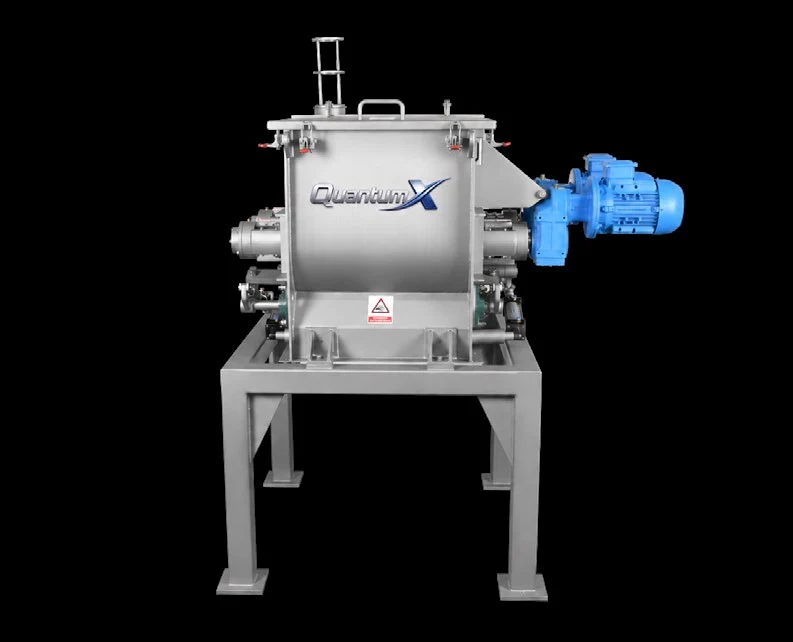
A fluidized zone mixer uses mechanical agitation to lift and redistribute particles in a three-dimensional flow. It does not require a gas-fluidized bed to create that motion. QuantumX offers PFBS single-shaft and PFB dual-shaft configurations, plus PFBSD and PFBD vacuum mixer/dryer variants.
Fluidized-zone mixer models and technical specifications
PFBS is the single-shaft fluidized-zone mixer family. PFB is the dual-shaft fluidized-zone mixer family. The letter D identifies the vacuum version: PFBSD for single-shaft and PFBD for dual-shaft configurations.
The tables below give standard mixer specifications. Vacuum-version drive power, speed, working volume, dimensions and ancillary equipment are confirmed separately for the selected duty; standard mixer ratings must not be assumed to apply to a D version.
PFBS — single-shaft fluidized-zone mixers
38 models, 5–30,000 L total volume. Working-volume limits are 40–60% in the supplied PFBS V2024 sheet.
| Model | Total volume (L) | Minimum working volume 40% (L) | Maximum working volume 60% (L) | Main motor (kW) | Agitator speed (rpm) | Chopper |
|---|---|---|---|---|---|---|
| PFBS-5L-CP * | 5 | 2 | 3 | 1.1 | 365 | 0.55kW x1 (3000rpm) |
| PFBS-10L-CP * | 10 | 4 | 6 | 1.1 | 365 | 0.55kW x1 (3000rpm) |
| PFBS-15L-CP * | 15 | 6 | 9 | 1.1 | 280 | 0.55kW x1 (3000rpm) |
| PFBS-20L-CP * | 20 | 8 | 12 | 1.1 | 280 | 0.55kW x1 (3000rpm) |
| PFBS-30 | 30 | 12 | 18 | 2.2 | 155 | 1.1kW x1 |
| PFBS-45 | 45 | 18 | 27 | 2.2 | 138 | 1.1kW x1 |
| PFBS-50 | 50 | 20 | 30 | 2.2 | 138 | 1.1kW x1 |
| PFBS-60 | 60 | 24 | 36 | 3 | 134 | 1.1kW x1 |
| PFBS-70 | 70 | 28 | 42 | 3 | 130 | 1.1kW x1 |
| PFBS-100 | 100 | 40 | 60 | 4 | 130 | 2.2kW x1 |
| PFBS-150 | 150 | 60 | 90 | 4 | 120 | 2.2kW x1 |
| PFBS-200 | 200 | 80 | 120 | 5.5 | 95 | 2.2kW x1 |
| PFBS-250 | 250 | 100 | 150 | 5.5 | 90 | 2.2kW x1 |
| PFBS-300 | 300 | 120 | 180 | 7.5 | 90 | 2.2kW x1 |
| PFBS-400 | 400 | 160 | 240 | 7.5 | 80 | 2.2kW x2 |
| PFBS-500 | 500 | 200 | 300 | 11 | 80 | 2.2kW x2 |
| PFBS-600 | 600 | 240 | 360 | 11 | 75 | 2.2kW x2 |
| PFBS-700 | 700 | 280 | 420 | 15 | 75 | 2.2kW x2 |
| PFBS-750 | 750 | 300 | 450 | 15 | 75 | 2.2kW x2 |
| PFBS-800 | 800 | 320 | 480 | 18.5 | 75 | 2.2kW x2 |
| PFBS-1000 | 1,000 | 400 | 600 | 18.5 | 72 | 2.2kW x2 |
| PFBS-1200 | 1,200 | 480 | 720 | 22 | 72 | 2.2kW x2 |
| PFBS-1500 | 1,500 | 600 | 900 | 22 | 68 | 2.2kW x2 |
| PFBS-2000 | 2,000 | 800 | 1,200 | 30 | 64 | 2.2kW x2 |
| PFBS-2500 | 2,500 | 1,000 | 1,500 | 37 | 64 | 2.2kW x3 |
| PFBS-3000 | 3,000 | 1,200 | 1,800 | 37 | 60 | 2.2kW x3 |
| PFBS-4000 | 4,000 | 1,600 | 2,400 | 45 | 57 | 4kW x4 |
| PFBS-5000 | 5,000 | 2,000 | 3,000 | 45 | 52 | 4kW x4 |
| PFBS-6000 | 6,000 | 2,400 | 3,600 | 55 | 50 | 4kW x4 |
| PFBS-7000 | 7,000 | 2,800 | 4,200 | 55 | 47 | 4kW x4 |
| PFBS-8000 | 8,000 | 3,200 | 4,800 | 75 | 47 | 4kW x4 |
| PFBS-9000 | 9,000 | 3,600 | 5,400 | 75 | 45 | 7.5kW x5 |
| PFBS-10000 | 10,000 | 4,000 | 6,000 | 90 | 45 | 7.5kW x5 |
| PFBS-12000 * | 12,000 | 4,800 | 7,200 | 110 | 40 | 7.5kW x5 |
| PFBS-15000 * | 15,000 | 6,000 | 9,000 | 132 | 35 | 7.5kW x5 |
| PFBS-20000 * | 20,000 | 8,000 | 12,000 | 160 | 32 | 7.5kW x5 |
| PFBS-25000 * | 25,000 | 10,000 | 15,000 | 200 | 30 | 7.5kW x5 |
| PFBS-30000 * | 30,000 | 12,000 | 18,000 | 250 | 28 | 7.5kW x5 |
PFB — dual-shaft fluidized-zone mixers
36 models, 5–20,000 L total volume. Working-volume limits are 25–60% in the supplied PFB V2025 sheet. PFB-B model designations are retained for the listed 200–20,000 L configurations.
| Model | Total volume (L) | Minimum working volume 25% (L) | Maximum working volume 60% (L) | Main motor (kW) | Agitator speed (rpm) | Chopper |
|---|---|---|---|---|---|---|
| PFB-5L-CP * | 5 | 1.25 | 3 | 1.1 | 365 | 0.55kW x2 (3000rpm) |
| PFB-10L-CP * | 10 | 2.5 | 6 | 1.1 | 365 | 0.55kW x2 (3000rpm) |
| PFB-15L-CP * | 15 | 3.75 | 9 | 1.1 | 280 | 0.55kW x2 (3000rpm) |
| PFB-20L-CP * | 20 | 5 | 12 | 1.1 | 280 | 0.55kW x2 (3000rpm) |
| PFB-30 | 30 | 7.5 | 18 | 1.5 | 140 | 1.1kW x2 |
| PFB-45 | 45 | 11.25 | 27 | 1.5 | 125 | 1.1kW x2 |
| PFB-50 | 50 | 12.5 | 30 | 2.2 | 125 | 1.1kW x2 |
| PFB-60 | 60 | 15 | 36 | 2.2 | 115 | 1.1kW x2 |
| PFB-70 | 70 | 17.5 | 42 | 3 | 115 | 1.1kW x2 |
| PFB-100 | 100 | 25 | 60 | 3 | 105 | 2.2kW x2 |
| PFB-150 | 150 | 37.5 | 90 | 3 | 95 | 2.2kW x2 |
| PFB-B-200 | 200 | 50 | 120 | 3 | 60 | 2.2kW x2 |
| PFB-B-250 | 250 | 62.5 | 150 | 4 | 60 | 2.2kW x2 |
| PFB-B-300 | 300 | 75 | 180 | 5.5 | 60 | 2.2kW x2 |
| PFB-B-400 | 400 | 100 | 240 | 7.5 | 60 | 2.2kW x2 |
| PFB-B-500 | 500 | 125 | 300 | 11 | 50 | 2.2kW x2 |
| PFB-B-600 | 600 | 150 | 360 | 11 | 50 | 2.2kW x2 |
| PFB-B-700 | 700 | 175 | 420 | 11 | 50 | 2.2kW x2 |
| PFB-B-750 | 750 | 187.5 | 450 | 11 | 50 | 2.2kW x2 |
| PFB-B-800 | 800 | 200 | 480 | 11 | 45 | 2.2kW x2 |
| PFB-B-1000 | 1,000 | 250 | 600 | 11 | 45 | 2.2kW x2 |
| PFB-B-1200 | 1,200 | 300 | 720 | 15 | 45 | 2.2kW x2 |
| PFB-B-1500 | 1,500 | 375 | 900 | 15 | 45 | 2.2kW x2 |
| PFB-B-2000 | 2,000 | 500 | 1,200 | 22 | 45 | 2.2kW x2 |
| PFB-B-2500 | 2,500 | 625 | 1,500 | 22 | 45 | 2.2kW x2 |
| PFB-B-3000 | 3,000 | 750 | 1,800 | 22 | 40 | 2.2kW x2 |
| PFB-B-4000 | 4,000 | 1,000 | 2,400 | 30 | 30 | 4kW x2 |
| PFB-B-5000 | 5,000 | 1,250 | 3,000 | 37 | 30 | 4kW x2 |
| PFB-B-6000 | 6,000 | 1,500 | 3,600 | 45 | 30 | 4kW x2 |
| PFB-B-7000 | 7,000 | 1,750 | 4,200 | 45 | 30 | 4kW x2 |
| PFB-B-8000 | 8,000 | 2,000 | 4,800 | 55 | 30 | 4kW x2 |
| PFB-B-9000 | 9,000 | 2,250 | 5,400 | 55 | 30 | 7.5kW x2 |
| PFB-B-10000 | 10,000 | 2,500 | 6,000 | 55 | 30 | 7.5kW x2 |
| PFB-B-12000 | 12,000 | 3,000 | 7,200 | 75 | 30 | 7.5kW x2 |
| PFB-B-15000 | 15,000 | 3,750 | 9,000 | 90 | 25 | 7.5kW x2 |
| PFB-B-20000 | 20,000 | 5,000 | 12,000 | 110 | 20 | 7.5kW x2 |
Vacuum configurations — PFBSD and PFBD
Specify PFBSD for a single-shaft vacuum mixer and PFBD for a dual-shaft vacuum mixer. Provide the material, batch mass, bulk density, target working volume and required vacuum duty. For drying applications, also define starting and final moisture, temperature limits and vapor-handling requirements.
The supplied PFBS and PFB sheets do not list separate D-version technical ratings. Vacuum configuration specifications are available on application; no standard mixer motor, speed or capacity value in these tables is presented as a confirmed vacuum-version rating.
Drive, choppers and configuration
The PFB sheet lists timing-gear drives on the 5–45 L models, chain drives on the 50–150 L models, and a single motor with dual gearboxes and belt drive on PFB-B models from 200 L upward. Dual shaft does not mean that the listed motor power should automatically be doubled.
Chopper entries give the listed power per unit and quantity, separately from the main motor. The 5–20 L L-CP models list 0.55 kW choppers at 3,000 rpm: one on PFBS and two on PFB.
Total volume is distinct from usable working batch volume. Final fill depends on material and process duty; batch mass also depends on bulk density. Asterisks (*) are retained from the source model names; no definition is included in the supplied sheets. Confirm marked values and final installation specifications with Proc-X.
Compare ploughshare mixers and ribbon mixers, explore vacuum mixers and dryers, or discuss your application.
Select around the result.
Single shaft versus twin shaft
The single-shaft arrangement uses plow- or paddle-shaped tools to move material through the vessel, with optional choppers for agglomerates and liquid addition. The twin-shaft arrangement uses counter-rotating shafts to create overlapping mixing zones. Compare the formulation, shear tolerance, access and discharge needs rather than assuming two shafts are always preferable.
Blend powders and incorporate additives
Applications described in the brochure include food ingredients, nutraceuticals, chemicals, ceramics and specialty powders. Assess bulk-density differences, particle-size distribution, liquid percentage and fragility. High agitation can damage delicate particles, while sticky formulations may require a different geometry or more specific torque evaluation.
Vacuum mixing and drying variants
PFBSD and PFBD configurations combine mixing with jacketed heat transfer and vacuum processing. Condensers and recovery tanks can be included where vapor recovery is needed. Specify the starting liquid content, final moisture or solvent target, product-temperature ceiling and available utilities so the drying duty can be evaluated.
Measure the complete batch cycle
A short mixing step alone does not establish production capacity. Include charging, minor-ingredient dosing, liquid spraying, discharge and cleaning. Define a representative sampling plan, blend-uniformity target and allowable particle damage. Any claimed cycle-time advantage needs comparison on the same formulation and acceptance criteria.
Go deeper with QuantumX.

Technical brochure and specialist expertise
Explore the supplied brochure, then discuss the configuration with Proc-X or visit the specialist brand website.
These are the original supplied brochures. Some editions contain earlier contact details or model designations. For current project support, use john.paul@procxinc.com or +1 (872) 260-5071; confirm final specifications in your quotation.
Questions engineers ask.
Does fluidized mixing require compressed air?
The mixing zone described here is created mechanically by the agitators. Utilities for actuators, cleaning or other options are separate requirements.
Can it handle liquid addition?
Liquid-addition ports, spray systems and choppers are available options. The amount and rate of liquid addition must suit the powder and desired final consistency.
How is mixing time confirmed?
Confirm it against a defined uniformity criterion and sampling method using representative material. Include filling and discharge when evaluating hourly capacity.
Compare related technologies.
QuantumX
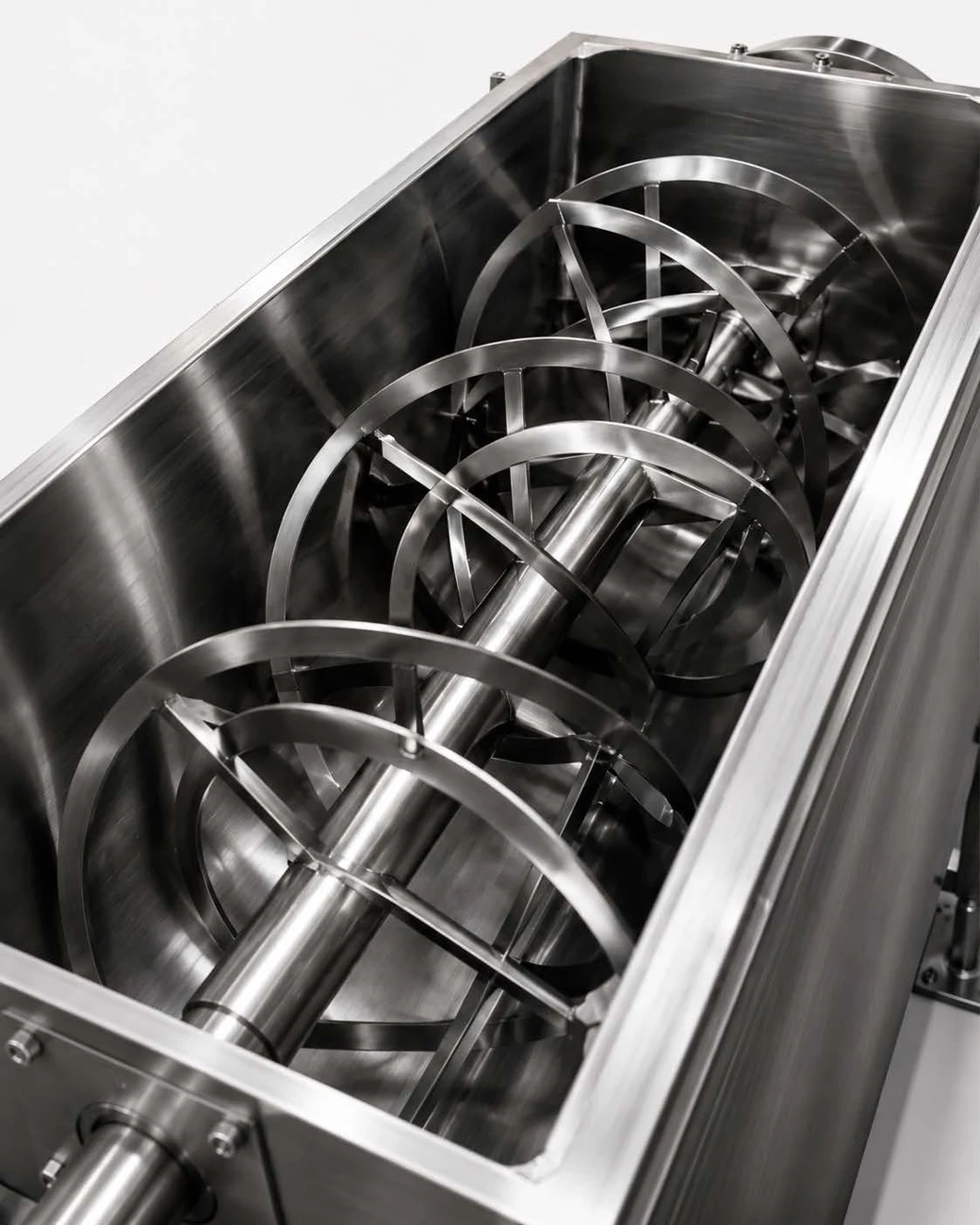
Ribbon Mixers & Blenders
Horizontal and vertical ribbon mixers for powders, granules and selected pastes. Build the blend around your batch size, ingredient behavior and production cycle.
QuantumX
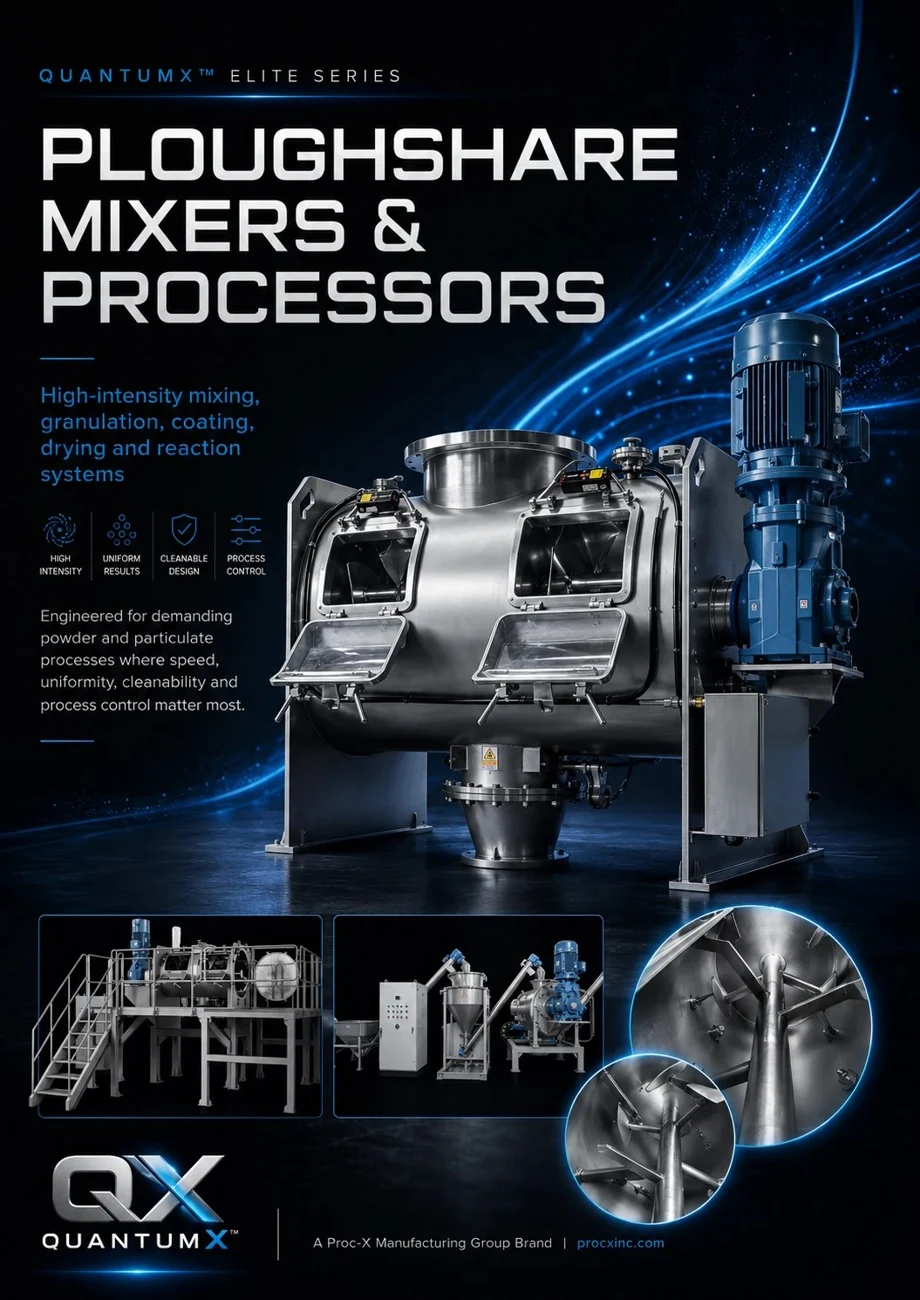
Ploughshare Mixers & Processors
Ploughshare mixers, also called plow mixers, for intensive powder blending, liquid incorporation, coating and granulation—with processor configurations for thermal and vacuum duties.
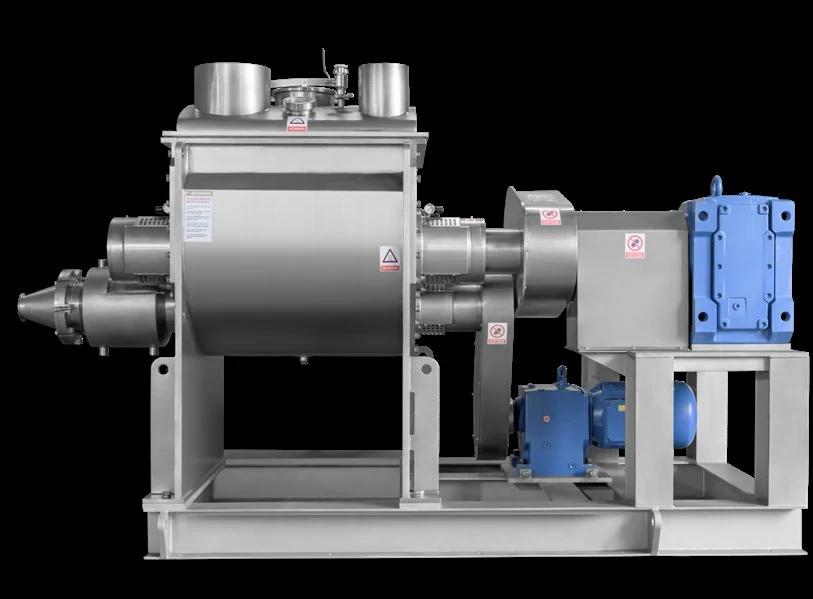
QuantumX
Sigma Mixers & Extruder Discharge
Double-arm kneaders for sticky, high-viscosity compounds—with tilting, bottom-discharge and screw-extruder options to connect mixing with the next process step.
Your material writes the specification.
Tell us what you process, the result you need and the capacity you want to achieve. We will help define the next engineering step.