PROC-X MANUFACTURING GROUP
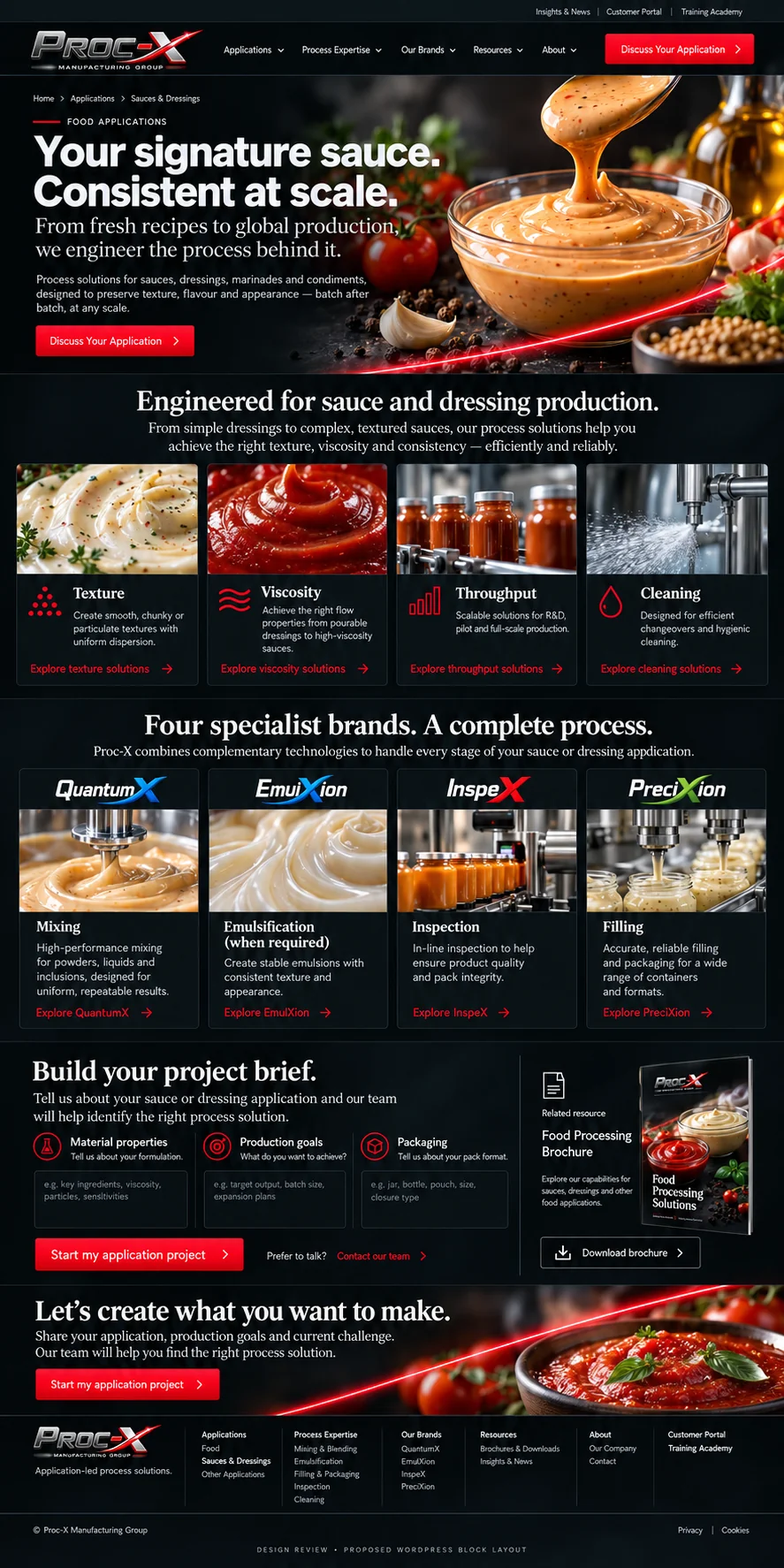
Your signature sauce. Consistent at scale.
Mixing, emulsification, inspection and filling for the sauces and dressings you want to make.
Engineered for sauce and dressing production.
Texture
Preserve the desired product structure.
Viscosity
Measure at operating temperature.
Throughput
Coordinate batch and filling cycles.
Cleaning
Agree changeover requirements.
Four specialist brands. A complete process.


Build your project brief.
Describe ingredients, addition sequence, viscosity, particulates, batch size and packaging format.
Knowledge for your application.
FEATURED RESOURCE
Food Processing Brochure
Explore the process considerations behind your material, formulation and production requirements.
Sauce & Dressing Processing Systems: Mixing to Filling
Build the process around your recipe
Proc-X considers sauce and dressing production as a connected sequence: ingredient dosing, powder incorporation, mixing, emulsification where required, temperature control, transfer, inspection and filling. The objective is to preserve the intended texture while matching batch production to packaging demand. Mayonnaise-style emulsions, marinades and particulate sauces can require different configurations even when their batch volumes are similar.
Powder incorporation and hydration
Gums, starches, spices and other dry ingredients may behave differently when added to liquid. Addition rate, wetting and the time required for hydration influence lump formation and viscosity development. Describe the ingredients and addition sequence so powder induction or batch mixing can be evaluated. A higher mixing speed is not a substitute for a suitable formulation sequence.
Emulsification and particulate preservation
Where oil must be dispersed into a water phase, shear and addition conditions affect emulsion formation. High shear mixing and high-pressure homogenization are different process options, not interchangeable defaults. If the product contains herbs, seeds or vegetable pieces, identify when they are added and the particle structure that must remain intact during mixing, pumping and filling.
Temperature, vacuum and product transfer
Provide the temperature profile and the purpose of each heating or cooling stage. Thermal food-safety requirements need a defined, validated process. Where aeration affects appearance or filling, discuss whether vacuum processing is appropriate. Pump and pipework selection should account for viscosity at transfer temperature, required flow and the size of any particulates.
Coordinate the line with packaging
Batch cycle time includes charging, processing and discharge. Buffer capacity may be needed to reconcile batch production with continuous filling. Specify the container, fill quantity, closure and desired line speed. QuantumX and EmulXion support relevant processing discussions, while InspeX inspection and PreciXion filling can be considered at the appropriate downstream stages.
Prepare your sauce-processing inquiry
Send a product description, working batch volume, target hourly output, viscosity with measurement conditions, largest particulate size and cleaning requirements. Include utility availability and a layout if known. A representative product trial or agreed test protocol may be needed before finalizing performance criteria for a new formulation.
Questions about your process.
Is a homogenizer required for every sauce?
No. Some products require gentle blending or controlled cooking rather than intensive size reduction. Select the mixing approach according to texture, emulsion requirements and the ingredients that must retain their structure.
How do I scale from a laboratory recipe?
Document ingredient order, temperature profile, mixing stages and product-quality checks. Scale-up should evaluate circulation, shear exposure, heating and cooling, not simply multiply the laboratory mixing time.
What determines the filling system?
Container format, fill quantity, viscosity, temperature, particulates and required line speed guide selection. The transfer and buffer arrangements should supply the filler consistently.
Can cleaning be considered during system design?
Yes. Identify allergens, changeover frequency, cleaning chemicals and the intended cleaning method. Access, drainability and retained product need review across the connected process.
Tell us what you want to make.
Share your application, production goals and current challenge.