PreciXion
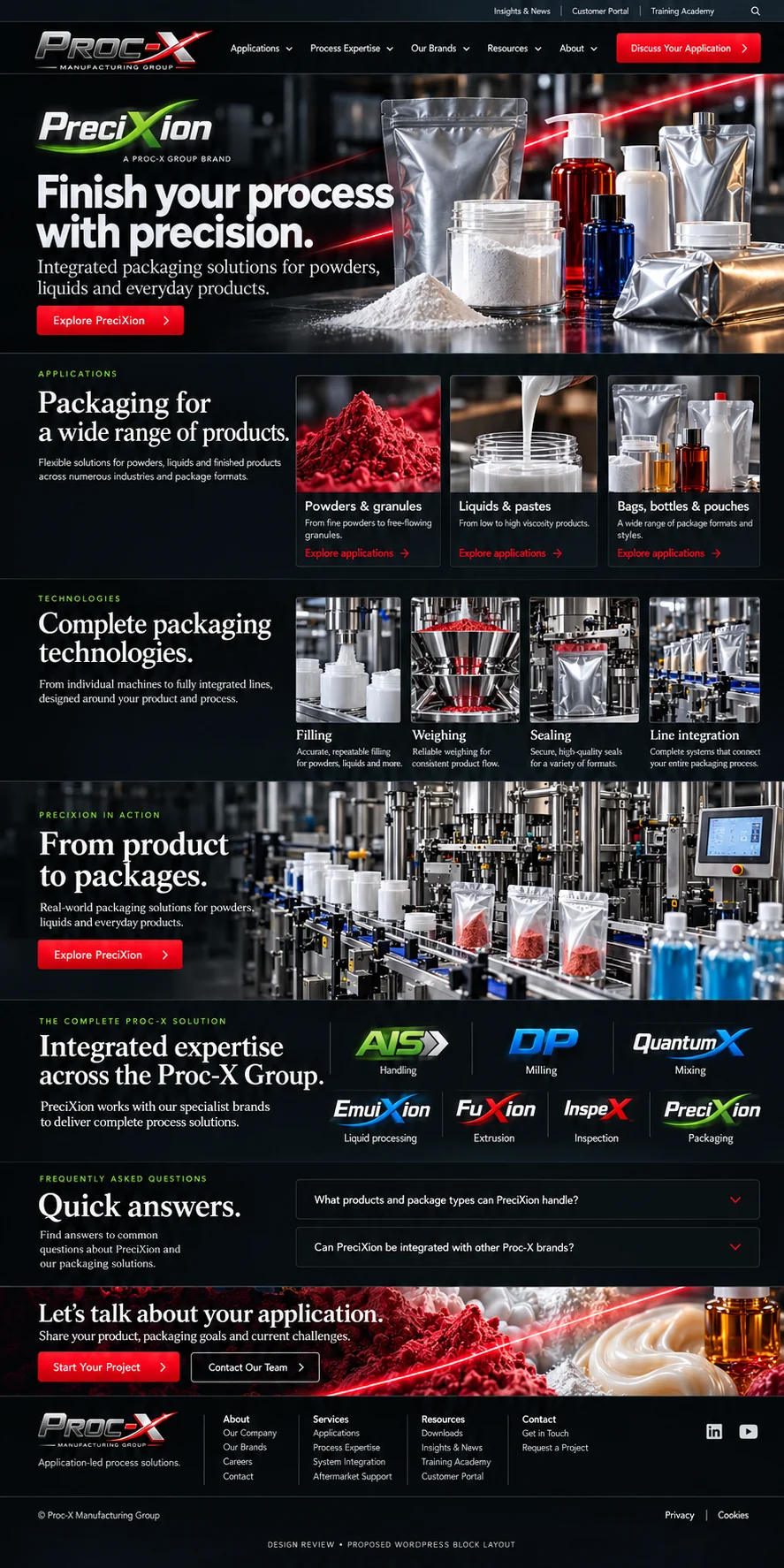
Finish your process with precision.
Filling and packaging systems that connect your product, package and production requirements.
Packaging for a wide range of products.
Powders & granules
Powder flow, bulk-density variation, dust and segregation affect filling.
Liquids & pastes
Viscosity at filling temperature, foaming, stringing and particulate size influence the filling configuration.
Bags, bottles & pouches
Filling, sealing, coding and inspection must work as a connected sequence.
Technologies matched to your process.

Engineered for real-world materials and processes.
Match the technology to your product characteristics, working capacity, cleaning expectations and connected process stages. Our discussion starts with the material and the outcome you need.
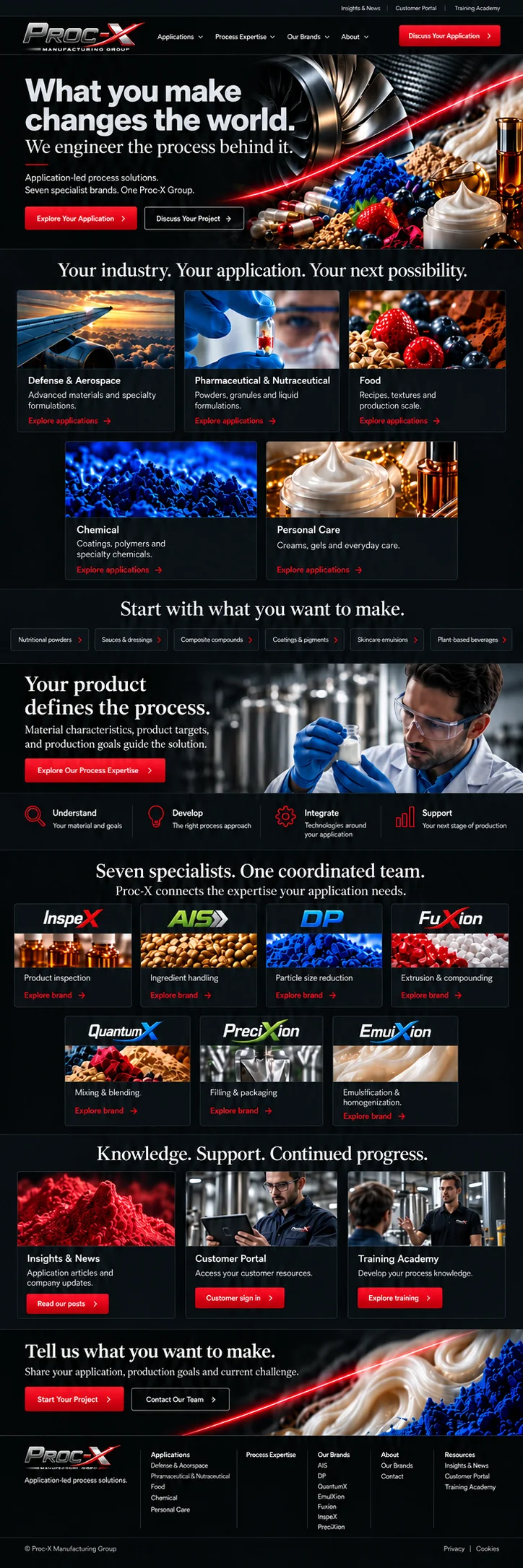
Seven specialists. One coordinated team.

Powder & Liquid Filling and Packaging Line Integration
Match the package to the finished product
PreciXion filling and packaging discussions begin with the product, container and production target. Powders, free-flowing liquids, viscous pastes and particulate foods require different filling approaches. Specify the fill quantity range, container dimensions, closure and desired output. The upstream process must supply product in a consistent condition at the filling point.
Powder filling and ingredient behavior
Powder flow, bulk-density variation, dust and segregation affect filling. Define how material arrives at the filler and whether conditioning or a buffer hopper is needed. Packaging may range from small containers to bags, with different requirements for handling, sealing and inspection. Establish the weight-control objective and how it will be checked in production.
Liquid and paste filling
Viscosity at filling temperature, foaming, stringing and particulate size influence the filling configuration. Product transfer can change texture or introduce air, so pumps and pipework should be reviewed alongside the filler. Container stability, nozzle arrangement and closure handling also affect the practical operating rate.
Coordinate inspection and line flow
Filling, sealing, coding and inspection must work as a connected sequence. InspeX checkweighing or contaminant inspection may be considered where appropriate. Define reject handling, accumulation, changeover time and the expected operator involvement. A quoted machine rate should be distinguished from sustained line output under actual production conditions.
Questions about your process.
Can one filler handle different container sizes?
Potentially, within an agreed operating range. Provide the smallest and largest containers, neck or opening dimensions, fill quantities and closure types so change parts and adjustments can be evaluated.
Why does filling temperature matter?
Temperature can change viscosity, flow and product stability. Specify the condition at the nozzle, not only the temperature in the mixing vessel.
What determines a realistic packaging line rate?
Product supply, filling, closure handling, inspection, accumulation and operator tasks all contribute. Evaluate the line as a whole and include changeovers and planned interruptions.
Tell us what you want to make.
Share your application, production goals and current challenge.