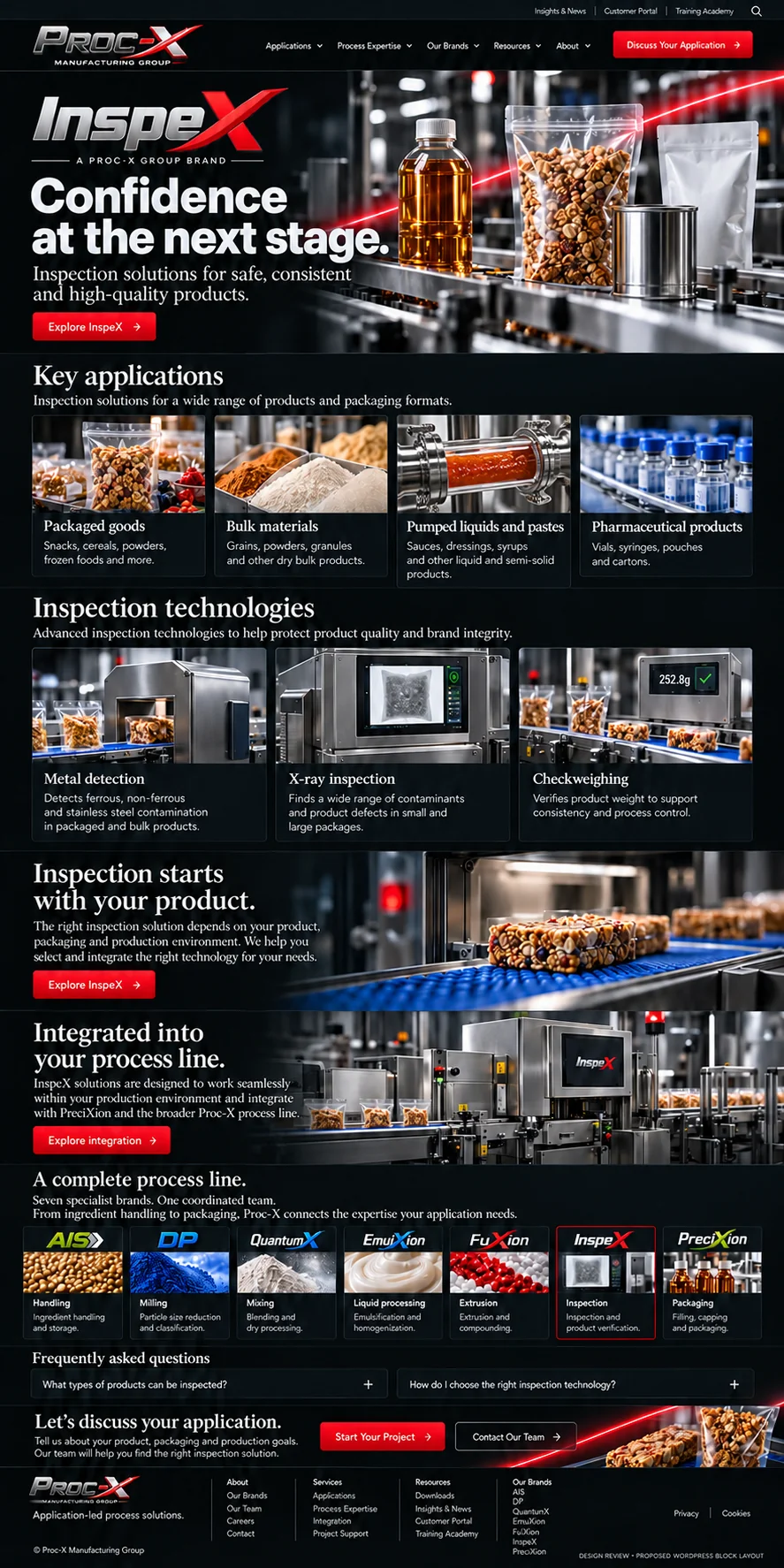
Confidence at the next stage.
Product inspection for the confidence you need at the next stage of production.
Key inspection applications.
Packaged goods
Metal detection is used to identify metallic contamination, with performance influenced by the product, aperture and operating conditions.
Bulk materials
Checkweighing evaluates package weight during production.
Pumped liquids & pastes
State the contaminants or weight limits of concern, product range and expected operating conditions.
Pharmaceutical products
State the contaminants or weight limits of concern, product range and expected operating conditions.
Technologies matched to your process.
X-ray inspection
Evaluate detectable contaminants for your product and package.

Engineered for real-world materials and processes.
Match the technology to your product characteristics, working capacity, cleaning expectations and connected process stages. Our discussion starts with the material and the outcome you need.
Seven specialists. One coordinated team.

Industrial Metal Detection, X-Ray Inspection & Checkweighing
Choose inspection around the product and package
InspeX connects product-inspection technology to the production environment. Selection starts with what is being inspected, how it moves and which nonconformities need to be detected. Package dimensions, composition, product temperature, line speed and available space affect the configuration. Inspection should be considered together with reject handling and the procedures used to verify operation.
Metal detection versus X-ray inspection
Metal detection is used to identify metallic contamination, with performance influenced by the product, aperture and operating conditions. X-ray inspection evaluates differences in attenuation and can address certain additional contaminants or product-integrity checks. Neither technology detects every possible foreign material. Define the detection objective and test representative products before agreeing acceptance criteria.
Checkweighing and line integration
Checkweighing evaluates package weight during production. A suitable system must accommodate package stability, spacing, line speed and the required weighing task. Combining inspection functions requires attention to conveyor transitions, controls and reject separation. Define how rejected product is secured and how faults or full reject bins will be handled within the line.
Make verification part of the specification
State the contaminants or weight limits of concern, product range and expected operating conditions. Agree test pieces, test locations, repeatability checks and records for the selected application. Sensitivity and throughput should be established for the actual configuration rather than assumed from a generic brochure. Connect inspection requirements to the wider quality plan and operator procedures.
Questions about your process.
Can inspection be added to an existing conveyor line?
Often it can be evaluated as a retrofit. Provide conveyor dimensions, product spacing, speed, elevations, package sizes and available installation space so transitions and reject arrangements can be reviewed.
Will X-ray detect every type of plastic?
No. Detectability depends on the material’s attenuation relative to the product, its size, shape and position. Representative testing is needed; a general claim that all plastics are detectable would be misleading.
What information is needed for an inspection proposal?
Send the product and packaging details, dimensions, production speed, detection or weighing objective and cleaning environment. Include photographs or a layout of the installation point where available.
Tell us what you want to make.
Share your application, production goals and current challenge.