PROC-X MANUFACTURING GROUP
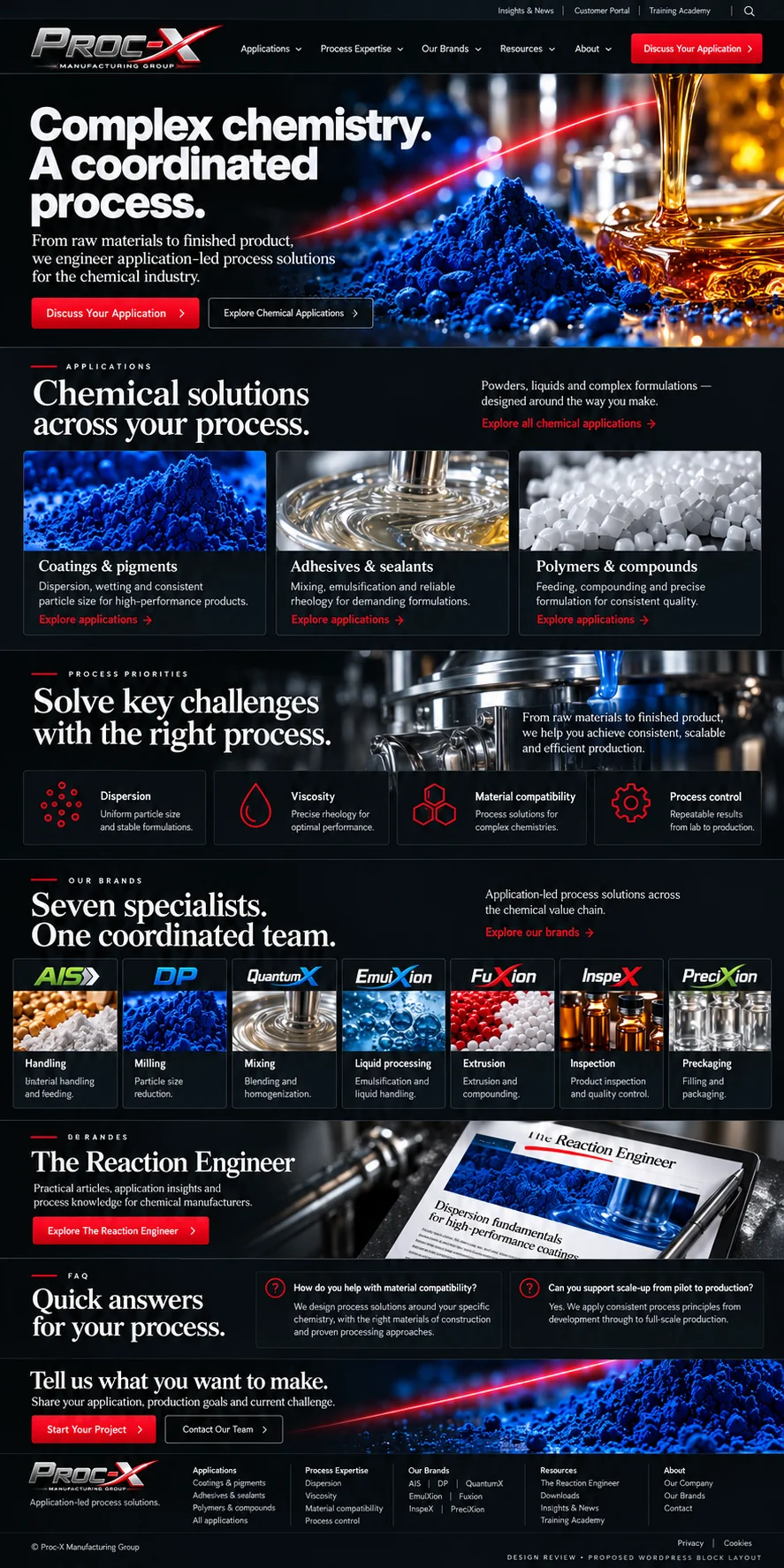
Complex chemistry. A coordinated process.
From raw materials to finished product, we engineer application-led process solutions for the chemical industry.
Applications for Chemical.
Coatings & pigments
Dispersion, wetting and particle size control for high-performance formulations.
Adhesives & sealants
Mixing, viscosity development and deaeration for demanding products.
Polymers & compounds
Feeding, extrusion and compounding around your formulation.
Engineered for what matters most.
Dispersion
Wetting and distribution of solids.
Viscosity
Review rheology at operating conditions.
Material compatibility
Specify product-contact requirements.
Process control
Define repeatable operating parameters.
Seven specialists. One coordinated team.

Knowledge for your application.

FEATURED RESOURCE
The Reaction Engineer
Explore the process considerations behind your material, formulation and production requirements.
Chemical Processing Systems for Powders, Dispersions & Compounds
Coatings, pigments and liquid dispersions
A dispersion process must wet the solid phase and distribute it within the liquid while meeting the required product properties. Solids concentration, agglomerate strength, viscosity and temperature sensitivity influence the mixing approach. Describe whether the objective is simple distribution, deagglomeration or a defined particle-size result so milling and liquid-processing options can be assessed appropriately.
Adhesives, resins and viscous formulations
Viscosity may change substantially as ingredients are added or temperature changes. Equipment selection should address the most demanding stage of the batch, including startup, powder addition and discharge. Where air incorporation affects quality, vacuum processing may be considered. Specify solvents, material compatibility and the available heating and cooling services before defining seals, contact materials or process controls.
Polymer compounds and filler incorporation
Compounding links controlled feeding with mixing, thermal management and downstream handling. Filler content, feed form, residence-time requirements and the sensitivity of the formulation help guide the choice between batch processing and extrusion. Consider how minor ingredients will be metered and how the product will be cooled, collected or transferred after processing.
Plan around the operating environment
Supply safety data sheets and the site’s hazard classification where applicable. Combustible dusts, solvents, corrosive materials and abrasive particles can change design requirements. DP Pulverizers, QuantumX, EmulXion and Fuxion offer distinct technology routes to discuss. Any requested hazardous-area configuration, protective measure or certification must be defined and confirmed for the quoted system.
Questions about your process.
Should a chemical formulation use batch mixing or continuous processing?
Compare formulation variability, required output, residence time, ingredient-feeding consistency and changeover needs. A batch process can offer recipe flexibility; continuous processing requires stable feed and coordinated downstream capacity.
Why is viscosity at operating temperature important?
Viscosity affects circulation, power demand, heat transfer and discharge. Provide the measurement method and temperature, and describe changes during processing, rather than supplying one unexplained viscosity value.
Can abrasive or corrosive materials be processed?
Material compatibility and wear must be reviewed for the actual feed and operating conditions. Identify chemistry, abrasiveness and acceptable contamination limits so contact materials and maintenance needs can be considered.
Tell us what you want to make.
Share your application, production goals and current challenge.