PROC-X MANUFACTURING GROUP
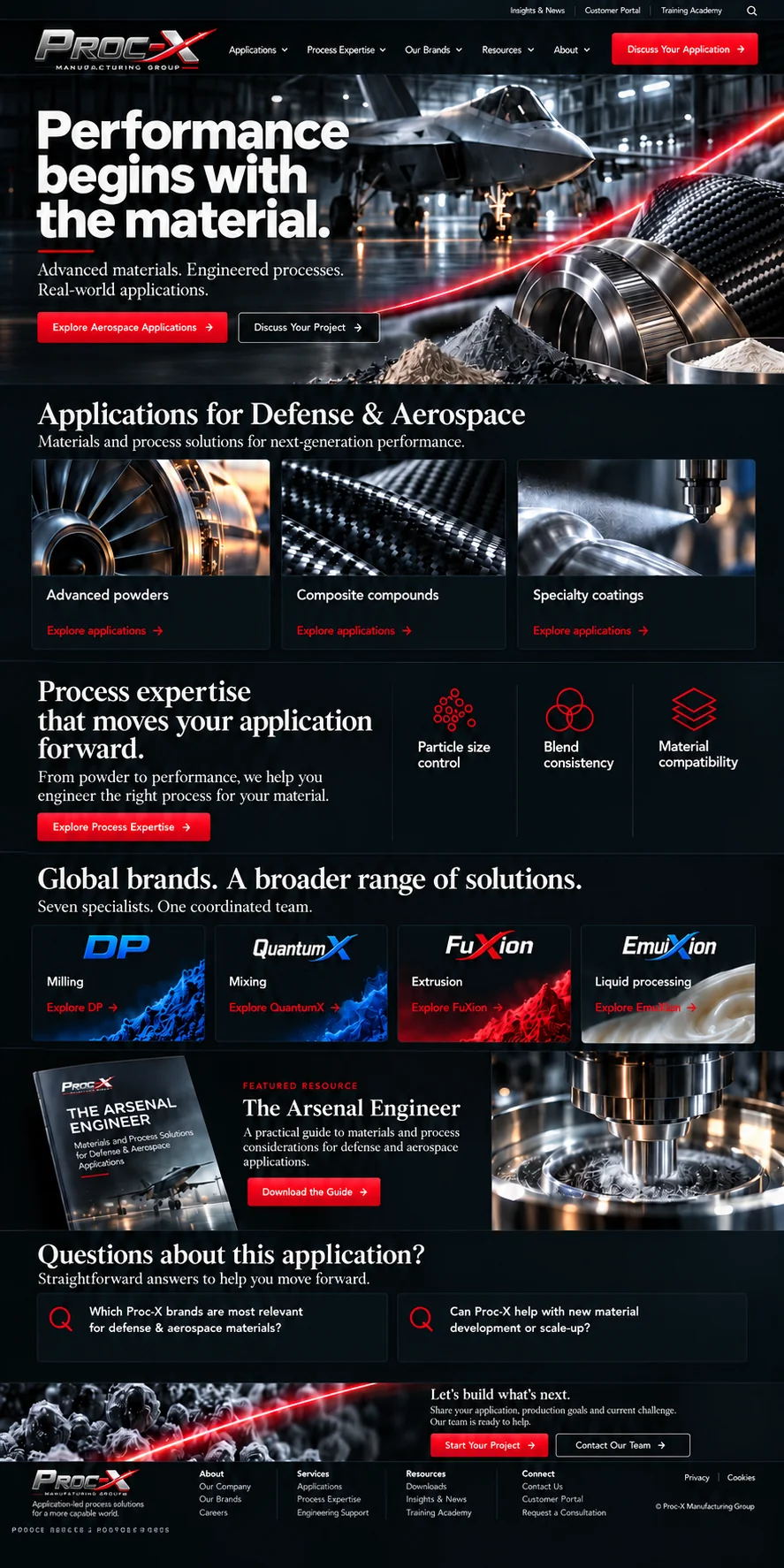
Performance begins with the material.
Advanced materials. Engineered processes.
Real-world applications.
Applications for Defense & Aerospace.
Advanced powders
Particle size, flow and contamination requirements for advanced material preparation.
Composite compounds
Evaluate filler incorporation, blend consistency and downstream processing.
Specialty coatings
Wetting, dispersion and rheology for functional coating formulations.
Engineered for what matters most.
Particle size
Define the distribution your application needs.
Blend consistency
Review ingredient distribution and segregation.
Material compatibility
Match contact materials to the formulation.
Seven specialists. One coordinated team.
Knowledge for your application.

FEATURED RESOURCE
The Arsenal Engineer
Explore the process considerations behind your material, formulation and production requirements.
Advanced Material Processing for Defense & Aerospace Applications
Begin with the material specification
Advanced-material applications can require controlled particle distributions, repeatable filler loading and close management of contamination. Proc-X’s application review focuses on the processing operations behind the material: feeding, size reduction, blending, dispersion and compounding. Define the material chemistry and required properties before selecting a technology or assuming that a standard configuration will suit the project.
Specialty powders and particle preparation
Powder handling and milling decisions depend on feed size, hardness, abrasiveness, moisture sensitivity and acceptable contamination. A target should describe the required particle distribution and measurement method, not simply “fine powder.” Where oxidation or dust hazards are relevant, specify the operating atmosphere and site requirements for engineering review.
Composite compounds and functional coatings
Filled resins, composite compounds and coatings may require controlled addition of fibers, pigments or other functional ingredients. Mixing intensity must suit dispersion requirements while respecting the sensitivity of the material. QuantumX, EmulXion and Fuxion technologies provide different processing approaches to evaluate; DP Pulverizers can contribute where size reduction is part of the process.
Define verification before the equipment specification
Identify product-contact restrictions, traceability expectations, process records and the tests needed to evaluate the proposed equipment. Agree what will be demonstrated at acceptance testing and what remains part of downstream material qualification. Discuss applicable project standards explicitly. Industry suitability, certification and end-product performance should never be inferred solely from the presence of a sector page.
Questions about your process.
Can Proc-X discuss a material before the full formulation is released?
An initial discussion can use non-sensitive information such as material form, density, target output and process conditions. Agree an appropriate confidentiality arrangement before sharing proprietary formulation details.
How should contamination limits be specified?
Identify the contaminants of concern, allowable limits and the test method. Contact materials, wear, cleaning and transfer arrangements can then be reviewed against a measurable requirement.
Does this page imply defense or aerospace certification?
No. Required certifications and project standards must be identified, reviewed and expressly included in the agreed scope. Application discussions do not establish a certification claim.
Tell us what you want to make.
Share your application, production goals and current challenge.