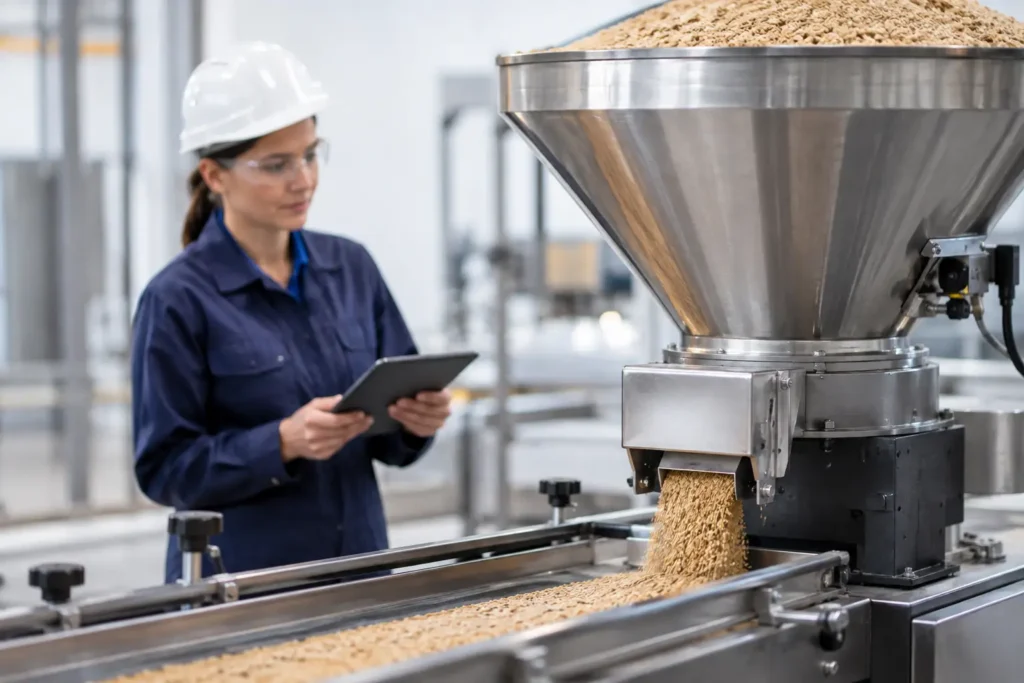
A feeder that holds a fixed screw speed can appear stable while the process receives an increasingly variable mass flow. Changes in bulk density, hopper head pressure, material level, or flow behavior can all shift the actual feed rate. For manufacturers managing formulations, reactions, extrusion, blending, or continuous processing, that gap between assumed and delivered rate can become a quality, yield, and compliance issue.
The question of why use loss weight feeders is fundamentally a question of control. A loss-in-weight feeder measures the mass leaving its supply hopper and continuously adjusts its discharge device to maintain a specified mass-flow setpoint. Rather than relying on volumetric assumptions, it regulates the result that matters: the amount of material entering the process.
Why Use Loss-in-Weight Feeders?
Loss-in-weight feeders are selected when accurate, repeatable continuous dosing is more valuable than the simplicity of a basic volumetric feeder. The system combines a hopper, load cells, a refill arrangement, a discharge device such as a screw feeder, and controls that calculate actual weight loss over time. As material leaves the hopper, the control system compares the measured rate of loss with the target rate and corrects feeder speed accordingly.
This closed-loop approach is especially valuable when material properties are not perfectly constant. Powder density can shift with aeration, consolidation, particle-size distribution, moisture, temperature, or handling history. A volumetric screw may still rotate at the same speed, but the mass delivered per revolution can change. Loss-in-weight control detects that change and compensates for it.
The benefit is not limited to tighter feeder accuracy. Better mass-flow control can improve downstream blend uniformity, active-ingredient dosing, reaction stoichiometry, extrusion stability, coating consistency, and finished-product quality. It also gives operations teams clearer evidence of what was actually fed, rather than what the equipment was expected to deliver.
Where Continuous Gravimetric Feeding Delivers Value
The strongest case for a loss-in-weight feeder usually involves one or more materials that are costly, performance-critical, difficult to handle, or tightly regulated. In pharmaceutical and nutraceutical production, small deviations in active ingredients, flavors, colors, excipients, or functional additives can affect uniformity and batch disposition. In food processing, consistent dosing of minor ingredients supports product quality while reducing overuse of high-cost components.
Chemical, battery, advanced-materials, and specialty-polymer operations often use loss-in-weight feeding to control ratios that affect product performance, rheology, conductivity, reaction behavior, or physical properties. In extrusion, feeder stability can directly influence throughput, melt quality, and dimensional consistency. For industrial minerals, agriculture, and bulk chemical applications, the value may be less about sub-gram precision and more about maintaining a reliable, documented ratio at higher throughputs.
A loss-in-weight feeder can also support conversion from batch to continuous manufacturing. Continuous lines depend on each upstream dosing point delivering a stable rate. When feeding varies, downstream equipment is forced to absorb the disturbance through longer residence times, wider control bands, rework, or reduced line speed. Accurate gravimetric feeding establishes a more controlled foundation for the entire process.
Accuracy Depends on More Than the Feeder
A loss-in-weight system cannot correct every material-handling problem on its own. It can measure a changing mass-flow rate and adjust the discharge mechanism, but the material still needs to reach that mechanism in a controlled, repeatable way. Hopper geometry, agitation, refill strategy, screw selection, material conditioning, and mechanical isolation all influence performance.
Cohesive powders may bridge or rat-hole in the hopper. Fine materials may aerate during refill and feed at a temporarily lower bulk density. Fibrous materials can interlock around screws. Friable products can degrade if an aggressive agitator or screw design is used. Abrasive powders may accelerate wear in feed screws, tubes, and seals. Each condition changes the engineering requirements.
For that reason, feeder selection should begin with the material, not the catalog. Bulk density, particle-size distribution, moisture content, flowability, temperature, abrasiveness, dust characteristics, and allowable product degradation should be evaluated alongside target rate and turndown requirements. A feeder that performs well with free-flowing pellets may be a poor fit for a low-density, cohesive powder.
Refill Is a Controlled Operating Condition
Loss-in-weight feeders operate gravimetrically while material is being discharged from the weighed hopper. During refill, incoming material affects the vessel weight, so the feeder typically transitions to a controlled volumetric mode based on its established operating parameters. After refill, it returns to gravimetric control.
This does not make refill an afterthought. Refill frequency, refill duration, incoming material flow, hopper capacity, and post-refill stabilization all affect total system performance. A properly engineered system manages this transition without introducing meaningful downstream variation. If the process has very tight limits, the design may require a larger hopper, refined refill controls, surge capacity, or an arrangement that minimizes disturbances during refill.
Mechanical Design Protects Measurement Quality
Load cells measure every force transmitted to the weighed assembly, not just material weight. Rigid piping, improperly supported flexible connections, cable tension, vibration from nearby equipment, and inconsistent dust-collection connections can all introduce error. The feeder frame, isolation system, inlet connection, outlet transition, and access arrangement must protect the integrity of the measurement.
This is where system-level engineering matters. A feeder can meet its stated performance capability in isolation yet underperform after installation if mechanical interfaces are overlooked. The same is true for control integration. Setpoint management, refill logic, alarming, recipe handling, data collection, and upstream-downstream interlocks should be designed as part of the production system.
When a Volumetric Feeder May Be the Better Choice
Loss-in-weight feeding is not automatically the correct answer for every ingredient. A volumetric feeder may be appropriate when the material has stable bulk density and flow properties, the process tolerates a wider feed-rate variation, capital cost must be minimized, or the application is a noncritical bulk addition. It can also serve effectively as a refill feeder or as part of a system where mass flow is verified elsewhere.
The trade-off is that volumetric control assumes a consistent relationship between feeder speed and material output. If that relationship changes, operators must recalibrate, manually adjust settings, or accept the deviation. For high-value formulations, regulated production, long operating campaigns, or materials with variable behavior, the apparent savings can be outweighed by scrap, over-dosing, quality investigations, and lost production time.
A practical decision starts with risk. Ask what happens if this ingredient is fed 2% high or low for an hour. Consider the cost of material variance, the impact on finished-product quality, the ability to detect deviation, and the consequences of a rejected batch or unstable continuous line. The answer often defines whether gravimetric control is justified.
Specify the Feeder Around the Process Objective
The most effective loss-in-weight feeder installation is sized and configured around the required production outcome. That means defining the normal and maximum feed rates, required turndown, acceptable accuracy band, batch or campaign duration, refill approach, environmental conditions, cleaning requirements, and control architecture. It also means confirming whether the material will be handled as received or conditioned before feeding.
For hygienic, pharmaceutical, and food applications, cleanability, containment, material traceability, and validation requirements may drive the design. For chemical or advanced-materials applications, corrosion resistance, wear protection, dust containment, inerting, hazardous-area requirements, and control of cross-contamination may be central. In either case, feeder performance should be evaluated in the context of the complete material path from storage through discharge into the next process step.
Proc-X approaches feeding as part of an integrated processing system, where material behavior, automation, transfer equipment, and downstream operations are engineered to work together. One coordinated design standard reduces the risk of solving a dosing problem at the feeder while creating a handling or control problem elsewhere on the line.
When a process depends on a precise material ratio, the feeder should verify and control that ratio continuously. Loss-in-weight feeding provides that accountability at the point where material enters the process, helping manufacturers make better decisions with every pound, kilogram, or gram they produce.