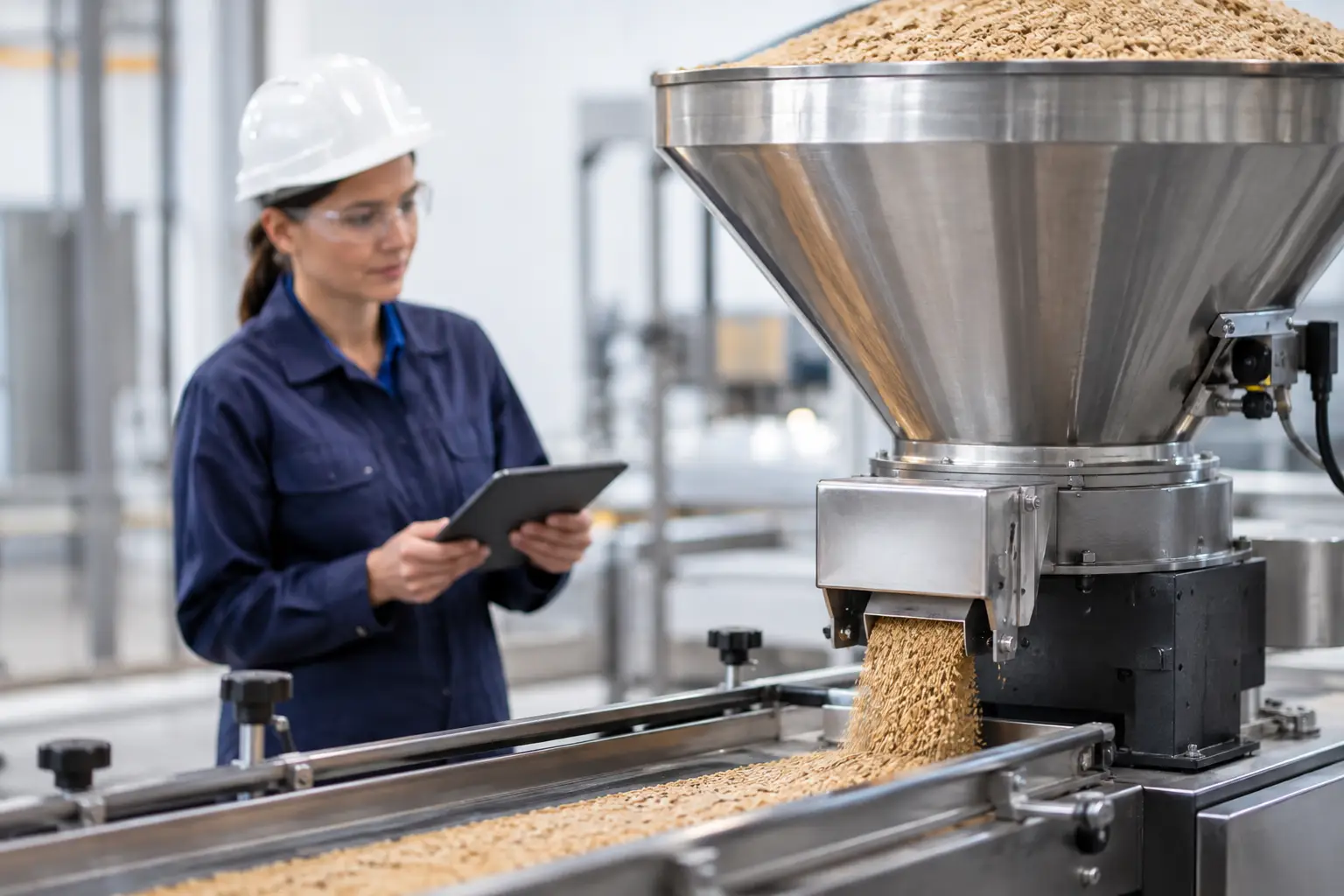
A sanitary system does not prove itself on the day it is installed. It proves itself after repeated production runs, wash cycles, formula changes, maintenance events, and quality audits. Effective sanitary process design makes those conditions predictable by treating cleanability, product protection, operator access, and process performance as one engineering problem.
For manufacturers of food, pharmaceuticals, nutraceuticals, cosmetics, and other controlled products, sanitation cannot be added after equipment selection. A high-performing mixer, feeder, mill, transfer line, or filler can still create risk if its interfaces trap product, its cleaning method is incomplete, or its controls cannot demonstrate that the required cycle occurred. The objective is not simply a clean-looking line. It is a process that can be cleaned, inspected, validated, and returned to production with confidence.
Sanitary Process Design Starts With the Product
The starting point is the material, not a generic equipment specification. Product behavior determines where residue will accumulate, how difficult it will be to remove, and whether a dry-cleaning, wet-cleaning, or clean-in-place approach is appropriate.
A free-flowing dry powder may be managed through controlled dry cleaning and carefully designed access points. A sticky protein blend, high-fat nutritional powder, sugar-based slurry, or high-viscosity paste creates a different challenge. These materials can bridge in hoppers, adhere to seals, accumulate at transitions, and resist conventional wash coverage. Hygroscopic products introduce another concern: moisture from cleaning can create caking, microbial risk, or long recovery times if the system cannot be fully dried.
The product’s particle size, bulk density, moisture level, temperature sensitivity, abrasiveness, and allergen or potency profile all matter. So do batch size, campaign length, and the cost of a failed changeover. A line producing a single product continuously may require a different sanitary strategy than a multiproduct operation changing formulas several times per week.
This is where process engineering prevents expensive compromises. Equipment geometry, transfer method, valve selection, dust collection, controls, and cleaning strategy must be evaluated together. A sanitary vessel does not solve a non-sanitary system if the upstream feeder, downstream conveyor, flexible connection, or packaging interface creates the real contamination risk.
Design for Complete Cleanability, Not Visual Cleanliness
The central question is straightforward: can every product-contact surface be adequately cleaned and, where required, sanitized or sterilized using a defined and repeatable method? The answer depends on geometry, surface condition, drainage, flow velocity, and access.
Product-contact surfaces should be compatible with both the material being processed and the chemicals, temperatures, and mechanical action used during cleaning. Stainless steel is common, but grade selection, finish, weld quality, passivation, gasket materials, and elastomer compatibility still require application-specific decisions. A material that performs well under ambient dry service may fail prematurely under repeated exposure to hot caustic wash cycles.
Geometry matters just as much. Crevices, threaded product-contact connections, poorly finished welds, sharp internal corners, stagnant pockets, and unsealed framework can retain residue. In wet systems, pipe routing must support drainage and avoid low points that hold cleaning solution or product. In powder handling systems, dead zones may collect fines that later dislodge into a new batch.
Cleanability also depends on whether the equipment is intended for clean-in-place, clean-out-of-place, or manual cleaning. CIP can reduce labor and improve repeatability, but it is not automatically the right answer. It requires sufficient flow, pressure, temperature, chemistry, and coverage at every intended surface. A spray device installed in a vessel is not proof of effective cleaning. Its performance must account for vessel geometry, internal components, product buildup, and the operating range of the cleaning circuit.
Manual cleaning can be practical for smaller systems or dry applications, provided access is safe and complete. Hinged covers, removable components, tool-less clamps where appropriate, and clear inspection access may improve sanitation as much as a more complex automated wash system. The trade-off is operational discipline: manual methods depend more heavily on trained personnel and consistent procedures.
Interfaces Are Often the Weakest Point
Sanitary risk frequently appears where machines connect. Transitions between bulk bags and receivers, feeders and mixers, mills and transfer lines, or process vessels and fillers deserve the same scrutiny as the major equipment itself. Flexible sleeves, rotary valves, sampling points, diverter valves, sight glasses, instrument ports, and discharge gates can all become residue-retention locations.
A system-level review should establish how each interface is cleaned, inspected, drained, and reassembled. It should also define which components are product-contact, which are splash-zone surfaces, and which areas can affect product through dust migration or condensation. This level of detail is particularly important in allergen-controlled food operations and in pharmaceutical or nutraceutical lines where cross-contact and batch traceability carry significant consequences.
Controls Make Sanitation Repeatable
A sanitary design is only as dependable as its execution. Controls and data management convert cleaning from an assumed activity into a documented process condition.
For automated cleaning, the control system can manage recipe-specific sequences, valve positions, circulation time, temperature, conductivity, flow, and final rinse conditions. Alarms should identify deviations that affect cleaning effectiveness rather than merely recording that a cycle started. For example, a low-flow condition, an incomplete return path, or a temperature shortfall may require investigation before the equipment is released for production.
The appropriate level of automation depends on the regulatory environment and operational risk. A food facility may focus on sanitation verification, allergen controls, and production scheduling. A pharmaceutical process may require more formal recipe control, electronic records, audit trails, and validated operating parameters. Neither approach should be copied blindly from another industry. The controls architecture should match the product, process, quality system, and documentation requirements.
Sanitation status must also be visible to operations. Clear equipment states help prevent production from beginning before cleaning is complete, inspection has been performed, or line clearance is approved. Interlocks can be valuable, but they should support the operating procedure rather than create workarounds. A system that is difficult to run under real plant conditions will eventually be bypassed.
Validate the Process You Will Actually Operate
Validation and verification should begin during design, not after fabrication. The project team needs agreement on acceptance criteria before equipment is built: what constitutes an acceptable clean condition, what sampling or inspection methods will be used, and which process parameters are critical.
For some operations, visual inspection and documented sanitation procedures may be sufficient. For others, testing may include allergen swabs, microbiological methods, conductivity confirmation, riboflavin coverage testing, residue analysis, or cleaning validation protocols. The point is not to apply every test available. It is to select evidence that demonstrates control of the relevant risk.
Factory acceptance testing and site acceptance testing should examine more than machine function. They should confirm accessibility, drainability, cleaning sequences, utility connections, instrument performance, and control logic. Where a line includes multiple suppliers, this is often where accountability becomes fragmented. A transfer system may function independently, and a mixer may function independently, yet the integrated line may still lack a reliable cleaning path.
Proc-X approaches this challenge as a complete process system, coordinating equipment selection and integration around the operating reality of the finished line. One engineering standard across material handling, processing, automation, and end-of-line equipment reduces the gaps that commonly emerge between separate machine packages.
Build Sanitation Into Capacity and Lifecycle Planning
Sanitary requirements affect throughput. Cleaning time, drying time, inspection time, line clearance, and changeover time all reduce available production hours. Treating them as secondary considerations can make an otherwise attractive capacity model unattainable.
A practical design basis should account for the full operating cycle: production, discharge, cleaning, verification, reassembly, startup, and any required quality release. This is especially important for high-value products, short campaigns, and plants operating near capacity. Sometimes the best answer is a more automated cleaning system. In other cases, dedicated product paths, duplicate contact parts, or a redesigned campaign schedule provide a better return.
Maintenance must be considered at the same time. Seals, gaskets, filters, hoses, and wear components need defined inspection and replacement practices. Hygienic design can be undermined when difficult-to-service components remain in place beyond their intended life or when maintenance introduces uncontrolled reassembly conditions. Accessible, standardized components improve both reliability and sanitation discipline.
The strongest sanitary systems are designed with a clear view of how people will operate them at 2 a.m., how maintenance will restore them after a shutdown, and how quality teams will defend their performance during an audit. When those realities shape the engineering decisions early, sanitation becomes a controlled production capability rather than a recurring source of lost time and uncertainty.