A transfer system can protect product quality or quietly become the source of lost yield, dust exposure, segregation, downtime, and inconsistent batches. The real question in pneumatic versus mechanical conveying is not which technology is better in general. It is which transfer method will move a specific material at the required rate, through the actual plant layout, without compromising the process around it.
For manufacturers handling powders, granules, flakes, and other bulk solids, that decision affects far more than the conveyor itself. It determines how material enters mixers and feeders, how efficiently it is recovered, how easily the line is cleaned, and how reliably production can scale. A sound selection starts with material behavior and ends with total system performance.
Pneumatic Versus Mechanical Conveying: The Core Difference
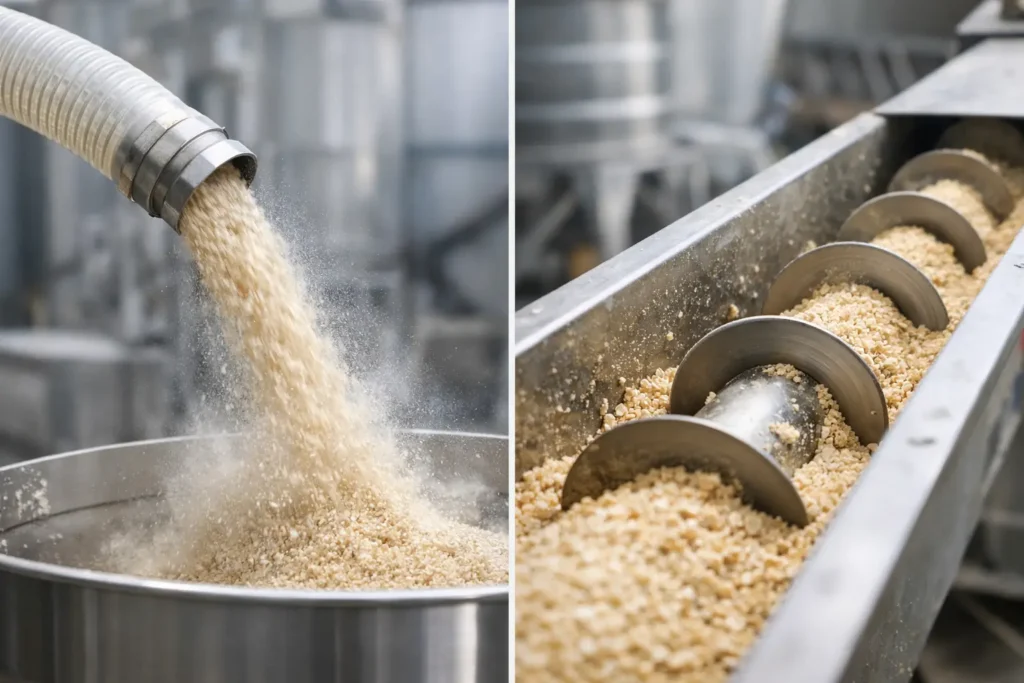
Pneumatic conveying moves bulk material through enclosed pipelines using air or another gas. Depending on the application, the system may operate under vacuum or positive pressure and may convey in dilute phase or dense phase. The material travels through a route that can turn corners, rise vertically, and cross distances with relatively little floor-level equipment.
Mechanical conveying uses moving components to carry the material. Common options include screw conveyors, flexible screws, belt conveyors, drag conveyors, bucket elevators, vibratory conveyors, and tubular cable systems. Each has a defined operating range based on the material, route, capacity, and required level of containment.
Neither category is a single solution. A dilute-phase pneumatic line behaves very differently from a dense-phase system, just as a screw conveyor has different limitations than a drag conveyor or bucket elevator. The comparison must be made at the equipment and process level, not by broad labels alone.
Start With the Material, Not the Conveyor
A bulk solid is not simply a tonnage figure. It has a particle-size distribution, bulk density, moisture condition, shape, temperature, flow pattern, and sensitivity to mechanical or air-driven transport. Those properties can change from one supplier lot to the next or as production conditions change.
Free-flowing, non-fragile granules may move effectively in either pneumatic or mechanical equipment. A fine cohesive powder may bridge in a feeder, build up in a pipeline, or require special air management. A friable agglomerate may lose its required particle structure in a high-velocity dilute-phase line. An abrasive mineral can rapidly wear bends, screws, elbows, and transfer points if the design does not account for velocity and contact surfaces.
The first engineering review should establish whether the material is likely to segregate, degrade, attrit, smear, absorb moisture, generate dust, or form deposits. Laboratory testing and representative material trials are often justified when product value, quality risk, or production volume is high. Design decisions based only on a material safety data sheet or a nominal bulk density commonly lead to expensive corrections after installation.
Where Pneumatic Conveying Performs Best
Pneumatic systems are often selected when enclosed transfer, flexible routing, and multiple pickup or discharge points are central requirements. A vacuum system, for example, can pull ingredients from bag dump stations, bulk bag unloaders, or storage vessels to a receiving hopper while maintaining controlled containment. Positive-pressure systems can move material from a central source to several distant destinations.
This approach is particularly useful in food, pharmaceutical, nutraceutical, chemical, battery, and advanced-material operations where dust control, product protection, and cleanable design have direct operational value. Pipelines require less physical footprint than many mechanical routes and can pass around existing equipment or structural obstacles. That can reduce disruption during a plant expansion where floor space is already constrained.
Pneumatic conveying also supports automated ingredient handling. Materials can be transferred to day bins, loss-in-weight feeders, mixers, mills, reactors, or packaging systems under coordinated controls. When properly engineered, the system can manage destination selection, receiving-vessel level, filter cleaning, line purging, and batch traceability as part of the wider process architecture.
Its limitations must be addressed directly. Pneumatic conveying usually requires more energy than a short, simple mechanical route because the system must generate airflow and overcome pressure losses. Long lines, high capacities, heavy bulk densities, and difficult materials can increase blower requirements and operating cost. Filters, rotary airlocks, diverter valves, pipeline bends, and receivers also require disciplined maintenance.
The conveying mode matters. Dilute-phase conveying generally uses higher air velocity and is often appropriate for many free-flowing powders and pellets. Dense-phase conveying uses lower velocity and higher material loading, which can reduce wear and particle damage for selected products. Dense phase is not automatically suitable for every powder, however. It depends on the material’s ability to form and move as plugs or dunes without unstable flow or line blockage.
Where Mechanical Conveying Has the Advantage
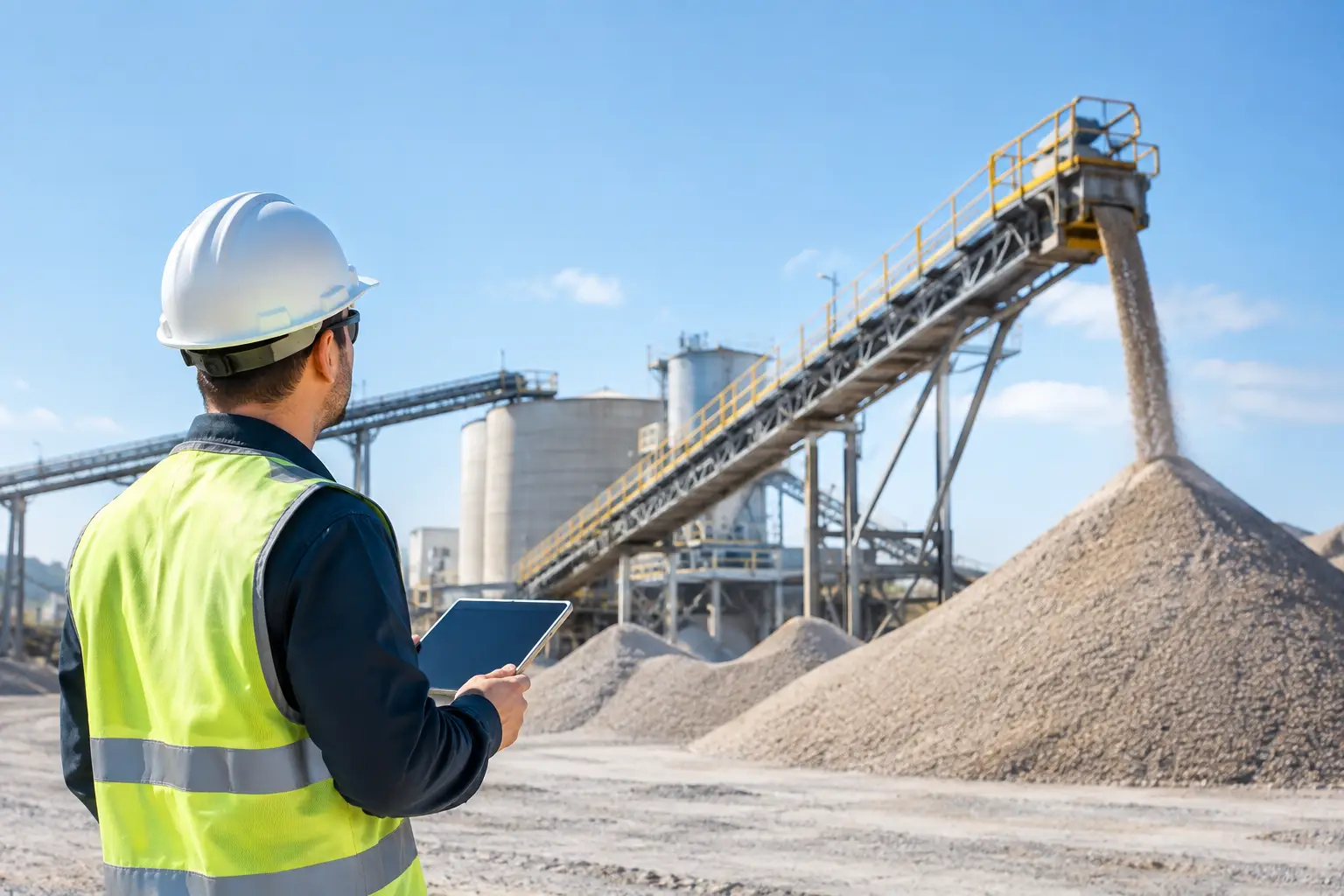
Mechanical conveying is frequently the more direct answer for short, predictable routes at high throughput. A screw conveyor may meter or transfer material between adjacent process steps. A drag conveyor can move certain dry bulk solids horizontally with controlled containment. A bucket elevator can provide vertical lift where a pneumatic line would consume substantial air volume and power.
For high-capacity applications involving dense, non-sensitive bulk materials, mechanical systems can offer strong energy efficiency. They also avoid the need for a large air stream to separate at the destination, reducing demands on filters and air-handling equipment. When a conveyor serves one source and one destination on a stable route, this simplicity can be valuable.
Mechanical equipment does introduce product-contact surfaces and moving parts along the transfer path. That may increase cleanout requirements, especially when changing products or handling allergen-sensitive, hygroscopic, sticky, or regulated materials. A screw can compact certain materials, while a belt or drag conveyor may create transfer-point dust if not fully enclosed. Wear from abrasives and contamination risks from poorly maintained components require attention throughout the equipment lifecycle.
Mechanical conveying is also less forgiving of route changes. Horizontal runs, inclines, vertical lifts, and complex elevations may call for multiple machines and transfer points. Every transfer point adds a potential location for dust escape, material buildup, segregation, and controls coordination. The apparent economy of individual conveyors should therefore be weighed against the installed complexity of the complete route.
Evaluate the System, Not the Equipment Purchase Price
A capital estimate alone rarely identifies the lower-cost choice. The better comparison includes installation, utilities, controls, dust collection, cleaning, maintenance access, spare parts, product loss, and the cost of a production interruption. It should also consider how the transfer method affects upstream and downstream equipment.
A practical evaluation should answer at least these questions:
- What are the minimum, normal, and peak transfer rates, and how often will the system operate at each condition?
- Is the material free-flowing, cohesive, abrasive, friable, heat-sensitive, moisture-sensitive, or prone to segregation?
- What containment, sanitation, explosion protection, and validation requirements apply?
- How many sources and destinations are required today, and what expansion paths are likely?
- What cleaning standard is necessary between products, batches, or campaigns?
- How will operators clear a blockage, inspect wear components, and safely maintain the system?
These questions reveal trade-offs that specifications often hide. A pneumatic line may be justified because it removes several mechanical transfer points, improves containment, and creates a cleaner route to multiple destinations. A mechanical conveyor may be the stronger choice because the route is short, the product is dense and non-friable, and energy efficiency is a priority. In many facilities, the correct answer is a hybrid arrangement.
Hybrid Systems Often Produce the Best Result
A production line does not need to commit to one transfer method everywhere. Mechanical equipment may receive material from bulk storage, elevate it to a processing platform, or handle a high-rate continuous stream. Pneumatic conveying can then transfer smaller ingredients, enclosed additions, or finished product to remote destinations. The split should follow the material and process requirement at each handoff.
This integrated approach is especially useful when the system includes weighing, dosing, milling, blending, or packaging. The transfer equipment must be matched to feeder accuracy, mixer cycle time, receiver capacity, and controls logic. Oversizing a pneumatic system can create unnecessary velocity and product damage. Undersizing a mechanical conveyor can starve a downstream process and reduce overall line output.
Proc-X approaches bulk-material transfer as part of the complete manufacturing system, with one engineering standard across material handling, process equipment, automation, and downstream integration. That perspective helps prevent isolated equipment decisions from creating bottlenecks elsewhere in the line.
Specify for the Operating Reality
The most reliable conveying system is one designed around the material you actually process, including its expected variability, rather than an idealized sample. Define performance requirements clearly, test difficult materials where needed, and review the route alongside cleaning, maintenance, safety, and controls requirements before equipment is released for fabrication.
A conveyor is not merely a connection between two points. It is a process-critical component that determines how consistently material arrives at the next step. Selecting it with that level of discipline gives the operation a stronger foundation for capacity, quality, and long-term reliability.