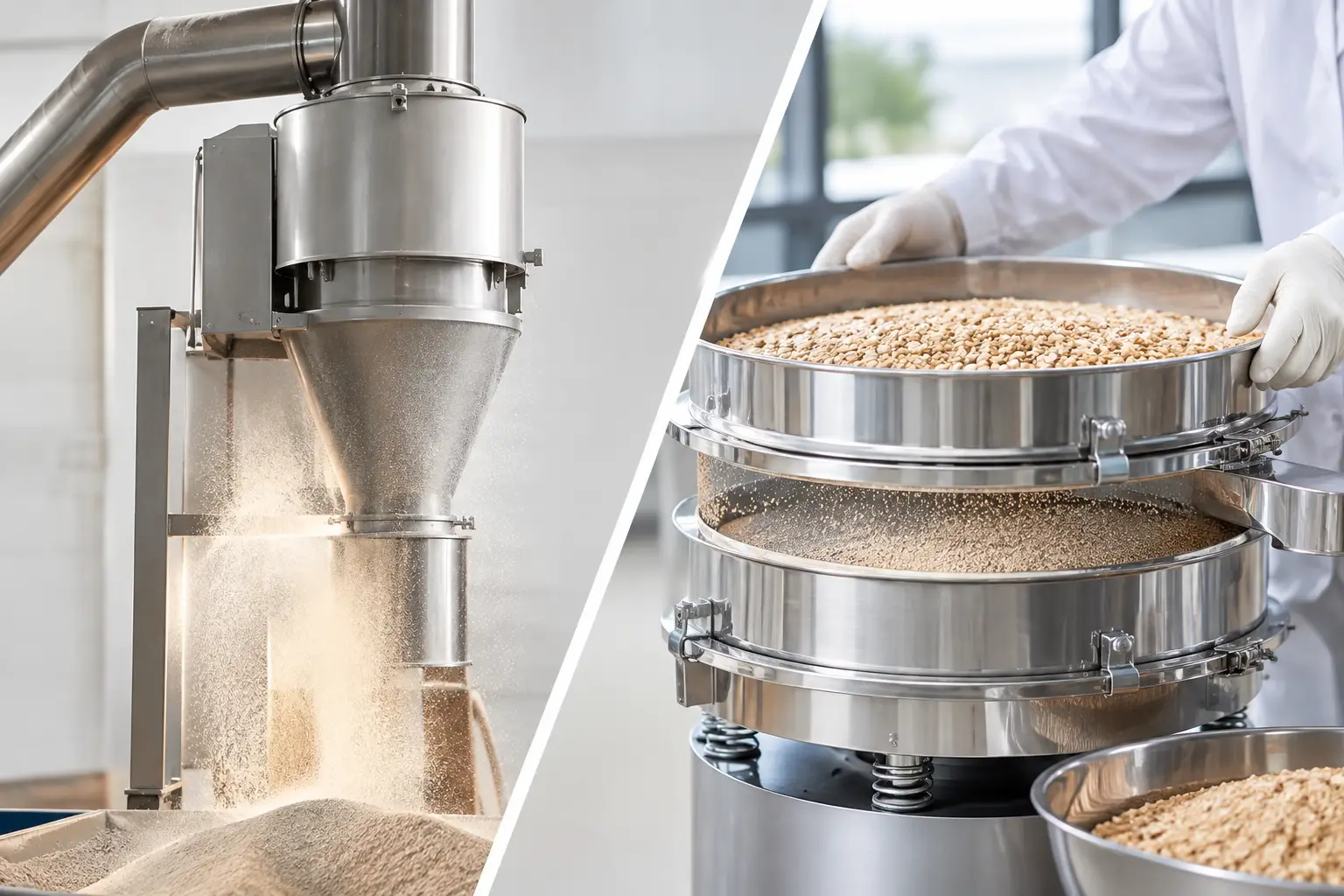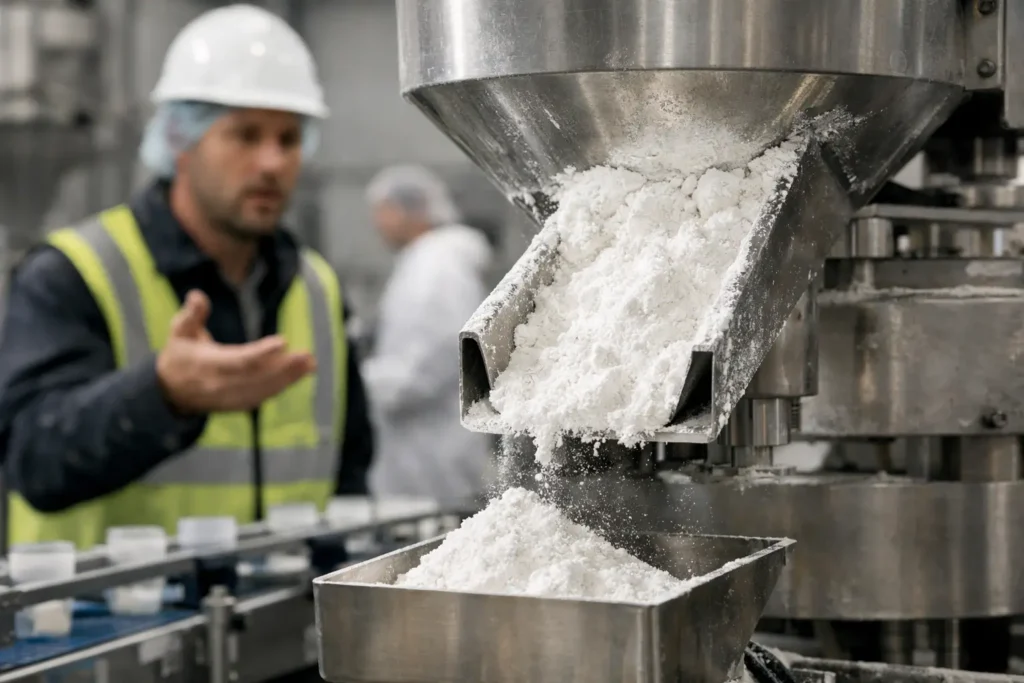
A feeder that surges, a hopper that bridges, or a pneumatic line that plugs is rarely an isolated equipment failure. Powder flow problems are process failures with consequences that travel downstream: inaccurate batch weights, poor blend uniformity, extended changeovers, missed production targets, and operators forced into manual intervention.
The visible symptom may occur at the discharge point, but the cause can begin much earlier. A small change in moisture pickup, particle-size distribution, storage time, conveying velocity, or vessel geometry can turn a previously stable process into an unpredictable one. The right response is not to add vibration or increase feeder speed by default. It is to determine how the material behaves under actual process conditions, then engineer the handling system around that behavior.
Powder Flow Problems Begin With the Material
There is no such thing as a universally free-flowing powder. Flow behavior depends on the relationship between material properties, the forces acting on the material, and the equipment containing it. A powder that discharges reliably from a bulk bag station may compact and rat-hole in a tall storage hopper. The same material may feed consistently at ambient temperature but become cohesive after a warm pneumatic transfer or exposure to humid plant air.
Cohesion is often the central issue. Fine particles have more surface area relative to their mass, which increases the effect of electrostatic attraction, van der Waals forces, moisture bridges, and other interparticle forces. Fat-containing food powders, hygroscopic ingredients, pharmaceutical excipients, pigments, metal powders, and many battery materials can all become difficult to handle for different reasons.
Bulk density matters as well. A low-density material may aerate, flush through a feeder, or segregate during transfer. A denser powder may impose greater consolidation stresses in a hopper, making it harder to restart after storage. Particle shape also changes the result. Rounded granules generally behave differently than needles, flakes, fibrous materials, or irregular fractured particles, even when median particle size appears similar.
The Symptoms Do Not Diagnose the Cause
Bridging, rat-holing, flooding, pulsating feed, and segregation are useful descriptions, but they are not root-cause diagnoses. A bridge may result from cohesive strength, an undersized outlet, unfavorable hopper-wall friction, mechanical interlocking, or compaction caused by the vessel head load. Rat-holing may indicate that material is flowing only through a narrow center channel while stagnant material remains against the walls.
Flooding creates a different risk. Aerated powders can discharge too quickly, causing a loss of feeding control, dust generation, and inconsistent dosing. In a loss-in-weight feeder, that behavior can distort weight signals and drive unnecessary control corrections. Treating all of these conditions as “poor flow” leads to generic fixes that may make the process less stable.
Diagnose the Process, Not Just the Hopper
A reliable investigation follows the powder through its entire operating path: receiving, storage, transfer, intermediate buffering, feeding, mixing, and packaging. The goal is to identify where the material state changes and where the handling equipment applies stress, shear, air, heat, or residence time.
Start with production evidence. Review feeder trends, refill intervals, downtime records, batch deviations, product moisture data, dust-collection performance, and operator workarounds. A problem that occurs only after a weekend shutdown points toward consolidation or environmental exposure. A problem that develops late in a run may indicate changes in particle segregation, temperature, or material level. A problem seen only with a particular supplier lot may point to raw-material variability rather than equipment wear.
Material testing should represent the actual powder condition, not an ideal sample taken immediately after production. Flow-function testing can quantify the material’s tendency to consolidate and establish the stresses at which it will fail to discharge. Wall-friction testing helps determine suitable contact materials and hopper angles. Additional evaluation may include bulk density, permeability, particle-size distribution, moisture sorption, compressibility, and electrostatic behavior.
These results should be interpreted with the process duty in mind. A hopper that holds material for 20 minutes before feeding has a different design requirement than one that holds material for 24 hours. Likewise, a feeder supplying a continuous reactor needs a tighter performance window than a manually supervised bagging operation. Engineering begins with the required operating envelope, not a catalog capacity rating.
Match the Flow Aid to the Failure Mechanism
Flow aids are valuable when they address a defined mechanism. They are not interchangeable accessories.
For cohesive powders, mass-flow hopper geometry can be the most durable solution. In mass flow, all material moves when discharge begins, reducing stagnant zones, limiting first-in/first-out errors, and reducing the chance of consolidation against vessel walls. Achieving mass flow requires the right outlet size, hopper angle, wall surface, and transition geometry for the specific material.
Mechanical agitation can break stable arches and promote discharge, but it also introduces shear. That may be acceptable for a durable mineral powder and unacceptable for a friable granule, a blend at risk of segregation, or a heat-sensitive formulation. Agitator design, speed, and location must be selected carefully. A poorly applied agitator can compact material above the outlet or create fines that worsen flow over time.
Vibration may assist difficult discharge, particularly during intermittent operations, but it can also densify some powders, fatigue structural components, and increase particle segregation. Air pads, air injection, and fluidization can help with powders that respond well to controlled aeration. They can also cause flushing, erratic feeder performance, or dust-control issues if the material becomes over-aerated.
Feeder selection is equally consequential. Screw feeders, twin-screw feeders, vibratory feeders, rotary valves, belts, and other metering technologies each impose different handling conditions. A single-screw feeder may be sufficient for a stable granular product, while a cohesive powder requiring high dosing accuracy may need twin-screw feeding, hopper conditioning, and closed-loop weight control. The required accuracy, turndown ratio, material sensitivity, and refill strategy determine the right approach.
Engineer the Full Material-Handling System
A hopper, feeder, and conveyor cannot be evaluated independently when they process the same powder. Upstream transfer changes the material presented to the feeder. Downstream pressure, dust collection, and equipment backpressure can change discharge behavior. Controls can either stabilize those interactions or conceal them until a disruption occurs.
Consider pneumatic conveying as an example. Conveying velocity, air humidity, pipeline routing, bends, receiver design, and filter performance can alter particle size, temperature, and aeration. A material delivered to a receiver in a highly aerated state may require a settling period or controlled deaeration before precision feeding. If that condition is ignored, the feeder may appear inconsistent even though its mechanical design is sound.
Segregation deserves the same systems-level attention. Differences in particle size, density, shape, or surface texture can cause components to separate during filling, conveying, hopper discharge, or refill. The result may be an apparently stable flow rate paired with an unstable formulation. For regulated products and high-value materials, maintaining composition can be as important as maintaining throughput.
Integration also includes sanitary, containment, and maintenance requirements. A design that improves flow but cannot be cleaned effectively, validated properly, or serviced without extensive downtime creates another operational constraint. In pharmaceutical, food, specialty chemical, and advanced-material applications, the best solution balances material movement with product protection, operator safety, and lifecycle access.
Proc-X approaches these projects from the material outward, coordinating handling, feeding, processing, controls, and downstream equipment under one engineering standard. That coordination reduces the risk of solving one restriction while creating another elsewhere in the line.
Commission for Normal Variability
A system should not be accepted based only on a short demonstration with one favorable material lot. Commissioning should establish how the process performs across realistic operating conditions: full and low hopper levels, expected moisture variation, startup and shutdown, feeder refills, maximum and minimum production rates, and planned cleaning intervals.
Control logic is part of the solution. Loss-in-weight feeder tuning, refill sequencing, alarm limits, discharge-device timing, and dust-collection interlocks affect material behavior and production consistency. Trend data should be retained so operations and maintenance teams can recognize gradual changes before they become recurring downtime events.
Operator input also matters. If a process runs only when an experienced operator taps a hopper, changes a setpoint, or manually breaks an arch, that knowledge identifies a design gap. The objective is to convert that workaround into a defined, repeatable operating method or eliminate the need for it through equipment and controls changes.
When Replacement Equipment Is Not the Answer
Replacing a troublesome hopper or feeder can be justified, but it is not always the first corrective action. Worn screws, damaged flexible connections, leaking air seals, incorrect feeder setup, blocked vent filters, and changed raw-material specifications can all produce conditions that resemble a fundamental design failure.
At the same time, minor adjustments cannot overcome an equipment concept that is mismatched to the material. If a highly cohesive powder is expected to discharge from a shallow hopper through an undersized outlet, repeated maintenance and flow aids will only manage the symptom. The capital decision should be based on measured behavior, production consequences, and the expected range of future materials.
Stable powder handling is built on evidence: characterize the material as it is actually used, identify the mechanism behind the disruption, and design each part of the system to support the next. When that discipline is applied early, powder movement becomes a controlled production function rather than a daily source of uncertainty.