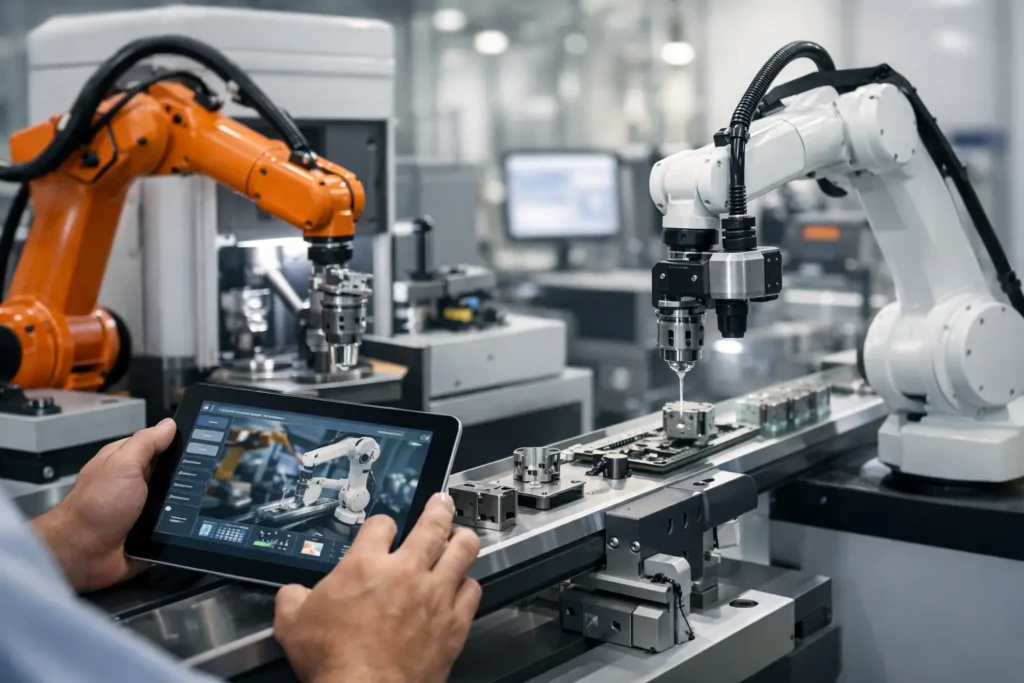
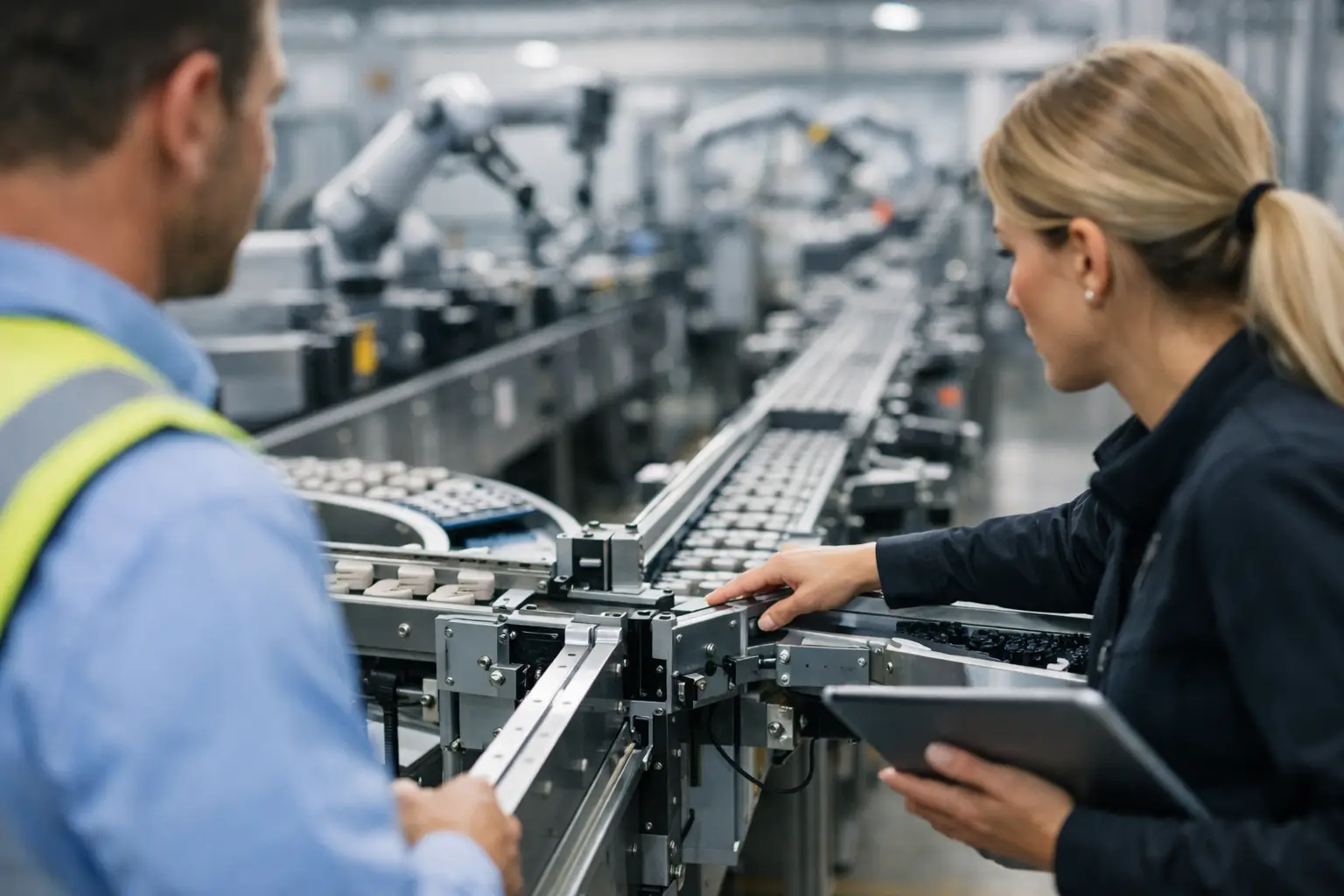
A production line can appear complete on a layout drawing and still fail at its first integrated run. The material may bridge at a transfer point, the feeder may not respond correctly to downstream demand, or a packaging machine may receive inconsistent product. These are not isolated equipment problems. They are system problems. Equipment interoperability in manufacturing determines whether individual assets operate as one controlled process or remain a collection of machines with disconnected responsibilities.
For manufacturers operating in food, pharmaceuticals, chemicals, advanced materials, batteries, and other high-consequence environments, interoperability is not a software feature to address late in the project. It is an engineering requirement that affects throughput, product quality, compliance, commissioning time, and long-term maintainability.
What Equipment Interoperability Means in Manufacturing
Equipment interoperability is the ability of machines, controls, utilities, material handling systems, and operating procedures to exchange the information, product, and commands required to perform a defined process reliably. It includes physical compatibility, process compatibility, controls coordination, safety integration, and serviceability across the line.
A conveyor that can physically connect to a mixer is not necessarily interoperable with it. The conveying rate must match the mixer’s available capacity. The material must retain its required characteristics during transfer. Level controls must prevent starvation and overfill. Cleanout and sanitation requirements must be addressed at the interface. The control system must recognize what happens when either asset stops, faults, or changes operating state.
This distinction matters because manufacturing performance is created at the interfaces. Milling, blending, extrusion, thermal processing, bulk transfer, and packaging may each perform to their individual specifications. If their operating windows are not coordinated, the complete line will still underperform.
The Five Layers of Equipment Interoperability in Manufacturing
Mechanical and material-flow compatibility
Equipment must connect in a way that supports stable material movement, access, cleanability, and maintenance. Chute angles, transition geometry, equipment elevation, dust collection points, valve selection, and conveying method all affect how a material behaves between process steps.
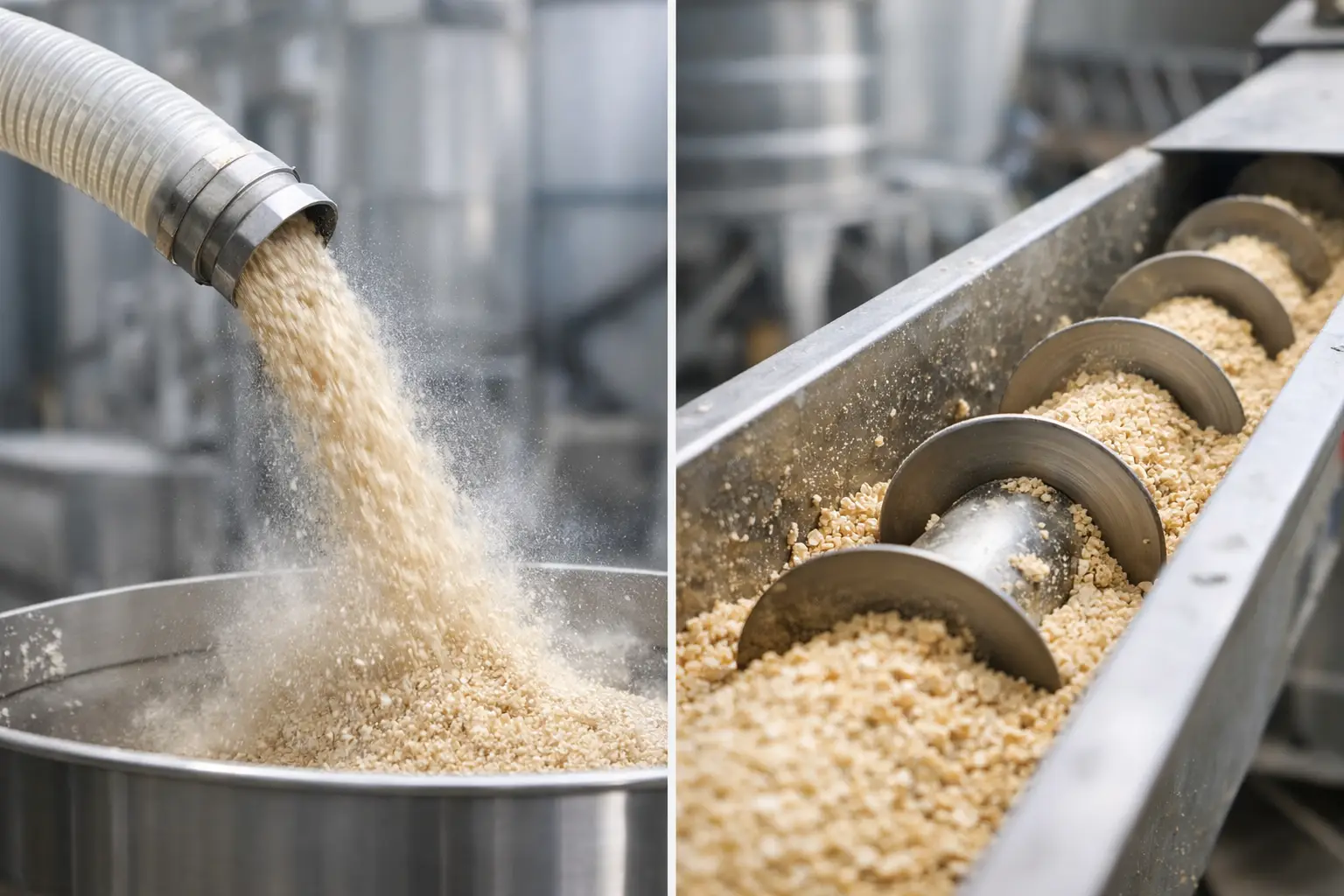
Bulk solids introduce particular risk. A powder that flows consistently from a hopper during a demonstration may segregate, compact, absorb moisture, or generate dust under actual production conditions. Mechanical interfaces should therefore be engineered around the material’s behavior, not selected from standard drawings alone. The same applies to viscous products, temperature-sensitive materials, abrasive compounds, and ingredients with strict containment requirements.
Process compatibility
Each machine has a preferred operating range. A mill may require a controlled feed rate. A blender may need a defined fill level and mixing time. An extruder may require consistent bulk density, particle size, moisture, and feed stability. The downstream process must be able to accept the output without creating bottlenecks or degrading product quality.
Process compatibility is where nominal capacity figures can be misleading. A feeder rated for a certain hourly rate, a mixer with a stated batch volume, and a packaging system with a defined speed do not automatically produce an equivalent line capacity. Actual performance depends on batch cycle time, product changeovers, startup losses, yield, buffering strategy, cleaning requirements, and the constraints imposed by the slowest reliable step.
A properly integrated line is designed around the required operating case, including normal production, startup, shutdown, changeover, product recovery, and foreseeable upset conditions. That work establishes a practical capacity rather than a theoretical one.
Controls and data coordination
Controls interoperability allows each asset to operate within a coordinated production sequence. It includes common command structures, interlocks, alarm priorities, permissives, recipe management, fault handling, and communication between programmable controllers, drives, sensors, and supervisory systems.
The key question is not whether every machine can communicate. It is whether the line responds predictably when conditions change. If a downstream packaging system stops, upstream equipment may need to slow, divert material, complete a batch, or stop in a controlled sequence. If a dust collector faults, the appropriate response may differ by process and material. If a product recipe changes, the system must ensure that setpoints, verification steps, and access permissions follow the approved operating procedure.
Standardizing the controls architecture across the production platform reduces ambiguity. Operators work with consistent screens and alarm conventions. Maintenance personnel can troubleshoot from a coordinated set of documentation. Engineers have a clearer foundation for future expansions and data integration.
Safety, quality, and compliance alignment
Interoperability also means that equipment operates under one coherent safety and quality strategy. Emergency stops, guarding, lockout provisions, dust hazard controls, containment features, clean-in-place sequences, and validation requirements should be designed across the system rather than treated as separate supplier obligations.
In regulated environments, disconnected systems can create documentation gaps as well as operating gaps. Batch records, material traceability, recipe controls, inspection points, and electronic data requirements must align with the actual process flow. A line that cannot demonstrate consistent control at the interfaces may create avoidable compliance exposure, even if each individual machine is well built.
Lifecycle and service compatibility
A production line is expected to operate for years, often through product additions, capacity changes, automation upgrades, and evolving regulatory requirements. Interoperable equipment is easier to support because drawings, spare parts strategies, controls documentation, and service responsibilities are coordinated from the beginning.
This does not mean every component must come from one source. In some projects, an existing machine, a customer-specified brand, or a specialized third-party technology is the right choice. The trade-off is that ownership of the interface must be explicit. Without clear responsibility for integration, the manufacturer can inherit the cost and delay of resolving problems between vendors.
Why Fragmented Lines Create Hidden Risk
Multi-vendor procurement often begins with a reasonable objective: select the best individual machine for each process step. The risk emerges when no party owns the performance of the assembled line. One supplier may be responsible for a feeder, another for conveying, another for controls, and another for packaging. When production is unstable, each can point to a condition outside its scope.
The result is usually not a single dramatic failure. It is a series of small losses: repeated operator intervention, unexplained downtime, extended commissioning, inconsistent rate control, excess scrap, difficult cleaning, and delayed root-cause analysis. These losses are expensive because they occur after capital has been committed and production schedules are under pressure.
Single-source engineering changes the accountability model. Instead of purchasing separate machines and managing their boundaries internally, the manufacturer works with one partner responsible for the process architecture, interface design, controls coordination, installation support, and system performance. Proc-X applies this model across complete processing lines, bringing multiple process technologies under coordinated engineering and project management.
Engineering Interoperability Before Equipment Is Selected
The strongest time to solve integration problems is before final equipment selection. Early process development should define the material properties, product specifications, production targets, batch or continuous operating mode, utility requirements, facility constraints, automation needs, and cleaning or containment expectations.
From there, the engineering team can establish the line’s control philosophy and material-flow strategy. Where should material be buffered? Which equipment controls the rate? What happens during a downstream fault? How will product be recovered during a changeover? Which data must be captured, and at what point in the process? These questions shape equipment selection, but they cannot be answered adequately by reviewing individual machine brochures.
Factory acceptance testing provides another critical checkpoint. Whenever practical, controls logic, interfaces, recipes, alarms, and representative material handling should be tested before shipment. This does not eliminate site work, especially for large or facility-dependent systems, but it reduces the number of unknowns that reach commissioning.
A Practical Standard for Evaluating an Integrated Line
When evaluating a manufacturing system, technical buyers should ask whether the supplier can define and stand behind the boundaries between process steps. That includes throughput at the required product condition, control responses during faults, utility and dust collection responsibilities, cleaning and access provisions, and acceptance criteria for the complete line.
The most useful project documents are those that make those commitments visible: process flow diagrams, mass balances, equipment layouts, interface schedules, functional descriptions, controls narratives, and clear acceptance test plans. These documents turn interoperability from a general promise into an engineered, testable requirement.
A production line should not require operators to compensate for unresolved equipment interfaces. When interoperability is engineered as part of the complete process, manufacturers gain a line that can be commissioned with greater control, operated with greater consistency, and expanded with a clearer path forward.