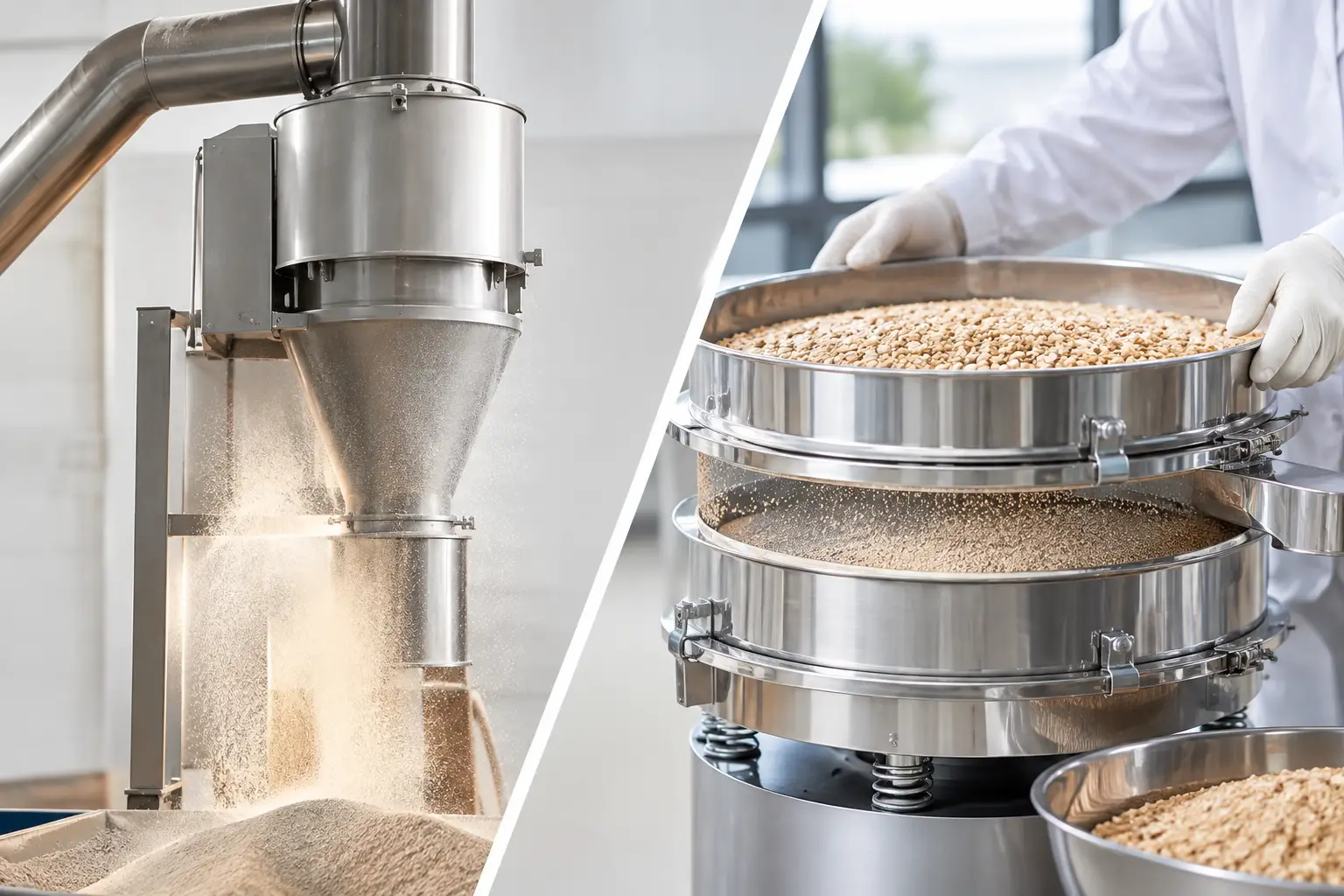
A food powder line rarely fails because of one machine. It fails at the handoff points – where ingredients stop flowing, particle size drifts, dust escapes containment, or controls do not coordinate upstream and downstream equipment the same way. That is why food powder processing systems should be evaluated as integrated production platforms, not as a collection of standalone assets.
For manufacturers producing seasonings, bakery blends, protein powders, dairy ingredients, beverage mixes, starches, sweeteners, and functional food formulations, the real question is not whether each component can run. The question is whether the full line can deliver repeatable throughput, tight formulation control, sanitary performance, and expansion capacity without introducing unnecessary operational risk.
What food powder processing systems actually need to do
In powder manufacturing, process performance is shaped by variability. Raw materials arrive with different bulk densities, moisture levels, particle sizes, and flow characteristics. Some ingredients bridge in hoppers. Others smear during milling, segregate during transfer, or generate combustible dust during handling. A system that performs well with free-flowing salt may struggle with hygroscopic dairy powders or fat-containing nutritional blends.
That is why properly engineered food powder processing systems are built around the material, the process objective, and the plant operating reality. Throughput matters, but so do residence time, cleanability, containment, changeover frequency, formulation accuracy, and downstream packaging requirements. The design basis has to account for all of it.
A practical system often includes raw material receiving, bulk bag or sack unloading, conveying, screening, size reduction, batch or continuous blending, thermal treatment where required, storage, and packaging integration. The equipment list is familiar. The challenge is getting every stage to perform as one coordinated system under real production conditions.
Integration matters more than isolated equipment performance
A high-performing blender does not fix inconsistent feed. An accurate feeder does not compensate for poor upstream particle size control. A packaging machine cannot stabilize output if the surge and transfer strategy ahead of it is wrong. In powder processing, local optimization often creates plant-wide inefficiency.
This is where integrated food powder processing systems separate themselves from pieced-together lines. When material handling, milling, mixing, transfer, controls, and packaging interfaces are designed under a common engineering standard, the process becomes more predictable. Capacity balances are defined earlier. Utility requirements are coordinated. Control logic is developed around the full line instead of around isolated machine functions.
That single-system approach also reduces a common source of project failure: accountability gaps. Multi-vendor lines often leave the manufacturer managing interface disputes around throughput, controls communication, startup sequencing, and performance acceptance. When one partner engineers the full platform, those handoff risks are materially lower because the system is expected to work as a system.
The core process blocks in food powder processing systems
Raw material handling sets the tone for everything downstream. If ingredients are discharged inconsistently, contaminated during transfer, or exposed to excess manual handling, the line starts in a compromised state. Bulk bag dischargers, sack dump stations, pneumatic or mechanical conveying, and ingredient storage must be selected based on actual powder behavior, not generic capacity assumptions.
Size reduction and milling follow the same rule. In some formulations, the goal is tighter particle size distribution for blend uniformity or dissolution performance. In others, milling is used to break agglomerates or condition incoming ingredients before mixing. But finer is not always better. Over-processing can increase dust loading, affect flavor release, change bulk density, or create flow problems in downstream packaging.
Mixing and blending are usually where process expectations are highest and design errors become expensive. Food manufacturers need confidence that minor ingredients disperse uniformly, allergens remain controlled, and batch-to-batch consistency is maintained at commercial scale. The right blender depends on formulation behavior, batch size, required homogeneity, and cleanout expectations. There is no universal mixer for every powder application, which is why process development and scale-up judgment matter.
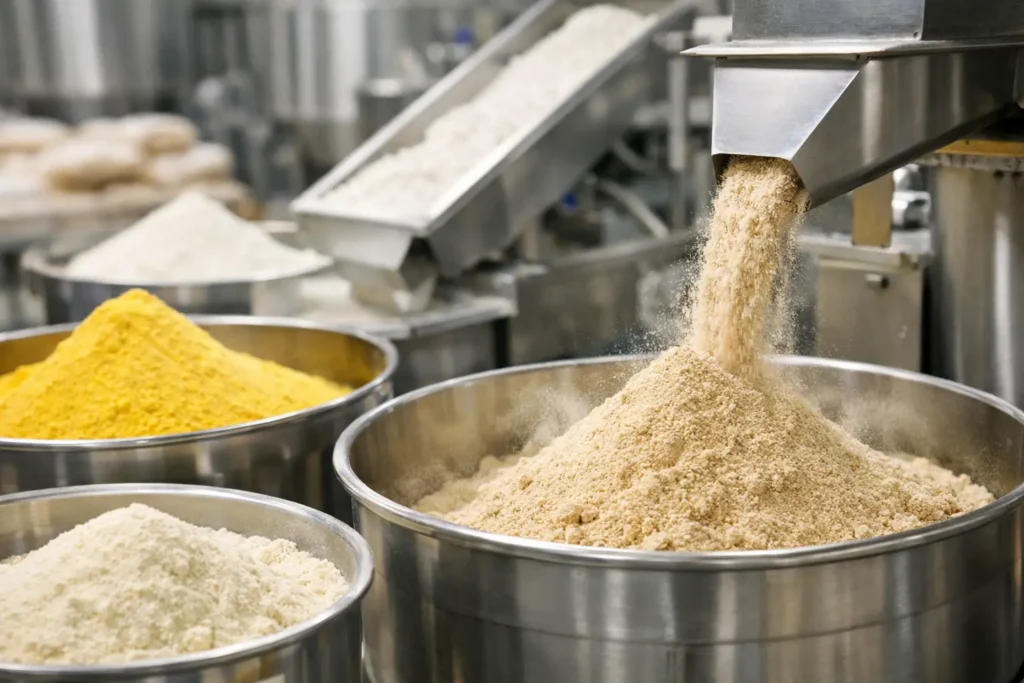
Transfer and storage are often underestimated. Powders can segregate between discharge and packaging, especially when particle size, density, or shape vary significantly between ingredients. Hopper geometry, refill strategy, pneumatic velocities, and drop distances all influence final product consistency. A line that tests well in a short pilot run can underperform in a production environment if the transfer path was not engineered with segregation control in mind.
Packaging integration closes the loop. If the packaging line starves, floods, dusts, or experiences inaccurate fills, the issue may not originate at the packer. It may start with inconsistent bulk density, poor surge design, or unstable upstream feed. That is why packaging should be engineered as part of the process line rather than treated as a downstream add-on.
Key design decisions depend on the product, not the brochure
There is no standard answer for how to configure food powder processing systems because powder behavior is product specific. Hygroscopic materials may demand humidity control and minimized exposure time. Abrasive ingredients can drive wear-resistant construction choices. Heat-sensitive formulations may require low-energy transfer and careful milling selection. Products with allergen constraints or frequent flavor changes may justify a design optimized for washdown access and rapid cleaning, even if that adds capital cost.
Throughput targets also need discipline. A line sized only for peak output may become difficult to control at lower operating rates. A system designed too close to the average may limit future expansion or create chronic bottlenecks. The best solution usually balances current production needs with a credible growth case, floor space constraints, labor strategy, and utility infrastructure.
Automation architecture deserves equal attention. Recipe management, batch traceability, feeder verification, alarm rationalization, and line-wide visibility are not secondary features. In regulated and performance-driven environments, they are part of the operating system. Controls should coordinate process states across the entire line so startups, shutdowns, interlocks, and upset recovery happen in a controlled and repeatable way.
Sanitation, safety, and uptime are engineered outcomes
Food manufacturers cannot afford to treat sanitation and safety as retrofit items. In powder processing, cleanability affects uptime just as directly as mechanical reliability. If the line is difficult to inspect, difficult to access, or difficult to clean between products, the result is longer changeovers, greater cross-contact risk, and lower asset utilization.
Dust control is another area where partial solutions create exposure. Powders can present housekeeping challenges, operator exposure concerns, and in some applications combustible dust risk. Containment strategy needs to be built into receiving, transfer, milling, and packaging from the start. That includes equipment sealing, aspiration, dust collection interfaces, zoning, and maintenance access.
Reliability follows the same logic. The strongest uptime performance usually comes from systems designed with compatible components, coordinated controls, and maintainability in mind. Spare parts strategy, service access, and instrumentation standardization make a measurable difference over the life of the line. A lower initial equipment price can become expensive quickly if the plant inherits fragmented controls, inconsistent documentation, and multiple service channels.
Why single-source accountability changes project outcomes
For capital projects involving food powder processing systems, technical risk does not end at equipment selection. It extends into engineering coordination, installation, commissioning, startup support, operator training, and long-term optimization. When these phases are split across multiple suppliers, the manufacturer often carries the burden of integration.
A single-source model changes that equation. One manufacturer. One engineering standard. One point of accountability. That structure simplifies project management, but more importantly, it improves the likelihood that the installed line performs as intended. Process interfaces are defined earlier, controls are developed with the full system in mind, and startup support is tied to overall line performance rather than individual machine acceptance.
For organizations scaling production, modernizing legacy lines, or entering new powder categories, that accountability has practical value. It reduces commissioning friction, shortens the path to stable production, and creates a clearer support model after startup. For many manufacturers, that is the difference between owning equipment and owning a dependable process.
Proc-X operates in that space – not as a seller of isolated machines, but as an engineering partner responsible for the performance of the complete system.
The strongest food powder lines are not defined by how many pieces of equipment they contain. They are defined by how well those pieces work together when product variability, sanitation demands, throughput pressure, and growth requirements all show up at once.