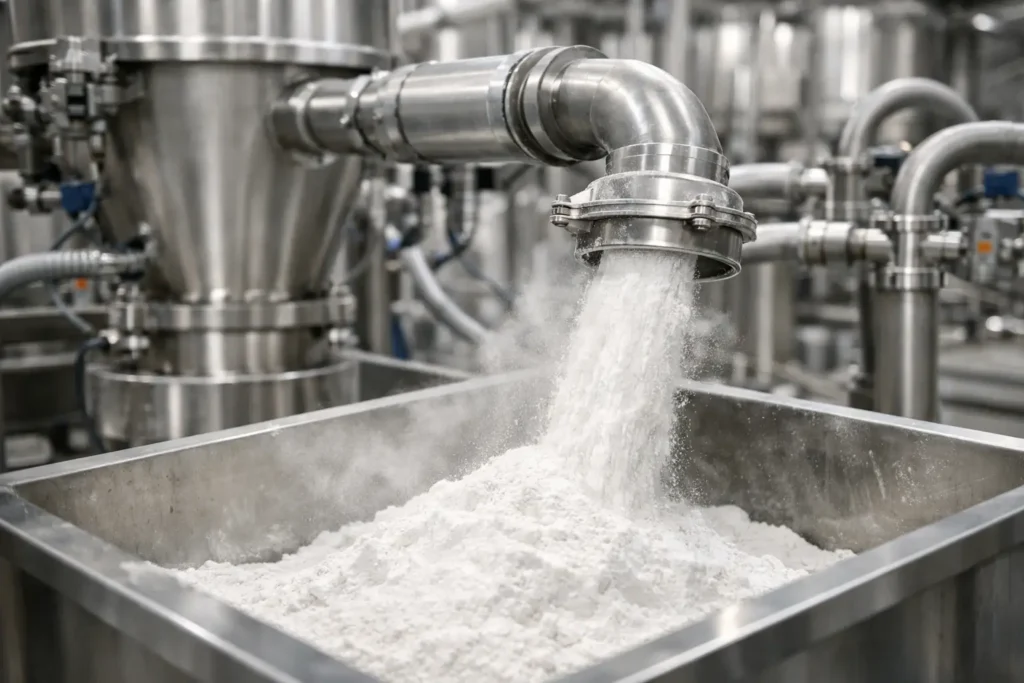
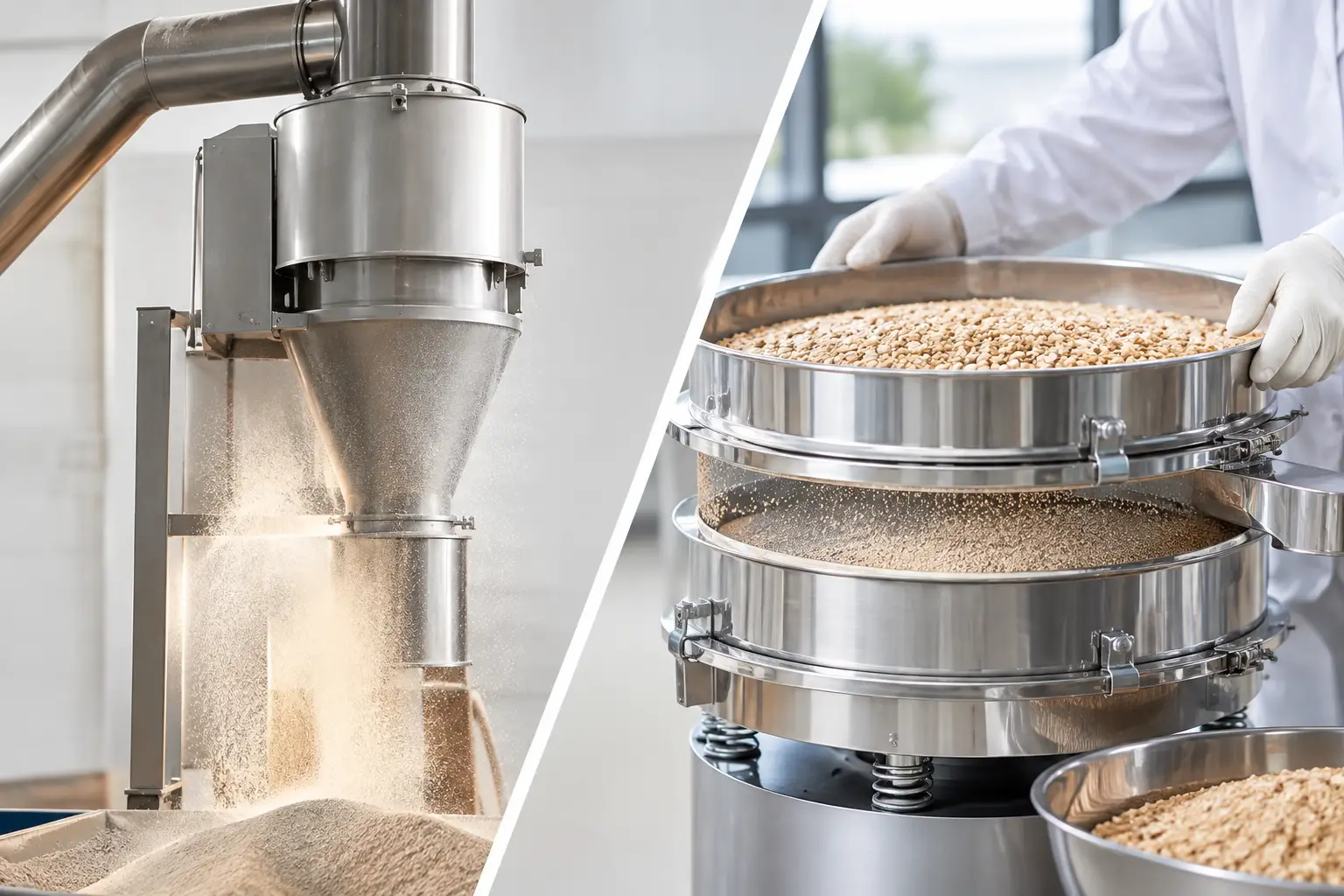
When a powder breaks down in transfer, plugs a line, or arrives at packaging with a different bulk density than it had at discharge, the problem usually starts much earlier than operators expect. In most cases, dense phase conveying design is not failing because the concept is wrong. It is failing because the system was sized around line length and throughput alone, instead of the actual behavior of the material and the realities of the full production line.
That distinction matters in industries where product integrity, housekeeping, traceability, and uptime are tied directly to conveying performance. Food ingredients, nutraceutical blends, battery materials, specialty chemicals, and pharmaceutical intermediates all respond differently to pressure, velocity, particle interaction, and transfer frequency. A dense phase system can protect fragile material and reduce wear, but only when it is engineered as part of the process, not treated as an isolated transport device.
What dense phase conveying design is really solving
Dense phase pneumatic conveying moves bulk solids at relatively low velocity and high solids loading, typically in slugs or dunes rather than a fully suspended high-speed stream. The appeal is straightforward. Lower conveying velocity can reduce particle attrition, minimize line erosion, limit dust generation, and improve containment.
Those benefits are real, but they are not automatic. Dense phase is often presented as the answer for fragile or abrasive materials, yet it can create new risks if the system does not maintain stable flow conditions. If pressure drops are misjudged, if the material does not form predictable plugs, or if the feed device cannot deliver a repeatable loading rate, the result can be unstable transport, line blockage, or difficult restart conditions.
This is why dense phase design begins with the material, not the pipeline.
Material behavior drives the design basis
Two powders with the same bulk density can behave completely differently in a conveying line. Particle size distribution, moisture sensitivity, friability, cohesiveness, compressibility, and aeration tendency all influence whether dense phase transport is even appropriate.
A free-flowing granular product may move effectively in low-velocity dunes with modest pressure requirements. A cohesive powder may compact under pressure and become difficult to restart after a short interruption. A friable blend may benefit from dense phase transport but still suffer segregation if the system creates inconsistent slug formation. Abrasive materials may justify dense phase from a wear standpoint, but line routing and elbow selection still determine how much maintenance is actually avoided.
That is where many projects go off track. Design assumptions are often borrowed from a similar product, a legacy installation, or an equipment supplier’s standard curve. For demanding applications, that approach is not enough. Material testing, flow characterization, and system-level review are what separate a system that conveys reliably from one that spends its life being tuned.
Dense phase conveying design is a controls problem as much as a mechanical one
There is a tendency to discuss pneumatic conveying in terms of vessels, blowers, and pipe diameters. Those matter, but dense phase performance depends just as heavily on controls architecture and pressure management.
A dense phase system only works well when it can consistently meter material into the line, manage air injection where needed, and maintain transport conditions through changing operating states. Batch loading, recipe changeovers, upstream surge variation, and downstream interruptions all affect line stability. If the control strategy cannot respond to those conditions, a mechanically sound system can still perform poorly.
For example, a line designed for one transfer rate may become unstable when upstream feeding drifts or when receivers cycle differently than expected. Supplemental air points can improve transport in some materials, but if they are poorly placed or badly controlled, they can increase velocity and defeat the original purpose of dense phase conveying. Pressure vessels need more than correct sizing. They need predictable filling, discharge sequencing, and integration with the rest of the line.
In practice, good dense phase design is a coordinated balance of vessel geometry, air supply, line profile, valve performance, instrumentation, and control logic.
Why line routing matters more than many specifications admit
It is easy to underestimate the effect of physical routing on dense phase systems. Long horizontal runs, excessive elbows, vertical lifts, and poor receiver positioning all influence pressure demand and flow stability.
Low-velocity conveying does not remove the need for disciplined pipeline design. In fact, it increases it. Dense phase transport is less forgiving when the route encourages material fallback, uneven slug movement, or excessive pressure loss. Elbow design is especially important because even at lower velocities, directional changes can become sites for accumulation, impact wear, or unstable flow depending on the product.
The shortest route is not always the best route, and the most convenient plant layout is not always compatible with stable dense phase operation. This is one reason system integration matters. Conveying design cannot be finalized in isolation from upstream size reduction, intermediate storage, dust collection, batch sequencing, or downstream packaging and process demands.
Throughput, turndown, and uptime need to be designed together
Many conveying systems perform adequately at nameplate capacity and struggle everywhere else. That is a problem because real plants do not operate at one fixed condition. Startups, shutdowns, recipe changes, partial loads, and maintenance bypasses create operating windows that can expose weak design decisions.
A strong dense phase conveying design accounts for peak throughput, normal operating range, and low-rate conditions without sacrificing reliability. That often requires a more disciplined view of turndown than a simple sales specification provides. If the material requires a narrow pressure and loading band to move predictably, operators need to know that before commissioning, not after repeated line plugs.
Uptime also depends on maintainability. Isolation valves, cleanout points, instrumentation access, receiver design, and line inspection strategy all affect how quickly a team can recover from an upset. In regulated environments, the design must also support cleaning validation, contamination control, and repeatable batch integrity. A technically elegant system that is difficult to inspect or service will create downstream operational cost.
Choosing dense phase for the right reasons
Dense phase is not automatically better than dilute phase. It is better when the process objective aligns with what dense phase actually does well.
If the main concern is preserving particle shape, minimizing fines, reducing wear, or improving containment, dense phase may be the right choice. If the material is highly aeratable, difficult to meter, or prone to compaction under pressure, another conveying approach or a hybrid strategy may be more reliable. Some applications benefit from low-velocity transfer only in selected portions of the process, rather than across the entire line.
This is where engineering discipline matters more than preference. The right question is not whether dense phase is more advanced. The right question is whether it improves total system performance under actual plant conditions.
Dense phase conveying design in integrated process systems
The most reliable conveying systems are designed with the full production environment in view. Feeders, mills, blenders, hoppers, receivers, controls, and packaging equipment all influence what the conveying system must handle and how much risk it can tolerate.
A single-source engineering approach has a practical advantage here. When conveying is developed as part of an integrated process platform, line sizing, controls logic, equipment interfaces, and commissioning strategy can be coordinated under one engineering standard. That reduces the common failure points seen in multi-vendor installations, where one supplier sizes the vessel, another defines the receiver cycle, and a third controls the upstream feed rate without full accountability for the interaction between them.
For manufacturers building or expanding complex production lines, that coordination is not a convenience. It is often the difference between predictable startup and a prolonged tuning exercise.
Proc-X approaches these applications from the perspective of total process responsibility. That means conveying performance is evaluated in the context of material handling, upstream processing, downstream packaging, controls integration, and long-term operational support rather than as a standalone equipment decision.
What good design work looks like
A capable engineering team will challenge assumptions early. They will ask how the material behaves across humidity and temperature changes, what the acceptable degradation limit is, how often the system must clean, what the actual operating envelope looks like, and where process interruptions are most likely to occur.
They will also quantify trade-offs. Lower velocity may reduce attrition but increase pressure demand. A larger line may reduce velocity but complicate slug stability. More air injection may improve movement in one section and create degradation in another. There is rarely a perfect answer. There is only the best answer for the process objective, the material, and the plant’s operating reality.
That is why dense phase conveying should be treated as an engineered process function, not a specification box to check. When the design is grounded in material behavior, integrated controls, and full-system accountability, it can deliver exactly what manufacturers expect from a critical transfer step – product protection, cleaner operation, and repeatable performance at production scale.
If a conveying project carries real consequences for quality, throughput, and uptime, the smartest next step is to define the system around the process you need to run, not the equipment you assume you need.