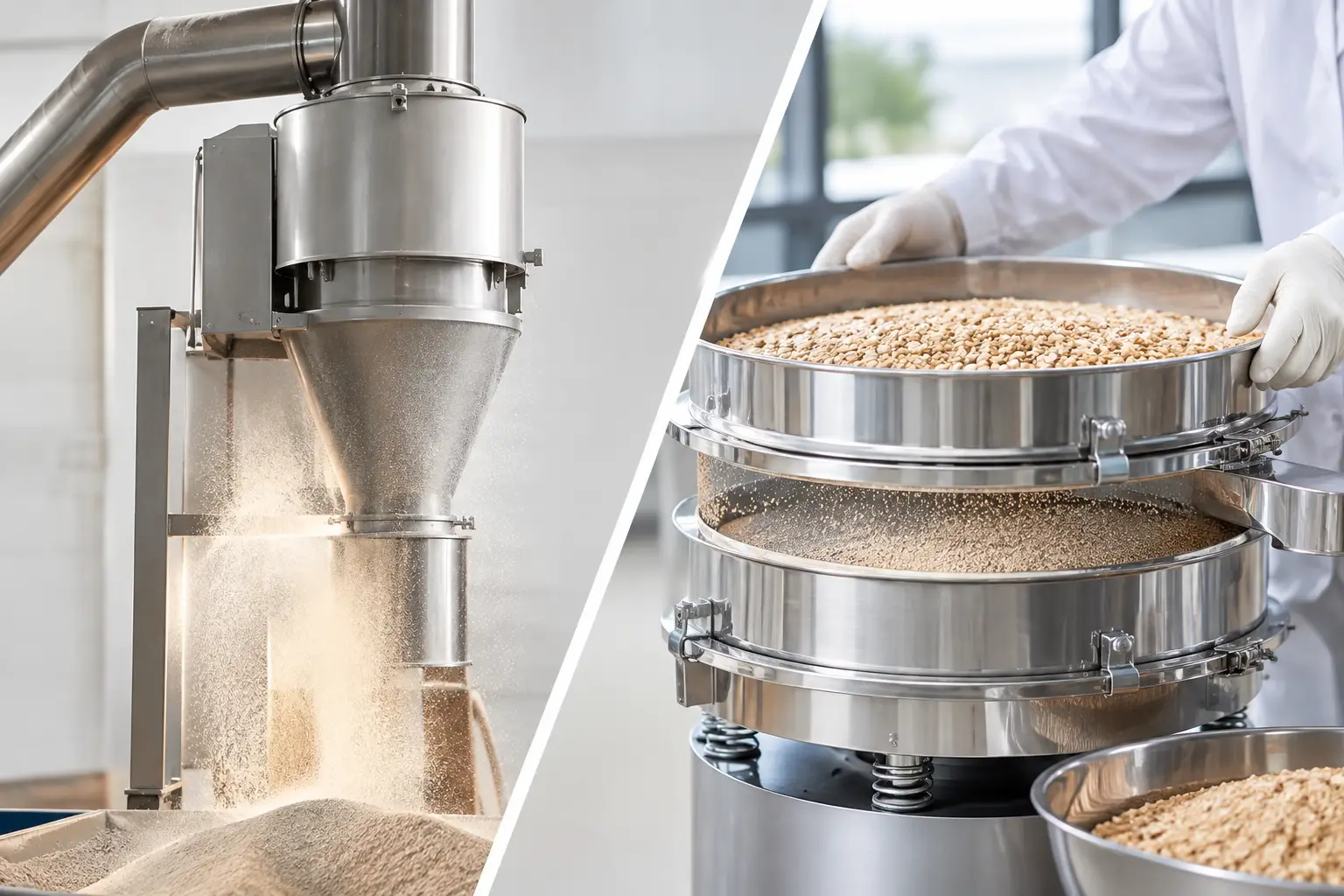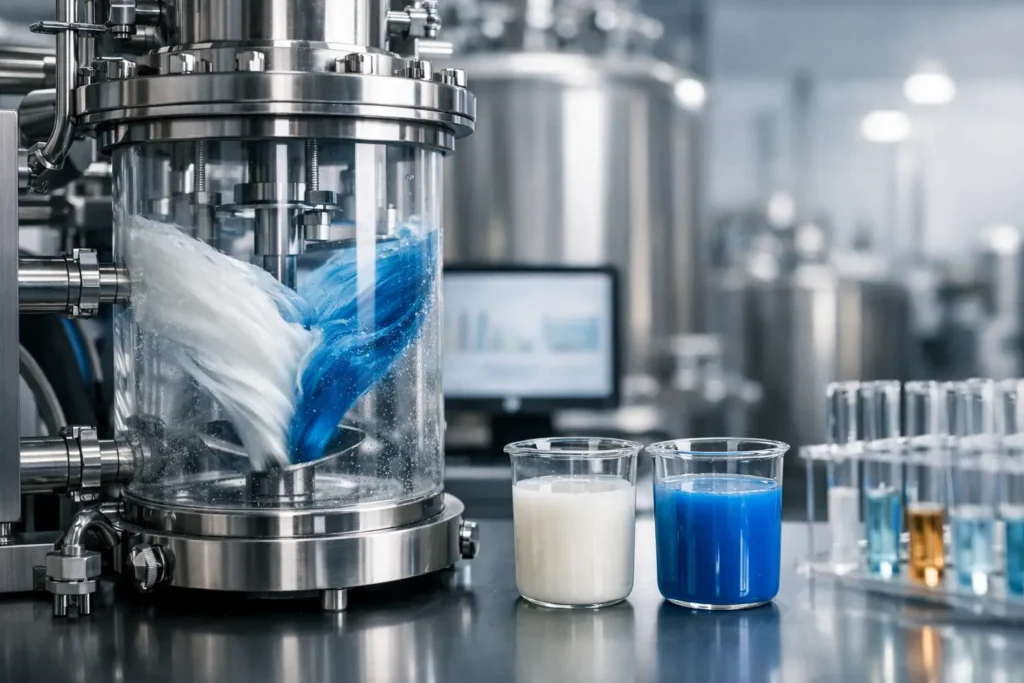
A blend that looks acceptable in a tote can still fail in production. Potency drift, poor flow, segregation during discharge, or inconsistent downstream performance usually trace back to one issue: the blending process was treated as a simple equipment step instead of a controlled system. That is the right place to start when asking what is blending technology.
In industrial manufacturing, blending technology is the engineered combination of equipment, process design, material handling, controls, and validation methods used to produce a uniform mixture from multiple ingredients. It is not limited to the blender itself. It includes how raw materials enter the process, how particle size and bulk density affect movement, how blending energy is applied, how discharge is managed, and how the product behaves in the next operation.
For regulated and performance-critical industries, that distinction matters. A blender does not create consistency on its own. The full process system does.
What is blending technology in an industrial setting?
At plant level, blending technology refers to the methods and machinery used to combine powders, granules, flakes, fibers, pastes, or other solids to a defined level of homogeneity. Depending on the application, the goal may be ingredient distribution, API uniformity, color consistency, flavor dispersion, functional additive incorporation, or preparation for granulation, extrusion, packaging, or further processing.
The right blending technology depends on material behavior and production requirements. Free-flowing powders behave very differently from cohesive, moisture-sensitive, abrasive, heat-sensitive, or electrostatically active materials. A formulation with similar particle sizes and densities may blend quickly and remain stable. A formulation with wide variation in those properties may blend unevenly, then segregate as soon as it moves downstream.
That is why blending is an engineering discipline, not just a mixing task. The process has to be matched to the material and to the performance target.
Blending and mixing are related, but not identical
In day-to-day plant language, people often use blending and mixing interchangeably. In technical practice, there is a useful distinction.
Blending usually refers to combining dry solids, or materials with relatively low liquid content, to improve uniformity without significantly changing the material state. The intent is distribution. Mixing often implies a more aggressive process, especially for liquids, slurries, wet masses, or applications where shear, dispersion, emulsification, or reaction support is required.
The difference matters because it affects equipment selection. A process that needs gentle randomization to protect fragile particles should not be handled the same way as a process that needs high-intensity shear to break agglomerates or distribute micro-ingredients. Overprocessing can damage product quality just as easily as underprocessing can leave the blend out of spec.
The core elements of blending technology
A well-designed blending system balances four variables: material characteristics, blender mechanics, process control, and downstream integration.
Material characteristics come first. Particle size distribution, shape, density, moisture, compressibility, friability, and flow properties all influence how ingredients move and separate. If one ingredient is much finer or denser than the rest, it may cluster, settle, or resist uniform distribution. If a material is cohesive, standard tumble blending may not apply enough energy. If it is fragile, aggressive agitation may create fines and make the blend less stable over time.
Blender mechanics define how energy enters the product. Some blenders rely on vessel rotation and gravitational movement. Others use internal agitators, plows, paddles, ribbons, or fluidization to move ingredients through the batch. The mechanics determine shear level, residence pattern, fill sensitivity, and discharge behavior.
Process control translates equipment capability into repeatable output. Blend time, fill level, rotational speed, agitator speed, sequence of addition, and liquid addition rate all affect final uniformity. In a production environment, these parameters have to be controlled, documented, and repeatable across shifts and lots.
Downstream integration is where many projects succeed or fail. A blend that meets test results inside the vessel can still segregate during transfer, surge storage, feeding, or packaging. Screw conveyors, pneumatic conveying, hoppers, and feeders can all alter the material distribution that the blender created. One manufacturer. One engineering standard. One point of accountability becomes especially valuable when those handoffs must perform as one system.
Common types of industrial blending equipment
Several blending technologies are used across manufacturing, and each solves a different process problem.
Tumble blenders are often selected for gentle blending of free-flowing powders and granules. Their strength is low shear and relatively simple operation. They are widely used when particle integrity matters, but they are less effective for cohesive materials or formulations with difficult micro-ingredient distribution unless intensifier bars or other aids are added.
Ribbon blenders use a horizontal trough and helical ribbons to move material in opposing directions. They are common in food, chemical, and dry ingredient applications because they provide predictable batch movement and good throughput. They can also support light liquid addition, but they may not be ideal where extremely fragile particles or strict cleanability requirements dominate the decision.
Plow blenders create more aggressive mechanical action and are often better suited for difficult powders, rapid blending, deagglomeration, or heavier liquid incorporation. That added intensity can improve performance, but it also raises questions around wear, heat generation, and material degradation depending on the formulation.
Paddle blenders are used where moderate shear and gentle handling need to be balanced. Continuous blenders, meanwhile, are selected when the process demands steady-state output rather than discrete batches. They can reduce footprint and support high throughput, but they require tighter control of feed consistency and process stability.
No blender type is universally best. The correct choice depends on the material, the required blend quality, sanitation expectations, validation burden, and how the product will move through the rest of the line.
Why blending technology affects more than uniformity
Uniformity is the most obvious performance metric, but it is not the only one that matters.
Blending technology also affects throughput. If a system requires extended blend times, frequent manual intervention, or repeated rework, line efficiency drops. In high-value production environments, that lost capacity can be more expensive than the equipment itself over time.
It affects quality risk as well. In pharmaceuticals, nutraceuticals, and specialty chemicals, blend inconsistency can create assay failures, content uniformity deviations, or batch rejection. In food and personal care products, poor blending may show up as visible variation, texture defects, inconsistent flavor release, or unstable downstream forming behavior.
It also affects cleaning and changeover. A blender that performs well on one product may become a bottleneck if it is difficult to access, slow to clean, or prone to residue retention. That matters even more in facilities managing allergen control, product family segregation, or validated cleaning procedures.
Then there is scale-up. A process that works in development does not automatically hold at production volume. Differences in fill depth, residence pattern, or ingredient introduction can change the result. Good blending technology accounts for scale from the beginning instead of forcing the plant to troubleshoot after installation.
How blending technology is evaluated
For most manufacturers, the right question is not just what is blending technology, but how do we know the chosen system will work.
That evaluation starts with the product. Material testing should identify flow behavior, particle size effects, density differences, and the tendency to agglomerate or segregate. Trial work should confirm whether the blend reaches target uniformity within a practical cycle time and whether that uniformity survives discharge and transfer.
From there, system design becomes critical. Inlet strategy, load cells, dust control, feeder accuracy, access for cleaning, discharge valve design, and conveying method all influence final performance. Controls should support recipe consistency, operator repeatability, and data capture where process documentation is required.
The strongest projects are not built around a standalone machine specification. They are built around a process outcome: target homogeneity, batch cycle, cleaning standard, containment level, and integration with upstream and downstream equipment.
What good blending technology looks like in practice
In practice, good blending technology is predictable. It produces a consistent result across lots, operators, and operating conditions. It fits the material instead of forcing the material to fit the machine. It supports the realities of production, including sanitation, maintenance access, changeover time, and future capacity needs.
Just as important, it is designed as part of the whole line. If milling changes particle size upstream, the blend may behave differently. If feeders pulse inconsistently downstream, the product may separate before packaging. Industrial blending works best when the entire process line is engineered as one accountable system rather than assembled through isolated equipment decisions.
That is often the difference between equipment that runs and a production line that performs.
When manufacturers ask what is blending technology, the most accurate answer is this: it is the controlled science of making material uniform, repeatable, and ready for the next step without introducing new risk. The closer that answer stays tied to total system performance, the better the outcome will be on the plant floor.