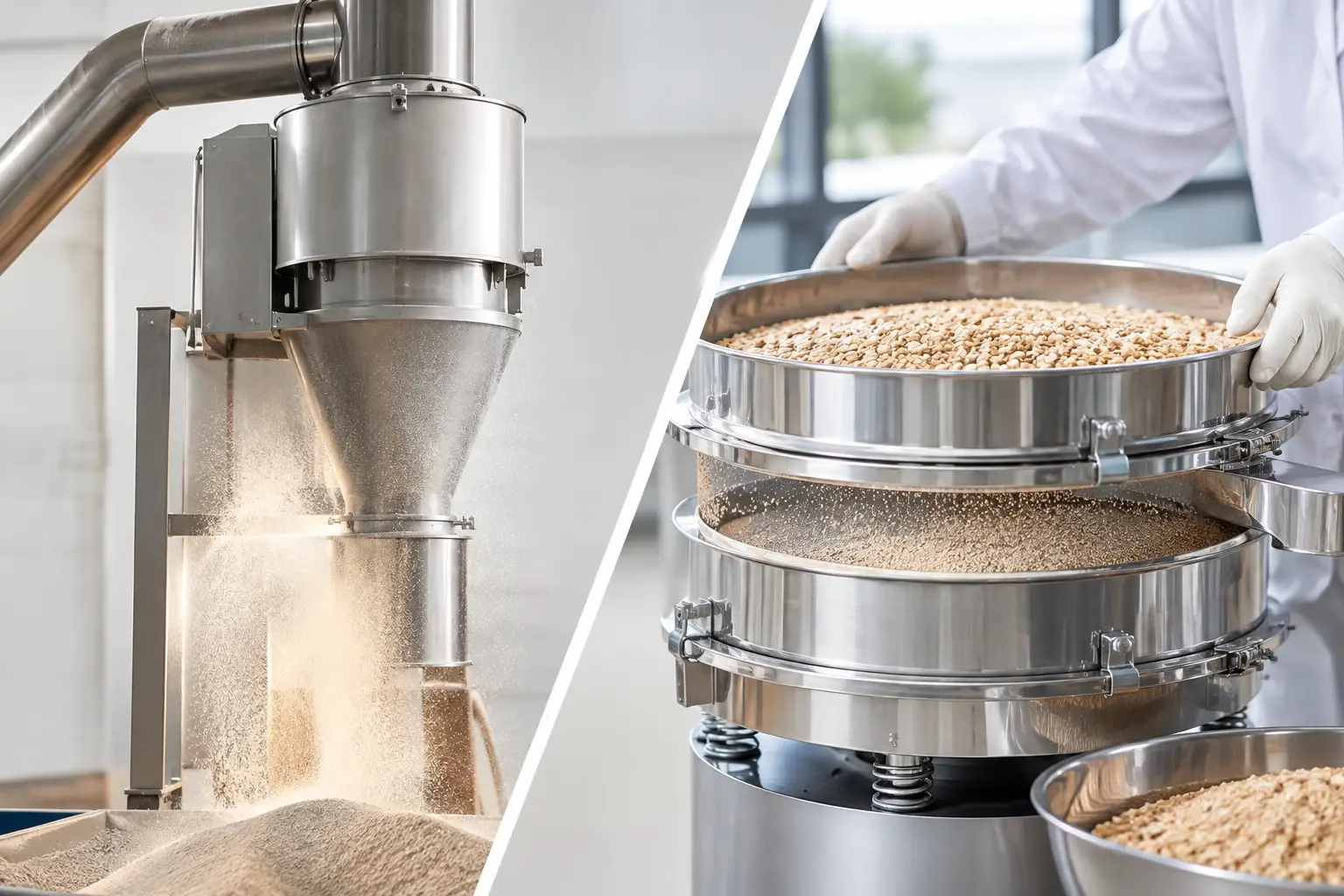
A dosing system can meet its target weight and still create an unreliable process. If a cohesive powder bridges in the hopper, a minor ingredient is added in the wrong sequence, or the control system cannot prove what entered the batch, the result may be rework, rejected product, or an extended investigation. Understanding how to automate ingredient dosing begins with treating dosing as a complete material-handling and process-control function, not simply an automated scale.
For manufacturers handling powders, granules, liquids, pastes, and high-viscosity materials, the correct approach connects ingredient receipt, storage, transfer, feeding, weighing, verification, and batch records. The equipment must suit the material, while the controls must suit the process and the operating environment.
Start With the Dosing Requirement, Not the Equipment
An effective automation project starts by defining what must be controlled. This includes the formulation, required batch size or continuous production rate, ingredient tolerances, order of addition, cycle time, sanitation requirements, and the downstream process. A feeder that performs well for a free-flowing granular ingredient may be unsuitable for a low-density powder that aerates, segregates, or forms stable arches.
Material data is the foundation of system design. Bulk density, particle-size distribution, moisture content, flowability, temperature, abrasiveness, friability, and electrostatic behavior all affect feeder selection and accuracy. So do handling conditions. An ingredient that flows acceptably from a drum in a laboratory may compact during storage in a large hopper or lose flow consistency after pneumatic transfer.
The production objective also matters. A batch system may require high-accuracy loss-in-weight or gain-in-weight dosing of dozens of ingredients into a mixer. A continuous process may require gravimetric feeders that maintain stable mass flow into extrusion, blending, milling, or thermal treatment. Volumetric dosing can be appropriate where density is stable and accuracy requirements are less demanding, but it should not be selected merely because it has a lower initial cost.
Choose the Right Dosing Method for Each Ingredient
No single dosing technology is correct for every material. A well-engineered system often combines several approaches within one line.
Gravimetric dosing for controlled mass addition
Gravimetric systems use load cells to measure weight and provide direct mass-based control. In a gain-in-weight arrangement, ingredients are dispensed into a receiving vessel on load cells until the programmed target is reached. This approach is common for batch blending and mixing, particularly where formulation accuracy and lot traceability are critical.
Loss-in-weight feeders measure the reduction in weight from a hopper and feeder assembly. The control system adjusts feeder speed to maintain a target mass flow rate. They are well suited to continuous processes and to applications where rate stability directly affects product quality.
Both methods require sound mechanical design. Load cells cannot compensate for structural interference, vibration, flexible connections that pull on a scale frame, or poorly managed refill events. Accuracy depends on the whole weighing assembly, not only on the scale indicator.
Volumetric dosing where conditions support it
Volumetric feeders meter material by screw speed, belt speed, rotary-valve displacement, pump displacement, or another repeatable volume. They can be practical for ingredients with consistent bulk density and predictable flow behavior. They are also commonly used as a prefeed stage before a gravimetric final dose.
The trade-off is that a volumetric feeder does not inherently correct for density shifts. Powder aeration, compaction, moisture uptake, particle segregation, and changing head pressure can change the mass delivered per revolution. If those variations affect the finished product, gravimetric feedback is generally the more defensible choice.
Liquid, paste, and high-viscosity dosing
Liquids can be dosed by weight, flow measurement, timed pump operation, or a combination of methods. For low-viscosity liquids, mass flow measurement may provide responsive control. For viscous materials, pastes, and materials with suspended solids, positive-displacement pumps and weigh-based verification are often more reliable.
The dosing method must account for line hold-up, valve response, temperature sensitivity, cleaning method, and residual material at shutoff. A system that doses accurately at ambient temperature may drift when viscosity changes during a heated process.
Design the Material Path to Protect Accuracy
Feeding problems are frequently mistaken for controls problems. If material does not discharge uniformly into the feeder, no software setting will create stable dosing. Hopper geometry, outlet size, agitation, bridging prevention, refill strategy, and feeder selection must work together.
For cohesive powders, options may include agitators, flexible-wall hoppers, live-bottom devices, mass-flow hopper designs, screw feeders with appropriate pitch and diameter, or purpose-built conditioning devices. Fragile products require a different approach: aggressive agitation or high-speed conveying may damage particles and alter the product before dosing even begins.
The transfer method also deserves early attention. Vacuum conveying, pressure conveying, mechanical conveying, and manual charging each affect material condition differently. Fine powders may aerate after transfer and need time to settle before a precise dose. Abrasive materials may require wear-resistant contact surfaces. Hygroscopic ingredients may need enclosed handling and humidity control.
A practical design separates bulk delivery from final metering. Storage and transfer equipment should keep the feeder supplied without imposing variable loads or inconsistent material conditions on the dosing device. This separation improves repeatability and makes maintenance less disruptive.
Build Controls Around the Actual Production Sequence
Ingredient automation is not complete when a feeder starts and stops automatically. The control system should execute the recipe, enforce the addition sequence, verify each dose, manage exceptions, and communicate the result to the wider production environment.
For a batch process, a typical sequence may confirm the correct ingredient source, validate vessel availability, tare the scale, run a coarse feed to approach the target, transition to a fine feed, settle the weight, and compare the final value against tolerance. The system should then record the actual quantity, lot or container identification where required, time stamp, operator actions, and any alarms or manual interventions.
Coarse-and-fine dosing is especially valuable for ingredients with meaningful tolerance requirements. A high-capacity feed stage reduces cycle time, while a lower-rate trim stage improves final accuracy. The correct transition point depends on feeder response, material flight time, discharge dynamics, and the scale’s settling behavior. It should be established through commissioning trials rather than assumed from a standard recipe.
For continuous production, controls must address refill behavior. A loss-in-weight feeder can maintain rate accurately during normal operation, but the feeder is temporarily unable to measure true weight loss while its hopper is refilled. A refill compensation strategy, properly sized hopper capacity, and stable upstream supply are necessary to avoid rate disturbances.
Engineer for Traceability, Validation, and Safe Operation
The level of documentation should match the industry and risk profile. Pharmaceutical, nutraceutical, food, defense, and specialty chemical operations may require electronic batch records, user access controls, audit trails, calibration procedures, and formal validation support. Other applications may prioritize production reporting, inventory reconciliation, and preventive-maintenance data.
Traceability should be designed into the workflow. Barcode or RFID confirmation, ingredient-source verification, controlled recipe permissions, and lot-level records can prevent a wrong-material event before it reaches the mixer. These controls are often more valuable than adding another decimal place of weighing resolution.
Safety and containment are equally central. Dust collection, explosion protection where applicable, ergonomic bag or drum handling, isolation from moving equipment, and enclosed transfer paths should be evaluated as part of the system. For hazardous, potent, allergenic, or cross-contamination-sensitive ingredients, containment and cleanability can determine the entire equipment arrangement.
Commission With Real Materials and Measurable Acceptance Criteria
Factory testing is useful, but final performance must be demonstrated with representative production materials. Substitute materials rarely reproduce the flow behavior, density variation, or cleanup demands of the actual ingredient. Commissioning should test normal operation as well as realistic upset conditions: refill cycles, empty source containers, material bridging, low-level alarms, scale drift checks, recipe changes, and recovery after a stopped batch.
Acceptance criteria should define more than target accuracy. They should cover repeatability, batch cycle time, throughput, material loss, dust control, cleanout time, operator intervention, and data-record completeness. Maintenance teams should also be involved before handover, with access, inspection points, spare-parts strategy, and calibration requirements established early.
The best automated dosing system is not the one with the most components. It is the one that gives operations a repeatable material path, quality teams defensible records, and maintenance teams equipment they can sustain. When feeding, weighing, controls, and downstream processing are engineered as one system, dosing becomes a controlled production advantage rather than a recurring source of variation.