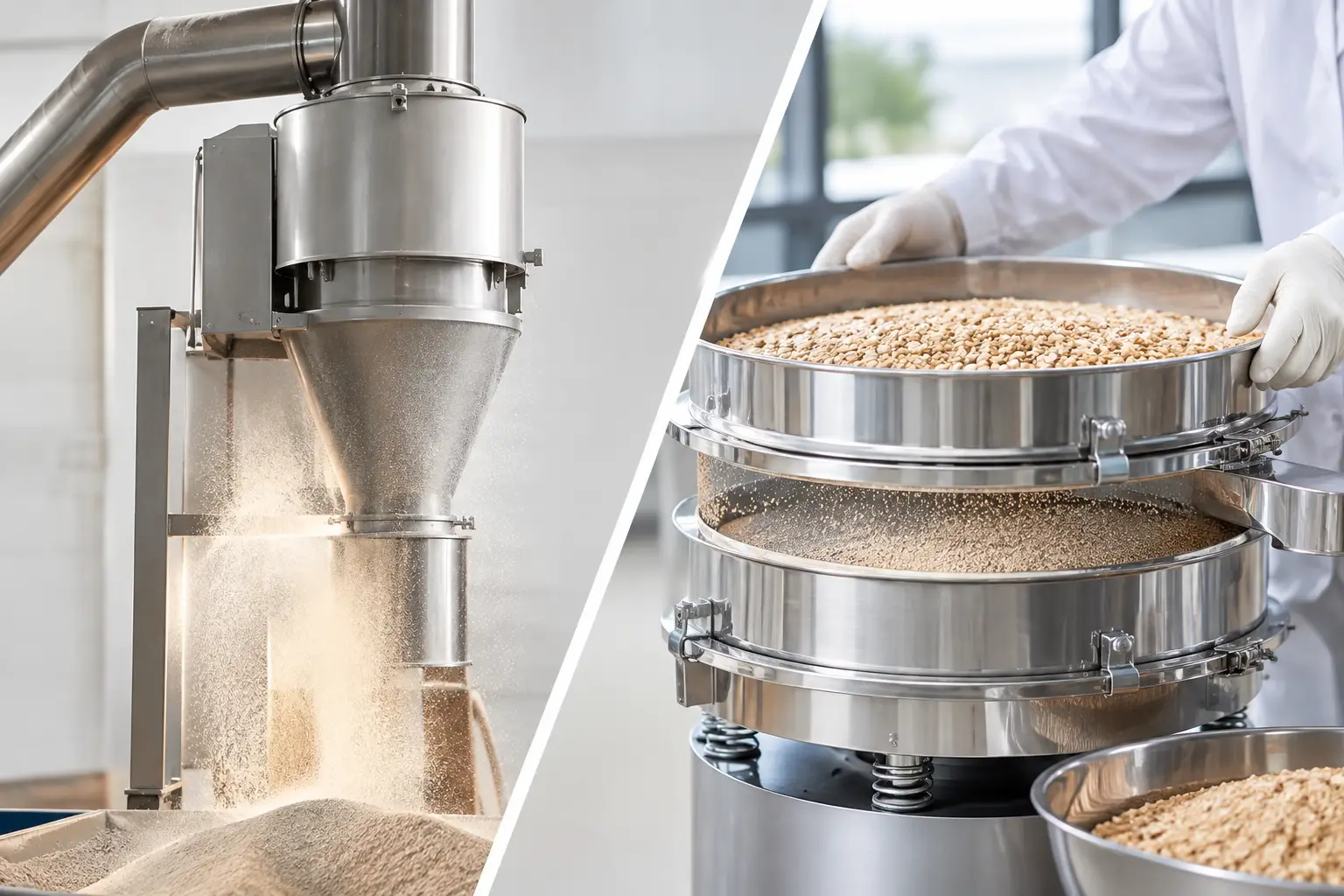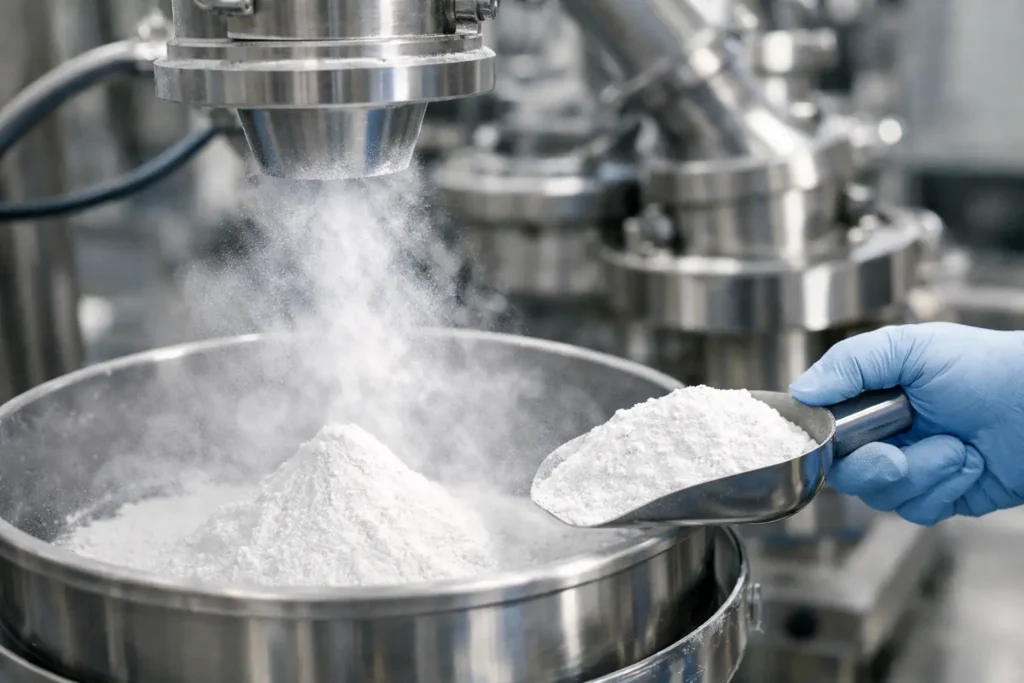
A fine-powder specification can look straightforward on paper: achieve a target particle size, protect the product, and maintain production rate. In practice, jet mills must resolve competing demands around particle-size distribution, heat exposure, contamination control, yield, compressed-air consumption, and safe material containment. The right answer depends on the material and on how the mill performs within the complete process.
What Jet Mills Do Differently
Jet milling reduces particle size by accelerating compressed air, nitrogen, or another process gas through nozzles at high velocity. Particles entrained in the gas stream collide with one another. Those high-energy particle-on-particle impacts create size reduction without conventional mechanical grinding media, pins, or rotating impact tools in the milling zone.
This operating principle makes jet milling particularly valuable where contamination from mill internals is unacceptable, where a narrow fine-particle cut is required, or where material must be processed with limited thermal input. Pharmaceutical actives, specialty chemicals, pigments, ceramics, battery materials, toner, and high-value advanced materials are common applications. Food and nutraceutical applications can also benefit when product quality, sanitation, and fine-powder control justify the operating cost.
“Cold milling” is often used to describe the process, but it should not be interpreted as a guarantee that product temperature never rises. Compressed-gas expansion can provide a cooling effect, while particle collisions, feed conditions, air compression, and downstream collection still influence actual product temperature. Heat-sensitive products require verification through testing and measured operating data, not an assumption based on mill type alone.
How a Jet Mill Controls Particle Size
A jet mill does not simply keep reducing every particle until it becomes ultrafine. Classification is central to its performance. In a fluidized-bed opposed jet mill, gas jets create a circulating particle bed while an integrated dynamic classifier separates particles that have reached the desired fineness from particles that remain too coarse. Fine product exits with the gas stream; oversized particles stay in the grinding zone for further collisions.
Classifier speed, gas flow, nozzle configuration, feed rate, and material characteristics all affect the final particle-size distribution. Increasing classifier speed generally produces a finer cut, but it may reduce throughput and increase specific energy use. Raising gas flow can increase collision energy, yet excessive flow may destabilize the grinding zone or overload downstream filters. The operating window must be established for the actual formulation rather than inferred from a single particle-size target.
Material behavior matters just as much. A brittle crystalline material may mill efficiently to a narrow distribution. A ductile, waxy, hygroscopic, or highly cohesive powder may resist fracture, agglomerate after milling, or foul conveying and collection equipment. Some materials become more difficult to process as they get finer because surface forces begin to dominate particle behavior.
Selecting Jet Mills Starts With the Material
A productive specification process begins with representative material, not just a data sheet. The particle-size distribution of the incoming feed, moisture content, bulk density, hardness, friability, flowability, and tendency to build static charge can materially change mill selection and system design.
Process engineers should define four requirements before selecting equipment:
- The required particle-size distribution, including the allowable coarse fraction and whether D10, D50, D90, or a maximum particle size governs quality.
- The needed production rate, expressed as sustained commercial throughput rather than an isolated peak trial result.
- Product-quality limits involving heat, cross-contamination, oxidation, sterility, metal contact, or changes in morphology and surface area.
- Operating constraints such as hazardous dust classification, containment target, cleanability, validation requirements, utilities, and available floor space.
These inputs determine whether a spiral jet mill, fluidized-bed opposed jet mill, or another milling method is appropriate. Spiral designs can be effective for smaller batches and laboratory development. Fluidized-bed systems are typically better suited to tighter classification control and scalable commercial operation. In other cases, an air classifier mill, pin mill, hammer mill, wet media mill, or cryogenic process may provide a better balance of throughput, energy, and product quality.
Jet milling should be selected because it addresses a defined process need, not because it is assumed to be the finest available technology.
The Mill Is Only One Part of the Process
A jet mill performs as part of an integrated system. Feed consistency, gas quality, collection efficiency, controls, containment, and material transfer all determine whether the process operates predictably at production scale.
The feeding system must deliver material at a controlled rate despite changes in bulk density or flowability. For cohesive powders, this may require agitation, conditioning, twin-screw feeding, loss-in-weight control, or a purpose-designed hopper geometry. An unstable feed rate creates an unstable milling environment, which appears downstream as shifts in particle-size distribution, pressure, yield, and product temperature.
Compressed air or nitrogen requires equal attention. The gas must be clean, dry, and available at the pressure and volume demanded by the selected mill. Oil, moisture, or pressure variation can compromise product quality and make a well-designed mill appear inconsistent. Nitrogen systems may be needed when oxidation control or dust-explosion mitigation is required, but they introduce additional considerations around inerting verification, gas recovery, oxygen monitoring, and facility safety procedures.
Downstream collection is another critical design point. Cyclones, bag filters, cartridge collectors, and high-efficiency secondary filtration must be matched to the product’s particle size, electrostatic behavior, and recovery requirements. Ultrafine material can challenge conventional collection systems. Poor recovery is not merely a yield issue – it can affect housekeeping, worker exposure, filter loading, and batch reconciliation.
Scale-Up Requires More Than a Larger Mill
Laboratory jet milling is valuable for feasibility work, formulation development, and early particle engineering. It does not automatically establish commercial performance. Small-scale results may not reflect full-scale feed behavior, gas distribution, residence time, classifier performance, or collection losses.
A disciplined scale-up program evaluates more than the final D50. It examines distribution shape, throughput, energy use, product temperature, yield, surface area, morphology where relevant, and lot-to-lot repeatability. For regulated products, it also considers cleanability, material traceability, data capture, and the control strategy needed to hold the validated operating range.
Pilot testing should simulate the full process as closely as possible. That includes the intended feed method, process gas, containment arrangement, and product collection approach. Testing a few kilograms through a laboratory setup may demonstrate that a powder can be milled. It may not reveal whether the material will bridge in a production hopper, blind filters, carry over into exhaust equipment, or meet recovery targets over an extended run.
Containment, Cleaning, and Reliability Must Be Engineered In
For potent compounds, sensitizers, hazardous chemicals, and dusty fine powders, containment cannot be added as an afterthought. The mill, feeder, discharge equipment, filters, valves, sampling points, and maintenance access must work together to control exposure. The required containment performance influences equipment layout, gasket design, split-butterfly valve use, wash-in-place capability, and maintenance procedures.
Cleaning requirements also affect configuration. A pharmaceutical system may need polished contact surfaces, documented material certifications, clean-in-place coverage, and design features that eliminate hard-to-reach product retention areas. A specialty mineral process may prioritize abrasion resistance, replaceable wear components, and rapid maintenance access instead. One equipment platform rarely serves both applications without meaningful changes in materials, geometry, and support systems.
Reliability depends on managing the full operating envelope. Filters need differential-pressure monitoring. Classifier drives need condition monitoring and accessible service points. Instrumentation should provide useful visibility into gas pressure, flow, feed rate, temperature, oxygen where applicable, and collector performance. Controls should make deviations visible before they become off-specification production or unplanned downtime.
Building a Defensible Jet Milling Specification
The strongest jet milling projects define success in process terms: a verified particle-size distribution at a sustainable rate, acceptable yield, controlled product temperature, safe containment, and maintainable operation. Equipment specifications that focus only on nominal motor power or a published fineness claim leave too much unresolved.
Proc-X approaches milling as part of the production system, connecting size reduction with feeding, classification, pneumatic transfer, collection, controls, and downstream packaging or blending requirements. That integrated perspective reduces handoff risk between separately supplied machines and creates clearer accountability for how the process performs.
Before committing to a jet mill, require representative trials, document the operating window, and evaluate the utility and collection systems with the same rigor applied to the mill itself. The best installation is not the one that produces the smallest particle in a short test. It is the one that repeatedly produces the required powder, safely and predictably, through every production shift.