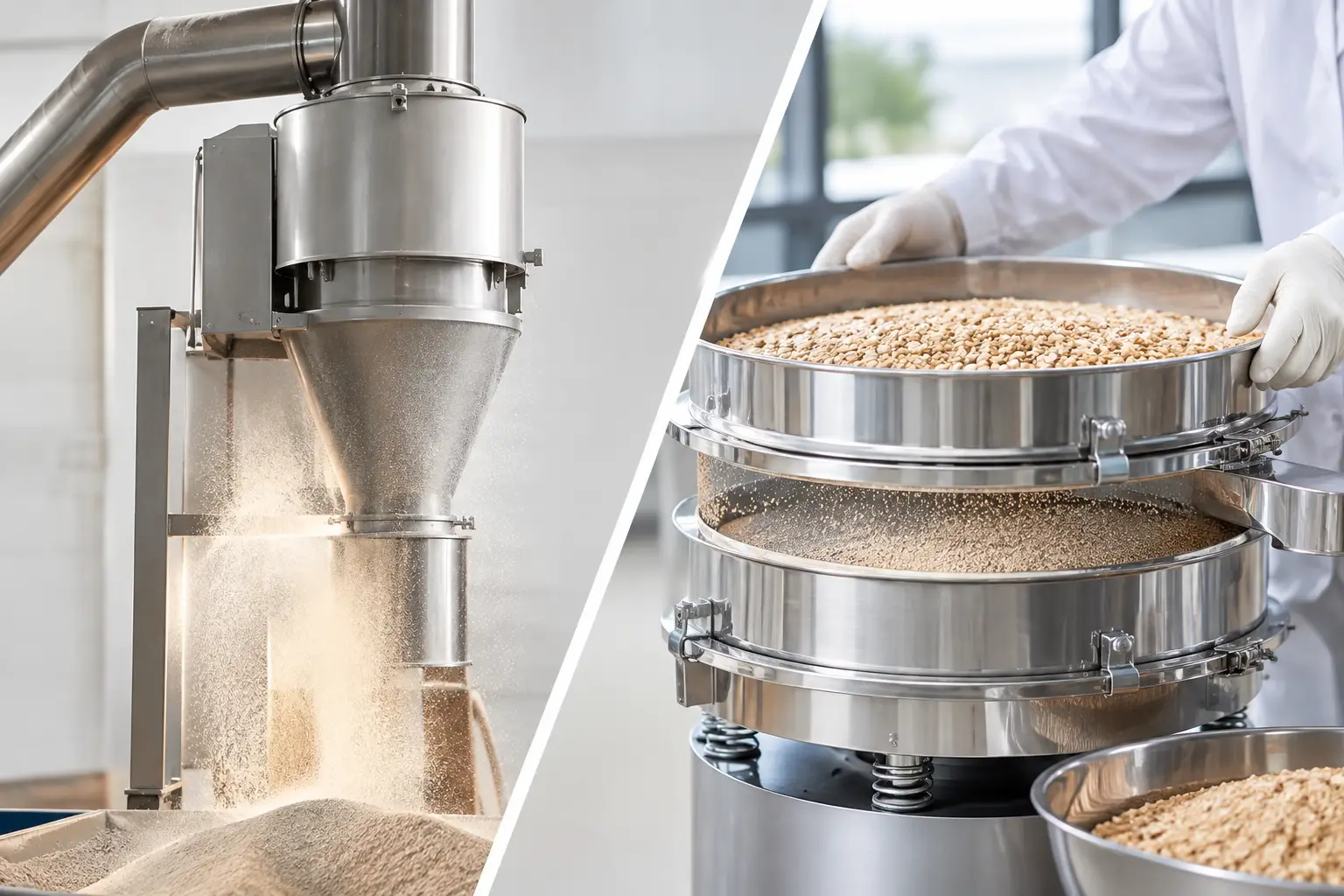
A transfer system that stops, segregates product, generates dust, or changes particle characteristics can limit the performance of an otherwise capable production line. Knowing how to improve material transfer starts with treating it as a process function, not a conveyor, pipe run, or pump selected in isolation. The material, source vessel, destination equipment, operating sequence, and quality requirements must work together.
For manufacturers handling powders, granules, liquids, pastes, slurries, or high-viscosity compounds, the objective is not simply to move material from point A to point B. It is to deliver the required amount, at the required rate, in the required condition, while protecting personnel, product quality, and equipment availability.
Start With the Material, Not the Transfer Method
Material behavior determines whether a transfer system will perform consistently. A free-flowing granular product may move efficiently through gravity chutes, screw conveyors, bucket elevators, or dilute-phase pneumatic lines. A cohesive powder with variable moisture may bridge in a hopper, pack in a rotary valve, or build deposits in bends. The same nominal material can behave differently after milling, blending, drying, temperature change, or extended storage.
A practical evaluation should document bulk density, particle-size distribution, flowability, moisture content, temperature, friability, abrasiveness, electrostatic behavior, and tendency to segregate. For liquids and pastes, viscosity is only one part of the picture. Shear sensitivity, yield stress, solids loading, temperature response, and cleanability can be equally important.
Material testing and representative trials are especially valuable when production depends on difficult ingredients or high-value formulations. Design based on a safety data sheet or a single laboratory sample often overlooks variation between lots, seasons, suppliers, and upstream process conditions. Transfer equipment needs to accommodate the operating range, not only the ideal condition.
Define What Better Material Transfer Means
Improvement targets should be measurable. A plant may need higher throughput, fewer operator interventions, lower dust exposure, shorter changeovers, improved batch accuracy, reduced product loss, or less degradation. These goals can point to different solutions.
For example, increasing conveying air velocity may clear a pneumatic line more reliably, but it can also increase particle attrition, line wear, and energy use. A larger screw conveyor can increase capacity, but if it is poorly fed, it may create surging that disrupts downstream weighing or blending. Faster pump speed may shorten transfer time while increasing heat input or damaging a shear-sensitive product.
The most effective projects establish performance criteria before equipment selection. Define the required rate in both average and peak terms, allowable residual material, transfer distance and elevation, batch size, acceptable variation, cleaning frequency, and planned operating hours. Include upset conditions, such as a partially full receiving vessel or a delay in downstream equipment. A transfer system that performs only under ideal timing is not production-ready.
Improve Material Transfer at the Source and Destination
Many transfer problems originate at the pickup point rather than in the conveying equipment. If material cannot discharge reliably from the source hopper, tote, drum, or process vessel, adding conveyor capacity will not correct the root cause. Hopper geometry, outlet size, wall finish, agitators, live-bottom feeders, vibrators, and flow aids must be selected for the actual material and the required discharge pattern.
Mass flow may be necessary when first-in, first-out handling, consistent bulk density, or reduced segregation is critical. Funnel flow can be acceptable for some materials, but it can leave stagnant zones and create unpredictable discharge behavior with cohesive powders. The correct choice depends on product sensitivity, storage time, and batch-control requirements.
The receiving point deserves the same level of engineering. Material entering a mixer, mill, reactor, packaging machine, or storage vessel must be introduced at a rate and location that supports the next operation. Poorly designed inlet geometry can cause dusting, air displacement, splash, product buildup, or overfilling. A receiver should have sufficient venting and filtration capacity to handle displaced air without creating backpressure that slows the transfer.
Level detection, interlocks, and high-level protection should be designed as operating controls, not afterthoughts. The system must know when it is permitted to start, when it should slow or stop, and how it responds if the downstream vessel is unavailable.
Select the Right Transfer Technology for the Duty
There is no universal best method for material movement. Mechanical conveyors can provide predictable, energy-efficient transfer over defined paths and are often well suited to controlled feeding, short-to-medium distances, and materials that tolerate contact with moving components. Screw conveyors, flexible screws, belt conveyors, drag conveyors, and bucket elevators each have different limits related to cleanliness, product degradation, incline, containment, and maintenance access.
Pneumatic conveying can reduce floor congestion and move materials through enclosed pipe routes, including around existing equipment. Dilute-phase systems can support higher rates for many dry bulk solids, while dense-phase approaches may reduce velocity and help protect friable or abrasive products. However, pneumatic conveying requires careful air balance, pickup design, line sizing, bend selection, receiver filtration, and discharge control. It is not automatically the right answer for sticky, highly cohesive, or moisture-sensitive powders.
For liquids, slurries, pastes, and high-viscosity products, pump selection must match the material and the process. Centrifugal pumps may suit lower-viscosity liquids, while progressive cavity, lobe, diaphragm, twin-screw, piston, or gear pumps may be better for viscous, particulate-laden, or shear-sensitive products. Jacketed lines, heat tracing, recirculation, and short transfer paths can be necessary where temperature drives viscosity.
The transfer path should be as direct as practical, but direct does not mean simplistic. Long-radius bends, appropriate line slopes, cleanout access, valves that match the material, and correctly placed inspection points can prevent chronic operating issues. In abrasive services, material selection and replaceable wear components should be considered at the design stage rather than after repeated failures.
Control Air, Dust, and Contamination
Air is part of every dry-material transfer system. It enters with pneumatic conveying, is displaced from receiving vessels, and can carry fine particles into work areas or filters. Inadequate dust collection can create housekeeping burdens, product loss, cross-contamination risk, and safety concerns. Excessive air can disrupt weighing, cause receiver flooding, or reduce separation efficiency.
A coordinated approach considers pickup velocity, conveying air, vessel venting, filtration area, pulse-cleaning performance, fan capacity, and pressure balance between connected equipment. For combustible dusts, the design must also account for the applicable hazard assessment and protective measures. Containment requirements are equally central in pharmaceutical, nutraceutical, chemical, and advanced-material applications where worker exposure limits or product purity requirements govern system design.
Cleanability should be designed into the transfer route. Dead legs, inaccessible bends, rough internal surfaces, and poorly drained liquid lines can increase changeover time and introduce carryover risk. Some applications justify clean-in-place capability, while others require quick-disconnect sections, validated manual cleaning, or dedicated transfer paths. The right level of cleaning infrastructure depends on product value, allergen control, potency, campaign length, and validation expectations.
Use Automation to Stabilize the Process
Automation improves transfer performance when it captures the conditions that actually drive variability. Load cells, flow measurement, pressure transmitters, motor load, level sensors, temperature measurement, and valve position feedback can reveal whether a system is feeding consistently or approaching a blockage.
Controls should coordinate the full operating sequence: source discharge, transfer initiation, destination availability, filtering or venting, batch cutoff, line clearing, and fault response. A simple start-stop scheme can be adequate for low-risk transfer. Higher-value or tightly controlled processes may require recipe management, loss-in-weight control, batch records, traceability, and alarm logic that helps operators identify the source of a deviation.
Data is useful when it supports action. Trending transfer time, motor current, pressure drop, filter differential pressure, and refill frequency can identify wear, buildup, changes in material behavior, or declining feed performance before an unplanned shutdown occurs.
Design for Maintenance and Scale
Transfer systems are often installed in constrained spaces, then expected to operate continuously with limited maintenance windows. Access to filters, drives, valves, rotary feeders, pumps, and wear points has a direct effect on lifecycle performance. If routine inspection requires extensive disassembly or unsafe access, it will be delayed.
Specify maintenance requirements early. Consider wear liners for abrasive materials, spare components for critical paths, isolation points for safe service, and layouts that allow equipment removal without dismantling adjacent systems. Capacity planning also matters. A system sized exactly to current average demand may have no margin for batch peaks, future growth, material variation, or planned maintenance.
Proc-X approaches transfer as part of the broader production ecosystem: one engineering standard across material handling, processing equipment, controls, containment, and downstream integration. That perspective helps prevent an improvement in one area from creating a restriction somewhere else.
The next productive step is to map one troublesome transfer route from source to destination and measure what occurs during a normal production run. The operating data, material condition, and operator observations will usually identify whether the constraint is flow, capacity, air balance, controls, cleaning, or equipment condition – and provide a sound basis for a targeted engineering solution.