An extruder system review should begin before comparing screw diameters, motor power, or quoted throughput. An extrusion line is a controlled transformation process: it receives a variable material stream, applies mechanical and thermal energy, develops pressure, forms the product, and manages downstream cooling, cutting, conveying, or packaging. If one part of that chain is mismatched to the material or operating objective, the extruder can become the visible source of a problem that actually started upstream or continues downstream.
For plant managers, process engineers, and capital-project teams, the right review is therefore not a catalog comparison. It is a disciplined evaluation of whether the complete system can produce the required product, at the required rate, with repeatable quality and practical maintenance access over its operating life.
What an Extruder System Review Must Measure
A useful review separates nameplate capability from demonstrated process capability. A machine may be rated for a high hourly output, but that rating has little value without knowing the feedstock condition, formulation, moisture level, allowable product temperature, die pressure, residence-time requirement, and downstream limitations.
The fundamental question is simple: what must happen to the material inside the process, and what conditions must remain controlled for that result to be repeatable? The answer changes substantially between a low-moisture snack product, a pharmaceutical hot-melt extrusion process, a ceramic compound, a filled polymer, a battery-material blend, and a high-viscosity paste.
An effective evaluation should establish measurable acceptance criteria before equipment selection. These typically include production rate, allowable variation in moisture or density, product temperature limits, pressure stability, dimensional tolerance, texture or density targets, particle integrity, scrap rate, cleaning requirements, and planned operating hours. The criteria should also account for startup, changeover, and shutdown, not just steady-state operation.
Material behavior drives equipment design
The material is the starting point for every sound extrusion decision. Bulk density, particle-size distribution, flowability, cohesiveness, moisture sensitivity, abrasiveness, and heat sensitivity all affect how material enters and moves through the system. A feeder that performs well with free-flowing pellets may bridge, pulse, or segregate a cohesive powder. That inconsistency reaches the extruder as a fluctuating mass flow, which can produce pressure variation, unstable product geometry, and unnecessary operator intervention.
For reactive, shear-sensitive, or thermally sensitive materials, the process window is narrower. Screw configuration, barrel zoning, venting, torque capacity, and residence-time distribution must work together to deliver sufficient mixing and pressure without degrading the product. High wear materials introduce another requirement: metallurgy, surface treatment, replaceable components, and inspection access need to be evaluated as operating-cost factors, not treated as secondary specifications.
Review the System, Not Only the Extruder
The extruder is central, but it is not a standalone production line. Its performance depends on the consistency of feeding and preconditioning, as well as the capability of every downstream operation to receive the product at the intended rate.
Upstream feeding and conditioning
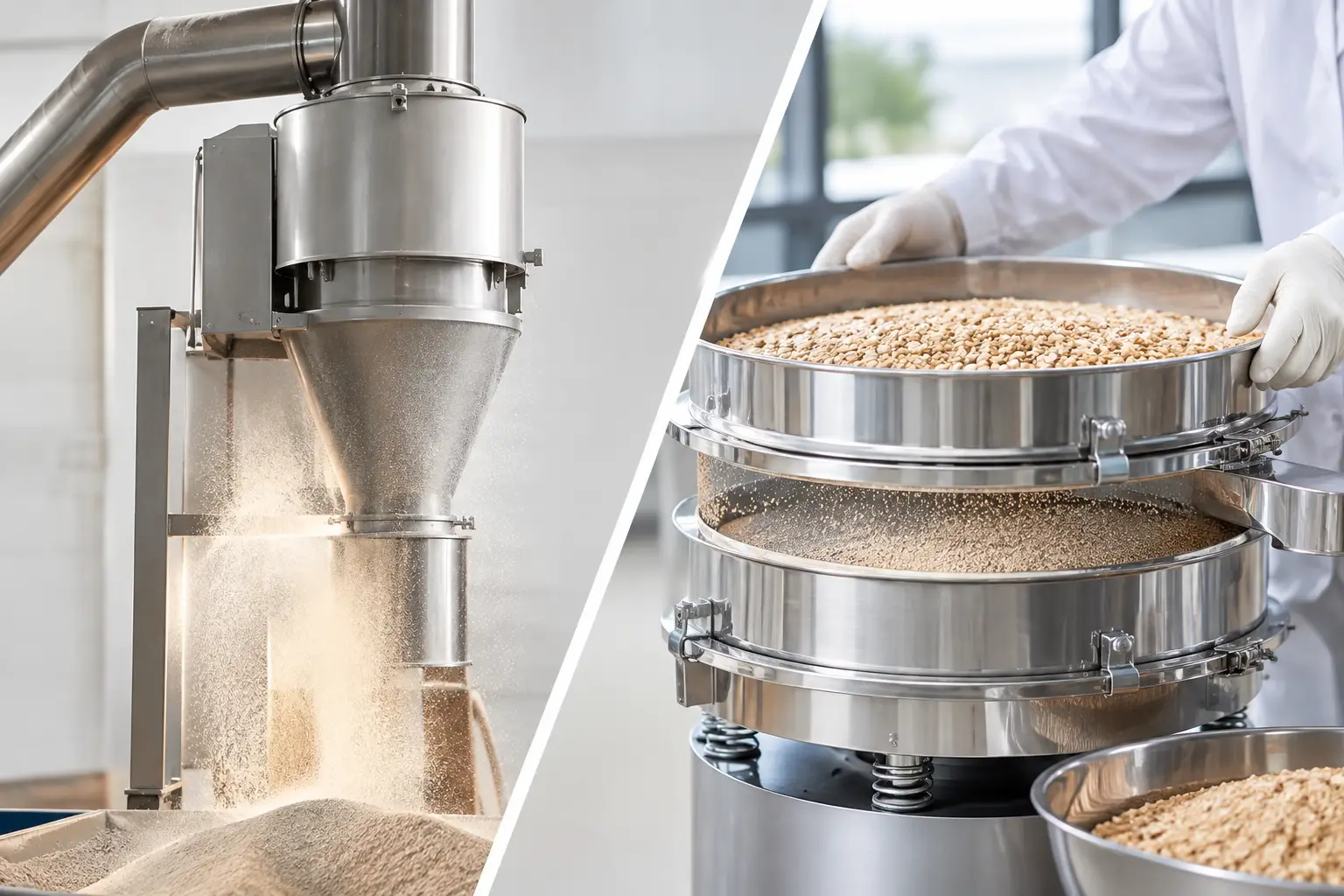
Reliable extrusion begins with controlled feed. The review should confirm that storage, discharge, conveying, weighing, dosing, and feeding equipment are designed for the actual material, including normal lot-to-lot variation. Loss-in-weight feeding may be required where formulation accuracy and rate stability directly affect product quality. In other applications, volumetric feeding can be appropriate, provided bulk density remains sufficiently stable and the process has adequate tolerance.
Preblending, liquid addition, thermal conditioning, deaeration, or pre-mixing may also be necessary. These operations should be reviewed as part of the extrusion process rather than as separate utility steps. For example, inconsistent liquid distribution before extrusion can create local viscosity differences that no screw design can fully correct.
Extruder configuration and process control
A review should examine whether the selected extruder type is appropriate for the duty. Single-screw designs can be effective for many conveying, melting, and forming applications. Twin-screw systems are often selected when higher mixing intensity, controlled residence time, venting, or difficult material handling is required. The correct choice depends on the process objective, not on a general preference for one architecture.
Key design questions include the available torque margin, screw speed range, barrel temperature control, pressure measurement locations, venting arrangement, die design, and the ability to accommodate foreseeable formulation changes. A system designed at the edge of its torque or cooling capacity may meet an initial production target but leave little room for normal feedstock variation or future capacity requirements.
Controls deserve the same scrutiny as mechanical design. Operators need a clear view of mass flow, screw speed, torque, barrel temperatures, pressure, vacuum where applicable, and downstream status. More importantly, the control strategy must define how the line responds when those values drift. Interlocks, alarms, recipe management, trend data, and historian integration should support timely decisions rather than create a screen full of unprioritized signals.
Downstream handling sets the real production rate
Many extrusion projects understate downstream constraints. Cooling capacity, belt speed, pelletizing or cutting performance, drying, classification, metal detection, transfer, and packaging must all sustain the output of the extruder without damaging the product or causing accumulation.
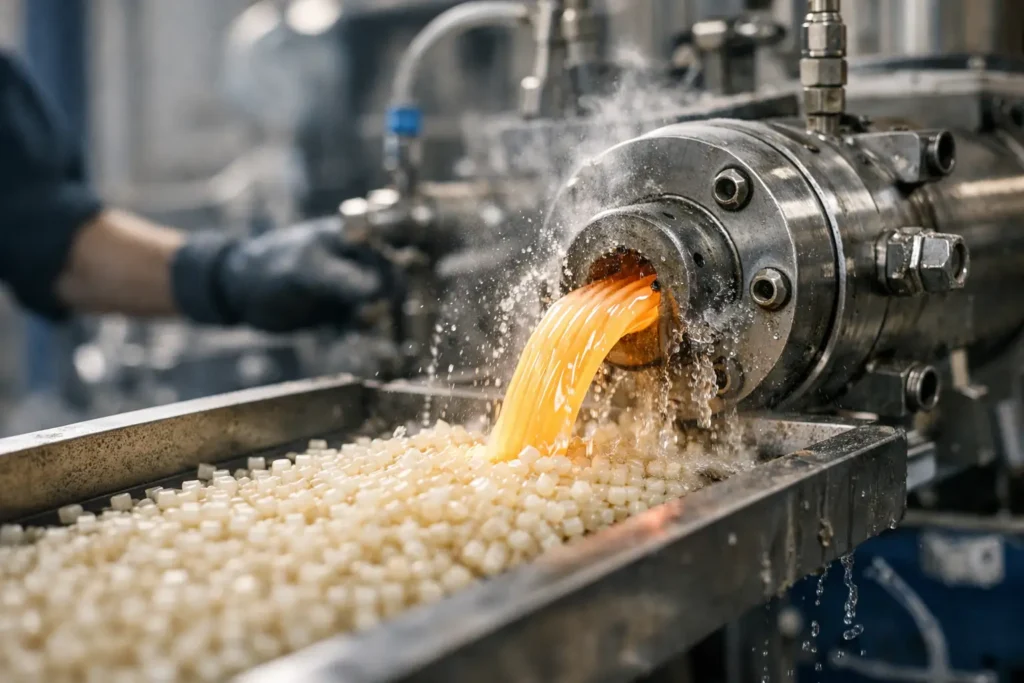
The handoff from die to downstream equipment is particularly important. Product at this point may be hot, soft, tacky, fragile, or dimensionally unstable. If cooling begins too late, cutting may smear or deform the material. If transfer velocity is too high, friable products can generate fines. If packaging intermittently stops the line, the system needs a controlled response that prevents material loss or quality excursions.
Evaluate Performance Across Real Operating Conditions
A credible extruder system review does not rely solely on a single successful trial. It considers the expected operating envelope: minimum and maximum production rates, normal ingredient variation, ambient temperature changes, startup material, rework policy, product changeovers, and cleaning intervals.
Factory acceptance testing and product trials should be tied to documented conditions. Record feed rates, moisture, temperature profiles, torque, pressure, screw speed, die configuration, output, energy use, and finished-product results. This creates a practical baseline for commissioning and later troubleshooting.
It also clarifies risk. A process proven only at one formulation and one throughput should not be represented as validated across an entire product family. Conversely, an engineered line with defined operating limits gives production teams the information needed to protect quality while maintaining output.
Reliability, Cleanability, and Serviceability Matter
Extrusion lines are often judged by output and product quality first, then by maintenance only after the equipment is installed. That sequence can be expensive. Reliability should be designed into the review from the beginning.
Assess access to screws, barrels, dies, cutters, screens, and wear components. Consider the time and lifting requirements needed for changeover, inspection, and cleaning. Review bearing arrangements, gearbox duty rating, lubrication practices, spare-parts strategy, and the availability of critical replacement components. For sanitary or regulated applications, surface finish, cleanout capability, material traceability, validation documentation, and contamination control may be central selection criteria.
The right level of automation also depends on operating risk. Manual adjustments can be reasonable for stable, low-volume production. For high-value materials, tight specifications, or extended production campaigns, automated recipe control and data capture can reduce dependence on individual operator technique and improve deviation investigation.
Compare Total Process Value, Not Purchase Price
Two systems with similar throughput ratings can have very different lifecycle economics. The lower initial-cost option may require more operator attention, consume more energy, generate more scrap, or create longer changeovers. The higher-capability system may not be justified if the application is simple and production volume is low. The decision depends on the cost of variability, downtime, labor, compliance exposure, and lost production in the specific plant.
A practical comparison should include installed utilities, footprint, structural requirements, dust collection, controls integration, commissioning effort, training, preventive maintenance, consumables, expected wear, and expansion capability. It should also identify who is accountable when feeder performance, extrusion behavior, controls, and downstream handling do not meet the agreed production objective.
That is where integrated engineering has a direct operational benefit. One manufacturer. One engineering standard. One point of accountability. Proc-X approaches extrusion as part of a coordinated material-processing system, aligning feed preparation, extrusion, forming, transfer, controls, and end-of-line requirements around the finished product.
The most valuable outcome of an extruder system review is not a longer specification sheet. It is a defined process window, clear acceptance criteria, and a system architecture that gives operators a realistic path to repeatable production long after commissioning is complete.