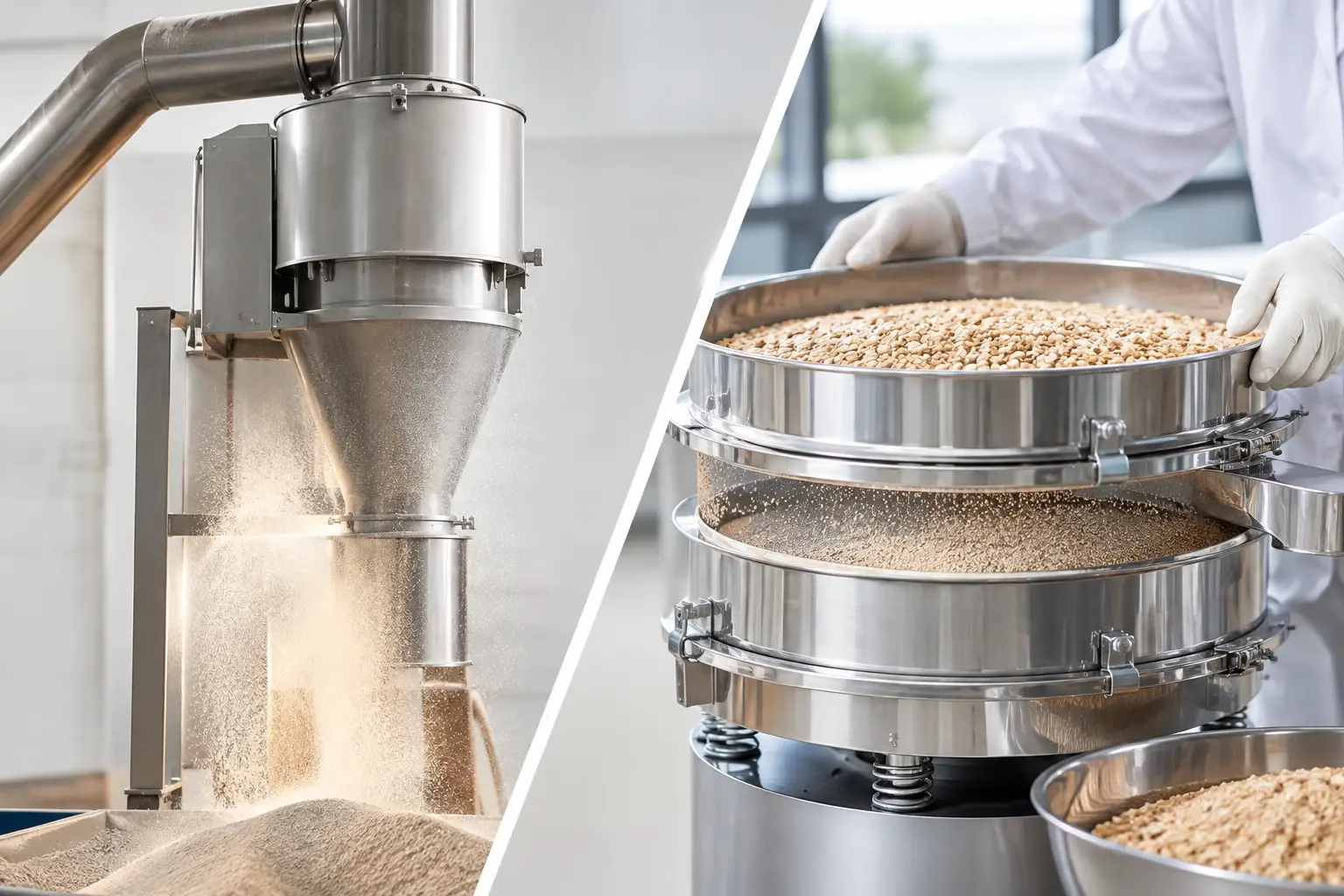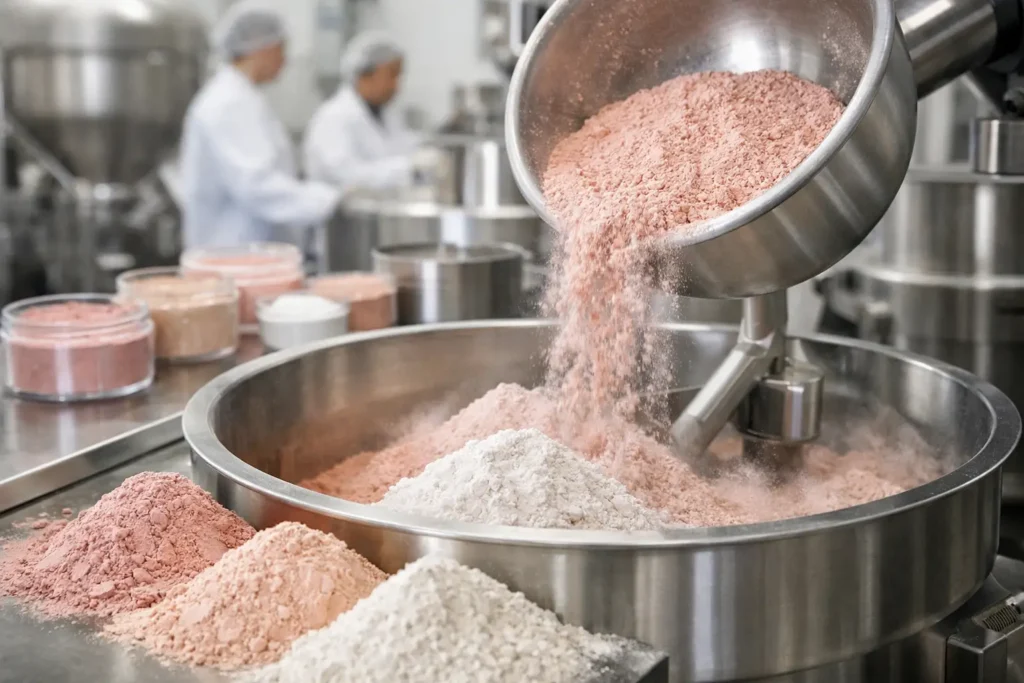
A pressed powder that looks uniform in the pan can still fail at the consumer level. A slight shift in pigment distribution may appear as streaking during application. Excess shear can change particle shape, damage fragile effect pigments, or alter the way a powder compacts. Cosmetic powder mixing systems must therefore do more than combine ingredients. They must produce repeatable color, texture, density, flow, and downstream performance at the required production rate.
For manufacturers of face powders, eye shadows, blushes, setting powders, dry shampoos, mineral foundations, and similar products, mixing is rarely an isolated operation. It connects ingredient receiving, weighing, dust collection, screening, milling, transfer, compaction or pressing, and packaging. The right solution begins with the formulation and process objective, then brings each of those functions into a controlled production system.
Why cosmetic powder mixing is a process-design issue
Cosmetic formulations often combine materials with very different physical behavior. Fine pigments may be cohesive and airborne. Mica, talc, starches, clays, silica, fillers, powders treated with surface modifiers, and functional additives can vary widely in bulk density, particle-size distribution, moisture sensitivity, and electrostatic behavior. A low-dose colorant or preservative may have an outsized effect on product quality even though it represents a small fraction of the batch.
This creates a central engineering challenge: the blend must achieve uniformity without damaging the ingredients or creating segregation after discharge. A mixer that produces a visually consistent sample in the vessel may not maintain that condition through transfer, storage, filling, or pressing. Material handling design matters as much as mixing time.
The correct process also depends on the intended finished form. A free-flowing loose powder calls for different discharge and packaging behavior than a powder blend destined for pans, compaction, or further wetting with binders. When the formulation includes fragile flakes, encapsulated actives, or specialty effect pigments, the allowable shear window becomes narrower. Higher-intensity mixing may improve dispersion of one component while reducing the visual effect or functional performance of another.
Selecting cosmetic powder mixing systems by material behavior
There is no single mixer that is best for every cosmetic powder. Equipment selection should start with the batch size, formulation composition, required homogeneity, allowable particle degradation, cleaning requirements, and downstream equipment. Production targets matter, but capacity alone is not a sufficient design basis.
Tumble and low-shear blending
Tumble blenders are often appropriate for free-flowing powders with relatively similar particle sizes and densities. Their low-shear action can protect delicate ingredients and reduce heat generation. They can also be a practical option when the formulation is already well conditioned through milling, screening, or premixing.
The trade-off is that low-shear blending may not adequately break apart agglomerates or distribute cohesive minor ingredients. It can also be more vulnerable to segregation if ingredients are loaded improperly or if the blend experiences excessive handling after discharge. In these applications, controlled ingredient addition and properly designed transfer paths are essential.
Ribbon, paddle, and plow mixing
Horizontal mixers provide stronger convective movement and can be effective for broader particle-size distributions, denser additives, and formulations that need faster batch cycles. Ribbon and paddle configurations can offer controlled blending action, while plow-style mixers can create more intensive mechanical fluidization.
The internal geometry, tip speed, fill level, and discharge design should match the product. For example, a high-intensity configuration may disperse a pigment agglomerate effectively but may also generate fines, heat, or attrition in friable materials. Testing should evaluate not only blend uniformity, but also particle-size change, color development, bulk density, and final application characteristics.
High-shear intensification where it is justified
Some formulations require an intensifier or high-shear component to distribute small additions, break soft agglomerates, or incorporate liquid binders into a dry powder base. This is common when the process must produce a granulated or conditioned powder with defined compaction behavior.
High shear should be applied deliberately rather than treated as a default solution. The critical questions are where it is needed, how long it should run, and whether it should operate continuously or only during a defined part of the batch cycle. Localized high shear can be useful, but it must not turn a controlled blend into an overworked material.
The hidden sources of blend variation
Many batch-to-batch problems attributed to the mixer originate upstream. Inconsistent weighing, poor feeder accuracy, uncontrolled raw-material condition, and manual addition practices can create variation that no mixer can fully correct. A properly engineered system identifies these risks before they reach the blend vessel.
Minor ingredients deserve particular attention. Pigments, fragrances carried on powders, preservatives, active materials, and flow aids may enter at low inclusion rates, yet require the highest level of distribution control. A premix step is often more reliable than adding these materials directly into a full production batch. The premix can create a concentrated but uniform intermediate that is then diluted through the main blend.
Dust control is another production requirement, not simply an environmental consideration. Fugitive dust can reduce yield, contaminate neighboring operations, complicate cleanup, and expose operators to fine materials. Enclosed charging, local capture, suitable filtration, sealed transfer, and correctly designed dust-collection interfaces support both worker protection and formula control.
Electrostatic charge can further complicate fine-powder handling. Certain pigments and treated powders can cling to vessel walls, transfer lines, gaskets, or packaging equipment. Grounding, material-of-construction decisions, humidity considerations, and transfer velocity may all influence performance. These details are especially relevant when a pilot process is being scaled to a larger production line.
Scale-up requires more than a larger vessel
A successful laboratory blend does not automatically translate to manufacturing scale. The relationship between mixer volume, fill level, agitator speed, tip speed, residence time, and ingredient addition sequence changes as equipment size increases. Simply matching the batch time from a pilot mixer can produce a different result at commercial scale.
Scale-up should define measurable quality attributes before equipment is selected. Depending on the product, these may include color uniformity, assay, particle-size distribution, bulk density, angle of repose, moisture, compaction response, pan fill consistency, or visual application performance. Samples should be collected from multiple locations in the mixer and across multiple batches to confirm that the process is genuinely repeatable.
The system must also address discharge. A well-mixed batch can segregate when it falls through a long chute, enters a hopper, or is conveyed pneumatically at unsuitable velocity. Gentle mechanical conveyance may preserve a blend better in some cases, while properly designed vacuum or pressure conveying may be appropriate in others. The answer depends on the formulation’s flowability, particle density differences, friability, and required transfer distance.
Build controls around the batch, not around individual machines
For cosmetic production, repeatability depends on a defined and enforced recipe. A controls platform should manage ingredient identity, target weights, addition order, mixer speed, mixing duration, interlocks, and batch records. Automation is not only about reducing labor. It creates a consistent operating method that supports quality investigations, validation requirements, and production planning.
A practical control strategy may include barcode or batch verification for ingredients, automated weighing for major components, guided addition for low-volume materials, and alarm limits for deviations. The level of automation should align with production volume and risk. A highly automated line is not always the right answer for a development-scale operation, but manual systems still benefit from structured recipe control and traceable records.
Cleaning and changeover must be considered early, particularly for facilities producing a broad shade range or handling ingredients that can create carryover concerns. Accessible mixer internals, cleanable discharge valves, contained charging, and a realistic sanitation procedure reduce downtime and lower the risk of cross-contamination. The fastest mixer is not necessarily the most productive system if it requires excessive time between batches.
One integrated line, one engineering standard
The mixer should be specified as part of a complete process path: raw-material receiving, storage, sifting or milling, weighing, blending, transfer, and final filling or compaction. When those elements are designed independently, interfaces often become the source of delays, dust leaks, material loss, and inconsistent product flow.
Proc-X approaches cosmetic powder processing from the material outward. That means evaluating how the formulation behaves at each stage, then integrating the mixing equipment, ingredient handling, transfer methods, dust control, and automation required to sustain the intended result. One manufacturer. One engineering standard. One point of accountability.
The most useful next step is not to ask which mixer is largest or fastest. Start with representative material samples, define the finished-product attributes that matter, and test the complete path from ingredient addition through discharge. That work establishes a process window that can support reliable production long after the first batch is approved.