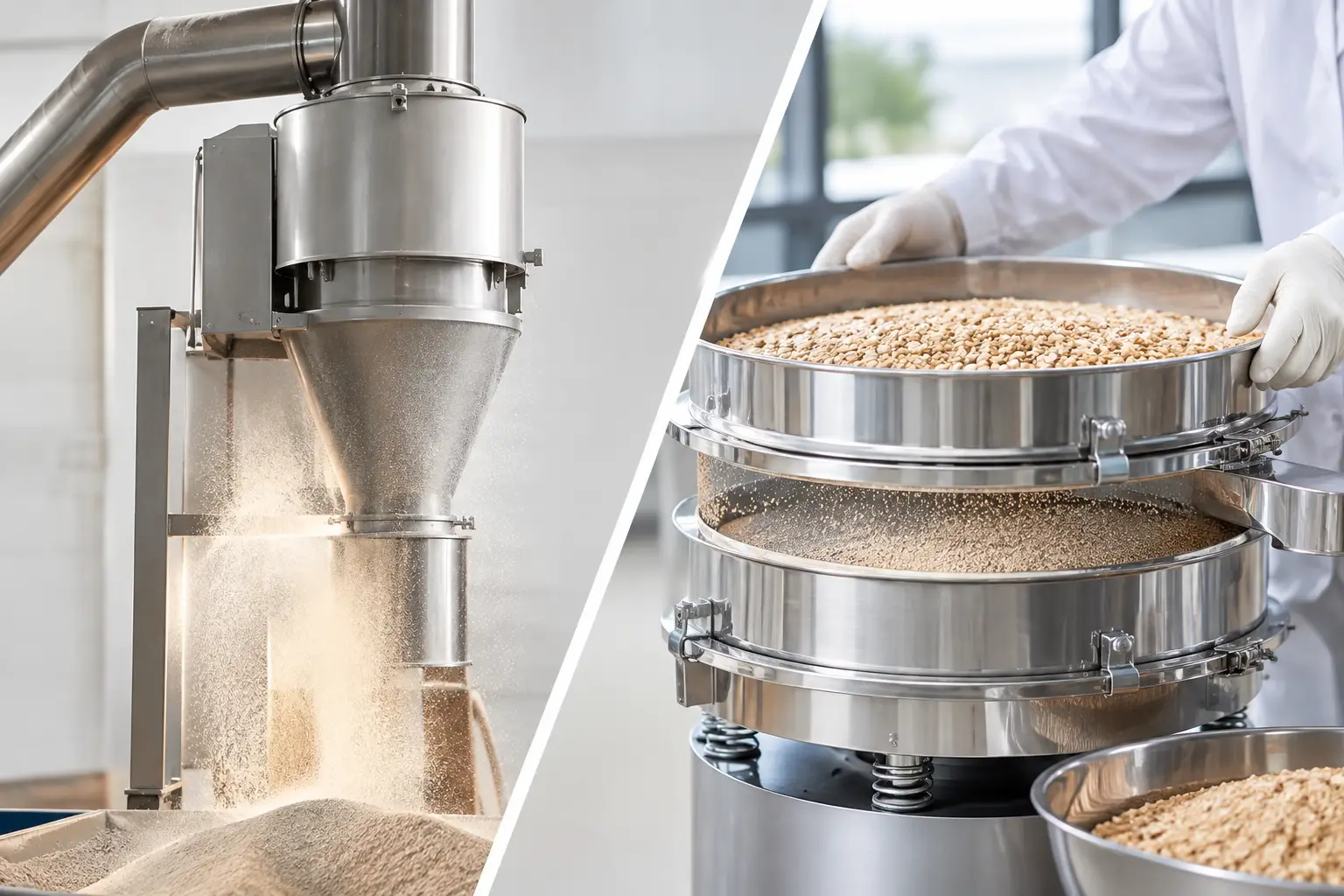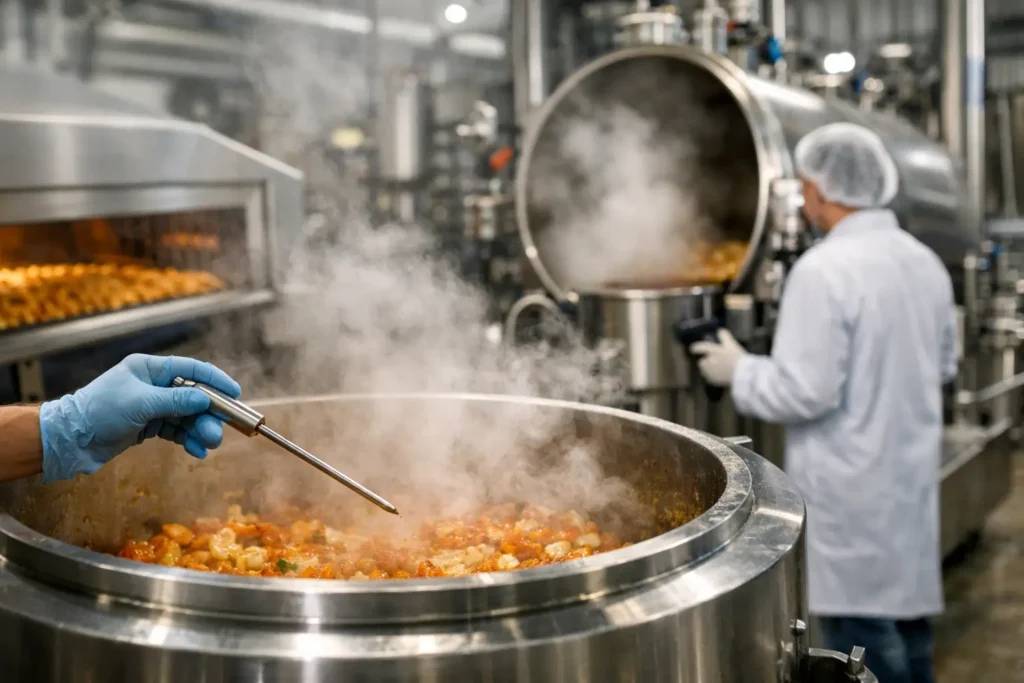
A thermal process can improve shelf life, drive off moisture, activate a reaction, set product structure, or prepare material for the next unit operation. It can also create irreversible quality losses in minutes. The best thermal processing strategies start with the material’s response to heat, not with a preferred equipment type. For plant teams, the objective is controlled heat transfer that achieves the required process result at the required production rate without creating variation, waste, or downstream handling problems.
Start With the Product, Not the Heater
Temperature alone does not define a thermal process. The relevant question is how each particle, droplet, or portion of bulk material receives heat over time. A powder with low thermal conductivity may have a large temperature difference between its surface and core. A high-viscosity paste can form stagnant zones if vessel agitation does not renew material at the heat-transfer surface. A liquid emulsion may reach target temperature quickly but lose stability under excessive residence time or shear.
A useful thermal design basis defines the target product state in measurable terms: final moisture, water activity, viscosity, microbial reduction, solvent residual, degree of reaction, particle integrity, color, density, or flowability. It should also establish the allowable operating range around that target. A process that meets specification only at one narrow temperature and feed-rate combination may be difficult to sustain in production.
Material characterization should include moisture behavior, specific heat, thermal conductivity, bulk density, particle-size distribution, heat sensitivity, stickiness, and flowability across the expected temperature range. For reactive or hazardous materials, engineers must also account for decomposition onset, dust explosibility, solvent vapor behavior, oxidation risk, and pressure requirements. These factors determine whether indirect heating, direct hot air, vacuum, conductive contact, or a combined approach is appropriate.
Match the Heating Method to the Process Duty
The right thermal technology depends on what heat must accomplish and what the product can tolerate. Direct convective heating can provide high throughput for free-flowing materials when exposure to process air is acceptable. Indirect systems provide closer control and can reduce contamination risk, but heat-transfer area, agitation, and residence time become more critical. Vacuum lowers boiling points, allowing moisture or solvents to be removed at temperatures that protect sensitive ingredients and formulations.
For many applications, the decision is not direct versus indirect in isolation. It is a system-level choice. A wet cake may require upstream dewatering before thermal drying is economical. A sticky powder may need conditioning, agitation, or a controlled recycle stream to prevent buildup. A hot discharge may require cooling, classification, conveying, or packaging protection before it can move reliably to the next step.
Drying requires control of more than final moisture
Drying systems are often specified around pounds of water removed per hour. That metric matters, but it does not adequately predict product quality. The moisture profile through the process, residence-time distribution, air velocity, humidity, solids loading, and discharge temperature can all affect the result.
Fast surface drying may create crusting that slows internal moisture migration. Excessive air temperature can discolor a food ingredient, degrade an active compound, alter a polymer, or increase fines generation in a friable mineral. Conversely, low temperature with insufficient airflow may leave residual moisture variation that later causes caking, microbial concerns, or unstable bulk density.
The process target should therefore include average moisture and moisture uniformity. Sampling plans need to account for startup, steady state, product changeovers, and changes in incoming raw-material moisture. Online moisture measurement can strengthen control, but it is most valuable when integrated with feed-rate, airflow, temperature, pressure, and residence-time logic rather than treated as a standalone indicator.
Heating, reaction, and mixing must work together
In jacketed vessels, reactors, and thermal mixers, product movement is part of heat transfer. The agitator must continuously expose fresh material to the heated surface and avoid dead zones. This is especially significant for pastes, high-solids slurries, waxes, resins, and cohesive powders.
Higher agitation can improve heat transfer, but it is not automatically better. It may introduce shear that damages crystals, changes particle shape, destabilizes emulsions, or incorporates air. For applications involving sensitive blends or delicate agglomerates, the design must balance thermal uniformity with mechanical treatment. Vessel geometry, agitator configuration, fill level, and batch size all affect that balance.
Continuous processing offers a different set of advantages and constraints. With stable feed conditions, it can deliver consistent throughput, repeatable thermal history, and lower labor demand. However, feed disturbances travel through the system quickly. Accurate gravimetric feeding, controlled inlet condition, and coordinated automation are essential when residence time is short or product tolerances are narrow.
Build Best Thermal Processing Strategies Around Residence Time
A temperature setpoint does not confirm that every unit of product has received the required treatment. Residence-time distribution determines exposure. Wide distribution means some material may be underprocessed while other material receives unnecessary heat.
This is a frequent issue in systems that rely on nominal retention time without examining actual flow behavior. Bridging, channeling, wall buildup, variable fill level, or poorly designed discharge geometry can create short-circuit flow and long-hold pockets. In batch systems, incomplete mixing can cause the same problem in another form: the batch may meet an average temperature while localized zones remain outside the intended process window.
Residence-time testing, temperature mapping, and representative sampling should be performed during commissioning and revisited when formulations, throughput, or operating conditions change. For regulated products, the validation approach must define critical process parameters, acceptable limits, sensor calibration requirements, and documented response actions when conditions fall outside the validated range.
Treat Energy Performance as a Process Variable
Energy use is not merely a utility cost. It is often evidence of process condition. Rising energy consumption can indicate fouled heat-transfer surfaces, leaking air systems, poor insulation, excessive recirculation, inefficient evaporation, or feed material that is arriving wetter than expected.
Heat recovery can provide meaningful value where hot exhaust air, condensate, cooling loops, or product discharge carry recoverable energy. The economic case depends on duty cycle, contamination risk, cleaning requirements, utility pricing, and the temperature level available for recovery. A heat-recovery project that complicates sanitation or creates cross-contamination exposure is not a practical improvement.
Good thermal system design also reduces unnecessary heating and cooling cycles. Insulated equipment, properly sized utilities, variable-speed air movement, controlled startup sequences, and coordinated upstream scheduling can lower energy demand while improving output consistency. The best result comes from measuring energy per unit of finished product alongside quality and throughput data.
Integrate Material Handling and Controls From the Beginning
Thermal equipment does not operate as an island. Its performance depends on stable feed, predictable discharge, dust control, utility availability, and dependable controls. A well-designed dryer can still underperform if the upstream feeder surges. A heated mixer can become a maintenance concern if downstream conveying begins before the product reaches a safe handling temperature. A vacuum process can lose repeatability if incoming material temperature and moisture are not managed.
Controls should connect the major process variables rather than monitor them separately. Feed rate, product temperature, jacket temperature, air temperature, airflow, vacuum level, agitator load, moisture, and discharge conditions should be interpreted as a process relationship. Alarm limits are necessary, but predictive trends are more useful for identifying fouling, changes in raw material, or mechanical degradation before an out-of-specification event occurs.
For integrated lines, one engineering standard across feeding, thermal treatment, transfer, controls, and packaging reduces interface risk. Proc-X approaches thermal processing as part of the complete production ecosystem, aligning equipment selection with material behavior, operating requirements, and the downstream product specification.
Design for Cleaning, Maintenance, and Changeover
Thermal performance declines when product builds up on heated surfaces, ducts, filters, valves, or discharge components. Some buildup is obvious. Other forms, such as thin films in a jacketed vessel or deposits in air-handling components, may first appear as longer cycle times, higher utility use, or increasing product variation.
The design should make inspection and cleaning realistic for the operating schedule. Consider access points, clean-in-place coverage where applicable, filter serviceability, tool requirements, gasket selection, and the time needed to return the system to validated operation. For multi-product facilities, changeover planning must consider thermal history as well as visible residue. Heat-sensitive ingredients, allergens, potent compounds, and reactive chemistries may require more stringent segregation and verification.
Maintenance teams need access to meaningful operating data. Trending motor load, heat-transfer performance, pressure drop, vacuum stability, and utility consumption helps distinguish normal process variation from equipment deterioration. This supports planned intervention instead of emergency repair during a production campaign.
Select a Strategy That Can Hold Its Performance
The strongest thermal process is not the one that reaches the highest temperature or posts the largest nameplate capacity. It is the one that repeatedly produces material within specification, accommodates realistic feed variation, uses energy intelligently, and remains serviceable over its operating life. Before committing capital, test the material under representative conditions and evaluate the entire line around the thermal step. That discipline turns heat from a source of process risk into a controlled manufacturing advantage.