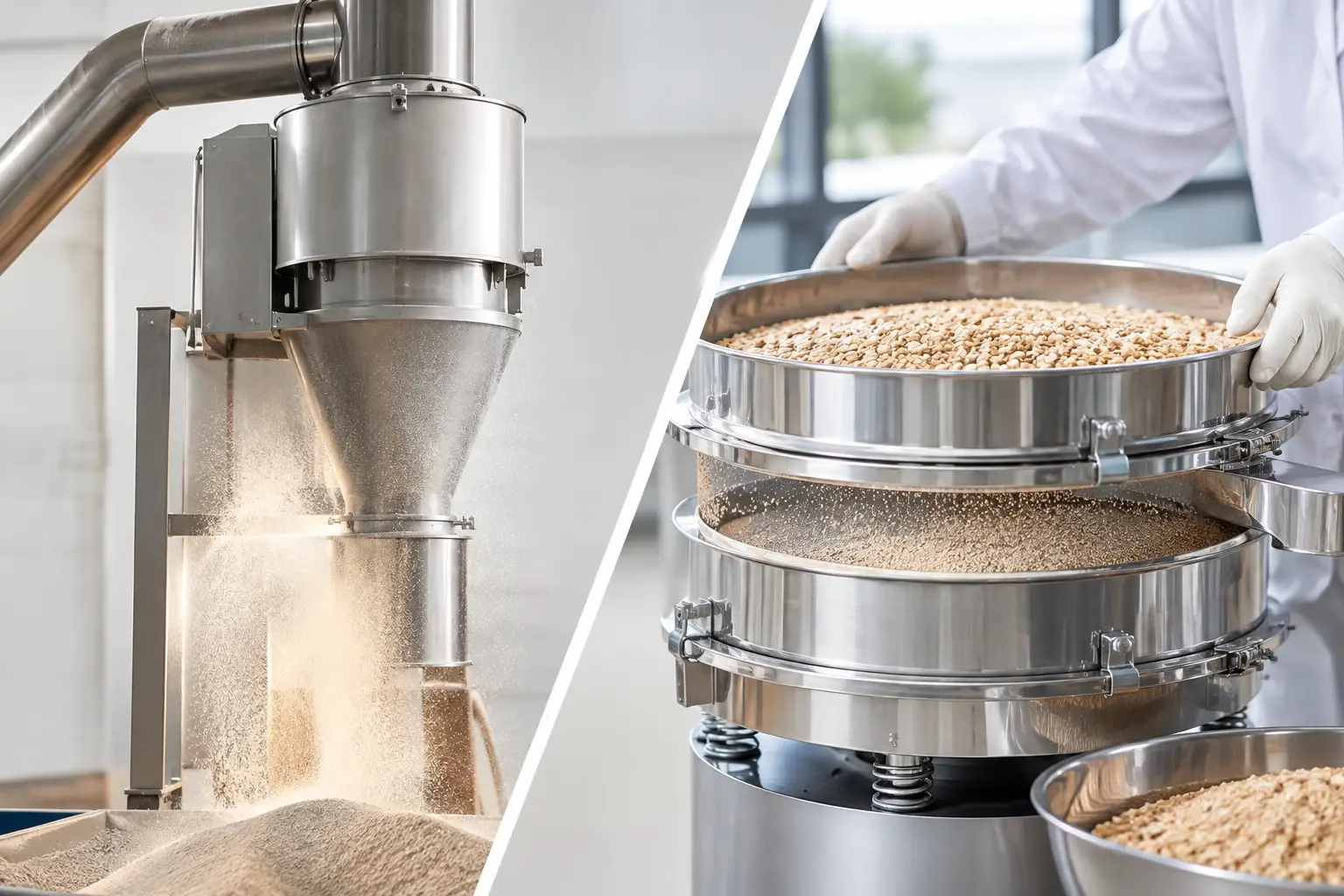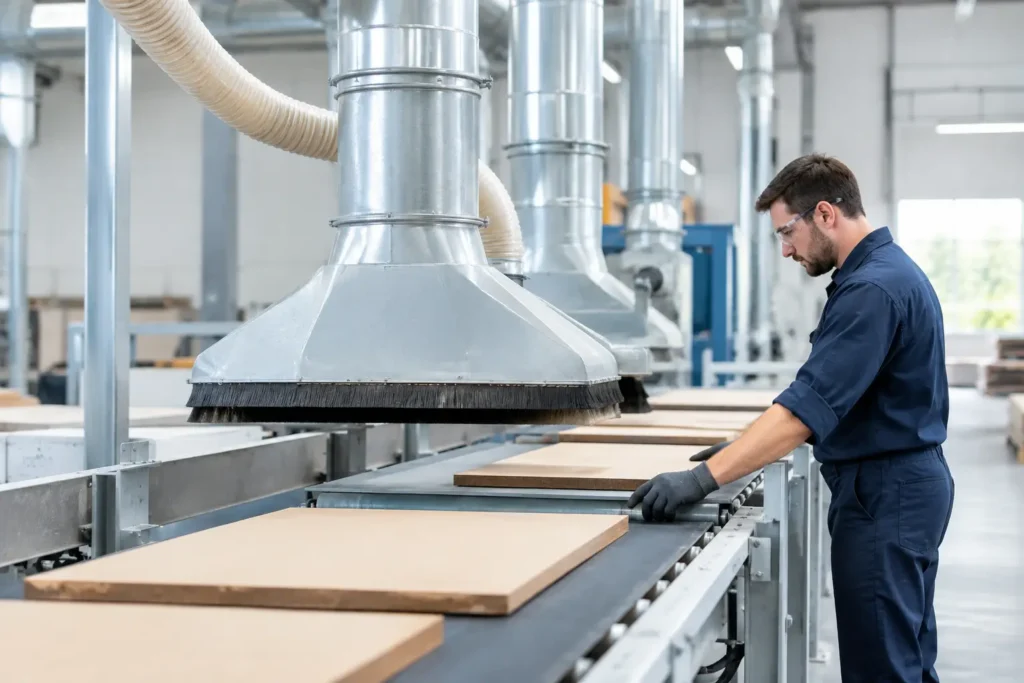
Dust collection is not a peripheral utility in a powder-processing plant. It directly affects operator exposure, product quality, housekeeping labor, equipment reliability, and the ability to run at the intended production rate. When it is treated as an afterthought, manufacturers often inherit unstable airflow, difficult cleaning, material loss, cross-contamination risk, and costly changes after startup.
For processing lines that receive, convey, weigh, mill, blend, transfer, and package dry materials, the correct approach begins with the process itself. The dust collector, ductwork, pickup points, discharge method, controls, and safety provisions must operate as one engineered system.
Start Dust Collection With the Material and Process
A collector cannot be selected correctly from airflow alone. The powder determines much of the design basis. Fine, low-density ingredients may stay airborne readily and require careful capture at transfer points. Abrasive mineral powders can erode elbows, ductwork, and filter media. Hygroscopic materials may bridge in hoppers or blind filters. Pharmaceutical or nutraceutical formulations may demand contained handling and cleaning validation, while food ingredients can introduce sanitation and allergen-segregation requirements.
Material behavior also changes across the line. A bag dump station, mill inlet, blender charge port, screen, and filling machine do not release dust in the same way. The task is to identify where air is displaced, where a falling stream entrains surrounding air, and where operators open the process to load, inspect, or clean equipment.
Production conditions matter just as much. A system designed around a nominal rate may underperform when the line runs at its maximum feed rate, when several stations operate at once, or when a receiving vessel is filled pneumatically. Engineering should account for batch sequencing, simultaneous demand, maintenance states, and future capacity increases rather than relying on a single static airflow estimate.
Capture at the Source Before Sizing the Collector
The most efficient dust collection system controls dust close to its release point. Once a cloud has expanded into the room, much more air is required to capture it, and the resulting system becomes larger, louder, and more expensive to operate.
Effective source capture depends on hood geometry, enclosure design, access openings, and the direction of material movement. At a bulk bag discharger, for example, the enclosure and operator access arrangement influence capture performance as much as the collector itself. At a conveyor transfer, a properly designed skirt, cover, and pickup location can reduce the airflow required while limiting material escape.
Excessive airflow is not automatically safer or better. It can pull usable product into the collector, disturb a weighing operation, cool or dry sensitive materials, and increase filter loading and fan energy. Insufficient airflow allows dust to escape from openings and settle on floors, structures, and equipment. The appropriate airflow is the amount needed to maintain containment under actual operating conditions, with enough margin for expected variation.
Understand the Role of Make-Up Air
Every cubic foot of air removed from a room or process enclosure must be replaced. Without a planned source of make-up air, a facility may experience negative building pressure, difficult door operation, drafts, uncontrolled air infiltration, and reduced performance at pickup points.
Make-up air should be considered early in a plant project, particularly in climate-controlled food, pharmaceutical, battery, and advanced-materials environments. Its temperature, humidity, filtration, and delivery location can influence both worker comfort and material performance. A dust collector may be mechanically sound but still create operating problems if the building air balance was ignored.
Select Filtration and Discharge for the Duty
Filter media selection should reflect particle size, loading characteristics, moisture exposure, temperature, chemical compatibility, and required emission performance. Cartridge collectors can offer high filtration area in a compact footprint for many dry, free-flowing applications. Baghouse designs may be appropriate for high-volume airflows, heavier loading, elevated temperatures, or applications where long filter media and specific cleaning methods are advantageous.
The right choice depends on the duty. A compact collector serving a packaging station has different needs than a central system serving multiple pneumatic receivers, milling equipment, and bulk transfer points. Centralization can simplify maintenance and provide a single discharge location, but it also introduces longer duct runs, balancing requirements, and greater consequences if the collector is offline. Dedicated collectors can isolate materials and simplify containment, although they increase the number of assets to maintain.
Collected dust must also be handled intentionally. If the material is valuable and suitable for recovery, the discharge may return it to the process through a rotary valve, screw conveyor, or sealed container. If it is waste, the design must still prevent re-entrainment and uncontrolled exposure during disposal. Hopper angles, discharge valve selection, level detection, and bridging behavior deserve the same attention as the filter housing.
Engineer Ductwork as a Process Component
Ductwork is often underestimated because it appears simple. In practice, poor duct design is a common source of weak capture and difficult maintenance. Long runs, unnecessary elbows, abrupt transitions, undersized branches, and poorly located blast gates can produce pressure losses that leave the most remote pickup point under-served.
Duct velocity must be high enough to keep conveyed particulate from settling where applicable, but excessive velocity increases fan horsepower, noise, wear, and product attrition. Abrasive powders may require wear-resistant construction or replaceable sections at elbows and high-impact areas. Sticky or moisture-sensitive materials may require layouts that minimize accumulation points and allow access for inspection.
A balanced system is especially important when one collector serves several machines. The airflow at each hood should be verified during commissioning with the actual equipment operating. Balancing a system with empty equipment or closed access doors can create a misleading result that disappears during production.
Address Fire, Explosion, and Containment Risks Early
Some powders may present combustible dust hazards, and others may require stringent containment because of toxicity, potency, allergen control, or product sensitivity. These considerations cannot be added casually after equipment layout and collector selection are complete.
The engineering team should evaluate the material hazard data, expected dust concentrations, ignition sources, zoning and isolation requirements, collector location, and applicable codes and authority requirements. Depending on the material and risk assessment, the system may need features such as explosion venting, flameless venting, suppression, isolation devices, conductive components, grounding, or specialized containment arrangements. The required approach depends on the application, facility constraints, and governing standards.
For contained processing, the target is not simply visible cleanliness. It is controlled exposure throughout charging, sampling, filter changeout, discharge, cleaning, and maintenance. A collector that contains dust during normal operation but exposes maintenance personnel during filter replacement has not solved the full operational problem.
Integrate Controls, Maintenance, and Validation
A dust collection system performs best when its controls respond to process conditions. Differential pressure monitoring can indicate filter loading or cleaning issues. Fan status, airflow verification, hopper level alarms, rotary valve status, and damper position can be incorporated into the line control strategy so operators can identify abnormal conditions before dust escapes into the production area.
Maintenance access should be designed into the installation. Filter changeout clearance, safe access platforms, hopper cleanout, duct inspection points, and isolation provisions affect whether preventive maintenance is completed efficiently. In regulated applications, material traceability, cleanability, and documented operating parameters may be equally important.
Proc-X approaches dust collection as part of the complete production ecosystem: material entry, processing equipment, conveying, containment, controls, and final packaging. One engineering standard across those interfaces reduces the risk that a well-specified collector is undermined by an incompatible process connection or operating sequence.
The best time to solve dust control is while the process is still being defined. Establish the material data, capture objectives, airflow demands, safety requirements, and maintenance strategy together, then verify performance at startup under real production conditions. That discipline turns dust collection from a reactive housekeeping measure into a controlled part of manufacturing performance.