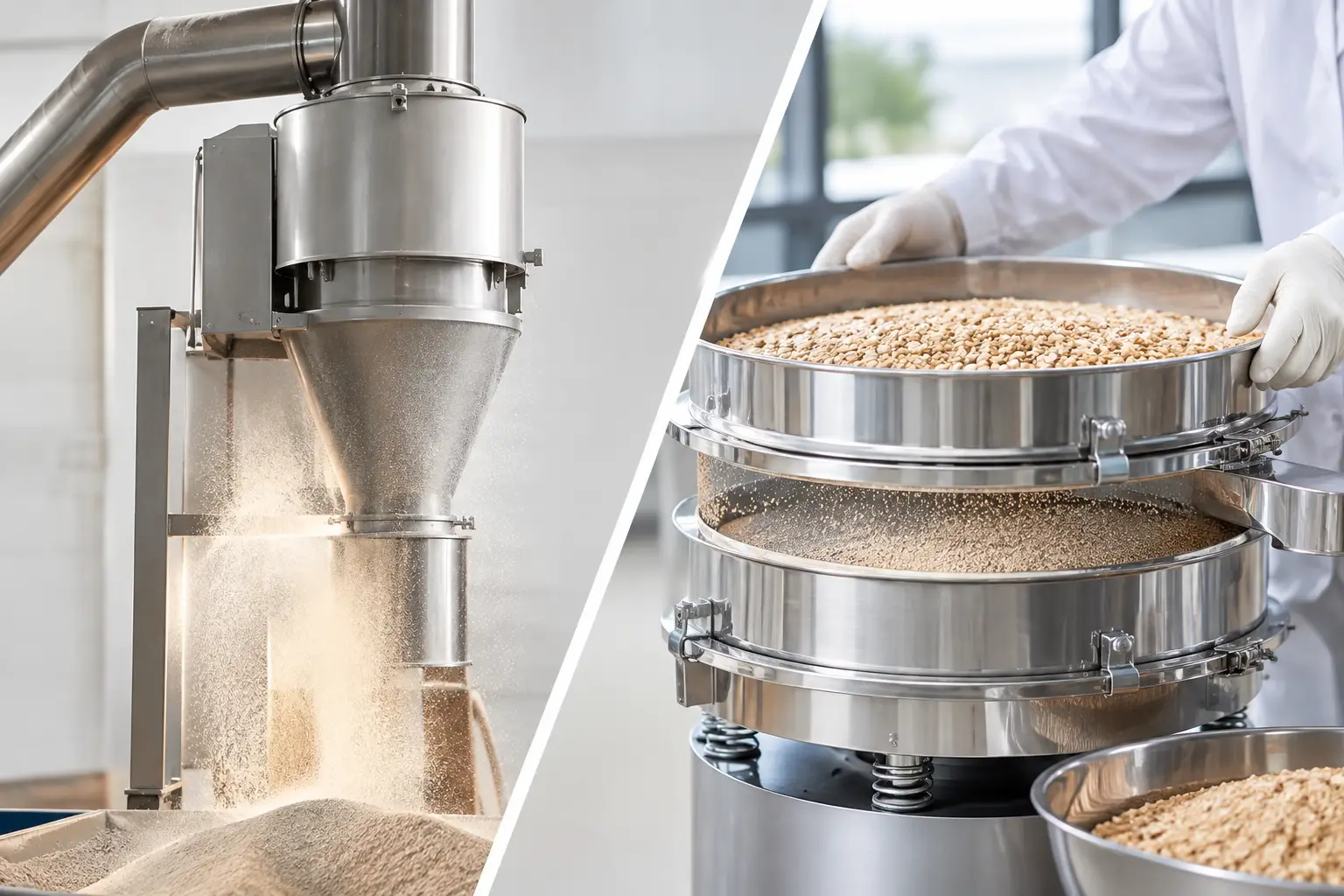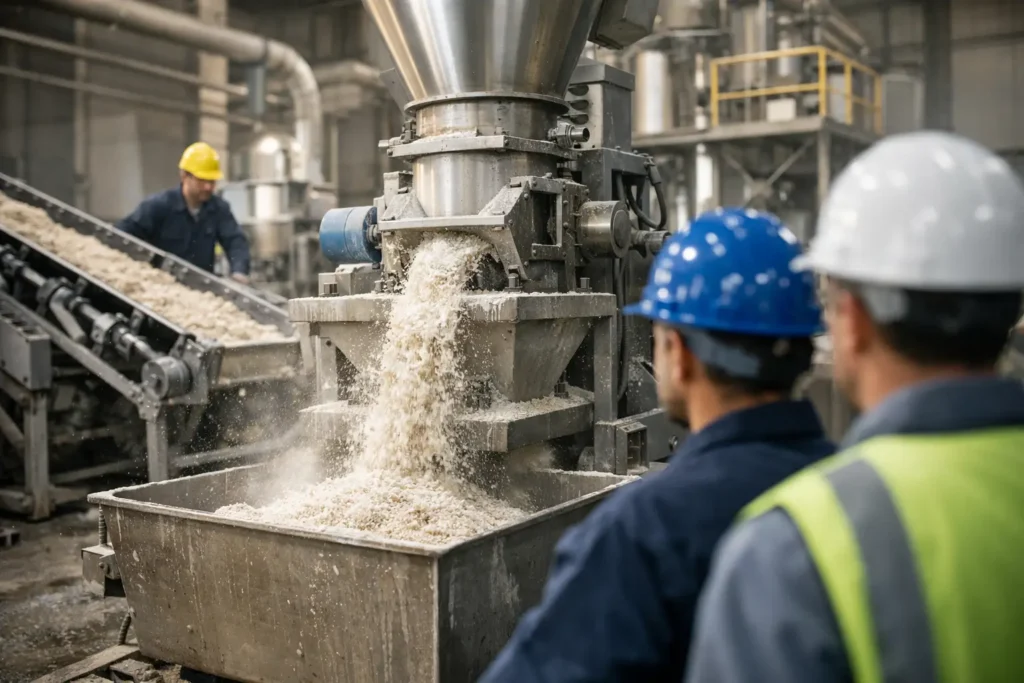
A mill can meet its stated capacity and still fail the process. If the finished material has a broad particle-size distribution, excessive heat exposure, metal contamination, poor flowability, or an unacceptable amount of fines, the problem is not solved at the mill discharge. This industrial milling equipment review examines milling from the perspective that matters in production: how equipment performs within the complete material-handling, processing, and quality-control system.
Industrial Milling Equipment Review: Start With the Material
The correct mill is defined by the material and the required product outcome, not by a catalog category. Two powders with the same nominal feed size can behave entirely differently because of moisture content, hardness, elasticity, fat content, thermal sensitivity, abrasiveness, electrostatic behavior, or tendency to agglomerate.
A process team should first establish the incoming particle-size distribution, bulk density, temperature, moisture range, flowability, and variability from lot to lot. It should then define the required finished distribution, allowable oversize and fines, target production rate, and any limits on temperature rise or particle damage. Without these parameters, capacity comparisons are usually misleading.
For regulated applications, the specification extends beyond size. Pharmaceutical, nutraceutical, food, and cosmetic processors may require hygienic design, validated cleaning procedures, material traceability, controlled access, and documented repeatability. Battery materials, specialty chemicals, industrial minerals, and additive manufacturing powders may prioritize contamination control, wear resistance, inert processing conditions, or narrow classification cuts. The same milling principle cannot satisfy every requirement equally well.
Compare Milling Principles by Process Fit
Industrial mills are often discussed as interchangeable size-reduction machines. They are not. Each mechanism creates a different balance of particle breakage, heat generation, wear, throughput, and sensitivity to feed variation.
Impact milling
Impact mills use high-speed rotating elements to fracture material against a target surface, screen, or internal liner. They are frequently selected for dry powders that need moderate-to-fine reduction at useful production rates. Performance depends heavily on rotor speed, screen geometry, airflow, feed consistency, and the material’s fracture characteristics.
Their advantages include a compact footprint and straightforward adjustment for many applications. The trade-off is heat. High peripheral speed can raise product temperature, particularly with fatty, low-melting, or thermally sensitive materials. Screen blinding and buildup can also reduce capacity when the feed is moist, sticky, or prone to smearing.
Hammer milling
Hammer mills are a practical choice for coarse-to-medium reduction, deagglomeration, and preparation of materials before downstream blending, screening, or finer milling. They can handle a broad range of agricultural ingredients, food products, minerals, and chemical intermediates when the feed is free-flowing and the target specification is not extremely tight.
A hammer mill’s output is influenced by hammer configuration, tip speed, screen selection, air movement, and feed rate. It is a cost-effective workhorse in many plants, but it may not be the right final-sizing platform where narrow distribution, minimal fines, or low-temperature operation is critical.
Pin and disc milling
Pin mills and disc mills use intermeshing or opposing surfaces to apply impact and shear. They can produce finer powder than many conventional hammer configurations and are often used where controllable fine reduction is needed without moving into the highest-energy milling methods.
These mills deserve careful review for heat-sensitive or abrasive materials. Higher energy input can improve fineness while accelerating wear or raising product temperature. For abrasive products, the metallurgy of pins, discs, liners, and other contact surfaces has a direct effect on maintenance intervals and contamination risk.
Air classification milling
Air classifier mills combine grinding with an internal or external air classifier. Fine particles are carried out of the grinding zone while oversize particles remain for further reduction. This arrangement can provide closer control of top size and reduce unnecessary overgrinding.
The process benefit is significant when particle-size distribution affects dissolution, reactivity, packing density, downstream blending, coating, or final product appearance. However, classifier performance relies on stable airflow, properly designed dust collection, and consistent feeding. It also introduces more control variables than a basic screened mill, which must be justified by the product requirement.
Jet milling and specialized fine grinding
Jet mills use compressed gas to accelerate particles and create particle-to-particle collisions. They are used for very fine powders and applications where metal contact must be minimized. They are common in high-value materials, specialty chemicals, pharmaceutical ingredients, and advanced powders.
The limitation is operating cost and utility demand. Compressed air or inert gas consumption, feed conditioning, containment, and downstream collection require a full operating-cost assessment. A jet mill is not automatically a better answer just because a fine result is possible. It is appropriate when the process specification warrants its precision and operating profile.
The Feed System Often Determines Mill Stability
A mill cannot maintain a repeatable particle-size distribution if its feed rate surges, bridges, segregates, or floods. Many apparent milling problems begin upstream at the hopper, feeder, bag dump station, bulk bag discharger, pneumatic transfer line, or intermediate storage vessel.
Loss-in-weight feeders, volumetric feeders, rotary valves, screw feeders, and airlocks must be selected around material flow behavior and required dosing accuracy. Cohesive powders may need agitation, hopper mass-flow geometry, conditioning devices, or a different feeder design. Fragile granules may require gentler conveying and lower drop heights before they reach the mill.
The discharge side matters equally. A poorly designed collection system can change airflow through an air-swept mill, allow fines to escape, create product buildup, or introduce cross-contamination during changeover. The mill, classifier, dust collector, receiver, and conveying system should be engineered as one process section, with one defined operating envelope.
Evaluate Performance Beyond Nameplate Throughput
Nameplate capacity is useful only when the test material, feed condition, target size, and operating configuration match the intended production case. A credible equipment evaluation should establish throughput at the required final specification, not at a coarser or more forgiving test point.
Review data should include particle-size distribution rather than a single average size. D10, D50, and D90 values reveal whether the process is producing excessive fines or oversize material. For some products, shape, surface area, bulk density, and flowability are just as consequential as particle size.
Temperature rise should be measured under sustained operation, not only during a short trial. Heat can alter flavor, degrade active ingredients, affect moisture, change fat behavior, or cause a powder to stick downstream. If the process requires cooling air, chilled gas, cryogenic assistance, or jacketed upstream conditioning, those utilities should be included in the equipment scope and operating-cost model.
For abrasive materials, evaluate wear as a production variable. Worn screens, hammers, pins, liners, and classifiers can slowly shift the product distribution before a failure is visible. Maintenance planning should address expected wear life, inspection access, replacement time, spare-parts strategy, and the effect of worn components on quality.
Sanitation, Containment, and Changeover Are Design Requirements
In food, pharmaceutical, nutraceutical, and cosmetic processing, cleanability is not an accessory feature. Product-contact geometry, surface finish, gasket design, access doors, screen handling, dead zones, and drainability determine whether a mill can be cleaned consistently and released quickly for the next campaign.
In chemical, battery, and fine-powder operations, containment can be equally decisive. Dust hazards, operator exposure limits, combustible dust requirements, and cross-contamination controls affect the choice of seals, enclosure design, pressure balance, filtration, grounding, and automated cleaning approach. A milling system should be reviewed against the site’s safety and quality framework before mechanical selection is finalized.
Changeover time also has financial value. A plant running short campaigns may gain more from accessible tooling and repeatable cleaning than from a small difference in peak milling capacity. Conversely, a dedicated high-volume line can justify a design optimized for continuous operation and minimal intervention.
Controls Turn a Mill Into a Repeatable Process
The most dependable milling systems control the variables that affect product quality: feeder rate, mill speed, classifier speed, airflow, differential pressure, product temperature, and downstream conveying conditions. Instrumentation should give operators clear visibility into whether the mill is operating within its validated or qualified window.
Automation does not replace process understanding. It makes that understanding executable. Recipes, alarms, interlocks, trend data, and batch records help prevent incorrect setup, identify gradual performance drift, and support investigation when quality results change. The required level of controls depends on the application, but disconnected machine controls create avoidable operating risk in any plant.
Proc-X approaches milling selection as part of a coordinated production system. That means evaluating upstream feeding, size reduction, classification, transfer, dust control, controls, and downstream handling against one product specification and one operating objective.
The most useful equipment review ends with a defined test plan: run representative material, measure sustained throughput, verify the full particle-size distribution, document temperature and yield, inspect for wear and buildup, and confirm cleaning or containment performance. That evidence gives a project team a sound basis for selecting equipment that will perform after installation, not just during a demonstration.