A ribbon blender vs paddle mixer decision is rarely resolved by batch capacity or motor horsepower alone. Both are proven horizontal batch mixers, but they move material differently, respond differently to formulation changes, and place different demands on the surrounding process. The correct choice starts with what the material does under shear, how it handles liquid additions, and what quality result the production line must repeat shift after shift.
For manufacturers working with powders, granules, premixes, and conditioned dry materials, the mixer is not an isolated purchase. It affects ingredient charging, dust collection, upstream feeding accuracy, downstream discharge behavior, cleaning time, automation logic, and the ability to scale a formulation without changing its finished-product characteristics.
Ribbon Blender vs Paddle Mixer: The Core Difference
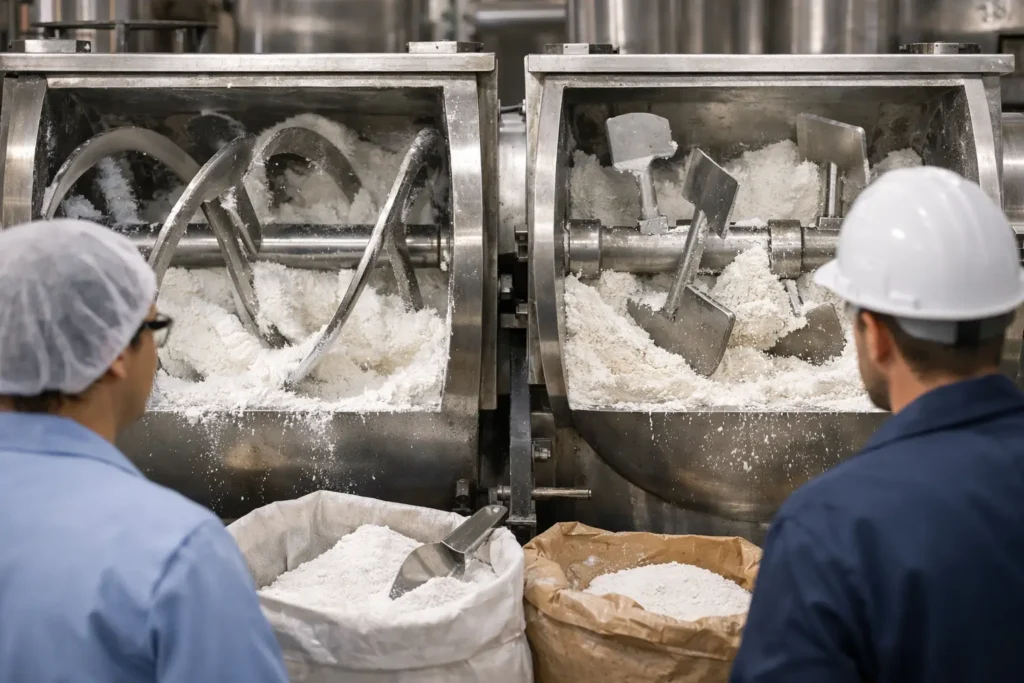
A ribbon blender uses inner and outer helical ribbons mounted on a central shaft. The ribbons create opposing material movement: one ribbon typically moves product toward the center while the other moves it toward the ends of the trough. This folding and circulation pattern is efficient for many free-flowing powders, dry blends, and applications where a uniform distribution of similar-density ingredients is the primary objective.
A paddle mixer uses paddles or plows arranged along one or more shafts. Rather than continuously conveying material lengthwise through the trough, paddles lift, throw, split, and fold the product through the mixing zone. That more active movement can produce a fluidized mixing action in suitable materials, helping disperse minor ingredients, break apart soft agglomerates, and distribute liquid additions without relying on a high-shear mixer.
Neither motion is automatically better. A ribbon blender can be a highly effective, economical solution for a stable dry formulation. A paddle mixer can provide more flexibility where product behavior varies, ingredients differ in particle size or bulk density, or the process includes liquid spraying and difficult discharge requirements.
Where Ribbon Blenders Perform Well
Ribbon blenders are widely used because their operating principle is straightforward and well matched to many dry-blending duties. They are often selected for flour blends, seasoning bases, dry chemical formulations, mineral blends, feed premixes, plastic powders, and similar materials that flow readily and do not require aggressive particle movement.
The helical ribbon design creates broad product turnover throughout the trough. With an appropriately sized batch, properly designed clearances, and a formulation that does not segregate easily, a ribbon blender can achieve repeatable homogeneity within practical cycle times. It can also be configured with choppers, liquid injection ports, heated or cooled jackets, vacuum capability, and discharge valves suited to the material.
Ribbon blending is especially compelling when the process calls for moderate mechanical energy and low product damage. Fragile particles, flakes, or crystals may tolerate the controlled folding action better than a more aggressive paddle arrangement. For products where particle integrity is a quality requirement, the relevant question is not simply how quickly a mixer reaches a blend target. It is whether that target can be achieved without generating fines, heat, or attrition that compromises downstream performance.
However, ribbon geometry has limits. Materials that are sticky, highly cohesive, or prone to building up on mixing elements can reduce circulation and create dead zones. Significant differences in ingredient density, particle size, or flowability may also require careful testing. A blend can appear uniform immediately after mixing yet segregate during discharge, transfer, or packaging if the formulation and process design are not evaluated as a system.
Where Paddle Mixers Add Value
Paddle mixers are commonly chosen when a process needs more energetic product movement without moving to a dedicated high-intensity mixer. Their paddles can create broad, three-dimensional circulation and a more dispersed product bed, particularly with powders and granules that respond well to lifting and cascading action.
This makes paddle mixers useful for formulations with low-dose ingredients, density differences, controlled liquid additions, or components that tend to form soft lumps. In food, nutraceutical, chemical, fertilizer, battery-material, and specialty mineral applications, that flexibility can improve blend consistency while shortening the time product remains in the mixer.
Liquid addition deserves particular attention. A mixer may technically accept a spray system, but the result depends on droplet size, spray location, nozzle coverage, mixing energy, and the material’s absorption rate. Paddle action can help distribute liquids before they form localized wet areas. That can be valuable for flavored powders, agglomerated products, conditioned mineral blends, and formulations where a binder, oil, or other low-volume liquid must reach every portion of the batch.
The trade-off is that a paddle mixer may impose more mechanical action on the product. For some materials, that is exactly what the process needs. For brittle granules or sensitive particles, it may create unacceptable attrition unless paddle design, shaft speed, fill level, and cycle time are tightly controlled. Paddle mixers can also require a more deliberate review of wear protection when handling abrasive products.
The Mixer Geometry Is Only Part of the Answer
The terms ribbon blender and paddle mixer describe a general mixing approach, not a complete performance specification. Trough shape, shaft arrangement, paddle or ribbon pitch, tip speed, fill level, internal clearances, chopper configuration, discharge valve design, and controls all influence the actual result.
For example, a single-shaft paddle mixer and a twin-shaft paddle mixer can deliver very different mixing intensity and discharge behavior. Likewise, a ribbon blender with a high-speed intensifier can address certain lump-breaking or liquid-dispersion challenges that a standard ribbon configuration cannot. Equipment comparisons should therefore use tested process conditions, not only brochure descriptions.
Evaluate the Material Before Selecting the Mixer
A defensible mixer selection begins with measurable material data. Bulk density establishes more than vessel volume. It affects loading, bed behavior, motor demand, and the chance of density-driven segregation. Particle-size distribution and particle shape influence how components circulate, while moisture level and hygroscopicity indicate whether the product may smear, cake, or form deposits.
Flowability is equally important. A free-flowing powder can often move effectively in either machine, though it may favor ribbon blending when low energy and gentle handling are priorities. A cohesive powder may need the lifting and dispersive action of paddles, auxiliary choppers, or a different mixer class altogether. Materials that pack under pressure, bridge at discharge, or develop lumps during storage should be evaluated in representative condition, not only as a fresh laboratory sample.
The process objective should be defined with the same discipline. Is the goal simple blend uniformity? Uniform distribution of a microingredient at a few parts per million? Controlled coating with a liquid? Dispersion of pigments or additives? Preservation of fragile particles? The answer changes the equipment recommendation.
Production Factors That Change the Decision
Mixing time should be evaluated as a complete cycle, including charging, blending, liquid addition, sampling, discharge, cleaning, and changeover. A mixer that blends quickly but discharges poorly can become the limiting point in a continuous production schedule. Conversely, a lower-energy ribbon blender may provide the best overall throughput for a single, stable formulation because it is simple to operate and maintain.
Discharge design is often underestimated. A full-width bomb-bay discharge can empty a batch rapidly and reduce residual material, while smaller outlet valves may be sufficient for products feeding downstream screw conveyors, extruders, or packaging equipment. The discharge must match the product’s flow behavior and the required level of batch recovery. Residual material is not just lost yield. In allergen-controlled, pharmaceutical, and high-value specialty applications, it can become a validation and cross-contamination concern.
Cleaning requirements can shift the economics significantly. If the line runs long campaigns of one product, a mixer optimized for throughput may be appropriate. If the operation changes formulations frequently, internal accessibility, cleanability, surface finish, removable components, and clean-in-place strategy deserve equal weight. The best mixer for a high-volume commodity blend is not necessarily the right machine for a short-run, multi-product plant.
Controls and integration also matter. Accurate loss-in-weight feeding, recipe management, liquid dosing, interlocked dust collection, batch traceability, and downstream transfer controls all influence final consistency. Proc-X approaches mixer selection within this broader production context, because material handling and process control can either protect or undermine the performance achieved inside the trough.
Use Trials to Resolve the Close Calls
When both mixer types appear viable, representative trials are the most reliable way to make the decision. Test the actual formulation, including minor ingredients, liquids, recycled material, and components at their expected storage condition. Measure blend uniformity at multiple sampling locations, then evaluate particle damage, temperature rise, agglomeration, discharge residue, and post-mix segregation.
A useful trial also examines operating range. Production rarely runs at one perfect fill level with one lot of raw material. Confirm performance across expected batch sizes, ingredient variability, and practical cycle times. This provides a more realistic basis for scale-up, capital approval, and quality documentation than a single successful test run.
The right choice is the mixer that repeatedly meets product specifications while fitting the complete process around it. Define the material behavior, quality target, cleaning standard, and operating schedule before finalizing equipment geometry. That work turns a mixer purchase into a controlled production decision rather than a capacity estimate.