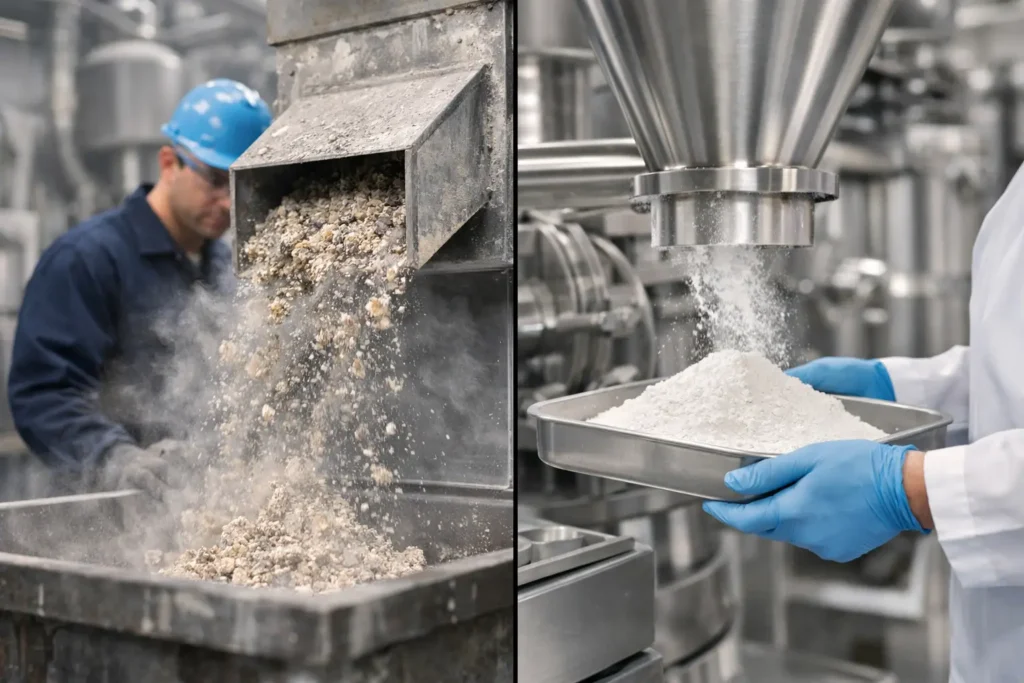
A mill selection can determine whether a downstream process runs predictably or becomes a source of variation, dust, rework, and maintenance interruptions. In a hammer mill vs pin mill decision, the right answer is not based on which machine produces the smallest nominal particle size. It depends on the material, required particle-size distribution, thermal limits, production rate, contamination controls, and how the mill performs within the complete process line.
Both machines use high-speed impact to reduce particle size. Their operating principles, however, create materially different results. A hammer mill is often selected for broad-duty grinding, coarse-to-medium reduction, and materials that benefit from adjustable screen control. A pin mill is commonly selected where a finer, more uniform powder is required from dry, friable feed materials. Those descriptions are useful starting points, not final specifications.
Hammer Mill vs Pin Mill: The Operating Difference
A hammer mill uses swinging or fixed hammers mounted to a rotating rotor. Material enters the grinding chamber and is repeatedly struck by the hammers, then fractured further through impact with breaker plates, the chamber liner, and other particles. A screen generally retains oversized material until it is reduced enough to pass through the selected openings.
This screen-based retention is central to hammer mill behavior. Screen hole size, open area, thickness, and wear condition affect capacity, particle-size distribution, air movement, and heat generation. Rotor speed, hammer configuration, feed rate, and discharge airflow also matter. The machine can be highly adaptable, but changes in one variable can affect several others.
A pin mill uses one or more discs fitted with rows of pins. In a single-disc configuration, pins on a high-speed rotating disc pass near stationary pins. In a counter-rotating design, opposing pin discs create substantially higher relative tip speed. Particles are accelerated through the pin field and reduced primarily by repeated impact and interparticle collision before exiting with the air stream.
Because pin mills usually do not rely on a perforated screen for final retention, they can provide efficient fine grinding with less risk of screen blinding. They also impose a different combination of impact intensity, residence time, and airflow. That can be an advantage for dry, brittle products, but it can be a poor fit for sticky, high-fat, heat-softening, or highly fibrous materials.
Particle Size Is More Than a Single Number
A target such as 200 mesh or 100 microns does not fully define a milling requirement. Production teams need to understand the complete particle-size distribution: the median size, oversize fraction, fines fraction, and batch-to-batch repeatability. These characteristics influence blend uniformity, dissolution, mouthfeel, flowability, compaction, coating performance, reactivity, and packaging behavior.
Hammer mills generally produce a broader distribution than pin mills, particularly as the selected screen opening becomes larger. That broader distribution is acceptable, and sometimes preferred, in applications such as animal feed, pre-grinding, biomass processing, fertilizer ingredients, mineral products, and many bulk chemical operations. A hammer mill can also be an effective first-stage machine ahead of a finer mill or classifier.
Pin mills are frequently better suited to applications requiring finer reduction and a narrower distribution from dry feedstock. Food ingredients, spices, sugars, pigments, polymers, pharmaceutical intermediates, and specialty chemicals may benefit from this approach when material behavior supports it. Still, a pin mill is not automatically the better choice for every fine-powder specification. If the product contains excessive moisture, becomes plastic under impact, or requires aggressive deagglomeration rather than true fracture, performance can fall short of expectations.
For either technology, laboratory and pilot trials should evaluate the actual production material, not an idealized sample. Feed material can vary in moisture, bulk density, temperature, particle shape, and lot-to-lot hardness. Those variations often explain why a mill that performs well during a short test produces inconsistent results on a plant floor.
Heat, Moisture, and Product Integrity
High-speed milling converts energy into size reduction, airflow, sound, and heat. The thermal effect deserves early attention when processing flavors, nutraceutical actives, fats, waxes, resins, heat-sensitive chemicals, or materials prone to melting, smearing, or volatile loss.
A hammer mill can generate substantial heat when screens restrict discharge, feed rates are excessive, or recirculation inside the chamber increases. Yet its lower operating intensity and configurable screen options may provide a useful operating window for some materials. Proper aspiration is often essential. Controlled airflow removes product efficiently, limits residence time, and helps contain dust.
A pin mill can achieve fine reduction quickly, but high tip speeds can create significant temperature rise. Counter-rotating systems demand particular attention to feed rate and product temperature. Chilled or conditioned feed, cooled process air, or cryogenic milling may be necessary when a material softens or degrades under normal ambient processing conditions.
Moisture is equally consequential. Slightly damp products can blind hammer mill screens and adhere to internal components. In a pin mill, moisture may cause buildup on pins, reduced grinding efficiency, and unstable discharge. When the process involves drying, conditioning, or temperature control, mill selection should be made alongside those upstream functions rather than after they are designed.
Capacity Depends on the Whole Material Path
Nameplate throughput is not a reliable basis for comparing mills. A quoted capacity may reflect one material, one feed size, one screen or rotor configuration, and a specific particle-size target. It rarely represents the conditions of another product or an integrated line.
A hammer mill can deliver high capacity when the feed is appropriately sized, freely flowing, and compatible with the selected screen. It is often forgiving of moderate feed-size variation and can handle applications where the objective is practical throughput rather than an exceptionally tight fine-powder cut.
Pin mill capacity is closely tied to product characteristics and final fineness. Increasing feed rate may reduce residence time and produce a coarser discharge. Increasing rotational speed may improve fineness but can increase heat, energy consumption, wear, and fines. The required balance should be defined through test data and process modeling, not assumed from a catalog range.
The feed system is part of that balance. Inconsistent feeding creates inconsistent milling. A loss-in-weight feeder, screw feeder, rotary valve, or controlled pneumatic feed arrangement may be required to maintain stable loading. Upstream size reduction may also be needed to prevent large particles or foreign material from damaging the mill or causing intermittent overloads.
Wear, Cleanability, and Containment
Abrasive products can change the economics of either mill. Hammer mill wear typically affects hammers, screens, liners, and breaker components. In a pin mill, pins, discs, and the internal impact zone can wear rapidly when processing hard minerals, ceramic materials, metal powders, or other abrasive feedstocks. Wear changes clearance, grinding action, particle distribution, and energy demand before it becomes an obvious mechanical failure.
For food, pharmaceutical, nutraceutical, and specialty chemical operations, cleanability may be as important as throughput. Product-contact metallurgy, surface finish, access to the chamber, gasket design, clean-in-place capability, and validation requirements should be specified before equipment selection. A mill that reaches the required particle size but requires excessive downtime for cleaning is not a production solution.
Dust containment must also be engineered as a system requirement. Fine powders may create operator exposure, cross-contamination, housekeeping, combustible-dust, or environmental-control concerns. The mill, feeder, discharge receiver, dust collector, isolation devices, grounding strategy, and control logic should be designed around the material hazard assessment and the applicable site standards.
When a Hammer Mill Is the Better Fit
A hammer mill is often the practical choice when the process needs broad application flexibility, coarse-to-medium size reduction, relatively high throughput, or a configurable screen-controlled discharge. It can be particularly effective for grains, feed ingredients, dry agricultural products, biomass, mineral feed, and pre-milling duties before blending, classification, or finer grinding.
It is also worth considering where future products may require different finished sizes. Changing screens and operating parameters can provide useful flexibility, although each change should be evaluated for its effect on capacity, heat, and distribution.
When a Pin Mill Is the Better Fit
A pin mill is typically the stronger candidate for dry, friable materials that require a fine powder and close control of particle-size distribution. It is well suited to ingredient, chemical, pigment, polymer, and advanced-material applications where fine impact grinding supports the required product performance.
The limitation is material sensitivity. Sticky, fatty, fibrous, damp, ductile, or thermally softening products may require conditioning, cooling, another milling technology, or a different process route entirely. Fine grinding does not justify a design that compromises yield, product integrity, or cleanability.
Specify the Milling System, Not Only the Mill
The best selection process starts with a material and product specification, then builds outward to include feeding, conveying, classification, dust collection, controls, cleaning, and downstream handling. Define the feed particle size and variability, moisture range, bulk density, throughput requirement, target distribution, allowable temperature rise, material hazards, and acceptable residual or cross-contamination limits.
Proc-X approaches mill selection through that full process lens. The objective is not simply to install a hammer mill or pin mill. It is to deliver stable particle control that supports the next operation, whether that is blending, compaction, extrusion, packaging, pneumatic transfer, or final product filling.
A well-run milling trial should produce more than a particle-size report. It should confirm throughput, temperature, yield, power demand, cleanout time, dust-control requirements, wear expectations, and downstream product behavior. That evidence gives engineering, operations, quality, and maintenance teams a common basis for a capital decision.
The most useful question is not which mill is better in general. Ask which milling system will keep your actual material within specification, at the required rate, through the full production schedule. That is where equipment choice becomes process performance.