A thermal process can improve flowability, remove residual moisture, activate a reaction, set a coating, sterilize a product, or create a material that cannot be recovered once overheated. That is why a thermal processing equipment guide must begin with the material and the required product condition, not with a catalog of dryer, oven, or furnace designs.
For plant managers and process engineers, the central question is not simply how much heat is required. It is how to apply heat, remove moisture or volatiles, control residence time, and protect product quality at the required production rate. The answer depends on physical behavior, operating environment, cleanability, emissions requirements, and how the thermal unit connects with upstream and downstream equipment.
Start With the Process Objective
Thermal equipment is selected to achieve a defined result. Drying reduces moisture or solvent to a target level. Heating may raise temperature for melting, reaction, curing, pasteurization, calcination, or conditioning. Cooling may be equally critical when a material leaves a mixer, extruder, mill, or reactor at a temperature that affects packaging, storage, or particle integrity.
The first engineering task is to establish what the product must look like at discharge. A moisture specification alone is rarely enough. Consider final temperature, bulk density, particle-size distribution, volatile content, color, flavor, active ingredient stability, and flow characteristics. For regulated products, the required evidence of temperature control, batch traceability, and cleanability must also be defined early.
Thermal duty follows from these requirements, but heat transfer is only one part of the design. A powder with low thermal conductivity may require agitation or a thin product layer. A sticky paste may need a mechanically agitated vessel rather than a conveyor-based dryer. A friable granule can meet a moisture target while failing the process because the handling method generates unacceptable fines.
Thermal Processing Equipment Guide: Main Technologies
No single thermal technology is best across materials. The right choice is determined by how the product accepts heat, releases moisture or volatiles, and moves through the process.
Tray, Batch, and Vacuum Dryers
Batch dryers are often appropriate when production volumes are moderate, formulations change frequently, or traceability by batch is required. Tray and cabinet-style systems can provide controlled heating with straightforward loading and unloading. Vacuum drying lowers the boiling point of water or solvents, making it useful for heat-sensitive materials and applications where low residual solvent levels are required.
The trade-off is labor, cycle time, and process variability if loading depth or tray arrangement changes between batches. Automated loading, recipe control, and defined operating procedures can reduce those variables, but they must be considered as part of the system design.
Rotary, Fluid Bed, and Conveyor Dryers
Continuous dryers generally support higher throughput and more consistent operation when the feed is stable. Rotary dryers are widely used for minerals, fertilizers, biomass, and other bulk materials that tolerate tumbling and can be conveyed reliably. They offer high capacity, but residence-time distribution, dust collection, and abrasion can become major design factors.
Fluid bed dryers use heated gas to suspend or mobilize particles. They can achieve efficient heat and mass transfer, particularly with free-flowing powders and granules. However, they are not a universal solution. Materials that are cohesive, highly irregular, wide in particle size, or prone to attrition may fluidize poorly or create excessive carryover.
Conveyor and belt dryers provide controlled product depth and gentler transport. They are useful where product shape, bed integrity, or staged temperature zones matter. Their footprint can be larger than more compact designs, and airflow uniformity across the bed must be engineered rather than assumed.
Agitated and Indirect Thermal Systems
For pastes, slurries, filter cakes, high-viscosity compounds, and sticky powders, indirect systems often provide greater control than direct hot-gas drying. Jacketed vessels, paddle dryers, and agitated thin-film equipment transfer heat through metal surfaces while mechanical agitation renews the product layer.
This approach can reduce gas volumes and simplify solvent recovery compared with direct drying. It also introduces mechanical considerations: shaft sealing, wear, torque demand, cleaning access, and the material’s tendency to build up on heated surfaces. The equipment must be designed for the product’s rheology across the full thermal cycle, not only at the feed condition.
Ovens, Kilns, Furnaces, and Thermal Reactors
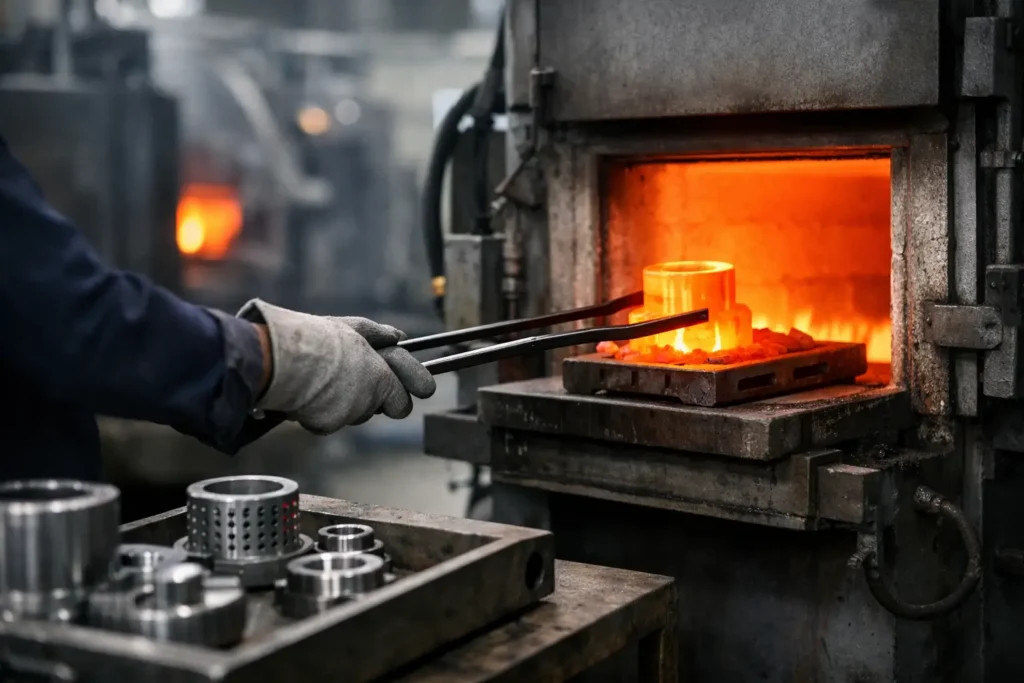
Ovens and furnaces are selected for curing, sintering, heat treatment, debinding, calcination, and controlled thermal transformation. Kilns are commonly applied where high temperatures and continuous solids processing are required. Thermal reactors may be required when heating drives a chemical reaction rather than simply removing moisture.
At these temperatures, atmosphere control can be as important as temperature. Oxygen content, humidity, inert gas purity, pressure, and gas flow affect oxidation, reduction, reaction kinetics, surface chemistry, and finished material properties. Battery materials, advanced ceramics, powdered metals, specialty chemicals, and aerospace materials often require this level of control.
Define the Material Before Defining the Machine
A credible equipment specification starts with representative material data. If the process involves changing formulations, blends, or feedstock sources, testing should capture the realistic operating range instead of a single ideal sample.
The following characteristics directly affect thermal equipment selection:
- Initial and final moisture or volatile content, including whether moisture is free, bound, or surface-held
- Particle-size distribution, shape, bulk density, and segregation behavior
- Flowability, cohesiveness, stickiness, and tendency to form lumps during heating
- Heat sensitivity, melting point, glass transition behavior, and reaction or degradation temperature
- Abrasiveness, corrosiveness, dust explosibility, and compatibility with contact materials
These properties can change as the process progresses. A wet cake may be sticky at the feed point, granular through the middle of the cycle, and dust-prone at discharge. Equipment must accommodate those transitions without creating plugging, buildup, uncontrolled carryover, or difficult cleaning conditions.
Design Around the Complete Production Line
A thermal unit does not operate independently. Feed consistency determines thermal consistency. If an upstream mixer, mill, filter, or feeder produces variable moisture content or mass flow, the dryer or oven must compensate through excess residence time, broader operating limits, or more sophisticated controls.
Likewise, downstream equipment establishes real constraints. A cooled powder may need to reach a specific temperature before blending, screening, filling, or packaging. A dried material may require lump breaking, classification, pneumatic conveying, or inert transfer before it can absorb ambient moisture. The thermal system should be engineered with these interfaces defined, including elevation changes, dust collection, containment, material transfer, and maintenance access.
This systems view also prevents a common capital-project failure: selecting a high-capacity thermal machine that becomes limited by feeding, exhaust handling, cooling, or packaging. Throughput should be calculated across the complete line using the actual operating schedule, expected downtime, product changeover requirements, and yield assumptions.
Controls, Safety, and Validation Are Part of the Equipment
Temperature indication alone does not establish process control. Depending on the application, the control strategy may need to manage inlet and outlet temperature, product temperature, humidity, pressure, airflow, feed rate, agitator load, oxygen concentration, and residence time. These variables should be tied to a defined operating window and alarm philosophy.
For combustible dusts, flammable solvents, or reactive materials, safety design requires early review. Hazard analysis may affect equipment construction, ventilation, relief provisions, inerting, grounding, explosion protection, gas monitoring, and the location of isolation devices. Retrofitting these measures after a machine is selected is more expensive and can compromise layout or performance.
Pharmaceutical, food, and nutraceutical processes may also require hygienic construction, clean-in-place capability, validated recipes, electronic records, and controlled material segregation. In these environments, access for inspection and cleaning is an operational requirement, not a convenience feature.
Use Testing to Reduce Scale-Up Risk
Thermal behavior is difficult to predict from a data sheet alone. Bench and pilot testing can establish drying curves, equilibrium moisture, product temperature response, material adhesion, particle degradation, and the effect of process variables on finished quality. It also provides the basis for determining whether batch or continuous operation is the better commercial path.
Testing is especially valuable where a material has a narrow thermal limit, variable feed composition, hazardous dust characteristics, or a new formulation. The objective is not simply to prove that drying or heating is possible. It is to establish a repeatable process window that can be scaled with confidence.
Proc-X approaches thermal processing as part of an integrated material-handling and production system. One manufacturer, one engineering standard, and one point of accountability can reduce interface risk when thermal equipment must coordinate with feeding, mixing, milling, conveying, controls, and packaging.
The most useful next step is to document the material, target product condition, throughput profile, operating constraints, and line interfaces before requesting equipment proposals. That discipline gives engineering teams a clearer basis for comparing solutions and gives operators a process they can run consistently long after startup.